https://github.com/qinwf/re2r
RE2 Regular Expression in R.
https://github.com/qinwf/re2r
r re2 regular-expression
Last synced: 7 months ago
JSON representation
RE2 Regular Expression in R.
- Host: GitHub
- URL: https://github.com/qinwf/re2r
- Owner: qinwf
- License: other
- Created: 2016-01-19T11:29:20.000Z (over 10 years ago)
- Default Branch: master
- Last Pushed: 2020-03-13T13:25:34.000Z (over 6 years ago)
- Last Synced: 2024-10-26T23:12:41.639Z (over 1 year ago)
- Topics: r, re2, regular-expression
- Language: C++
- Homepage: https://qinwenfeng.com/re2r_doc
- Size: 1.05 MB
- Stars: 99
- Watchers: 11
- Forks: 15
- Open Issues: 20
-
Metadata Files:
- Readme: README.md
- License: LICENSE
Awesome Lists containing this project
README
re2r
====
[](https://travis-ci.org/qinwf/re2r) [](https://ci.appveyor.com/project/qinwf/re2r/branch/master) [](http://cran.r-project.org/package=re2r) [](https://codecov.io/gh/qinwf/re2r)
RE2 is a primarily DFA based regexp engine from Google that is very fast at matching large amounts of text.
Installation
------------
From CRAN:
``` r
install.packages("re2r")
```
From GitHub:
``` r
library(devtools)
install_github("qinwf/re2r", build_vignettes = T)
```
To learn how to use, you can check out the [vignettes](https://qinwenfeng.com/re2r_doc/).
Related Work
------------
[Google Summer of Code](https://github.com/rstats-gsoc/gsoc2016/wiki/re2-regular-expressions) - re2 regular expressions.
Brief Intro
-----------
### 1. Search a string for a pattern
`re2_detect(string, pattern)` searches the string expression for a pattern and returns boolean result.
``` r
test_string = "this is just one test";
re2_detect(test_string, "(o.e)")
```
## [1] TRUE
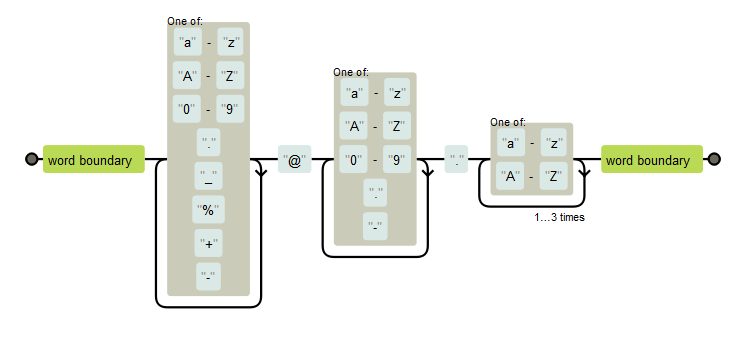
Here is an example of email pattern.
``` r
show_regex("\\b[a-zA-Z0-9._%+-]+@[a-zA-Z0-9.-]+\\.[a-zA-Z]{2,4}\\b", width = 670, height = 280)
```
``` r
re2_detect("test@gmail.com", "\\b[a-zA-Z0-9._%+-]+@[a-zA-Z0-9.-]+\\.[a-zA-Z]{2,4}\\b")
```
## [1] TRUE
`re2_match(string, pattern)` will return the capture groups in `()`.
``` r
(res = re2_match(test_string, "(o.e)"))
```
## .match .1
## [1,] "one" "one"
The return result is a character matrix. `.1` is the first capture group and it is unnamed group.
Create named capture group with `(?Ppattern)` syntax.
``` r
(res = re2_match(test_string, "(?Pthis)( is)"))
```
## .match testname .2
## [1,] "this is" "this" " is"
``` r
is.matrix(res)
```
## [1] TRUE
``` r
is.character(res)
```
## [1] TRUE
``` r
res$testname
```
## testname
## "this"
If there is no capture group, the matched origin strings will be returned.
``` r
test_string = c("this is just one test", "the second test");
(res = re2_match(test_string, "is"))
```
## .match
## [1,] "is"
## [2,] NA
`re2_match_all()` will return the all of patterns in a string instead of just the first one.
``` r
res = re2_match_all(c("this is test",
"this is test, and this is not test",
"they are tests"),
pattern = "(?Pthis)( is)")
print(res)
```
## [[1]]
## .match testname .2
## [1,] "this is" "this" " is"
##
## [[2]]
## .match testname .2
## [1,] "this is" "this" " is"
## [2,] "this is" "this" " is"
##
## [[3]]
## .match testname .2
``` r
is.list(res)
```
## [1] TRUE
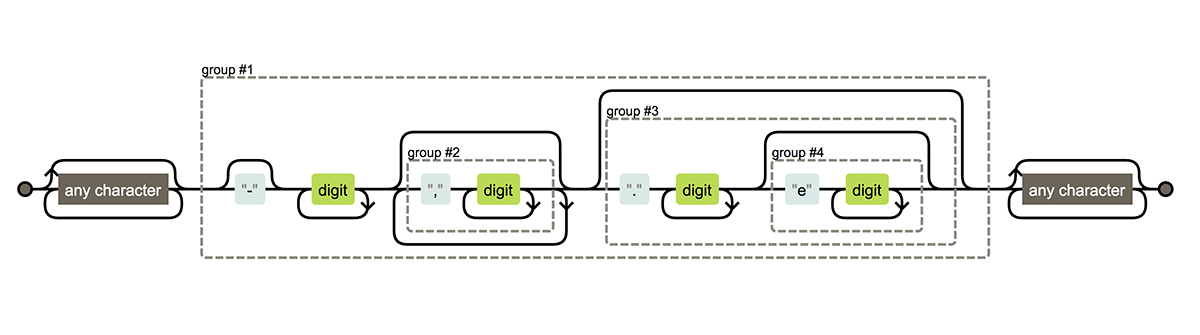
match all numbers
``` r
texts = c("pi is 3.14529..",
"-15.34 °F",
"128 days",
"1.9e10",
"123,340.00$",
"only texts")
(number_pattern = re2(".*?(?P-?\\d+(,\\d+)*(\\.\\d+(e\\d+)?)?).*?"))
```
## re2 pre-compiled regular expression
##
## pattern: .*?(?P-?\d+(,\d+)*(\.\d+(e\d+)?)?).*?
## number of capturing subpatterns: 4
## capturing names with indices:
## .match number .2 .3 .4
## expression size: 56
``` r
(res = re2_match(texts, number_pattern))
```
## .match number .2 .3 .4
## [1,] "pi is 3.14529" "3.14529" NA ".14529" NA
## [2,] "-15.34" "-15.34" NA ".34" NA
## [3,] "128" "128" NA NA NA
## [4,] "1.9e10" "1.9e10" NA ".9e10" "e10"
## [5,] "123,340.00" "123,340.00" ",340" ".00" NA
## [6,] NA NA NA NA NA
``` r
res$number
```
## [1] "3.14529" "-15.34" "128" "1.9e10" "123,340.00"
## [6] NA
``` r
show_regex(number_pattern)
```
### 2. Replace a substring
``` r
re2_replace(string, pattern, rewrite)
```
Searches the string "input string" for the occurence(s) of a substring that matches 'pattern' and replaces the found substrings with "rewrite text".
``` r
input_string = "this is just one test";
new_string = "my"
re2_replace(new_string, "(o.e)", input_string)
```
## [1] "my"
mask the middle three digits of a US phone number
``` r
texts = c("415-555-1234",
"650-555-2345",
"(416)555-3456",
"202 555 4567",
"4035555678",
"1 416 555 9292")
us_phone_pattern = re2("(1?[\\s-]?\\(?\\d{3}\\)?[\\s-]?)(\\d{3})([\\s-]?\\d{4})")
re2_replace(texts, us_phone_pattern, "\\1***\\3")
```
## [1] "415-***-1234" "650-***-2345" "(416)***-3456" "202 *** 4567"
## [5] "403***5678" "1 416 *** 9292"
### 3. Extract a substring
``` r
re2_extract(string, pattern, replacement)
```
Extract matching patterns from a string.
``` r
re2_extract("yabba dabba doo", "(.)")
```
## [1] "y"
``` r
re2_extract("test@me.com", "(.*)@([^.]*)")
```
## [1] "test@me"
### 4. `Regular Expression Object` for better performance
We can create a regular expression object (RE2 object) from a string. It will reduce the time to parse the syntax of the same pattern.
And this will also give us more option for the pattern. run `help(re2)` to get more detials.
``` r
regexp = re2("test",case_sensitive = FALSE)
print(regexp)
```
## re2 pre-compiled regular expression
##
## pattern: test
## number of capturing subpatterns: 0
## capturing names with indices:
## .match
## expression size: 10
``` r
regexp = re2("test",case_sensitive = FALSE)
re2_match("TEST", regexp)
```
## .match
## [1,] "TEST"
``` r
re2_replace("TEST", regexp, "ops")
```
## [1] "ops"
### 5. Multithread
Use `parallel` option to enable multithread feature. It will improve performance for large inputs with a multi core CPU.
``` r
re2_match(string, pattern, parallel = T)
```