https://github.com/quenchworks/charts
Clean-room Helm charts for the QuenchWorks catalog: each pinned to a signed, 0-CVE image digest, published as OCI to GHCR and listed on ArtifactHub.
https://github.com/quenchworks/charts
artifacthub cosign devsecops digest-pinned hardened helm helm-charts k8s kubernetes oci security sigstore
Last synced: 12 days ago
JSON representation
Clean-room Helm charts for the QuenchWorks catalog: each pinned to a signed, 0-CVE image digest, published as OCI to GHCR and listed on ArtifactHub.
- Host: GitHub
- URL: https://github.com/quenchworks/charts
- Owner: quenchworks
- License: mit
- Created: 2026-06-11T09:11:42.000Z (23 days ago)
- Default Branch: main
- Last Pushed: 2026-06-19T21:55:47.000Z (15 days ago)
- Last Synced: 2026-06-19T22:12:44.755Z (15 days ago)
- Topics: artifacthub, cosign, devsecops, digest-pinned, hardened, helm, helm-charts, k8s, kubernetes, oci, security, sigstore
- Language: Go Template
- Homepage: https://quench-works.com/
- Size: 870 KB
- Stars: 2
- Watchers: 0
- Forks: 0
- Open Issues: 0
-
Metadata Files:
- Readme: README.md
- License: LICENSE
- Roadmap: .github/ROADMAP.md
Awesome Lists containing this project
README
# QuenchWorks charts
Clean-room Helm charts for the [QuenchWorks](https://github.com/quenchworks) catalog. Every chart deploys a hardened, 0-CVE image from the [images](https://quench-works.com/images) factory, pins it strictly by `sha256` digest, ships as a cosign-signed OCI artifact on GHCR, and is listed on ArtifactHub as a **verified publisher** with a Values schema.
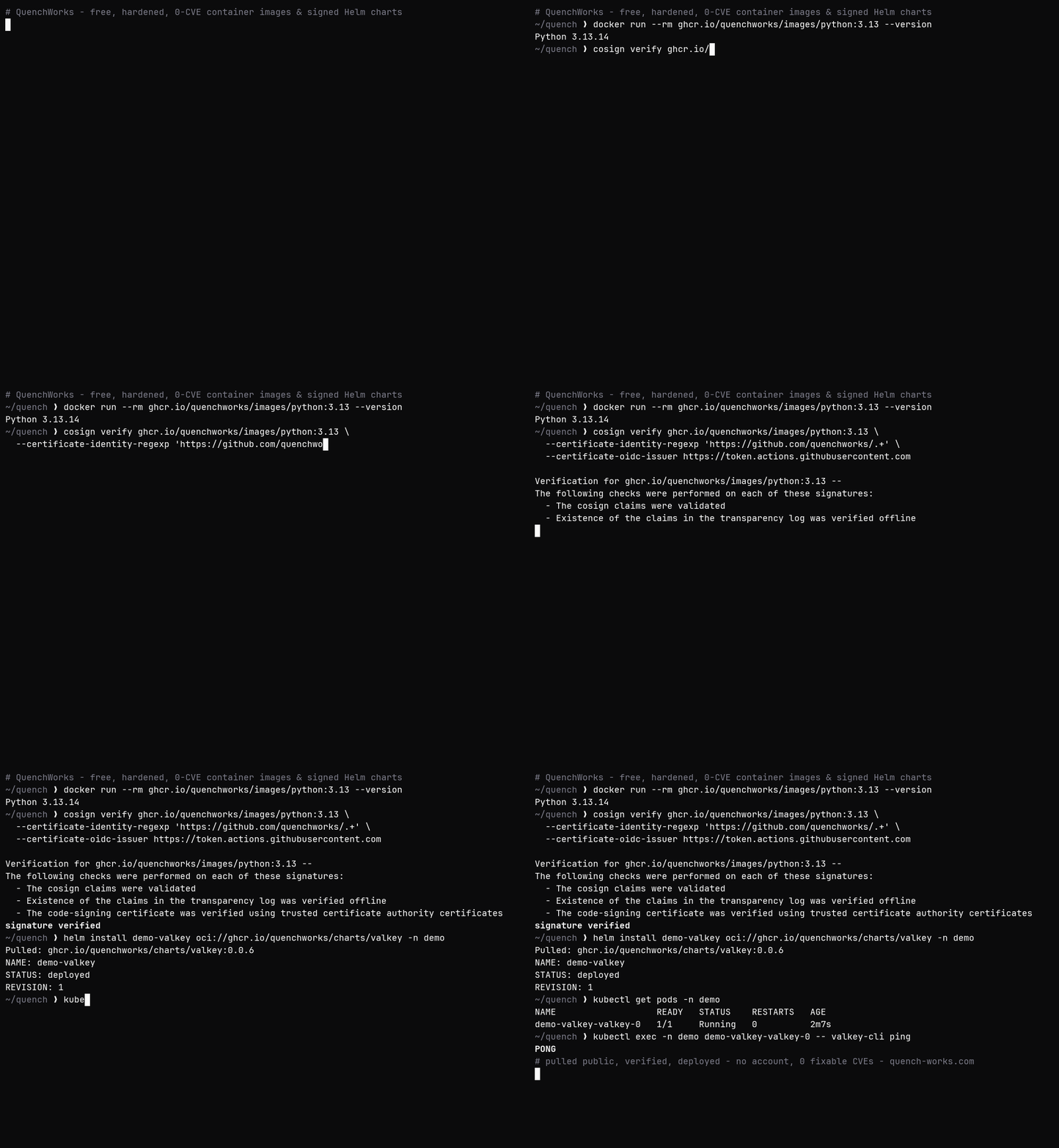
**54 charts.** No paywall, no account, no vendor lock. Browse them all at [quench-works.com/charts](https://quench-works.com/charts).
```bash
helm install cache oci://ghcr.io/quenchworks/charts/redis
```
That's the whole install. The image it deploys is already signed and pinned to a digest, so you don't have to track image security yourself.
## The security model
Three guarantees, baked into every chart:
- **Digest-pinned, always.** Charts resolve images by `repository@sha256:...`, never by tag. A tag-only reference is refused on purpose, so a chart physically can't ship an unpinned image.
- **One hardened baseline.** Every chart inherits the same pod and container security context from the [`quench-common`](https://github.com/quenchworks/common) library chart: nonroot, read-only root filesystem, no privilege escalation, all capabilities dropped, seccomp `RuntimeDefault`. Fix it once, fix it everywhere.
- **Verifiable provenance.** Charts are cosign keyless-signed, and the images they point at are signed and SBOM-carrying. You can check it all yourself.
## The catalog
| Category | Charts |
|----------|--------|
| Relational | `postgresql` · `mariadb` · `mysql` · `cockroachdb` ⚠️ |
| Document | `couchdb` · `ferretdb` · `documentdb` · `postgres-documentdb` · `mongodb` ⚠️ |
| Wide-column | `cassandra` · `scylladb` |
| Key-value / cache | `valkey` · `redis` · `memcached` · `dragonfly` ⚠️ |
| Search / vector | `opensearch` · `solr` · `meilisearch` · `qdrant` · `elasticsearch` ⚠️ |
| Time series | `influxdb` · `victoriametrics` |
| Analytical | `clickhouse` |
| Graph | `neo4j` |
| Messaging / streaming | `kafka` · `nats` · `rabbitmq` · `pulsar` |
| Coordination | `etcd` · `zookeeper` · `temporal` |
| Observability | `prometheus` · `grafana` · `loki` · `tempo` · `otel-collector` · `vector` · `fluent-bit` |
| Gateways / proxies | `nginx` · `caddy` · `traefik` · `haproxy` |
| Object storage | `garage` · `rustfs` · `seaweedfs` |
| Secrets / identity | `openbao` · `keycloak` |
| Registry · Git · CI/IaC | `harbor` · `gitea` · `atlantis` |
⚠️ = source-available, **not** OSI-approved open source (see [licensing](#a-note-on-licensing)).
## Verify a chart
```bash
cosign verify ghcr.io/quenchworks/charts/postgresql@sha256:DIGEST \
--certificate-identity-regexp 'https://github.com/quenchworks/.+' \
--certificate-oidc-issuer https://token.actions.githubusercontent.com
```
## Per-chart docs
GitHub shows this single repo README on every chart's package page; it can't render a per-chart README for OCI artifacts. Each chart's own docs (values, examples, security notes) live on **ArtifactHub** and ship inside the chart itself:
```bash
helm show readme oci://ghcr.io/quenchworks/charts/
```
## Layout
```
quench// one app chart per directory, e.g. quench/postgresql
.github/workflows/ release (lint, install, package, push) and digest repin
```
The shared `quench-common` library chart lives in its own repo, [quenchworks/common](https://github.com/quenchworks/common), published at `oci://ghcr.io/quenchworks/charts/quench-common`. App charts depend on it and pull it at build time, so it isn't vendored here.
## How releases work
The image factory builds and signs an image, then fires an `image-published` dispatch to this repo. `on-digest.yml` repins the chart's `values.yaml` to the new digest and commits. That push triggers `release-.yml`, which lints, templates, installs into a kind cluster and runs a real client roundtrip as a gate, then packages and pushes the cosign-signed OCI chart and publishes the ArtifactHub metadata.
## The clean-room rule
Charts here are written from each application's own upstream documentation. They are not copied or adapted from any other vendor's charts. See [CONTRIBUTING](https://github.com/quenchworks/.github/blob/main/CONTRIBUTING.md).
## A note on licensing
Most of the catalog is OSI-clean. Four charts wrap source-available datastores and carry a loud license banner in their README, NOTES, and on the website, because these are **not** OSI-approved open source. Each names the clean alternative we recommend instead:
| Chart | License | Clean alternative |
|-------|---------|-------------------|
| `mongodb` | SSPL-1.0 | `ferretdb` + `documentdb` (MongoDB-wire compatible, truly open) |
| `elasticsearch` | SSPL-1.0 | `opensearch` (Apache-2.0 drop-in fork) |
| `cockroachdb` | BUSL-1.1 | `postgresql` for single-region SQL (BUSL converts to Apache after 3 years) |
| `dragonfly` | BUSL-1.1 | `valkey` (BSD-3-Clause, Redis-compatible) |
## License
MIT for the chart templates and tooling. Each deployed application carries its own upstream license.