https://github.com/raphaelmansuy/edgeparse
EdgeParse converts any digital PDF into Markdown, JSON (with bounding boxes), HTML, or plain text — deterministically, without a JVM, without a GPU, and with best-in-class accuracy on the 200-document benchmark suite included in this repository.
https://github.com/raphaelmansuy/edgeparse
markdown markitdown pdf pdf-converter
Last synced: 3 months ago
JSON representation
EdgeParse converts any digital PDF into Markdown, JSON (with bounding boxes), HTML, or plain text — deterministically, without a JVM, without a GPU, and with best-in-class accuracy on the 200-document benchmark suite included in this repository.
- Host: GitHub
- URL: https://github.com/raphaelmansuy/edgeparse
- Owner: raphaelmansuy
- License: other
- Created: 2026-03-22T08:02:45.000Z (4 months ago)
- Default Branch: main
- Last Pushed: 2026-03-29T01:33:07.000Z (4 months ago)
- Last Synced: 2026-04-03T00:41:44.056Z (4 months ago)
- Topics: markdown, markitdown, pdf, pdf-converter
- Language: Rust
- Homepage: https://edgeparse.com
- Size: 62.9 MB
- Stars: 73
- Watchers: 1
- Forks: 10
- Open Issues: 9
-
Metadata Files:
- Readme: README.md
- Contributing: CONTRIBUTING.md
- License: LICENSE
Awesome Lists containing this project
- awesome - raphaelmansuy/edgeparse - EdgeParse converts any digital PDF into Markdown, JSON (with bounding boxes), HTML, or plain text — deterministically, without a JVM, without a GPU, and with best-in-class accuracy on the 200-document benchmark suite included in this repository. (<a name="Rust"></a>Rust)
README
# EdgeParse
**Fastest PDF extraction engine. Rust-native. Zero GPU, zero JVM, zero OCR models.**
[](LICENSE)
[](https://www.rust-lang.org/)
[](https://crates.io/crates/edgeparse-cli)
[](https://pypi.org/project/edgeparse/)
[](https://www.npmjs.com/package/edgeparse)
Extract Markdown, JSON (with bounding boxes), and HTML from any born-digital PDF
— deterministically, in milliseconds, on CPU.
- **How accurate is it?** — **0.787 overall** on the latest `opendataloader.org` PDF-to-Markdown benchmark, with the best score in every reported metric: reading order, tables, headings, paragraphs, text quality, table detection, and speed. [Benchmark details](#benchmark)
- **How fast?** — **0.064 s/doc** on the 200-document benchmark corpus on Apple M4 Max. Faster than OpenDataLoader, Docling, PyMuPDF4LLM, MarkItDown, and LiteParse.
- **Does it need a GPU or Java?** — No. No JVM, no GPU, no OCR models, no Python runtime for the CLI. Single ~15 MB binary.
- **RAG / LLM pipelines?** — Yes. Outputs structured Markdown for chunking, JSON with bounding boxes for citations, preserves reading order across multi-column layouts. [See integration examples](#rag--llm-integration)
Available as a **Rust library**, **CLI binary**, **Python package**, **Node.js package**, and **WebAssembly module** for in-browser PDF parsing.
---
## Table of Contents
- [Get Started in 30 Seconds](#get-started-in-30-seconds)
- [What Problems Does This Solve?](#what-problems-does-this-solve)
- [Release Channels](#release-channels)
- [Benchmark](#benchmark)
- [Capability Matrix](#capability-matrix)
- [Installation](#installation)
- [Python SDK](#python-sdk)
- [Node.js SDK](#nodejs-sdk)
- [WebAssembly SDK](#webassembly-sdk)
- [CLI Reference](#cli-reference)
- [Output Formats](#output-formats)
- [RAG / LLM Integration](#rag--llm-integration)
- [Agent Skill](#agent-skill)
- [Architecture](#architecture)
- [FAQ](#faq)
- [Tutorials](#tutorials)
- [Documentation](#documentation)
- [Project Layout](#project-layout)
- [Contributing](#contributing)
- [License](#license)
---
## Get Started in 30 Seconds
**Python** (Python 3.9+):
```bash
pip install edgeparse
```
```python
import edgeparse
# Markdown — ready for LLM context or RAG chunking
md = edgeparse.convert("report.pdf", format="markdown")
# JSON with bounding boxes — for citations and element-level control
data = edgeparse.convert("report.pdf", format="json")
```
**CLI** (Rust 1.85+):
```bash
cargo install edgeparse-cli
edgeparse report.pdf --format markdown --output-dir output/
```
**Node.js** (Node 18+):
```bash
npm install edgeparse
```
```js
import { convert } from 'edgeparse';
const md = convert('report.pdf', { format: 'markdown' });
```
---
## Release Channels
Tagged releases publish every supported distribution target through GitHub Actions:
| Channel | Artifact | Install / Pull |
|---------|----------|----------------|
| Rust crates | `pdf-cos`, `edgeparse-core`, `edgeparse-cli` | `cargo install edgeparse-cli` |
| Python SDK | `edgeparse` wheels + sdist | `pip install edgeparse` |
| Node.js SDK | `edgeparse` + 5 platform addons | `npm install edgeparse` |
| WebAssembly SDK | `edgeparse-wasm` | `npm install edgeparse-wasm` |
| CLI binaries | GitHub Release archives for macOS, Linux, Windows | [GitHub Releases](https://github.com/raphaelmansuy/edgeparse/releases) |
| Homebrew | `raphaelmansuy/edgeparse` tap | `brew tap raphaelmansuy/edgeparse && brew install edgeparse` |
| Containers | GHCR + Docker Hub multi-arch images | `docker pull ghcr.io/raphaelmansuy/edgeparse:0.2.1` |
Release automation and registry details: [docs/07-cicd-publishing.md](docs/07-cicd-publishing.md)
---
## What Problems Does This Solve?
| Problem | EdgeParse Solution | Status |
|---------|--------------------|--------|
| PDF text loses reading order in multi-column layouts | XY-Cut++ algorithm preserves correct reading sequence across columns, sidebars, and mixed layouts | ✅ Shipped |
| Table extraction is broken (merged cells, borderless tables) | Ruling-line table detection + borderless cluster method; `--table-method cluster` for complex cases | ✅ Shipped |
| OCR/ML tools add 500 MB+ of dependencies to a simple PDF pipeline | Zero GPU, zero OCR models, zero JVM — single 15 MB binary, pure Rust | ✅ Shipped |
| Heading hierarchy is lost (all text looks the same) | Font-metric + geometry-based heading classifier; MHS score 0.553 on the current benchmark | ✅ Shipped |
| PDFs can carry hidden prompt injection payloads | AI safety filters: hidden text, off-page content, tiny-text, invisible OCG layers detected and stripped | ✅ Shipped |
| Need bounding boxes to cite sources in RAG answers | Every element (`paragraph`, `heading`, `table`, `image`) has `[left, bottom, right, top]` coordinates in PDF points | ✅ Shipped |
| In-browser PDF parsing uploads data to a server | WebAssembly build — full Rust engine in the browser, PDF data never leaves the device | ✅ Shipped |
---
## Benchmark
Evaluated on **200 real-world PDFs** — academic papers, financial reports, multi-column layouts, complex tables, mixed-language documents — running on Apple M4 Max.
### Current comparison set
| Engine | NID ↑ | TEDS ↑ | MHS ↑ | PBF ↑ | TQS ↑ | TD F1 ↑ | Speed ↓ | Overall ↑ |
|--------|------:|-------:|------:|------:|------:|--------:|--------:|----------:|
| **EdgeParse** | **0.889** | **0.596** | **0.553** | **0.559** | **0.920** | **0.901** | **0.064 s/doc** | **0.787** |
| OpenDataLoader | 0.873 | 0.326 | 0.442 | 0.544 | 0.916 | 0.636 | 0.094 s/doc | 0.733 |
| Docling | 0.867 | 0.540 | 0.438 | 0.530 | 0.908 | 0.891 | 0.768 s/doc | 0.745 |
| PyMuPDF4LLM | 0.852 | 0.323 | 0.407 | 0.538 | 0.888 | 0.744 | 0.439 s/doc | 0.710 |
| EdgeParse (pre-frontier baseline) | 0.859 | 0.493 | 0.500 | 0.482 | 0.891 | 0.849 | 0.232 s/doc | 0.751 |
| MarkItDown | 0.808 | 0.193 | 0.001 | 0.362 | 0.861 | 0.558 | 0.149 s/doc | 0.564 |
| LiteParse | 0.815 | 0.000 | 0.001 | 0.383 | 0.887 | N/A | 0.196 s/doc | 0.564 |
EdgeParse now leads the entire comparison set on every reported benchmark metric, including speed. Relative to the previous EdgeParse baseline, the current pipeline increases reading-order accuracy, table structure similarity, paragraph boundaries, text quality, table-detection F1, and overall score while cutting latency from `0.232` to `0.064 s/doc`.
**When to choose what:**
| Use case | Recommendation |
|----------|---------------|
| Born-digital PDFs, latency matters, production deployment | **EdgeParse** — best accuracy/speed, zero dependencies |
| Complex scanned tables, GPU available, batch offline | Consider Docling or MinerU |
| Scanned documents requiring full OCR | Dedicated OCR pipeline |
### Metrics
| Metric | What it measures |
|--------|-----------------|
| **NID** | Reading order accuracy — normalised index distance |
| **TEDS** | Table structure accuracy — tree-edit distance vs. ground truth |
| **MHS** | Heading hierarchy accuracy |
| **PBF** | Paragraph boundary F1 |
| **TQS** | Text quality score |
| **TD F1** | Table detection F1 |
| **Overall** | Normalized aggregate benchmark score |
| **Speed** | Wall-clock seconds per document (full pipeline, 200 docs, parallel) |
### Running the benchmark
```bash
cargo build --release
cd benchmark
uv sync
uv run python run.py # EdgeParse on all 200 docs
uv run python compare_all.py # Compare against 9 engines
```
Results → `benchmark/prediction/edgeparse/` · HTML reports → `benchmark/reports/`
### Regression thresholds
`benchmark/thresholds.json` defines minimum acceptable scores for CI:
```json
{
"nid": 0.85,
"teds": 0.40,
"mhs": 0.55,
"table_detection_f1": 0.55,
"elapsed_per_doc": 2.0
}
```
---
## Capability Matrix
| Capability | Available | Notes |
|-----------|-----------|-------|
| **Extraction** | | |
| Text with correct reading order | ✅ | XY-Cut++ across columns and sidebars |
| Bounding boxes for every element | ✅ | `[left, bottom, right, top]` in PDF points |
| Table extraction — ruling-line borders | ✅ | Default mode |
| Table extraction — borderless/cluster | ✅ | `--table-method cluster` |
| Heading hierarchy detection | ✅ | Numbered + unnumbered, all levels |
| List detection (numbered, bulleted, nested) | ✅ | |
| Image extraction with coordinates | ✅ | PNG or JPEG, embedded or external |
| Header / footer / watermark filtering | ✅ | |
| Multi-column layout support | ✅ | |
| CMap / ToUnicode font decoding | ✅ | Handles non-standard encodings |
| Tagged PDF structure tree | ✅ | `--use-struct-tree` preserves author intent |
| **Safety** | | |
| Hidden text filtering | ✅ | Prompt injection protection |
| Off-page content filtering | ✅ | |
| Tiny-text / invisible OCG layer filtering | ✅ | |
| PII sanitization | ✅ | `--sanitize` flag |
| **Output** | | |
| Markdown (GFM tables) | ✅ | |
| JSON with bounding boxes | ✅ | |
| HTML5 | ✅ | |
| Plain text (reading order preserved) | ✅ | |
| **SDKs** | | |
| Python (PyO3 native extension) | ✅ | Python 3.9+, pre-built wheels |
| Node.js (NAPI-RS native addon) | ✅ | Node 18+, pre-built addons |
| WebAssembly | ✅ | In-browser, no server required |
| Rust library | ✅ | `edgeparse-core` crate |
| CLI binary | ✅ | `edgeparse-cli` on crates.io |
| **Runtime** | | |
| GPU required | ❌ No | CPU only |
| JVM required | ❌ No | Pure Rust |
| OCR models required | ❌ No | Born-digital PDFs only |
| Parallel processing | ✅ | Rayon per-page parallelism |
| Deterministic / reproducible | ✅ | Same input → same output, always |
---
## Installation
### Python
```bash
pip install edgeparse
```
Python 3.9+. Pre-built wheels for macOS (arm64, x64), Linux (x64, arm64), Windows (x64).
### CLI
```bash
cargo install edgeparse-cli
```
Requires [Rust 1.85+](https://rustup.rs/).
### Rust library
```toml
[dependencies]
edgeparse-core = "0.2.1"
```
Docs: [docs.rs/edgeparse-core](https://docs.rs/edgeparse-core) · [docs.rs/edgeparse-cli](https://docs.rs/edgeparse-cli)
### Node.js
```bash
npm install edgeparse
```
Node 18+. Pre-built native addons for macOS (arm64, x64), Linux (x64, arm64), Windows (x64).
### Build from source
```bash
git clone https://github.com/raphaelmansuy/edgeparse.git
cd edgeparse
cargo build --release
# Binary: target/release/edgeparse
```
### System requirements
- macOS 12+, Linux (glibc 2.17+), or Windows 10+
- ~15 MB binary (stripped release build)
- No Java, no Python (for the CLI), no GPU
---
## Python SDK
**Package:** `edgeparse` · **Requires:** Python 3.9+ · **Source:** [`sdks/python/`](sdks/python/)
### `edgeparse.convert()`
```python
def convert(
input_path: str | Path,
*,
format: str = "markdown", # "markdown", "json", "html", "text"
pages: str | None = None, # e.g. "1,3,5-7"
password: str | None = None,
reading_order: str = "xycut", # "xycut" or "off"
table_method: str = "default", # "default" or "cluster"
image_output: str = "off", # "off", "embedded", "external"
) -> str: ...
```
### `edgeparse.convert_file()`
```python
def convert_file(
input_path: str | Path,
output_dir: str | Path = "output",
*,
format: str = "markdown",
pages: str | None = None,
password: str | None = None,
) -> str: ... # returns output file path
```
### Examples
```python
import edgeparse
# Basic Markdown extraction
md = edgeparse.convert("report.pdf", format="markdown")
# JSON with bounding boxes
json_str = edgeparse.convert("report.pdf", format="json")
# Password-protected, specific pages, borderless tables
md = edgeparse.convert(
"secure.pdf",
format="markdown",
pages="1,3,5-7",
password="secret",
reading_order="xycut",
table_method="cluster",
)
# Write output file
out_path = edgeparse.convert_file("report.pdf", output_dir="output/", format="markdown")
```
### CLI entry point (Python package)
```bash
edgeparse report.pdf -f markdown -o output/
edgeparse *.pdf --format json --output-dir out/ --pages "1-3"
```
---
## Node.js SDK
**Package:** `edgeparse` · **Requires:** Node.js 18+ · **Source:** [`sdks/node/`](sdks/node/)
### `convert()`
```ts
import { convert } from 'edgeparse';
// Markdown
const md = convert('report.pdf', { format: 'markdown' });
// JSON with bounding boxes
const json = convert('report.pdf', { format: 'json' });
// With options
const result = convert('report.pdf', {
format: 'markdown',
pages: '1-5',
readingOrder: 'xycut',
tableMethod: 'cluster',
});
```
### `ConvertOptions`
```ts
interface ConvertOptions {
format?: 'markdown' | 'json' | 'html' | 'text'; // default: "markdown"
pages?: string; // e.g. "1,3,5-7"
password?: string;
readingOrder?: 'xycut' | 'off'; // default: "xycut"
tableMethod?: 'default' | 'cluster'; // default: "default"
imageOutput?: 'off' | 'embedded' | 'external'; // default: "off"
}
```
### CLI (npm)
```bash
npx edgeparse report.pdf -f markdown -o output.md
npx edgeparse report.pdf --format json --pages "1-5"
```
---
## WebAssembly SDK
EdgeParse compiles to WebAssembly — **client-side PDF extraction in any modern browser with no server, no uploads, and no backend infrastructure.**
- Same Rust engine, identical output to CLI/Python/Node
- PDF data never leaves the user's device (privacy by design)
- Works offline after initial WASM load (~4 MB cached)
- Zero infrastructure cost — static hosting only
### Quick start
```typescript
import init, { convert_to_string } from 'edgeparse-wasm';
await init(); // load WASM binary once
const bytes = new Uint8Array(await file.arrayBuffer());
const markdown = convert_to_string(bytes, 'markdown');
const json = convert_to_string(bytes, 'json');
const html = convert_to_string(bytes, 'html');
```
### API
| Function | Returns | Description |
|----------|---------|-------------|
| `convert(bytes, format?, pages?, readingOrder?, tableMethod?)` | JS object | Structured `PdfDocument` with pages, elements, bounding boxes |
| `convert_to_string(bytes, format?, pages?, readingOrder?, tableMethod?)` | `string` | Formatted output (Markdown, JSON, HTML, or text) |
| `version()` | `string` | EdgeParse version |
### Live demo
**[edgeparse.com/demo/](https://edgeparse.com/demo/)** — drag-and-drop any PDF, all processing runs locally in your browser.
### Build from source
```bash
curl https://rustwasm.github.io/wasm-pack/installer/init.sh -sSf | sh
cd crates/edgeparse-wasm
wasm-pack build --target web --release
# Output: crates/edgeparse-wasm/pkg/
```
Full documentation: [docs/09-wasm-sdk.md](docs/09-wasm-sdk.md)
---
## CLI Reference
```
edgeparse [OPTIONS] ...
```
### Core options
| Flag | Default | Description |
|------|---------|-------------|
| `-o, --output-dir ` | — | Write output files to this directory |
| `-f, --format ` | `json` | Output format(s), comma-separated |
| `-p, --password ` | — | Password for encrypted PDFs |
| `--pages ` | — | Page range e.g. `"1,3,5-7"` |
| `-q, --quiet` | false | Suppress log output |
### Output format values
| Value | Description |
|-------|-------------|
| `json` | Structured JSON with bounding boxes and element types (default) |
| `markdown` | Standard Markdown with GFM tables |
| `markdown-with-html` | Markdown with HTML table fallback for complex tables |
| `markdown-with-images` | Markdown with embedded or linked images |
| `html` | Full HTML5 document with semantic elements |
| `text` | Plain UTF-8 text, reading order preserved |
Multiple formats: `--format markdown,json`
### Layout & extraction options
| Flag | Default | Description |
|------|---------|-------------|
| `--reading-order ` | `xycut` | Reading order: `xycut` or `off` |
| `--table-method ` | `default` | Table detection: `default` (ruling lines) or `cluster` (borderless) |
| `--keep-line-breaks` | false | Preserve original line breaks within paragraphs |
| `--use-struct-tree` | false | Use tagged PDF structure tree when available |
| `--include-header-footer` | false | Include headers and footers in output |
| `--sanitize` | false | Enable PII sanitization |
| `--replace-invalid-chars ` | `" "` | Replacement for invalid Unicode characters |
### Image options
| Flag | Default | Description |
|------|---------|-------------|
| `--image-output ` | `external` | `off`, `embedded` (base64), or `external` (files) |
| `--image-format ` | `png` | `png` or `jpeg` |
| `--image-dir ` | — | Directory for extracted image files |
### Separator options
| Flag | Description |
|------|-------------|
| `--markdown-page-separator ` | String inserted between Markdown pages |
| `--text-page-separator ` | String inserted between plain-text pages |
| `--html-page-separator ` | String inserted between HTML pages |
### Content safety options
| Flag | Default | Description |
|------|---------|-------------|
| `--content-safety-off ` | — | Disable safety filters: `all`, `hidden-text`, `off-page`, `tiny`, `hidden-ocg` |
### Hybrid backend options
| Flag | Default | Description |
|------|---------|-------------|
| `--hybrid ` | `off` | Hybrid backend: `off` or `docling-fast` |
| `--hybrid-mode ` | `auto` | Triage mode: `auto` or `full` |
| `--hybrid-url ` | — | Hybrid backend service URL |
| `--hybrid-timeout ` | `30000` | Timeout in milliseconds |
| `--hybrid-fallback` | false | Fall back to local extraction on hybrid error |
---
## Output Formats
| Format | Flag value | Best for |
|--------|-----------|----------|
| JSON with bounding boxes | `json` | RAG citations, element-level processing, source highlighting |
| Markdown (GFM) | `markdown` | LLM context windows, chunking pipelines, readable output |
| Markdown + HTML tables | `markdown-with-html` | Complex tables that don't render well in pure Markdown |
| Markdown + images | `markdown-with-images` | Documents where figures matter |
| HTML5 | `html` | Web display, accessibility pipelines |
| Plain text | `text` | Keyword search, simple NLP, legacy pipelines |
Combine formats: `--format markdown,json`
### JSON output example
```json
{
"type": "heading",
"id": 42,
"level": "Title",
"page number": 1,
"bounding box": [72.0, 700.0, 540.0, 730.0],
"heading level": 1,
"font": "Helvetica-Bold",
"font size": 24.0,
"content": "Introduction"
}
```
| Field | Description |
|-------|-------------|
| `type` | Element type: `heading`, `paragraph`, `table`, `list`, `image`, `caption` |
| `id` | Unique identifier for cross-referencing |
| `page number` | 1-indexed page reference |
| `bounding box` | `[left, bottom, right, top]` in PDF points (72 pt = 1 inch) |
| `heading level` | Heading depth (1+) |
| `content` | Extracted text |
---
## RAG / LLM Integration
EdgeParse is designed for AI pipelines. Every element has a `bounding box` and `page number`, so you can cite exact sources in answers.
### Extract Markdown for chunking
```python
import edgeparse
md = edgeparse.convert("report.pdf", format="markdown")
# Feed directly into an LLM
response = llm.invoke(f"Summarize this document:\n\n{md}")
```
### Extract JSON for source citations
```python
import json, edgeparse
data = json.loads(edgeparse.convert("report.pdf", format="json"))
for element in data["kids"]:
if element["type"] == "paragraph":
# element["bounding box"] → highlight location in original PDF
# element["page number"] → link back to source page
print(f"p.{element['page number']}: {element['content'][:80]}")
```
### LangChain integration
EdgeParse has no official LangChain loader yet, but integrates trivially:
```python
from langchain.schema import Document
import edgeparse, json
def load_pdf(path: str) -> list[Document]:
data = json.loads(edgeparse.convert(path, format="json"))
docs = []
for el in data["kids"]:
if el["type"] in ("paragraph", "heading"):
docs.append(Document(
page_content=el["content"],
metadata={
"source": path,
"page": el["page number"],
"bbox": el["bounding box"],
"type": el["type"],
}
))
return docs
```
### LlamaIndex integration
```python
from llama_index.core import Document
import edgeparse, json
def edgeparse_reader(path: str) -> list[Document]:
data = json.loads(edgeparse.convert(path, format="json"))
return [
Document(
text=el["content"],
metadata={"page": el["page number"], "source": path}
)
for el in data["kids"]
if el.get("content")
]
```
### Which output format for which use case?
| Use case | Recommended format | Why |
|----------|--------------------|-----|
| Feed PDF to LLM | `markdown` | Clean structure, fits in context window |
| RAG with source citations | `json` | Bounding boxes enable "click-to-source" UX |
| Semantic chunking by section | `markdown` | Headings make natural chunk boundaries |
| Element-level filtering | `json` | Filter by `type`, `page number`, `heading level` |
| Web display | `html` | Styled output with semantic elements |
---
## Agent Skill
EdgeParse ships as a **Claude agent skill** — a structured description that teaches Claude (and any compatible AI agent) how to extract PDF content on behalf of users.
```bash
# Add the EdgeParse skill to your agent environment
npx skills add raphaelmansuy/edgeparse --skill edgeparse
# Install the Python package
pip install edgeparse
```
The `npx skills add` command registers the skill in `skills-lock.json`:
```json
{
"version": 1,
"skills": {
"edgeparse": {
"source": "raphaelmansuy/edgeparse",
"sourceType": "github"
}
}
}
```
Once installed, the agent reads `skills/edgeparse/SKILL.md` and knows when to call `edgeparse.convert()`, which format to use for different tasks, and how to handle edge cases like encrypted PDFs, borderless tables, and multi-column layouts.
See [docs/08-agent-skill.md](docs/08-agent-skill.md) for the full integration guide (LangChain, LlamaIndex, MCP, CrewAI patterns).
---
## Architecture
### Crate structure
```
edgeparse/
├── crates/
│ ├── pdf-cos/ # Low-level PDF object model (fork of lopdf 0.39)
│ ├── edgeparse-core/ # Core extraction engine (~90 source files)
│ │ └── src/
│ │ ├── api/ # ProcessingConfig, FilterConfig, BatchResult
│ │ ├── pdf/ # Loader, content stream parser, font/CMap decoding
│ │ ├── models/ # ContentElement, BoundingBox, TextChunk, PdfDocument
│ │ ├── pipeline/ # 20-stage orchestrator + Rayon parallel helpers
│ │ ├── output/ # Renderers: JSON, Markdown, HTML, text, CSV
│ │ ├── tagged/ # Tagged-PDF structure tree → McidMap
│ │ └── utils/ # XY-Cut++ algorithm, sanitizer, layout analysis
│ ├── edgeparse-cli/ # CLI binary (clap derive, 25+ flags)
│ ├── edgeparse-python/ # PyO3 native extension
│ └── edgeparse-node/ # NAPI-RS native addon
└── sdks/
├── python/ # Python packaging (maturin, pyproject.toml)
└── node/ # npm packaging (TypeScript wrapper, tsup)
```
### Processing pipeline (20 stages)
```
PDF file
│
▼
pdf-cos ← xref parsing, object graph, encrypted streams
│
▼
edgeparse-core::pdf ← page tree, content stream operators, font decoding,
│ CMap/ToUnicode, image extraction, tagged PDF
▼
edgeparse-core::pipeline ← 20 sequential/parallel stages:
│ [page range] → [watermark] → [filter] → [table borders] →
│ [cell assignment] → [boxed headings] → [column detection] →
│ [TextLine assembly] → [TextBlock grouping] → [table clustering] →
│ [header/footer] → [list detection] → [paragraph] → [figure] →
│ [heading classification] → [XY-Cut++ reading order] →
│ [list pass 2] → [caption/footnote/TOC] → [cross-page tables] →
│ [element nesting] → [final reading order] → [sanitize]
▼
edgeparse-core::output ← render to JSON / Markdown / HTML / text
```
Stages marked `par_map_pages` run in parallel via Rayon; cross-page stages run sequentially.
---
## FAQ
### What is the best PDF parser for RAG?
For RAG pipelines, you need a parser that preserves document structure, maintains correct reading order, and provides element coordinates for citations. EdgeParse outputs structured JSON with bounding boxes for every element, handles multi-column layouts with XY-Cut++, and runs locally on CPU without a GPU or JVM. On the current 200-document benchmark it leads the comparison set in both overall score (`0.787`) and latency (`0.064 s/doc`). [See RAG integration examples](#rag--llm-integration).
### How do I cite PDF sources in RAG answers?
Every element in JSON output includes a `bounding box` (`[left, bottom, right, top]` in PDF points, 72 pt = 1 inch) and `page number`. Map the source chunk back to its bounding box to highlight the exact location in the original PDF — enabling "click-to-source" UX. No other non-OCR open-source parser provides bounding boxes for every element by default.
### How do I extract tables from PDF?
EdgeParse detects tables using border (ruling-line) analysis by default. For complex or borderless tables, add `--table-method cluster` (CLI) or `table_method="cluster"` (Python). This uses a text-clustering algorithm to detect table structure without visible borders. On the current benchmark it reaches `0.596` TEDS and `0.901` table-detection F1, both best in the published comparison set.
### Does it work without sending data to the cloud?
Yes. EdgeParse runs 100% locally. No API calls, no data transmission — your documents never leave your environment. The WebAssembly SDK also runs entirely in the browser: the PDF is processed client-side and never uploaded to any server. Ideal for legal, healthcare, and financial documents.
### Does it handle multi-column layouts?
Yes. XY-Cut++ reading order analysis correctly sequences text across multi-column pages, sidebars, and mixed layouts. This works without any configuration change; it is the default reading order algorithm.
### Does it need a GPU or Java?
No. EdgeParse is a pure Rust implementation. It requires no JVM, no GPU, no OCR models, and no Python runtime for the CLI binary. The CLI binary is ~15 MB stripped. On Apple M4 Max, it processes the 200-document benchmark corpus in about `12.7` seconds total.
### How does it compare to Docling, MinerU, and Marker?
| vs. | EdgeParse advantage | Tradeoff |
|-----|---------------------|----------|
| OpenDataLoader | Faster (`0.064` vs `0.094 s/doc`) with stronger table structure and heading recovery | OpenDataLoader remains close on text quality and paragraph boundaries |
| IBM Docling | Faster (`0.064` vs `0.768 s/doc`) with better TEDS and overall score in the current benchmark snapshot | Docling remains a viable OCR-heavy fallback for scanned documents |
| Marker | Faster and materially better on every published metric in this benchmark family | Marker supports scanned PDFs via Surya OCR |
| PyMuPDF4LLM | Faster (`0.064` vs `0.439 s/doc`) with stronger tables, headings, and reading order | PyMuPDF4LLM is simpler if you only need lightweight text extraction |
### Does it support scanned PDFs?
Not directly — EdgeParse is built for born-digital PDFs with embedded fonts. It does not include an OCR engine. For scanned documents, use EdgeParse's hybrid backend option (`--hybrid docling-fast`) which routes complex pages to a Docling-Fast backend running locally.
### What does "deterministic" mean?
Same input PDF → same output, every time. No stochastic models, no floating-point non-determinism from ML inference. This makes EdgeParse safe to use in CI pipelines, regression tests, and compliance workflows where reproducibility is required.
### How do I chunk PDFs for semantic search?
Use `format="markdown"`. EdgeParse preserves heading hierarchy and table structure in Markdown output — headings make natural chunk boundaries for `RecursiveCharacterTextSplitter` (LangChain) or heading-based splitters. For element-level control, use `format="json"` and split on `heading level` boundaries or `page number` changes.
### Does the Python SDK run on Windows?
Yes. Pre-built wheels are available for Windows (x64). The Python package installs from PyPI with no compilation needed:
```bash
pip install edgeparse
```
---
## Tutorials
Step-by-step guides with working examples live in [`tutorials/`](tutorials/):
| Tutorial | Description |
|----------|-------------|
| [tutorials/01-cli.md](tutorials/01-cli.md) | All CLI flags with working examples and output samples |
| [tutorials/02-python-sdk.md](tutorials/02-python-sdk.md) | `pip install edgeparse` — full API, batch processing, JSON parsing |
| [tutorials/03-nodejs-sdk.md](tutorials/03-nodejs-sdk.md) | `npm install edgeparse` — TypeScript, CJS, and worker threads |
| [tutorials/04-rust-library.md](tutorials/04-rust-library.md) | `edgeparse-core` in your Rust project — config, models, Rayon |
| [tutorials/05-output-formats.md](tutorials/05-output-formats.md) | JSON schema, bounding boxes, Markdown variants, HTML, plain text |
---
## Documentation
Technical documentation lives in [`docs/`](docs/):
| Document | Description |
|----------|-------------|
| [docs/00-overview.md](docs/00-overview.md) | Project overview, goals, and design philosophy |
| [docs/01-architecture.md](docs/01-architecture.md) | Crate structure, module map, data-flow diagram |
| [docs/02-pipeline.md](docs/02-pipeline.md) | All 20 pipeline stages with ASCII diagrams |
| [docs/03-data-model.md](docs/03-data-model.md) | Type hierarchy: `ContentElement`, `BoundingBox`, `PdfDocument` |
| [docs/04-pdf-extraction.md](docs/04-pdf-extraction.md) | PDF loader, chunk parser, font/CMap decoding |
| [docs/05-output-formats.md](docs/05-output-formats.md) | JSON schema, Markdown renderer, HTML/text/CSV output |
| [docs/06-sdk-integration.md](docs/06-sdk-integration.md) | CLI flag reference, Python SDK API, Node.js SDK API, Batch API |
| [docs/07-cicd-publishing.md](docs/07-cicd-publishing.md) | CI/CD publishing pipeline — how it works and how to configure it |
| [docs/08-agent-skill.md](docs/08-agent-skill.md) | EdgeParse agent skill — `npx skills add`, SKILL.md structure, SDK patterns |
| [docs/09-wasm-sdk.md](docs/09-wasm-sdk.md) | WebAssembly SDK — objectives, API, use cases, build instructions |
---
## Project Layout
```
edgeparse/
├── LICENSE
├── CONTRIBUTING.md
├── README.md
├── Cargo.toml # Rust workspace (5 members)
├── Cargo.lock
│
├── crates/
│ ├── pdf-cos/ # lopdf 0.39 fork — low-level PDF object model
│ ├── edgeparse-core/ # Core extraction engine (~90 source files)
│ ├── edgeparse-cli/ # CLI binary (clap, 25+ flags)
│ ├── edgeparse-wasm/ # WebAssembly build for browsers (wasm-bindgen)
│ ├── edgeparse-python/ # PyO3 native Python extension
│ └── edgeparse-node/ # NAPI-RS native Node.js addon
│
├── sdks/
│ ├── python/ # Python wheel packaging (maturin + pyproject.toml)
│ │ └── edgeparse/ # Pure-Python wrapper + CLI entry point
│ └── node/ # npm packaging (TypeScript + tsup + vitest)
│ └── src/ # index.ts, types.ts, cli.ts
│
├── benchmark/ # Evaluation suite
│ ├── run.py # Benchmark runner (EdgeParse)
│ ├── compare_all.py # Multi-engine comparison (9 engines)
│ ├── pyproject.toml
│ ├── thresholds.json # Regression thresholds
│ ├── pdfs/ # Benchmark PDFs (200 docs)
│ ├── ground-truth/ # Reference Markdown and JSON annotations
│ ├── prediction/ # Per-engine output directories
│ ├── reports/ # HTML benchmark reports
│ └── src/ # Python evaluators and engine adapters
│
├── docs/ # Technical documentation (Markdown)
│
├── demo/ # Interactive WASM demo (Vite + TypeScript)
│ └── src/ # Demo application source
│
├── examples/
│ └── pdf/ # Sample PDFs for quick testing
│ ├── lorem.pdf
│ ├── 1901.03003.pdf # Academic paper (multi-column)
│ ├── 2408.02509v1.pdf # Academic paper
│ └── chinese_scan.pdf # CJK + scan example
│
├── benches/ # Rust micro-benchmarks (criterion)
├── docker/ # Dockerfile and Dockerfile.dev
├── scripts/ # bench.sh, publish-crates.sh
└── tests/
└── fixtures/ # Rust integration test fixtures
```
---
## Contributing
See [CONTRIBUTING.md](CONTRIBUTING.md). In short:
1. Fork, branch from `main`
2. `cargo fmt && cargo clippy -- -D warnings`
3. Run the benchmark to check for regressions: `cd benchmark && uv run python run.py --engine edgeparse`
4. Open a PR
---
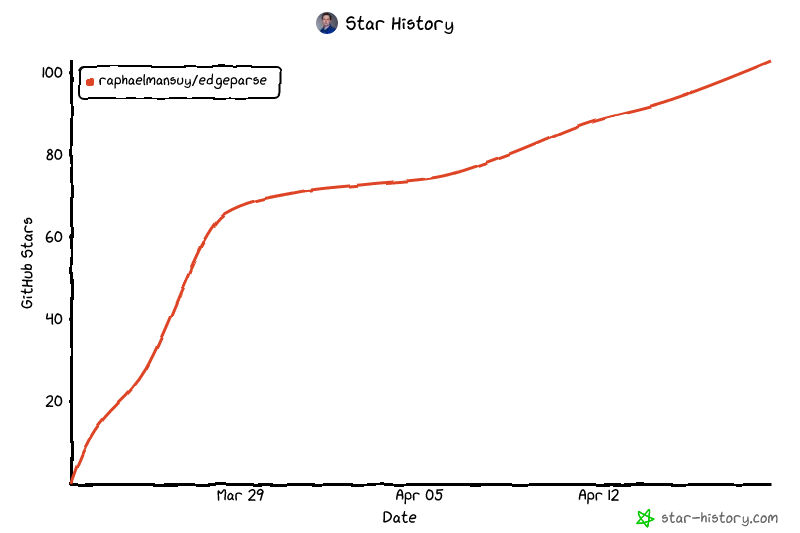
## Star History
## License
EdgeParse is licensed under the **Apache License 2.0**. See [LICENSE](LICENSE) for the full text.
The `crates/pdf-cos/` directory is a fork of [lopdf](https://github.com/J-F-Liu/lopdf) (MIT/Apache-2.0 dual-licensed).
Benchmark PDF documents (`benchmark/pdfs/`) are sourced from publicly available documents and are used solely for evaluation purposes.