https://github.com/rddevitte/simplest-avr-projects
ATmega and ATtiny starter projects, as simple as they can be
https://github.com/rddevitte/simplest-avr-projects
arduino atmega328p atmel attiny85 avr avr-libc microcontroller
Last synced: 3 months ago
JSON representation
ATmega and ATtiny starter projects, as simple as they can be
- Host: GitHub
- URL: https://github.com/rddevitte/simplest-avr-projects
- Owner: rddevitte
- License: unlicense
- Created: 2023-01-08T23:38:48.000Z (over 3 years ago)
- Default Branch: master
- Last Pushed: 2023-01-28T20:50:32.000Z (over 3 years ago)
- Last Synced: 2025-05-14T23:08:31.577Z (about 1 year ago)
- Topics: arduino, atmega328p, atmel, attiny85, avr, avr-libc, microcontroller
- Language: C
- Homepage:
- Size: 341 KB
- Stars: 0
- Watchers: 1
- Forks: 0
- Open Issues: 0
-
Metadata Files:
- Readme: README.md
- License: LICENSE
Awesome Lists containing this project
README
# Simplest AVR projects
Those projects aim to (at least they try to) be the smallest and simplest ones possible for the
Microchip's (formerly Atmel) [ATmega328P](https://www.microchip.com/en-us/product/ATmega328P)
and [ATtiny85](https://www.microchip.com/en-us/product/ATtiny85) microcontrollers, both pretty
popular among the hobbyist community. They can be freely used as a basis for bigger, more
elaborated, projects.
The projects are intended to be built on a GNU/Linux environment; [see below](#environment). To
build on Windows, a tool such as [MinGW-w64](https://www.mingw-w64.org/), [MSYS2](https://www.msys2.org/)
or [Cygwin](http://cygwin.com/) is required.
## Content
This repo is comprised of two projects, one for ATmega328P and the other for ATtiny85, each one in
separated directories. Each project dir. contains:
- A single C source file (`main.c`). What it does is just disable ADC and other units for power
saving, blink a LED connected to a pin for 3 times and then power the uC down.
- A GNU makefile. Running `make` or `make all` will only compile the source and generate a `.hex`
file; to burn down the `.hex` onto the microcontroller, `make install` must be issued.
## Environment
The softwares used to compile the codes, "extract" from the binary ELF the HEX file and write them
onto the ICs were, respectively:
- `avr-gcc` (GCC) 5.4.0
- GNU `avr-objcopy` (GNU Binutils) 2.26.20160125
- `avrdude` version 6.3-20171130
- OS: Ubuntu 22.04.1 LTS x86-64 GNU/Linux
## Targets
### ATmega328P
The first target is a custom, homebrew board with an ATmega328P running by its internal clock source
at 8MHz. The following is a picture of the board used to test this project, connected to a LED.
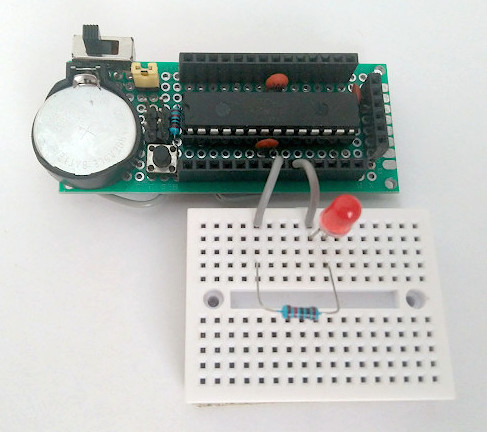
Its bootloader is the [MiniCore one by MCUdude](https://github.com/MCUdude/MiniCore).
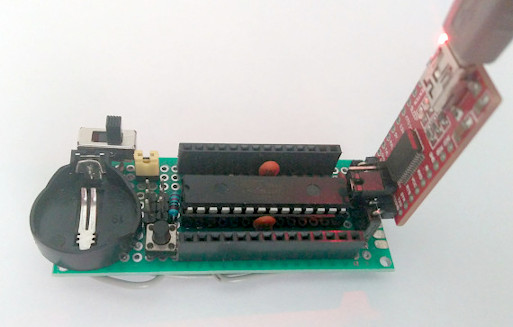
To program the chip it was used a FTDI serial-to-USB breakout module. Below is a picture of the
board being programmed.
### ATtiny85
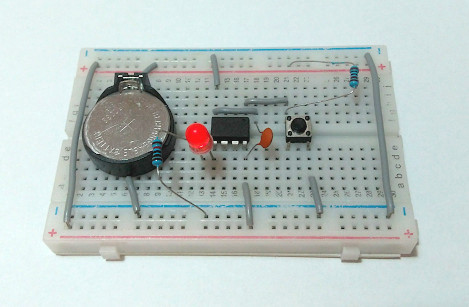
The second target is an ATtiny85 running at 8MHz in a breadboard. It has no bootloader.
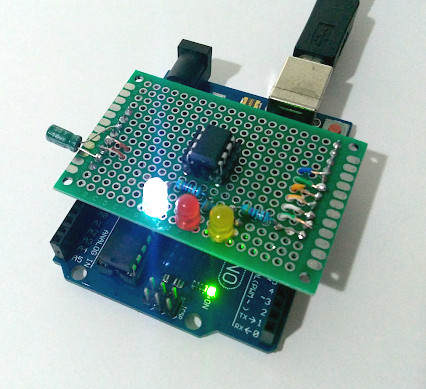
To program the chip it was made a custom shield board to connect to an Arduino, which in its turn
acts as an AVRISP programmer. Below is a picture of the ATtiny chip being programmed.
The following shows the microcontroller already programmed and running in a breadboard sketch.
## References / Credits
Those projects were mostly inspired by [Mitch Davis' YT playlist on Fundamentals of Microcontrollers](https://www.youtube.com/playlist?list=PLNyfXcjhOAwOF-7S-ZoW2wuQ6Y-4hfjMR).
The low power stuff was based off of [Nick Gammon's material on Power saving techniques for microprocessors](https://www.gammon.com.au/power).