https://github.com/redhat-nfvpe/koko
Connect containers as point-to-point connection, using veth/vxlan/vlan/macvlan
https://github.com/redhat-nfvpe/koko
docker ip-netns macvlan namespace veth vlan vxlan
Last synced: 5 months ago
JSON representation
Connect containers as point-to-point connection, using veth/vxlan/vlan/macvlan
- Host: GitHub
- URL: https://github.com/redhat-nfvpe/koko
- Owner: redhat-nfvpe
- License: apache-2.0
- Created: 2017-03-03T05:47:31.000Z (over 9 years ago)
- Default Branch: master
- Last Pushed: 2025-08-14T14:48:57.000Z (11 months ago)
- Last Synced: 2026-02-06T21:44:35.330Z (5 months ago)
- Topics: docker, ip-netns, macvlan, namespace, veth, vlan, vxlan
- Language: Go
- Homepage:
- Size: 18.2 MB
- Stars: 115
- Watchers: 4
- Forks: 18
- Open Issues: 11
-
Metadata Files:
- Readme: README.md
- License: LICENSE
Awesome Lists containing this project
README
# koko: Container connector (for chaining)
[](https://travis-ci.org/redhat-nfvpe/koko) [](https://goreportcard.com/report/github.com/redhat-nfvpe/koko) [](https://opensource.org/licenses/Apache-2.0)
# What is 'koko'?
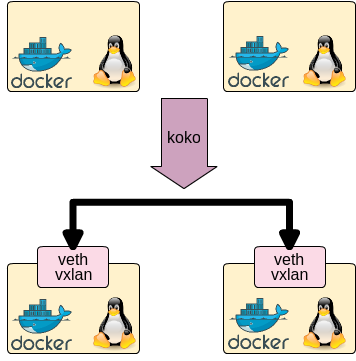
`koko` is a simple tool which connects between Docker containers/linux netns processes with veth devices/vxlan
of linux kernel. Using `koko`, you can simply make point-to-point connection for containers without linux bridges.
# Support Container Type and Interfaces
`koko` supports following container:
- Docker
- Linux netns namespace (i.e. 'ip netns' or see 'man ip-netns' for its detail)
`koko` supports following linux interface to connect above:
- veth: Virtual Ethernet Interface
- vxlan: Virtual eXtensible Local Area Network
# Get Releases
See [releases page](https://github.com/redhat-nfvpe/koko/releases).
# Build Requirements
- golang 1.7 or later
# Build
`koko` is written in go, so following commands makes `koko` single binary. Build and put it in your container host.
go get github.com/redhat-nfvpe/koko
# Syntax
`koko` takes two arguments: two endpoints of container and `koko` connects both.
`koko` supports veth for two containers in one host and vxlan for two containers in separate host.
## Connecting containers in container host using veth
./koko {-c |
-d ,[,/,...] |
-n ,[,/,...]|
-p ,[,/,...]|
-c }
{-d ,[,/,...] |
-n ,[,/,...]|
-p ,[,/,...]|
-c }
## Connecting containers using vxlan (interconnecting container hosts)
Connecting containers which are in separate hosts with vxlan. Following command makes vxlan interface
and put this interface into given container with/without IP address.
./koko {-c |
-d ,[,,...] |
-n ,[,,...]|
-p ,[,,...] }
-x ,,
= {/ |
mirror:{ingress|egress|both},}
## Connecting containers using VLAN
Connecting containers which are in separate hosts with vlan. Following command makes vlan interface
and put this interface into given container with/without IP address.
./koko {-c |
-d ,[,,...] |
-n ,[,,...]|
-p ,[,,...] }
-V ,
= {/ |
mirror:{ingress|egress|both},}
## Connecting containers using macvlan
Connecting containers which are in separate hosts with macvlan. Following command makes macvlan interface
and put this interface into given container with/without IP address.
./koko {-c |
-d ,[,,...] |
-n ,[,,...]|
-p ,[,,...] }
-M ,
= {/ |
mirror:{ingress|egress|both},}
## Delete link in containers
`koko -D` and `koko -N` deletes veth interface or vxlan interface. In case of veth, peering interface is also
removed in this command.
./koko {-D , | -N , }
## Note (for egress mirroring)
In case of 'egress' (and 'both'), the target interface (i.e. ) needs to be configured to have a queue because veth does not have tx queue in default (see https://github.com/moby/moby/issues/33162 for the details).
`ip link set qlen ` sets queue length to corresponding veth device.
## Command option summary
- `-c` is to create veth and put it in current namespace
- `-C` is to delete veth in current namespace
- `-d` is to create interface and put it in docker container namespace
- `-D` is to delete interface of docker container namespace
- `-e` is to create interface and put it in cri-o container namespace
- `-E` is to delete interface of cri-o container namespace
- `-n` is to create interface and put it in linux netns namespace
- `-N` is to delete interface of linux netns namespace
- `-p` is to create interface and put it in pid's netns namespace
- `-P` is to delete interface of pid's netns namespace
- `-X` is to create vxlan interface
- `-V` is to create vlan interface
- `-M` is to create macvlan interface
- `-h` is to show help
- `-v` is to show version
## Printing help
./koko -h
# Usage
Please see [Examples](https://github.com/redhat-nfvpe/koko/wiki/Examples) in Wiki.
## Example
# connect between docker containers with IPv4 address
sudo ./koko -d centos1,link1,192.168.1.1/24 -d centos2,link2,192.168.1.2/24
# connect between docker containers with IPv6 address
sudo ./koko -d centos1,link1,2001:DB8::1/64 -d centos2,link2,2001:DB8::2/64
# connect between docker containers with IPv4/IPv6 address
sudo ./koko -d centos1,link1,192.168.1.1/24,2001:DB8::1/64 -d centos2,link2,192.168.1.2/24,2001:DB8::2/64
# connect between netns namespaces
sudo ./koko -n testns1,link1,192.168.1.1/24 -n testns2,link2,192.168.1.2/24
# connect between docker container and netns namespace
sudo ./koko -d centos1,link1,192.168.1.1/24 -n testns2,link2,192.168.1.2/24
# create vxlan interface and put it into docker container
sudo ./koko -d centos1,link1,192.168.1.1/24 -x eth1,10.1.1.1,1
# Todo
- Document
# Authors
- Tomofumi Hayashi (s1061123)
- Doug Smith (dougbtv)
# Contributers
- Antonio Ojea (aojea)