https://github.com/redsoftwaresystems/nodejs-mdp02
Implementation of 0mq Majordomo Pattern 0.2 written in ES6
https://github.com/redsoftwaresystems/nodejs-mdp02
zeromq
Last synced: about 1 year ago
JSON representation
Implementation of 0mq Majordomo Pattern 0.2 written in ES6
- Host: GitHub
- URL: https://github.com/redsoftwaresystems/nodejs-mdp02
- Owner: RedSoftwareSystems
- License: mit
- Created: 2024-11-08T16:02:36.000Z (over 1 year ago)
- Default Branch: master
- Last Pushed: 2024-11-08T16:02:55.000Z (over 1 year ago)
- Last Synced: 2025-05-01T04:43:53.857Z (about 1 year ago)
- Topics: zeromq
- Language: JavaScript
- Size: 52.7 KB
- Stars: 0
- Watchers: 2
- Forks: 0
- Open Issues: 0
-
Metadata Files:
- Readme: README.md
- License: LICENSE
Awesome Lists containing this project
README
# MDP02
This is the implementation of the MDP written in ES6 and relying on [bindings](https://github.com/JustinTulloss/zeromq.node)
for node.js and io.js to [ZeroMQ](http://zeromq.org/)
The [Majordomo Protocol (MDP)](http://rfc.zeromq.org/spec:18) defines a reliable service-oriented request-reply dialog between a set of client
applications, a broker and a set of worker applications.
MDP covers presence, heartbeating, and service-oriented request-reply processing.
This protocol is ideal for a multiprocess distributed microservice architecture.
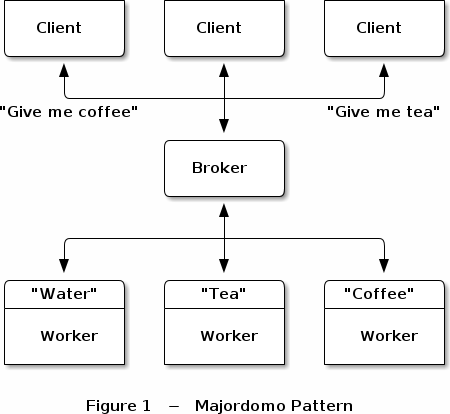
The goals of MDP are to
* Allow requests to be routed to workers on the basis of abstract service names.
* Allow both peers to detect disconnection of the other peer, through the use of heartbeating.
* Allow the broker to implement a "least recently used" pattern for task distribution to workers for a given service.
* Allow the broker to recover from dead or disconnected workers by resending requests to other workers.
This library is ideal for a distributed micro-services architecture where scalability and performance are
key features.
Broker, workers and clients, don't require a specific order to start and broker and workers can be
disconnected without breaking the request-response process, if the request timeout is respected.
## Broker
Broker is the central unit that has the task to dispatch messages between a Client originating a request
and a Worker that exposes a service and returns a response.
A broker can be bound to more than a single socket. The service can be provided by workers connected
to different end points.
```javascript
const broker = makeBroker({
bindings: [
"tcp://127.0.0.1:4242",
"tcp://192.168.100.1:4243",
"ipc:///tmp/mdp02-01"
]
});
broker.start();
```
## Worker
Worker is a unit that serves synchronous request-response pairs for a given service.
A service is identified by its name, and a **service may be served by more than a worker**, a worker can serve
only a request a time.
```javascript
const makeWorker = require('mdp02').makeWorker,
fs = require('fs');
const worker = makeWorker({
serviceName: "fileTransfer",
address: "tcp://127.0.0.1:4242"
});
worker.on('request', function (req) {
let response = req.response,
readable = fs.createReadStream(req.request.toString()); //no exception handling
readable.pipe(response);
});
worker.start();
```
## Client
Client is the request originator.
Clients can execute a request at a time, requests sent are queued into Client internal buffer for sequential execution.
On send method a stream is returned.
```javascript
const makeClient = require('mdp02').makeClient,
fs = require('fs');
let helloClient = makeClient({address: "tcp://127.0.0.1:4242"}),
fileName = path.resolve('remoteFile.txt'),
outputFile = fs.createWriteStream('path-to-local-file.txt');
let response = helloClient.send("fileTransfer", fileName);
response.pipe(outputFile);
outputFile.on('finish', function() {
helloClient.stop();
doSomethingWithLocalFile();
});
```
## API
### Broker
Broker can be accessed with:
const makeBroker = require('mdp02').makeBroker;
**makeBroker(opts) -> Broker** is a function that returns a Broker instance.
A Broker is an instance of EventEmitter.
**_opts::Object{bindings, workerTimeout, clientTimeout}_**
* **bindings(required)**: Array of addresses to which the Broker will be bound to.
ex.: ['tcp://127.0.0.1:3333', 'ipc:///tmp/mdp02-01']
* **workerTimeout**: (default to 5000 msec) Timeout for which a connected worker
is considered stale and unregistered. A disconnect message is sent to the worker,
so that the worker will try to automatically disconnect and reconnect to the worker.
* **clientTimeout**: (default to 5000 msec) Timeout for which a client request is considered expired and removed form the request queue.
* **hbFrequence**: (default to 1/5 of workerTimeout) Frequence of heart beat, used to check connections with brokers and
clients ealth.
#### Worker Methods
* **start** Binds the broker to the given addresses
* **stop** Disconnects the broker and removes all listeners
#### Broker Events
> name: **'error'**, Event: Error
Emitted on erros (soket or protocol errors)
> name: **'request'**, Event::Object{binding, service, command}
Emitted when a request comes from a client.
* Event.binding: the binding address that received the request
* Event.service: the service name
* Event.command: the command request
> name: **'worker-connect'**, Event: Object{binding, service}
Emitted when a worker is connected to the service pool.
* Event.binding: the binding address that received the request
* Event.service: the service name
> name: **'worker-ready'**, Event: Object{binding, service}
Emitted when a worker is ready to serve a request.
* Event.binding: the binding address that received the request
* Event.service: the service name
> name: **'worker-busy'**, Event: Object{binding, service}
Emitted when a worker is actually serving a request
* Event.binding: the binding address that received the request
* Event.service: the service name
> name: **'worker-disconnect'**, Event: Object{binding, service}
Emitted when a worker is going to be disconnected from the broker
* Event.binding: the binding address that received the request
* Event.service: the service name
### Worker
Worker can be accessed with:
const makeWorker = require('mdp02').makeWorker;
**makeWorker(opts) -> Worker** is a function that returns a Worker instance.
A Worker is an instance of EventEmitter.
**_opts::Object{address, timeout, hbFrequence}_**
* **address(required)**: The address to use to connect to the Broker.
ex.: 'tcp://127.0.0.1:3333'
* **timeout**: (default to 5000 msec) Timeout for which a broker
is considered in stale. A disconnect message is sent to the broker and a restart
action is performed.
* **hbFrequence**: (default to 1/5 of timeout) Frequence of heart beat, used to check connection/broker
ealth.
#### Worker Methods
* **start** Connects the worker to the Broker
* **stop** Disconnects the worker from the Broker
#### Worker Events
> name: **'error'**, Event: Error
Emitted on erros (soket or protocol errors).
> name: **'request'**, Event: Object{response::Stream, request::Buffer|Buffer[]}
Emitted when a worker receives a request from a Client through a broker
* Event.response: a [stream.Writable](https://nodejs.org/api/stream.html#stream_class_stream_writable) used to send the response back
* Event.request: the request message originated from the client
> name: **'close-request'**, Event: _null_
Emitted when the worker has finished sennding back its reply
### Client
Client can be accessed with:
const makeWorker = require('mdp02').makeClient;
**makeClient(opts) -> Client** is a function that returns a Client instance.
A Client enqueue requests for the desired services and obtain responses in the
give order.
```javascript
function newClient(address) {
return makeClient({
address: 'tcp://127.0.0.1:3333'
});
}
function makePromise() {
return new Promise(function(resolve, reject) {
let client = newClient(),
response = client.send("now");
response.on('data', function(data) {
console.log('received', data);
});
response.on('end', function(data) {
resolve(parseInt(data, 10));
});
response.on('error', function(err) {
reject(err);
});
});
}
let p1 = makePromise(),
p2 = makePromise(),
p3 = makePromise();
Promise.all([p1, p2, p3]).then(function (result) {
let [r1, r2, r3] = result;
assert(r1 < r2 < r3, `Resuts not in the correct order ${r1} < ${r2} < ${r3} === ${r1 < r2 < r3}`);
});
```
* **address(required)**: The address to use to connect to the Broker.
ex.: 'tcp://127.0.0.1:3333'
* **timeout**: (default to 5000 msec) Timeout for which a client
is considered in stale. A retry is performed in case.
* **maxRetries** Number of time ca client can try a request.
Must be grater than 1 (default is 3). If the number of tries exceeds this limit
an error event is emitted and the enqueued requests are discarded
#### Client Properties
#### Client Methods
> **send(service::String, message::String|Buffer|String[]|Buffer[]) -> [stream.Readable](https://nodejs.org/api/stream.html#stream_class_stream_readable)** Send a request for a service and returns
a stream.Readeable.
* **service(required)**: The service name to call
* **message**: The message to send to the desired service. Can be a String, Buffer or an array of strings or buffers.
> **stop** Disconnects the client from the Broker and resets the request queue
1) _workers, clients and broker timeouts should match to avoid false error handling_