https://github.com/rinosukmandityo/hexagonal-login
Sample of hexagonal architecture to handle login logic and user CRUD
https://github.com/rinosukmandityo/hexagonal-login
go golang hexagonal hexagonal-architecture
Last synced: 9 months ago
JSON representation
Sample of hexagonal architecture to handle login logic and user CRUD
- Host: GitHub
- URL: https://github.com/rinosukmandityo/hexagonal-login
- Owner: rinosukmandityo
- Created: 2020-02-04T00:30:16.000Z (over 6 years ago)
- Default Branch: master
- Last Pushed: 2020-03-26T01:16:05.000Z (over 6 years ago)
- Last Synced: 2025-04-07T17:51:26.325Z (about 1 year ago)
- Topics: go, golang, hexagonal, hexagonal-architecture
- Language: Go
- Size: 1.73 MB
- Stars: 16
- Watchers: 1
- Forks: 2
- Open Issues: 0
-
Metadata Files:
- Readme: README.md
Awesome Lists containing this project
README
# hexagonal-login
Sample of hexagonal architecture to handle login logic and user CRUD
How to run
---
#### Set Environment Variable
This application support 2 kind of database MySQL and MongoDB to prove our ports is completely agnostic from the implementation.
By default it will connect into our mongo DB database with default host & port `localhost:27017` and collection `local`
To connect into different database we need to set database information in environment variable
1. MongoDB
```cli
set url=mongodb://localhost:27017/local
set timeout=30
set db=local
set driver=mongo
```
2. MySQL
```cli
set url=root:Password.1@tcp(127.0.0.1:3306)/tes
set timeout=10
set db=tes
set driver=mysql
```
After setting the database information we only need to run the main.go file
`go run main.go`
#### API List & Payloads
Here is our API List and its payload:
1. [GET] **/user/{_user\_id_}**
`/user/userid01`
2. [POST] **/user**
`/user`
```javascript
{
Name: "Name",
Username: "username",
Password: "Password.User",
ID: "userid01",
Email: "usermail01@gmail.com",
Address: "User Address 01",
IsActive: false
}
```
3. [PUT] **/user/{_user\_id_}**
`/user/userid01`
```javascript
{
Name: "Name",
Username: "username",
Password: "Password.User",
ID: "userid01",
Email: "usermail01@gmail.com",
Address: "User Address 01",
IsActive: false
}
```
4. [DELETE] **/user/{_user\_id_}**
`/user/userid01`
5. [POST] **/auth**
```javascript
{
Username: "username",
Password: "Password.User"
}
```
Hexagonal Architecture Concept
---
The concept of **Hexagonal Architecture** is to make sure that we divide our software in such a way that each piece of the software maintains its separation of concerns so that our application is modular.
#### Domain Logic
_**App & Domain Logic**_ needs to be completely separated from the infrastructure like database or web service.
In the figure below, we have _**Domain Logic**_ in the middle and _**Ports & Adapters**_ layer on the outside which connect the _**Domain Logic**_ to outside things like a user interface, Repository, REST API, External API or Message Queue.
So whenever our _**Domain Logic**_ needs some infrastructure then we need to make our _**Domain Logic**_ to depend on _**Ports**_.
#### Ports
Ports are simply interfaces that represent what that infrastructure needs to do.
For example if we need to get user data from a database, a port can be an interface that has a method that returns a list of users.
These ports are completely agnostic from the implementation.
#### Adapters
Adapters do the concrete action and talk to the infrastructure
In the figure we can see that these Adapters are outside of the Domain Logic so that we keep our Domain Logic completely ignorant about infrastructure
You can refer to below images to gain more clarity, I got [this image from medium post](https://medium.com/@msmechatronics/hexagonal-architecture-in-java-5b21ebea849d)
:
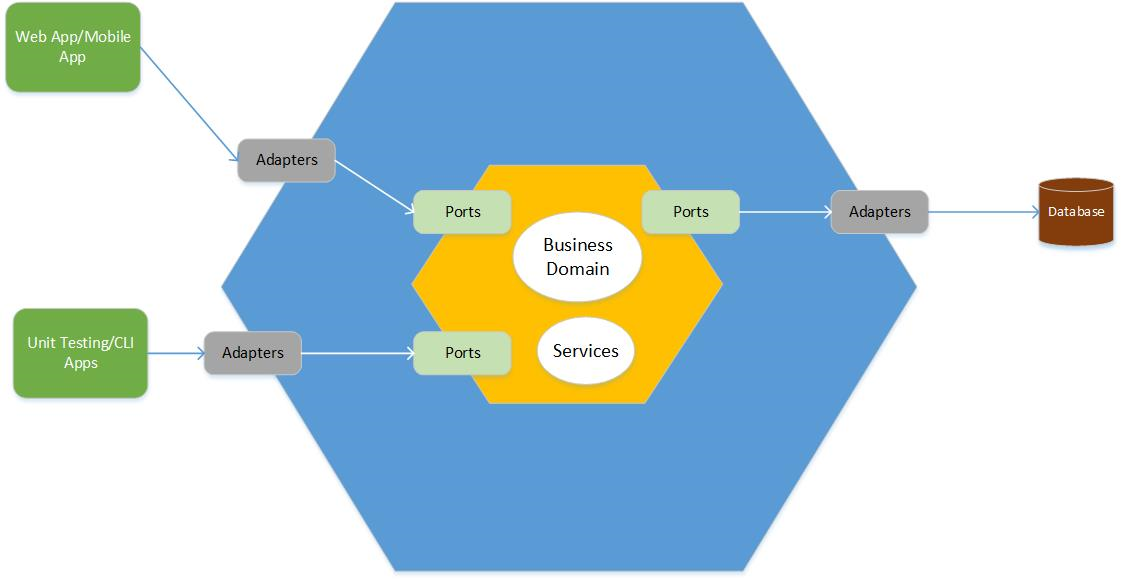
By using this architecture we can make sure that the _**Business Logic**_ itself is independent of any kind of framework.
So if we rely on framework to one of our _**Ports & Adapters**_, if the framework become depreciated or if want to use a different framework we could just take our _**Business Logic**_ and move it over to that other framework.
We also can make sure that our _**Domain Logic**_ are testable without any of the _**Port & Adapters**_, so if we don't have a database or an API we can still test the _**Business Logic**_ and make sure that it actually works properly
#### The service that we are going to build
So we have our service which is a user management and login and it will connect to serializer which will either serialize the data into json or message pack before serving it through REST API
And then on the other side we have our repository which will either choose to use MongoDB or MySQL based on how we start the application from command line.
So basically our API will be able to accept JSON or message pack format and also our repository is able to use both MongoDB and MySQL and it won't really affect our service
Project Structure
---
By implementing Hexagonal Architecture we also implement Dependency Inversion and Dependency Injection. Here is some explanations about project structure:
1. **api**
contains handler for API
2. **models**
contains data models
3. **repositories**
contains **Port** interface for repository adapter
- **mongodb**
contains mongo **Adapter** that implement UserRepository interface. This package will store mongo client and connect to mongoDB database to handle database query or command
- **mysql**
contains MySQL **Adapter** that implement UserRepository interface. This package will store MySQL client and connect to MySQL server to handle database query or data manipulation
4. **serializer**
contains **Port** interface for decode and encode serializer. It will be used in our API to decode and encode data.
- **json**
contains json **Adapter** that implement serializer interface to encode and decode data
- **msgpack**
contains message pack **Adapter** that implement serializer interface to encode and decode data
5. **services**
contains **Port** interface for our domain service and logic
6. **logic**
contains service **Adapter** that implement service interface to handle service logic like constructing repository parameter and calling repository interface to do data manipulation or query