https://github.com/robertdebock/ansible-role-openbao
Install and configure openbao on your system.
https://github.com/robertdebock/ansible-role-openbao
ansible application cloud database infrastructure linux molecule openbao playbook security storage system tools
Last synced: 5 months ago
JSON representation
Install and configure openbao on your system.
- Host: GitHub
- URL: https://github.com/robertdebock/ansible-role-openbao
- Owner: robertdebock
- License: apache-2.0
- Created: 2025-08-29T11:46:54.000Z (11 months ago)
- Default Branch: master
- Last Pushed: 2026-02-11T15:47:50.000Z (5 months ago)
- Last Synced: 2026-02-12T00:31:44.635Z (5 months ago)
- Topics: ansible, application, cloud, database, infrastructure, linux, molecule, openbao, playbook, security, storage, system, tools
- Language: Jinja
- Homepage: https://robertdebock.nl/
- Size: 186 KB
- Stars: 7
- Watchers: 0
- Forks: 3
- Open Issues: 0
-
Metadata Files:
- Readme: README.md
- Contributing: CONTRIBUTING.md
- Funding: .github/FUNDING.yml
- License: LICENSE
- Code of conduct: CODE_OF_CONDUCT.md
- Security: SECURITY.md
Awesome Lists containing this project
README
# [Ansible role openbao](#ansible-role-openbao)
Install and configure OpenBao server and/or OpenBao agent on your system.
|GitHub|GitLab|Downloads|Version|
|------|------|---------|-------|
|[](https://github.com/robertdebock/ansible-role-openbao/actions)|[](https://gitlab.com/robertdebock-iac/ansible-role-openbao)|[](https://galaxy.ansible.com/robertdebock/openbao)|[](https://github.com/robertdebock/ansible-role-openbao/releases/)|
## [Example Playbook](#example-playbook)
This example is taken from [`molecule/default/converge.yml`](https://github.com/robertdebock/ansible-role-openbao/blob/master/molecule/default/converge.yml) and is tested on each push, pull request and release.
```yaml
---
- name: Converge
hosts: all
become: true
gather_facts: true
roles:
- role: robertdebock.openbao
openbao_storage:
type: raft
path: /opt/openbao/data
node_id: node1
retry_join:
- leader_api_addr: "http://127.0.0.2:8200"
openbao_cluster_addr: "https://127.0.0.1:8201"
openbao_api_addr: "https://127.0.0.1:8200"
openbao_listeners:
- name: tcp
address: "127.0.0.1:8200"
tls_disable: true
openbao_telemetry:
prometheus_retention_time: "30s"
disable_hostname: true
openbao_log_requests_level: "info"
openbao_audit_devices:
- type: file
path: "audit"
description: "Audit logs to file"
options:
file_path: "/openbao/logs/audit.log"
log_raw: false
openbao_seal:
- name: static
current_key_id: "20250606-1"
current_key: "file:///openbao/secrets/unseal-20250606-1.key"
# Install plugin binaries
openbao_plugin_directory: "/opt/openbao/plugins"
openbao_plugin_validate_certs: false
openbao_plugins:
- name: openbao-plugin-auth-aws
version: "0.1.0"
download_url: https://github.com/openbao/openbao-plugins/releases/download/auth-aws-v0.1.0/openbao-plugin-auth-aws_linux_amd64_v1.tar.gz
- name: openbao-plugin-secrets-aws
version: "0.1.0"
download_url: https://github.com/openbao/openbao-plugins/releases/download/secrets-aws-v0.1.0/openbao-plugin-secrets-aws_linux_amd64_v1.tar.gz
openbao_plugin_cleanup: false
# Configure OpenBao Agent with AppRole authentication
openbao_agent_config: |
vault {
address = "http://127.0.0.1:8200"
}
auto_auth {
method "approle" {
config {
role_id_file_path = "/opt/openbao/approle-role-id"
secret_id_file_path = "/opt/openbao/approle-secret-id"
}
}
sink "file" {
config {
path = "/opt/openbao/agent-token"
}
}
}
openbao_agent_environment:
BAO_ADDR: "http://127.0.0.1:8200"
```
The machine needs to be prepared. In CI this is done using [`molecule/default/prepare.yml`](https://github.com/robertdebock/ansible-role-openbao/blob/master/molecule/default/prepare.yml):
```yaml
---
- name: Prepare
hosts: all
become: true
gather_facts: false
roles:
- role: robertdebock.bootstrap
tasks:
# To unseal using a static key, we need to generate a key and set the ownership and permissions.
# This is not a part of the Ansible role and needs to be done before applying this role.
# This package is required to generate a static unseal key.
- name: Install OpenSSL to generate static unseal key
ansible.builtin.package:
name: openssl
state: present
# This group is created by the OpenBao package, but since we're using a static unseal key, we need to create it ourselves.
- name: Create OpenBao group
ansible.builtin.group:
name: openbao
system: true
state: present
# This user is created by the OpenBao package, but since we're using a static unseal key, we need to create it ourselves.
- name: Create OpenBao user
ansible.builtin.user:
name: openbao
group: openbao
system: true
shell: /bin/false
home: /opt/openbao
create_home: false
state: present
- name: Create OpenBao directories
ansible.builtin.file:
path: "{{ item }}"
state: directory
mode: '0750'
owner: openbao
group: openbao
loop:
- /openbao/secrets
- /openbao/logs
- name: Generate static unseal key
ansible.builtin.command: openssl rand -out /openbao/secrets/unseal-20250606-1.key 32
args:
creates: /openbao/secrets/unseal-20250606-1.key
- name: Set ownership and permissions for static unseal key
ansible.builtin.file:
path: /openbao/secrets/unseal-20250606-1.key
owner: openbao
group: openbao
mode: '0640'
```
Also see a [full explanation and example](https://robertdebock.nl/how-to-use-these-roles.html) on how to use these roles.
## [Role Variables](#role-variables)
The default values for the variables are set in [`defaults/main.yml`](https://github.com/robertdebock/ansible-role-openbao/blob/master/defaults/main.yml):
```yaml
---
# defaults file for openbao
# Whether to configure and manage the OpenBao server. When false,
# only the OpenBao package will be installed (required for the agent).
# Set to false to use this role for agent-only deployments.
openbao_server_enable: true
# Version of OpenBao to install. This value is used to select the
# package version from your configured package repositories.
# Example: "2.5.0"
openbao_version: "2.5.0"
# Directory to store temporary downloaded artifacts (for example,
# plugin archives). This directory is created before any downloads.
openbao_download_dir: "/tmp"
# Whether to validate TLS certificates when downloading the OpenBao
# GPG key. When false, TLS certificate validation is disabled
# (insecure; use only in controlled environments).
openbao_validate_certs: false
# Enable or disable the OpenBao web UI. When true, the UI will be
# accessible at the configured listener address.
openbao_ui: true
# Storage backend configuration for OpenBao.
# Supported types: file, inmem, raft, postgresql
# Example for file storage:
# openbao_storage:
# type: file
# path: /opt/openbao/data
#
# Example for in-memory storage:
# openbao_storage:
# type: inmem
#
# Example for raft storage:
# openbao_storage:
# type: raft
# path: /opt/openbao/raft
# node_id: node1
# performance_multiplier: 1
# trailing_logs: 10000
# snapshot_threshold: 8192
# snapshot_interval: 120
# max_entry_size: 1048576
# max_transaction_size: 8388608
# autopilot_reconcile_interval: "10s"
# autopilot_update_interval: "2s"
# retry_join_as_non_voter: false
# retry_join:
# - leader_api_addr: "https://127.0.0.2:8200"
# leader_ca_cert_file: "/path/to/ca1"
# leader_client_cert_file: "/path/to/client/cert1"
# leader_client_key_file: "/path/to/client/key1"
# - auto_join: "provider=aws region=eu-west-1 tag_key=openbao tag_value=..."
# openbao_cluster_addr: "https://127.0.0.1:8201"
#
# Example for PostgreSQL storage:
# openbao_storage:
# type: postgresql
# connection_url: postgresql://user:pass@localhost:5432/openbao
openbao_storage:
type: file
path: /opt/openbao/data
# Listener configuration for OpenBao.
# Each listener can have different parameters based on its type.
# Example for HTTP listener:
# openbao_listeners:
# - name: tcp
# address: "127.0.0.1:8200"
# tls_disable: true
#
# Example for HTTPS listener:
# openbao_listeners:
# - name: tcp
# address: "0.0.0.0:8200"
# tls_cert_file: "/opt/openbao/tls/tls.crt"
# tls_key_file: "/opt/openbao/tls/tls.key"
# proxy_protocol_behavior: "use_always"
# proxy_protocol_authorized_addrs: "10.10.20.0/24"
#
# Example for multiple listeners:
# openbao_listeners:
# - name: tcp
# address: "127.0.0.1:8200"
# tls_disable: true
# - name: tcp
# address: "0.0.0.0:8200"
# tls_cert_file: "/opt/openbao/tls/tls.crt"
# tls_key_file: "/opt/openbao/tls/tls.key"
openbao_listeners:
- name: tcp
address: "0.0.0.0:8200"
tls_cert_file: "/opt/openbao/tls/tls.crt" # This certificate is part of the openbao package.
tls_key_file: "/opt/openbao/tls/tls.key" # This key is part of the openbao package.
# Cluster address for OpenBao. Required when using raft storage.
# This is the address that other nodes in the cluster will use to communicate.
openbao_cluster_addr: ""
# API address for OpenBao. This is the address that other nodes will use
# to communicate with this node's API. Required when using raft storage.
openbao_api_addr: ""
# Seal configuration for OpenBao.
# Currently OpenBao supports only one seal method, but this structure
# allows for future extensibility.
# Example for AWS KMS:
# openbao_seal:
# - name: awskms
# region: us-east-1
# access_key: "XYZ"
# secret_key: "ZYX"
# kms_key_id: "1-2-3"
#
# Example for AliCloud KMS:
# openbao_seal:
# - name: alicloudkms
# region: cn-hangzhou
# access_key: "XYZ"
# secret_key: "ZYX"
# key_id: "1-2-3"
#
# Example for Azure Key Vault (with client credentials):
# openbao_seal:
# - name: azurekeyvault
# tenant_id: "tenant-id"
# client_id: "client-id"
# client_secret: "client-secret"
# vault_name: "vault-name"
# key_name: "key-name"
#
# Example for Azure Key Vault (with machine identity / Managed Identity):
# openbao_seal:
# - name: azurekeyvault
# tenant_id: "tenant-id"
# vault_name: "vault-name"
# key_name: "key-name"
#
# Example for GCP Cloud KMS:
# openbao_seal:
# - name: gcpckms
# credentials: "/path/to/credentials.json"
# project: "project-id"
# region: "global"
# key_ring: "keyring"
# crypto_key: "key"
#
# Example for KMIP:
# openbao_seal:
# - name: kmip
# server: "server:5696"
# certificate: "/path/to/cert.pem"
# key: "/path/to/key.pem"
# ca_cert: "/path/to/ca.pem"
#
# Example for OCI KMS:
# openbao_seal:
# - name: ocikms
# auth_type: "user_principal"
# key_id: "ocid1.key.region1.tenant1.xyz"
# crypto_endpoint: "https://crypto.kms.us-ashburn-1.oraclecloud.com"
#
# Example for PKCS#11:
# openbao_seal:
# - name: pkcs11
# lib: "/usr/lib/libpkcs11.so"
# slot: "0"
# pin: "1234"
# key_label: "label"
#
#
# Example for Transit:
# openbao_seal:
# - name: transit
# address: "http://127.0.0.1:8200"
# token: "s.xyz123"
# key_name: "autounseal"
# mount_path: "transit/"
#
# Example for Static Key:
# openbao_seal:
# - name: static
# current_key_id: "20250606-1"
# current_key: "file:///openbao/secrets/unseal-20250606-1.key"
# previous_key_id: "20250306-1"
# previous_key: "file:///openbao/secrets/unseal-20250306-1.key"
#
# Example for no seal (Shamir's Secret Sharing):
# openbao_seal: []
openbao_seal: []
# Telemetry configuration for OpenBao.
# Example for Prometheus:
# openbao_telemetry:
# prometheus_retention_time: "30s"
# disable_hostname: true
#
# Example for StatsD:
# openbao_telemetry:
# statsd_address: "statsd.company.local:8125"
# metrics_prefix: "openbao"
#
# Example for DogStatsD:
# openbao_telemetry:
# dogstatsd_addr: "localhost:8125"
# dogstatsd_tags:
# - "env:production"
# - "service:openbao"
#
# Example for Stackdriver:
# openbao_telemetry:
# stackdriver_project_id: "my-test-project"
# stackdriver_location: "us-east1-a"
# stackdriver_namespace: "openbao-cluster-a"
# disable_hostname: true
# enable_hostname_label: true
openbao_telemetry: {}
# Logging configuration for OpenBao.
# Example for debug level logging:
# openbao_log_requests_level: "debug"
#
# Example for info level logging:
# openbao_log_requests_level: "info"
#
# Example for disabling request logging:
# openbao_log_requests_level: "off"
#
# Valid levels: error, warn, info, debug, trace, off
openbao_log_requests_level: "info"
# Audit device configuration for OpenBao.
# Audit devices provide detailed logs of all requests and responses to OpenBao.
# Multiple audit devices can be configured to log to different destinations.
#
# Example for file audit device:
# openbao_audit_devices:
# - type: file
# path: "audit"
# description: "Audit logs to file"
# options:
# file_path: "/var/log/openbao/audit.log"
# log_raw: false
#
# Example for syslog audit device:
# openbao_audit_devices:
# - type: syslog
# path: "syslog"
# description: "Audit logs to syslog"
# options:
# facility: "AUTH"
# tag: "openbao"
# log_raw: false
#
# Example for socket audit device:
# openbao_audit_devices:
# - type: socket
# path: "socket"
# description: "Audit logs to socket"
# options:
# address: "127.0.0.1:9000"
# socket_type: "tcp"
# log_raw: false
#
# Example for multiple audit devices:
# openbao_audit_devices:
# - type: file
# path: "file-audit"
# description: "File audit device"
# options:
# file_path: "/var/log/openbao/audit.log"
# log_raw: false
# - type: syslog
# path: "syslog-audit"
# description: "Syslog audit device"
# options:
# facility: "AUTH"
# tag: "openbao"
# log_raw: false
openbao_audit_devices: []
# File mode used for directories that hold file-based audit logs.
# The role always creates the parent directory of each file_path from
# file-type entries in openbao_audit_devices with this mode.
openbao_audit_directories_mode: "0750"
# TLS certificate management for OpenBao.
# When this map is populated, the role will manage TLS certificates.
# Leave empty to skip certificate management.
#
# Example for inline certificate content:
# openbao_tls:
# directory: "/opt/openbao/tls"
# cert_file: "tls.crt"
# key_file: "tls.key"
# ca_file: "ca.crt"
# cert_content: |
# -----BEGIN CERTIFICATE-----
# MIIDXTCCAkWgAwIBAgIJAKoK...
# -----END CERTIFICATE-----
# key_content: |
# -----BEGIN PRIVATE KEY-----
# MIIEvQIBADANBgkqhkiG9w0BAQEFAASCBKcwggSjAgEAAoIBAQC7VJTUt9Us8cKB...
# -----END PRIVATE KEY-----
# ca_content: |
# -----BEGIN CERTIFICATE-----
# MIIDXTCCAkWgAwIBAgIJAKoK...
# -----END CERTIFICATE-----
#
# Example for external file sources:
# openbao_tls:
# directory: "/opt/openbao/tls"
# cert_content: "{{ lookup('file', '/path/to/cert.pem') }}"
# key_content: "{{ lookup('file', '/path/to/key.pem') }}"
# ca_content: "{{ lookup('file', '/path/to/ca.pem') }}"
#
# Example for custom filenames and directory:
# openbao_tls:
# directory: "/etc/openbao/tls"
# cert_file: "server.crt"
# key_file: "server.key"
# ca_file: "ca.crt"
# cert_content: "{{ lookup('file', '/path/to/cert.pem') }}"
# key_content: "{{ lookup('file', '/path/to/key.pem') }}"
# ca_content: "{{ lookup('file', '/path/to/ca.pem') }}"
openbao_tls: {}
# Declarative self-initialization blocks (executed once on first startup).
# Keep empty on non-bootstrap nodes.
# Example matching the RFC (requires env var INITIAL_ADMIN_PASSWORD):
# openbao_initialize:
# - name: identity
# requests:
# - name: mount-userpass
# operation: update
# path: sys/auth/userpass
# data:
# type: userpass
# path: userpass/
# description: admin
# - name: userpass-add-admin
# operation: update
# path: auth/userpass/users/admin
# data:
# password:
# # Example: env source (requires env_var)
# eval_type: string
# eval_source: env
# env_var: INITIAL_ADMIN_PASSWORD
# token_policies:
# - superuser
# - name: enable-oidc
# operation: update
# path: sys/auth/oidc
# data:
# type: oidc
# - name: configure-oidc
# operation: update
# path: auth/oidc/config
# data:
# # Example: file source (requires path)
# oidc_client_id:
# eval_type: string
# eval_source: file
# path: /etc/openbao/oidc-client-id
# # Example: response source (requires initialize_name, response_name, field_selector)
# mount_accessor:
# eval_type: string
# eval_source: response
# initialize_name: identity
# response_name: enable-oidc
# field_selector: mount_accessor
# - name: policy
# requests:
# - name: add-superuser-policy
# operation: update
# path: sys/policies/acl/superuser
# data:
# policy: |
# path "*" {
# capabilities = ["create", "update", "read", "delete", "list", "scan", "sudo"]
# }
openbao_initialize: []
# Environment variables to inject into the OpenBao systemd service.
# Use this to pass secrets needed for self-initialization (e.g., INITIAL_ADMIN_PASSWORD).
# Example:
# openbao_service_environment:
# INITIAL_ADMIN_PASSWORD: "changeme"
openbao_service_environment: {}
# Plugin installation for OpenBao.
# This role can download and install plugin binaries and set the
# plugin_directory in the OpenBao configuration. Registration/enabling
# of plugins in the catalog is intentionally out of scope.
#
# Directory where plugin binaries are installed and from which OpenBao
# loads plugins. This will be rendered into openbao.hcl as
# plugin_directory = "..." when non-empty.
openbao_plugin_directory: "/opt/openbao/plugins"
# Whether to validate TLS certificates when downloading plugins.
openbao_plugin_validate_certs: true
# List of plugins to install. Each item should contain:
# - name: Binary name inside the archive (and final installed name)
# - version: Version string used for naming the downloaded archive
# - download_url: Direct URL to the plugin archive (.tar.gz)
# Example:
# openbao_plugins:
# - name: openbao-plugin-auth-aws
# version: "0.1.0"
# download_url: https://github.com/openbao/openbao-plugins/releases/download/auth-aws-v0.1.0/openbao-plugin-auth-aws_linux_amd64_v1.tar.gz
openbao_plugins: []
# Remove downloaded archives and temporary extracted files after install.
openbao_plugin_cleanup: false
# Plugin registration is intentionally not performed by this role.
# To register plugins, see the OpenBao docs and perform registration
# in your playbook after the server is initialized.
#
# Example (in your playbook):
# - name: Register plugin
# command:
# argv:
# - bao
# - plugin
# - register
# - "-sha256="
# - "" # auth|database|secret
# - ""
# environment:
# BAO_ADDR: "http://127.0.0.1:8200"
# BAO_TOKEN: ""
# OpenBao Agent configuration.
# When openbao_agent_config is filled (non-empty string), the agent will be
# configured and started. Leave empty to skip agent configuration.
#
# The agent configuration should be provided as HCL (HashiCorp Configuration Language).
# You can provide it inline, via lookup('file', '...'), or using your own template.
#
# Example minimal agent configuration:
# openbao_agent_config: |
# vault {
# address = "http://127.0.0.1:8200"
# }
# auto_auth {
# method "token_file" {
# config {
# token_file_path = "/tmp/vault-token"
# }
# }
# sink "file" {
# config {
# path = "/tmp/agent-token"
# }
# }
# }
openbao_agent_config: ""
# Path where the agent configuration file will be placed.
openbao_agent_config_path: "/etc/openbao/openbao-agent.hcl"
# Environment variables to inject into the OpenBao agent systemd service.
# Use this to pass secrets or configuration needed by the agent.
# Example:
# openbao_agent_environment:
# BAO_ADDR: "http://127.0.0.1:8200"
openbao_agent_environment: {}
# Path to the environment file for the OpenBao agent systemd service.
openbao_agent_env_path: "/etc/openbao/openbao-agent.env"
# Binary path for OpenBao agent command. This is needed for the agent service to start.
openbao_agent_binary: "/usr/bin/bao"
```
## [Requirements](#requirements)
- pip packages listed in [requirements.txt](https://github.com/robertdebock/ansible-role-openbao/blob/master/requirements.txt).
## [State of used roles](#state-of-used-roles)
The following roles are used to prepare a system. You can prepare your system in another way.
| Requirement | GitHub | GitLab |
|-------------|--------|--------|
|[robertdebock.bootstrap](https://galaxy.ansible.com/robertdebock/bootstrap)|[](https://github.com/robertdebock/ansible-role-bootstrap/actions)|[](https://gitlab.com/robertdebock-iac/ansible-role-bootstrap)|
## [Context](#context)
This role is part of many compatible roles. Have a look at [the documentation of these roles](https://robertdebock.nl/) for further information.
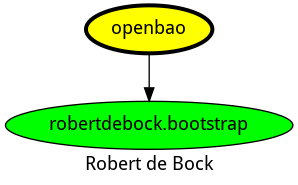
Here is an overview of related roles:
## [Compatibility](#compatibility)
This role has been tested on these [container images](https://hub.docker.com/u/robertdebock):
|container|tags|
|---------|----|
|[Debian](https://hub.docker.com/r/robertdebock/debian)|all|
|[EL](https://hub.docker.com/r/robertdebock/enterpriselinux)|all|
|[Fedora](https://hub.docker.com/r/robertdebock/fedora)|all|
|[Ubuntu](https://hub.docker.com/r/robertdebock/ubuntu)|jammy, noble|
The minimum version of Ansible required is 2.12, tests have been done on:
- The previous version.
- The current version.
- The development version.
If you find issues, please register them on [GitHub](https://github.com/robertdebock/ansible-role-openbao/issues).
## [License](#license)
[Apache-2.0](https://github.com/robertdebock/ansible-role-openbao/blob/master/LICENSE).
## [Author Information](#author-information)
[robertdebock](https://robertdebock.nl/)
Please consider [sponsoring me](https://github.com/sponsors/robertdebock).