https://github.com/rose-stl-lab/autonpp
Efficient computation of temporal point process intensity using automatic integration
https://github.com/rose-stl-lab/autonpp
Last synced: about 1 year ago
JSON representation
Efficient computation of temporal point process intensity using automatic integration
- Host: GitHub
- URL: https://github.com/rose-stl-lab/autonpp
- Owner: Rose-STL-Lab
- License: mit
- Created: 2023-05-12T22:54:04.000Z (about 3 years ago)
- Default Branch: temporal
- Last Pushed: 2023-06-11T18:07:09.000Z (about 3 years ago)
- Last Synced: 2025-06-04T20:52:54.912Z (about 1 year ago)
- Language: Python
- Size: 89.8 KB
- Stars: 4
- Watchers: 0
- Forks: 0
- Open Issues: 0
-
Metadata Files:
- Readme: README.md
- License: LICENSE
Awesome Lists containing this project
README
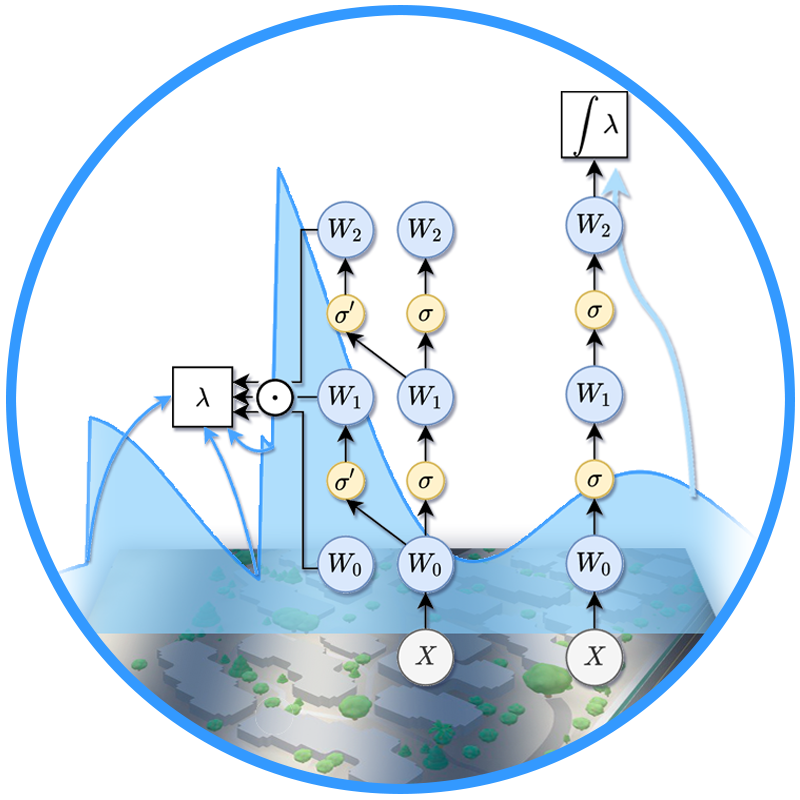
Auto-NPP
✨Automatic Integration for Neural Point Process✨


## | Paper
[Automatic Integration for Fast and Interpretable Neural Point Processes](https://proceedings.mlr.press/v211/zhou23a/zhou23a.pdf)
## | Installation
Dependencies: `make`, `conda-lock`
```bash
make create_environment
conda activate autonpp
```
## | Dataset Download
```bash
make download prefix=data
```
## | Get Trained Models
```
make download prefix=models
```
## | Training and Testing
Specify the parameters in `configs/test_autoint_1d_dataset.yaml` and then run
```bash
make run
```
The loss curves and example intensity predictions are saved to `figs/`.
With real-world datasets, the ground truth intensity is a placeholder and can be safely ignored.
The logs are saved to `logs/`.
The models are saved to `models/`.
To use the trained models, set `retrain: false`.
## | Cite
```
@article{zhou2023automatic,
title={Automatic Integration for Fast and Interpretable Neural Point Processes},
author={Zhou, Zihao and Yu, Rose},
journal={Learning for Dynamics and Control (L4DC)},
year={2023}
}
```