https://github.com/ryanlua/digital-archive-exhibit
Website about The Great Gatsby and the Harlem Renaissance created for a school project
https://github.com/ryanlua/digital-archive-exhibit
css history html static
Last synced: 8 months ago
JSON representation
Website about The Great Gatsby and the Harlem Renaissance created for a school project
- Host: GitHub
- URL: https://github.com/ryanlua/digital-archive-exhibit
- Owner: RyanLua
- Created: 2025-03-27T20:02:17.000Z (about 1 year ago)
- Default Branch: main
- Last Pushed: 2025-04-01T20:17:37.000Z (about 1 year ago)
- Last Synced: 2025-07-04T13:27:56.935Z (12 months ago)
- Topics: css, history, html, static
- Language: HTML
- Homepage: https://ryanlua.github.io/digital-archive-exhibit/
- Size: 3.05 MB
- Stars: 0
- Watchers: 1
- Forks: 0
- Open Issues: 0
-
Metadata Files:
- Readme: README.md
Awesome Lists containing this project
README
# Celebrating 50 Years of The Great Gatsby with Its Truth
In it’s over 50 years, _The Great Gatsby_, has survived the test of time as an American classic. The novel was published and set in the [Roaring Twenties], a time of great change in America. However, the book mainly shows the lives of wealthy white people. It fails to represent all voices of the 1920s, such as the voices of marginalized communities who were making historical progress and redefining the [American Dream] of this time. Learn about the [Harlem Renaissance] and how it provided African Americans with the right tools to overcome societal barriers and establish their roots in history and discover the side of the American Dream that Fitzgerald did not include in his novel.
Sources include Langston Hughes’s poem _Harlem_ about dreams denied by racism, Claude McKay’s _The Barrier_ and the deep racial divisions of the time, Billie Holiday’s song "Strange Fruit" made in reponse to the brutal lynching of Black Americans, and James VanDerZee’s photograph Couple in Raccoon Coats which capture Black pride and success.
[Roaring Twenties]: https://en.wikipedia.org/wiki/Roaring_Twenties
[American Dream]: https://en.wikipedia.org/wiki/American_Dream
[Harlem Renaissance]: https://en.wikipedia.org/wiki/Harlem_Renaissance
## Understanding _The Great Gatsby_
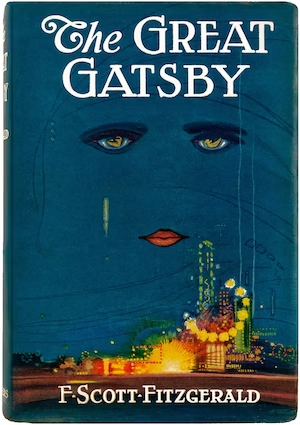
###### _The Great Gatsby_ by F. Scott Fitzgerald (1925)
Before talking about the Harlem Renaissance, we need to understand _The Great Gatsby._ The book’s author, [F. Scott Fitzgerald], is known for focusing on wealth, class struggles, and the idea of the American Dream and it is no different in this book. The novel criticizes the idea that money alone can lead to success, but it mostly tells the story of wealthy white characters. While it does portray an accurate and believable life of the elite, it does not explore how people from different backgrounds, especially African Americans, experienced the American Dream during this time.
[F. Scott Fitzgerald]: https://en.wikipedia.org/wiki/F._Scott_Fitzgerald
## Dreams Denied by Color
[Langston Hughes] was a poet during the Harlem Renaissance. This cultural movement aimed to celebrate Black life and protest injustice. In his poem _Harlem_, Hughes writes about the pain of having dreams put on hold because of race.
###### _Harlem_ by Langston Hughes (1951)
> What happens to a dream deferred?
> Does it dry up
> like a raisin in the sun?
> Or fester like a sore—
> And then run?
> Does it stink like rotten meat?
> Or crust and sugar over—
> like a syrupy sweet?
>
> Maybe it just sags
> like a heavy load.
>
> Or does it explode
The poem uses images like a “raisin in the sun” (something dried up and wasted) and “rotten meat” (something spoiled) to show how delaying dreams can lead to sadness, frustration, and anger. Hughes suggests that denying African Americans their dreams due to prejudice is harmful and could lead to bigger problems (“Or does it explode?”). This show that for many Black Americans in the 1920s, systemic racism made even starting the dream difficult which is harshly different from what Fitzgerald portrays in his book and has you to believe. Not only was this dream difficult or blocked, it could be dangerous as well.
[Langston Hughes]: https://en.wikipedia.org/wiki/Langston_Hughes
## Songs of Protest and Peace
Music was a important factor to the Harlem Renaissance. While jazz celebrated Black culture, other songs directly addressed the harsh realities of racism. “Strange Fruit” by [Billie Holiday] is a powerful protest song against the brutal lynching of Black Americans. The song was written as a response to racial violence in the South.
###### “Strange Fruit” by Billie Holiday (1939)
https://github.com/user-attachments/assets/7f774b8e-d799-43e4-aec3-54628b92dbe1
The lyrics describe “Black bodies swinging” from trees, showing the horror of lynching. The “strange fruit” is the bodies of lynched victims hanging from trees. The song exposes the reality that racism made the American Dream not just impossible for many Black people, but dangerous and could cost Black Americans their lives. Instead of the safe and prosperous life that Gatsby and Daisy lived, Black Americans were living in fear of their lives. “Strange Fruit” became an anthem for the [Civil Rights Movement], proving that progress required ending racial violence.
[Billie Holiday]: https://en.wikipedia.org/wiki/Billie_Holiday
[Civil Rights Movement]: https://en.wikipedia.org/wiki/Civil_rights_movement
## Diamonds in the Ruff
Despite the huge challenges, the Harlem Renaissance was also a time of Black achievement and pride. Photographer [James Van Der Zee], it shows Black success and dignity during the Harlem Renaissance. The photo shows a well-dressed Black couple standing in front of a luxury car, symbolizing success.
###### Couple in Raccoon Coats by James Van Der Zee (1932)
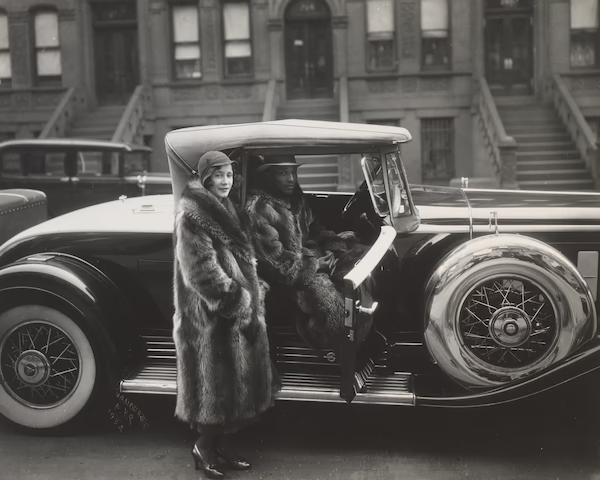
Despite racism, some African Americans found ways to achieve wealth and status. The photograph challenges stereotypes and shows that Black people were creating their own version of the American Dream. This photo represents the rare victories for Black Americans in which are not convered by _The Great Gatsby_.
[James Van Der Zee]: https://en.wikipedia.org/wiki/James_Van_Der_Zee
## Barriers to the American Dream
Another important writer of the Harlem Renaissance was [Claude McKay](https://en.wikipedia.org/wiki/Claude_McKay). His poem _The Barrier_ describes how racism prevents progress and personal relationships. McKay often wrote about racial injustice and the struggles of being Black in America.
###### _The Barrier_ by Claude McKay (1922)
> I must not gaze at them although
> Your eyes are dawning day;
> I must not watch you as you go
> Your sun-illumined way;
>
> I hear but I must never heed
> The fascinating note,
> Which, fluting like a river reed,
> Comes from your trembling throat;
>
> I must not see upon your face
> Love’s softly glowing spark;
> For there’s the barrier of race,
> You’re fair and I am dark.
The poem’s lines about racial separation, like “You’re fair and I am dark,” highlight how racism divides people. The poem shows how racism not only affects careers and rights but also personal connections and emotions. For African Americans, success wasn’t just about money, like Gatsby’s struggles with old vs. new wealth, it was about breaking down racial barriers in all parts of life.
## Afterword
With 50 years to date and many more to come, The Great Gatsby does not fully represent the Roaring Twenties as it might have you think. This doesn’t mean its a good read or should not be considered an American classic, but it just doesn't include unrepresented groups such as Black Americans which are covered here. Learning about the Harlem Renaissance gives us a better picture of this important decade in American history.
### Works Cited
1. Holiday, Billie. “Strange Fruit.” _The New York Times Web Archive_, 1939, [www.nytimes.com/books/first/m/margolick-fruit.html](https://archive.nytimes.com/www.nytimes.com/books/first/m/margolick-fruit.html).
2. Hughes, Langston. “Harlem.” _Poetry Foundation_, 1951, [www.poetryfoundation.org/poems/46548/harlem](https://www.poetryfoundation.org/poems/46548/harlem).
3. Hutchinson, George. “Harlem Renaissance.” _Encyclopedia Britannica_, 18 February 2025, [www.britannica.com/event/Harlem-Renaissance-American-literature-and-art](https://www.britannica.com/event/Harlem-Renaissance-American-literature-and-art).
4. McKay, Claude. “The Barrier.” _Lehigh University Scalar_, 1922, [scalar.lehigh.edu/mckay/the-barrier](https://scalar.lehigh.edu/mckay/the-barrier).
5. National Museum of African American History and Culture. “A New African American Identity: The Harlem Renaissance.” _National Museum of African American History and Culture_, 14 March 2018, [nmaahc.si.edu/explore/stories/new-african-american-identity-harlem-renaissance](https://nmaahc.si.edu/explore/stories/new-african-american-identity-harlem-renaissance).
6. VanDerZee, James. _Couple in Raccoon Coats_. 1932. MoMA, [www.moma.org/collection/works/180240](https://www.moma.org/collection/works/180240).