https://github.com/s4cha/plug
🔌 Plug implementation details for a cleaner Architecture on iOS
https://github.com/s4cha/plug
actions clean-architecture decoupling dependency-injection dependency-inversion di-container inversion-of-control ioc plug swift swinject use-case
Last synced: about 1 year ago
JSON representation
🔌 Plug implementation details for a cleaner Architecture on iOS
- Host: GitHub
- URL: https://github.com/s4cha/plug
- Owner: s4cha
- License: mit
- Created: 2017-03-04T08:10:41.000Z (over 9 years ago)
- Default Branch: master
- Last Pushed: 2020-02-12T15:34:22.000Z (over 6 years ago)
- Last Synced: 2025-04-11T03:59:29.318Z (about 1 year ago)
- Topics: actions, clean-architecture, decoupling, dependency-injection, dependency-inversion, di-container, inversion-of-control, ioc, plug, swift, swinject, use-case
- Language: Swift
- Homepage:
- Size: 35.8 MB
- Stars: 29
- Watchers: 4
- Forks: 1
- Open Issues: 1
-
Metadata Files:
- Readme: README.md
- License: LICENSE
Awesome Lists containing this project
README

# Plug
[](https://developer.apple.com/swift)

[](https://github.com/Carthage/Carthage)
[](https://app.bitrise.io/app/c6d3096518e622f3)
[](https://codebeat.co/projects/github-com-s4cha-plug-master)
[](https://github.com/freshOS/Arrow/blob/master/LICENSE)
[]()
[Reason](#why) - [Example](#example-project) - [Idea](#main-idea) - [Get Started](#get-started) - [Installation](#installation)
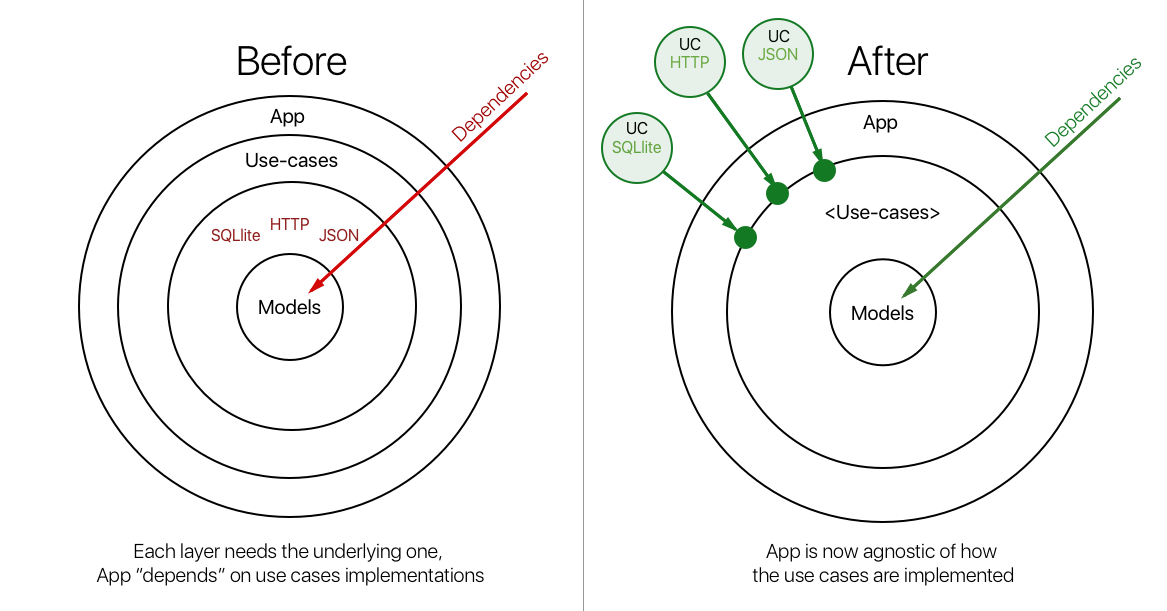
## Why
Because the **classic way** of building iOS Apps introduces **tight coupling**, often with the network layer. **Dependencies grow** and **code is harder to test.**
## How
By providing a **simple convention** on how to **cleanly plug implementations** in an iOS App. Developers spend **less time** architecting and more time **adding value for their users.**
## Benefits
- [x] Cleaner Architecture (think easier to maintain)
- [x] Faster build times
- [x] Less Dependencies (think Better Testability, & Faster tests)
- [x] Code 90% of the App without the backend implementation
## Example Project
Download and launch the `Example Project` to see how a Typical `LikePhoto` use case would be implemented using this approach.
## Main Idea
The **main idea** is that you want to **decouple your App from it's delivery mechanisms.**
Let me rephrases that for you in a classic iOS App context.
Your **ViewControllers should not know how an action is performed**. For instance when you like a photo, the controller should'nt know if it's going to send a `web request`, a `database command`, or even a `local request`.
The ONLY thing it should know is : "I want to like this photo"
This is based on **Robert-C Martin** (Uncle Bob) thoughts, the guy behind the **SOLID** principles. You can watch one of his terrific talks here :
https://skillsmatter.com/skillscasts/2437-uncle-bob-web-architecture
His examples are often written in Java, and the swift examples I came across were often Java directly translated into swift.
This is an **alternative approach** aiming at the **same goal**, but **leveraging swift awesomeness**.
## Get Started
### Action
The entire Approach is built on the concept of `Actions`.
An `Action` has an `Input` and an `Output`.
Here is what it looks like in swift :
```swift
public protocol IsAction {
associatedtype Input
associatedtype Output
func perform(_ input: Input) -> Output?
}
```
### Create Your Action
For instance in the case of liking a photo, the `LikePhoto` action has an input of `Photo` and an Output of `Promise`
A cool thing is that Output can be **synchronous or asynchronous**, it's yours to choose \o/.
Here is how our App defines the `LikePhoto` use-case :
```swift
class LikePhoto: Action> { }
```
### Call it
```swift
action(LikePhoto.self, Photo()).then {
// photo liked !
}
```
*Note : This uses dependency injection behind the hood to provide the concrete `LikePhoto` implementation at runtime*.
### Add some Model sugar
This phase is optional. But software is built for humans and we want this to be as readable as possible !
```swift
extension Photo {
func like() -> Promise {
return action(LikePhoto.self, self)
}
}
```
You can now like a photo like this:
```swift
photo.like().then {
// Photo liked \o/
}
```
### Providing A Concrete implementation
```swift
class MyLikePhoto: LikePhoto {
override func perform(_ input: Photo) -> Promise {
return network.post("/photos/\(input.identifier)/like")
}
}
```
### 🔌 Plug it !
We can now Inject this implementation in our App form the `AppDelegate` :
```swift
Actions.plug(LikePhoto.self, to: MyLikePhoto())
```
Or if you prefer the short version :
```swift
LikePhoto.self <~ MyLikePhoto()
```
All the `LikePhoto` actions of our App will now use our concrete Implementation preforming a network call :).
This is now super easy to provide a dummy `MockLikePhoto` for testing purposes!
## Sum Up
Using this approach we have:
- A `Type-Safe` way to decouple and inject actions in our App.
- A clean and readable way to call actions on models.
## Installation
#### Swift Package Manager
```swift
https://github.com/s4cha/Plug
```
#### Carthage (Deprecated)
```
github "s4cha/Plug"
```
## Swift Version
Swift 3 -> version **0.2.0**
Swift 4 -> version **0.3.0**
Swift 4.2 -> version **1.0.0**
Swift 5.0 -> version **1.1.0**
Swift 5.1 -> version **1.1.1**
Swift 5.1.3 -> version **1.1.2**