https://github.com/sarthakjshetty/fracture
Vision Based Inspection tool comprising of retrained Inception V3 network and OpenCV Filters for fracture detection. Published at A2IC 2019.
https://github.com/sarthakjshetty/fracture
computer-vision image-processing inceptionv3 opencv python
Last synced: 12 months ago
JSON representation
Vision Based Inspection tool comprising of retrained Inception V3 network and OpenCV Filters for fracture detection. Published at A2IC 2019.
- Host: GitHub
- URL: https://github.com/sarthakjshetty/fracture
- Owner: SarthakJShetty
- Created: 2018-06-07T07:42:12.000Z (about 8 years ago)
- Default Branch: master
- Last Pushed: 2019-06-19T05:18:42.000Z (about 7 years ago)
- Last Synced: 2025-04-23T05:41:31.669Z (about 1 year ago)
- Topics: computer-vision, image-processing, inceptionv3, opencv, python
- Language: Python
- Homepage:
- Size: 943 KB
- Stars: 11
- Watchers: 3
- Forks: 9
- Open Issues: 0
-
Metadata Files:
- Readme: README.md
Awesome Lists containing this project
README
# Fracture
Building a Computer Vision based tool for detecting fractures and fatiguing in mechanical components.
### :warning: Code is buggy :warning:
### Introduction:
- This project aims to develop a tool for identifying fractures and fissures in a mechanical component.
- The tool makes use of OpenCV and TensorFlow. OpenCV is used to visually detect the presence of the fracture and TensorFlow is used to predict the presence of fractures.
Note: Most of the TensorFlow code has been pulled from the TensorFlow repository sans a few changes.
- Paper on the approach & results presented at the Artificial Intelligence International Conference in Barcelona is available on arXiv here!
### Overview of model:
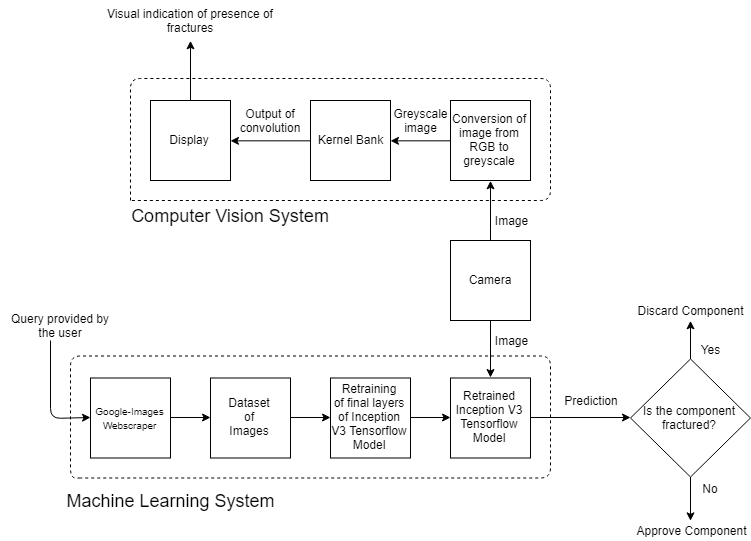
Fig 1. Block diagram of pipeline
### Working:
1. A image is sent to the OpenCV code which runs it through a series of "Kernels", which include:
- Sobel-X
- Sobel-Y
- Small Blur
- Large Blur
- Sharpen
- Laplacian
2. The OpenCV code serves as a detector for fractures and relays it to the operator.
3. The image is then passed to the ```label_image.py``` [script](https://github.com/SarthakJShetty/Fracture/blob/master/label_image.py), which predicts whether the object is classified as fractured or not.
4. A ```retrain.py``` [script](https://github.com/SarthakJShetty/Fracture/blob/master/retrain.py) code is provided which is trained on the dataset of images.
5. A webscraper has been developed which scrapes Google Images for the images to build your dataset (yet to be developed).
#### Usage:
1. Clone the repository:
```git clone https://github.com/SarthakJShetty/Fracture.git```
2. Using the webscraper, scrape images from Google Images to build your dataset.
Usage: ```python webscraper.py --search "Gears" --num_images 100 --directory /path/to/dataset/directory```
Note: Make sure that both categories of images are in a common directory.
Credits: This webscraper was written by genekogan. All credits to him for developing the scrapper.
3. Retrain the final layers of Inception V3, to identify the images in the new dataset.
Usage: ```python retrain.py --image_dir path/to/dataset/directory --path_to_files="project_name"```
Note: The ```path_to_files``` creates a new file ```project_name``` under the ```tmp``` folder, and stores retrain logs, bottlenecks, checkpoints for the project here.
4. The previous step will cause logs and graphs to be generated during the training, and will take up a generous amount of space. We require the labels, bottlenecks and output graphs generated for the ```Labeller.py``` script.
5. We can now use ```Labeller.py``` to identify the whether the given component is defective or not.
Usage: ```python Labeller.py --graph=path/of/tmp/file/generated/output_graph.pb --labels=path/of/tmp/file/project_name/generated/labels.txt --output_layer=final_result```
6. The above step triggers the ```VideoCapture()``` function, which displays the camera feed. Once the specimen is in position, press the Q button on the keyboard, the script will retain the latest frame and pass it onto the ```Labeller.py``` and ```Kerneler.py``` programs.
#### Results of Kerneler:
- **Laplacian Kernel:**
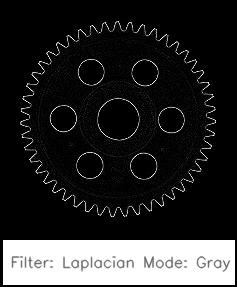
Fig 2. Result of Laplacian Kernel
- **Sharpen:**
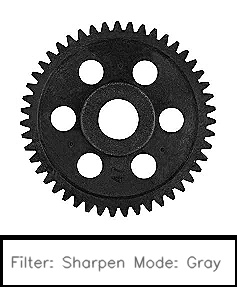
Fig 3. Result of Sharpening Kernel
- **Sobel X:**
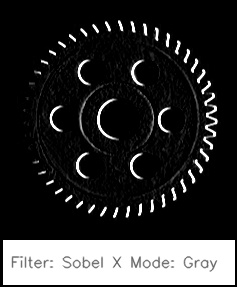
Fig 4. Result of Sobel-X Kernel
- **Sobel Y:**
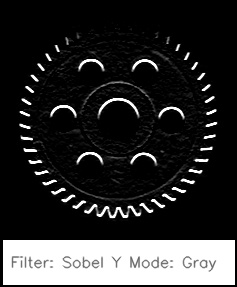
Fig 5. Result of Sobel-Y Kernel
#### Results of TensorFlow model:
- **Prediction 1:**

Fig 6. Prediction 1 made by model
- **Prediction 2:**

Fig 7. Prediction 2 made by model
- **Train accuracy:**
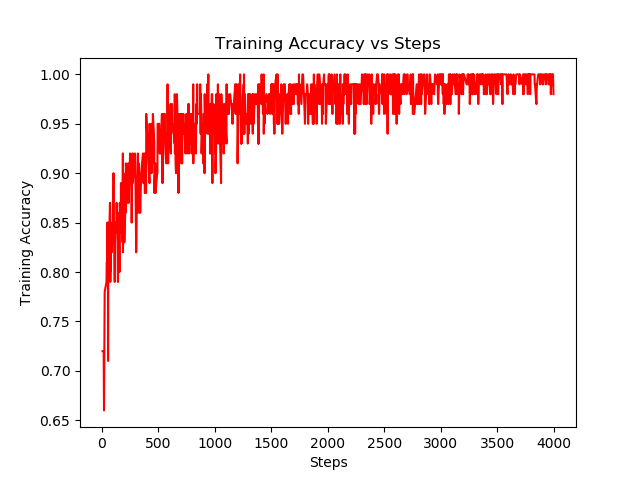
Fig 8. Training Accuracy vs Steps
- **Validation accuracy:**
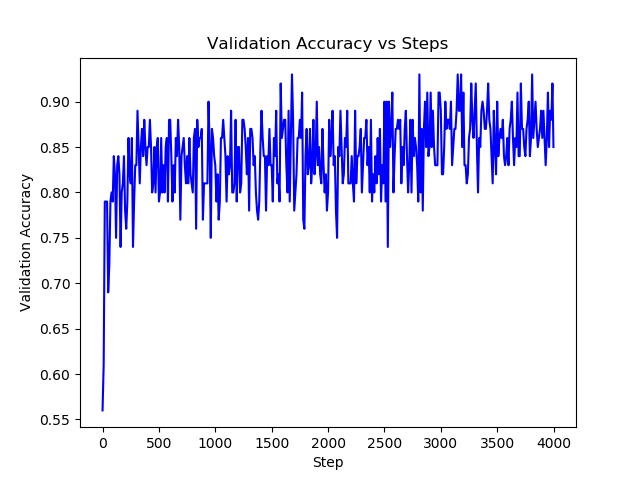
Fig 9. Validation Accuracy vs Steps
- **Cross-entropy (Training):**
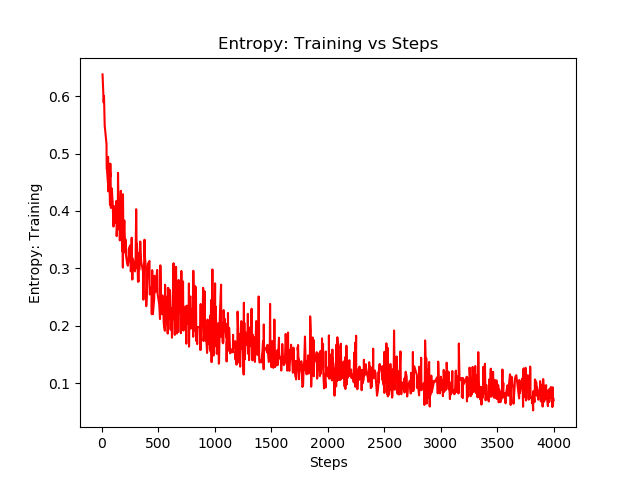
Fig 10. Training Entropy vs Steps
- **Cross-entropy (Validation):**
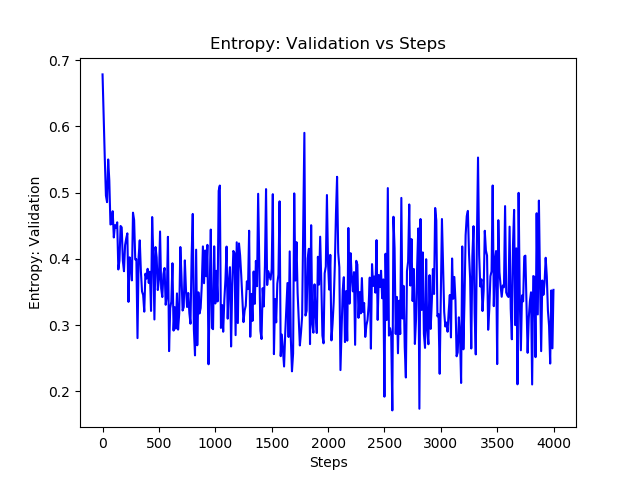
Fig 11. Validation Entropy vs Steps