https://github.com/sayed3li97/skillscore
Lint and score any AI agent SKILL.md against the official Claude, Codex, and Antigravity authoring guides — offline Dart CLI.
https://github.com/sayed3li97/skillscore
agent-skills agentic ai-agents antigravity claude claude-code cli code-quality codex cursor dart developer-tools gemini-cli linter prompt-engineering sarif skill skill-md static-analysis
Last synced: 7 days ago
JSON representation
Lint and score any AI agent SKILL.md against the official Claude, Codex, and Antigravity authoring guides — offline Dart CLI.
- Host: GitHub
- URL: https://github.com/sayed3li97/skillscore
- Owner: sayed3li97
- License: apache-2.0
- Created: 2026-06-12T17:20:05.000Z (about 1 month ago)
- Default Branch: main
- Last Pushed: 2026-07-05T20:48:41.000Z (17 days ago)
- Last Synced: 2026-07-05T22:10:56.743Z (17 days ago)
- Topics: agent-skills, agentic, ai-agents, antigravity, claude, claude-code, cli, code-quality, codex, cursor, dart, developer-tools, gemini-cli, linter, prompt-engineering, sarif, skill, skill-md, static-analysis
- Language: Dart
- Size: 9.88 MB
- Stars: 4
- Watchers: 0
- Forks: 0
- Open Issues: 0
-
Metadata Files:
- Readme: README.md
- Changelog: CHANGELOG.md
- Contributing: CONTRIBUTING.md
- License: LICENSE
- Code of conduct: CODE_OF_CONDUCT.md
- Citation: CITATION.cff
- Security: SECURITY.md
Awesome Lists containing this project
README
# skillscore
[](https://github.com/sayed3li97/skillscore/actions/workflows/ci.yml)
[](https://pub.dev/packages/skillscore)
[](https://marketplace.visualstudio.com/items?itemName=sayed-ali-alkamel.skillscore)
[](https://open-vsx.org/extension/sayed-ali-alkamel/skillscore)
[](LICENSE)
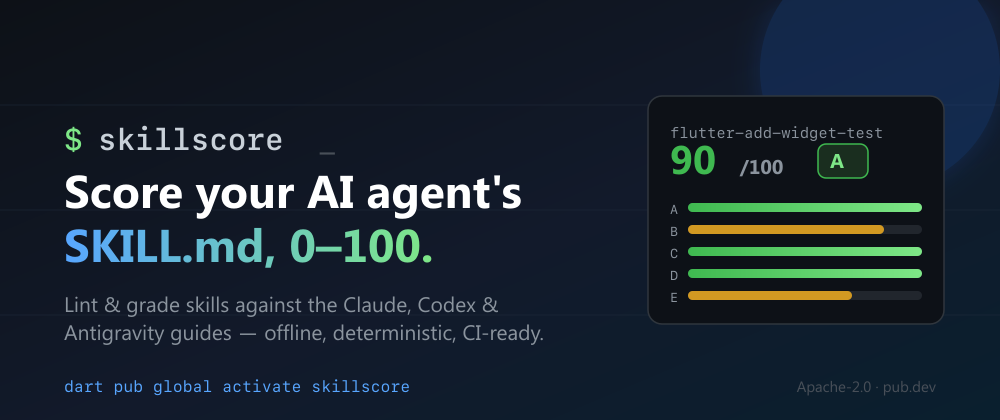
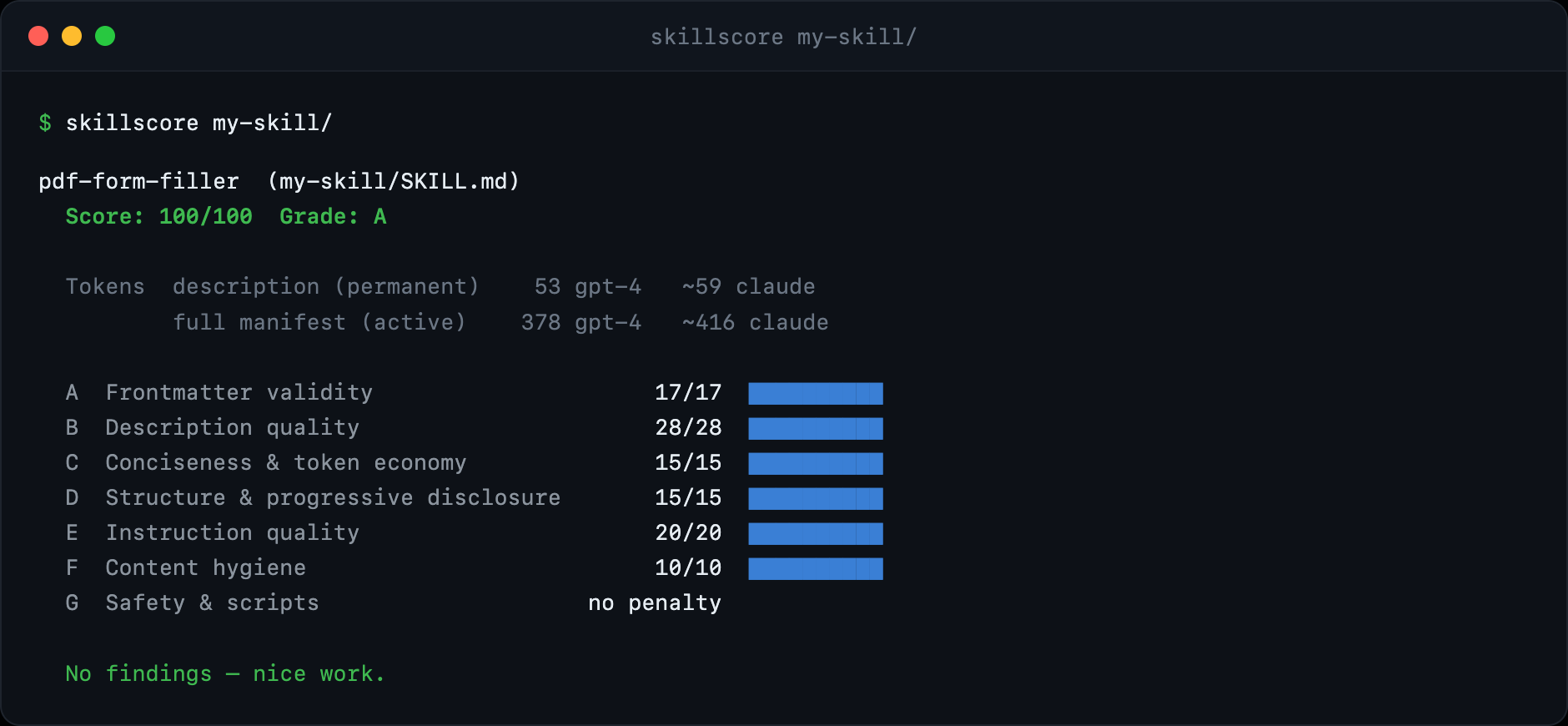
**skillscore** statically analyzes any AI agent skill (a `SKILL.md` manifest and its folder) and produces a **0 to 100 quality score**, a **letter grade**, and a list of **actionable findings**, scored against the official skill-authoring guides from **Anthropic (Claude)**, **Google (Antigravity)**, and **OpenAI (Codex)**. It is offline, deterministic, and built for CI.
## What is skillscore?
skillscore is a **skill linter, `SKILL.md` validator, and agent-skill quality checker**. Agent skills are an open standard: a folder with a `SKILL.md` (YAML frontmatter plus a Markdown body) and optional `references/`, `examples/`, `scripts/`, and `assets/` subfolders, used by Claude Code, Codex, Antigravity, Gemini CLI, and Cursor.
Because an agent keeps every skill's `name` and `description` in its context budget permanently, **a vague or malformed skill is worse than no skill**. skillscore catches exactly those problems before a skill ships, and it never leaves your machine.
## How it works
A manifest goes in, a score comes out. Every step runs locally.
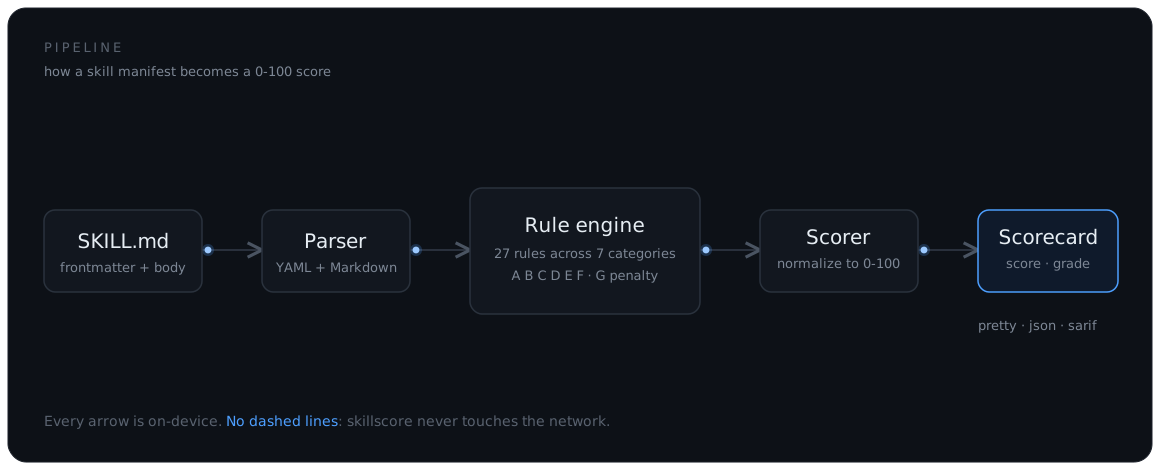
The parser reads the frontmatter and body, the rule engine runs 26 checks grouped into 7 categories, and the scorer normalizes the result to a 0 to 100 score with a letter grade. There is no network call anywhere in that path.
## Quickstart
```bash
# Install
dart pub global activate skillscore
# Score a single skill (any name, any location)
skillscore path/to/SKILL.md
# Score every skill in a folder or monorepo
skillscore path/to/skills/
# Score several specific skills in one command
skillscore skill-a/ skill-b/ skill-c/
# Pick a target ruleset
skillscore my-skill/ --target claude
# Machine-readable output for CI and dashboards
skillscore my-skill/ --format json
# Gate CI: fail the build if any skill scores below 80
skillscore skills/ --min-score 80
```
## Scoring, and the rubric
100 points, seven categories, each rule tagged with the authoring guide it comes from.
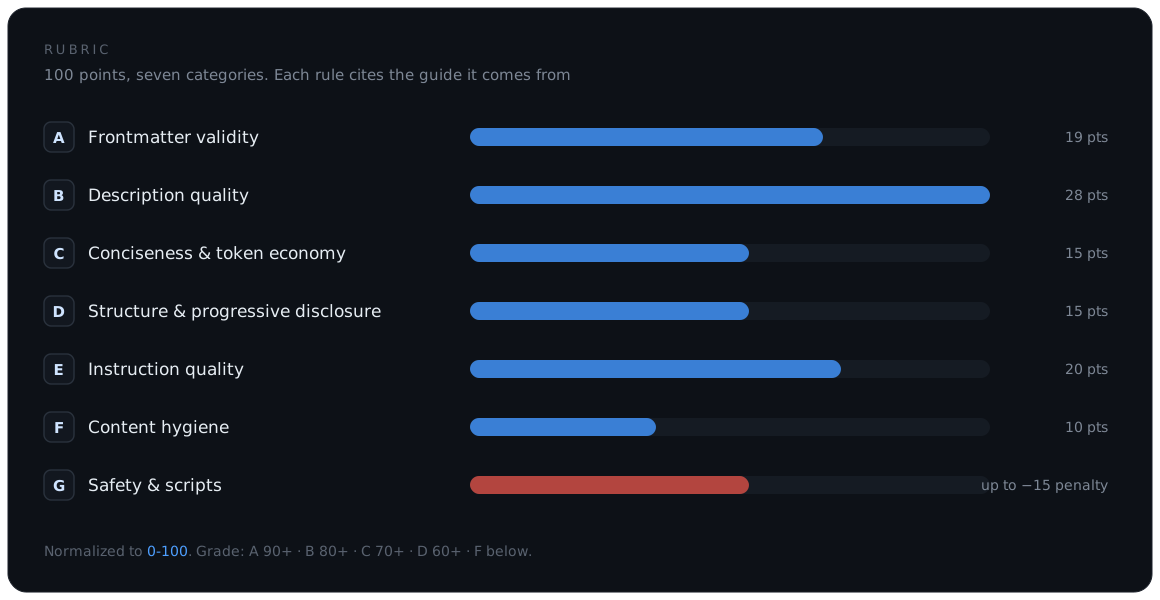
Each rule awards full, partial, or zero points. Category G (safety) is a **penalty** of up to `-15` that applies only when a skill ships scripts or terminal commands. Profiles that exclude a rule (for example `--target claude` excludes the Codex-specific B4) are normalized back to a 0 to 100 scale, so scores stay comparable across targets.
**Grades:** A is 90 and up, B is 80 and up, C is 70 and up, D is 60 and up, F is below 60.
The full rubric (all 26 rules)
| Rule | Title | Pts | Severity | Targets | Source |
|---|---|---|---|---|---|
| `A1_frontmatter_present` | YAML frontmatter delimited by `---` | 4 | error | all | Anthropic |
| `A2_name_format` | `name` at most 64 chars, lowercase / digits / hyphens | 4 | error | all | Anthropic |
| `A3_name_reserved_words` | `name` avoids "anthropic" and "claude" | 3 | error (claude) / info | all | Anthropic |
| `A4_description_present` | `description` present, at most 1024 chars | 4 | error | all | Anthropic |
| `A5_frontmatter_keys` | Only recognized keys, no typos ("did you mean") | 2 | warning | all | Anthropic |
| `B1_description_what` | States WHAT (opens with an action verb) | 6 | warning | all | Anthropic |
| `B2_description_when` | States WHEN ("use when ...") | 6 | warning | all | Anthropic |
| `B3_third_person` | Written in third person | 5 | warning | all | Anthropic |
| `B4_frontloaded_triggers` | Concrete keywords in the first 60 chars | 4 | warning | codex, universal | Codex |
| `B5_boundary_clause` | Has a "do not use" boundary | 4 | warning (antigravity) / info | antigravity, universal | Antigravity |
| `B6_description_truncation` | Self-contained within 250 chars (Claude routing) | 3 | warning | claude, universal | Anthropic |
| `C1_body_length` | Body at most 500 lines (linear to 0 at 1000) | 6 | warning | all | Anthropic |
| `C2_explainer_bloat` | No definitions of common knowledge | 5 | warning | all | Anthropic |
| `C3_excessive_optionality` | No long "or" chains | 4 | info | all | Anthropic |
| `D1_progressive_disclosure` | Depth split into references / examples | 5 | info | all | Anthropic |
| `D2_one_level_links` | Reference links one level deep | 5 | warning | all | Anthropic |
| `D3_reference_toc` | Long reference files have a TOC | 5 | info | all | Anthropic |
| `E1_anti_patterns` | States anti-patterns explicitly | 6 | warning | all | Flutter |
| `E2_workflow_checklist` | Checklist or numbered workflow | 5 | warning | all | Anthropic |
| `E3_feedback_loop` | Validate, fix, repeat loop | 5 | warning | all | Anthropic |
| `E4_code_example` | At least one fenced code example | 4 | warning | all | Anthropic |
| `F1_time_sensitive` | No date-anchored statements that rot | 4 | warning | all | Anthropic |
| `F2_forward_slashes` | Paths use forward slashes only | 3 | error | all | Anthropic |
| `F3_consistent_terminology` | No synonym mixing (conservative) | 3 | info | all | Anthropic |
| `G1_safety_section` | Scripts / commands need a Safety section | -8 | error | antigravity, universal | Antigravity |
| `G2_script_docs` | Bundled scripts are documented | -7 | warning | all | Anthropic |
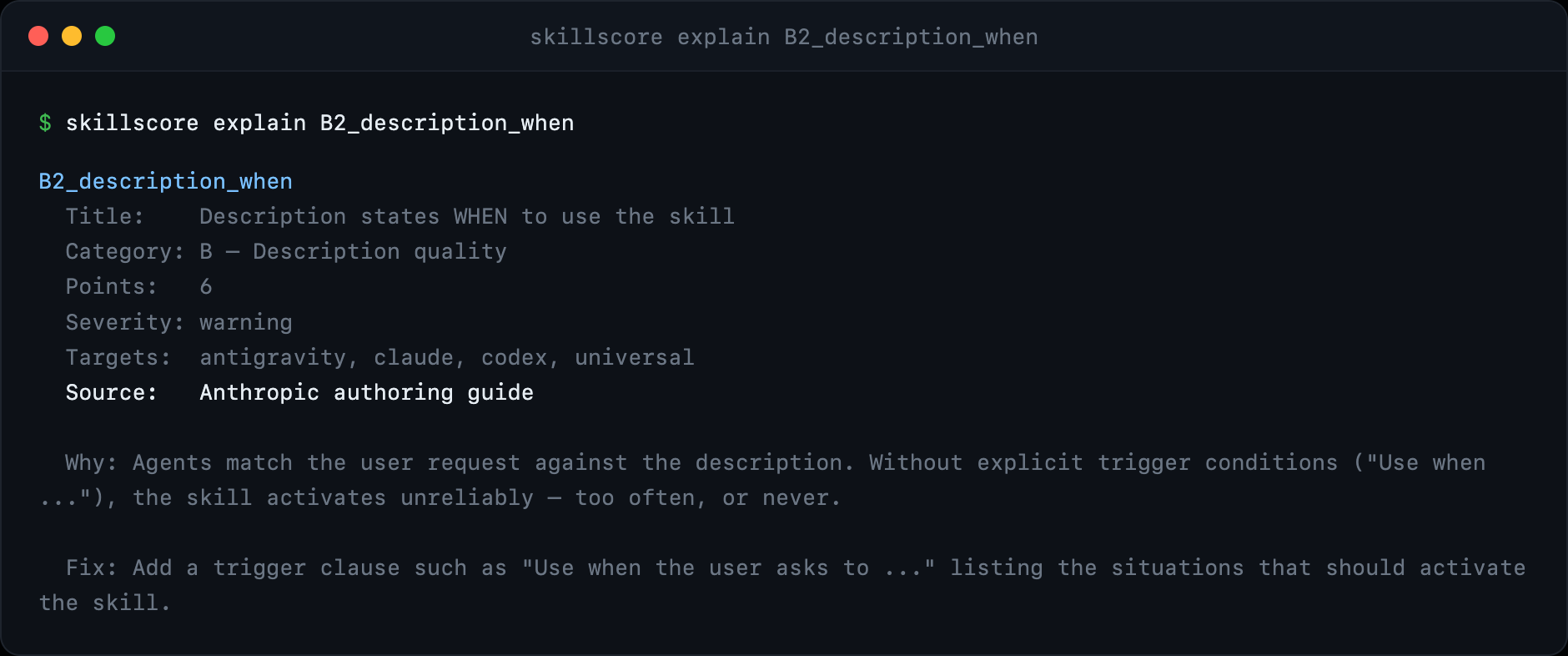
Run `skillscore rules` for the live table, or `skillscore explain ` for any rule's rationale, fix, and source.
Every finding cites the guide it comes from, and `skillscore explain` prints the rationale and the fix:
## One manifest, four guides
The same `SKILL.md` can be scored through four different authoring guides. Pick a lens with `--target`; the default `universal` is the union of all of them.
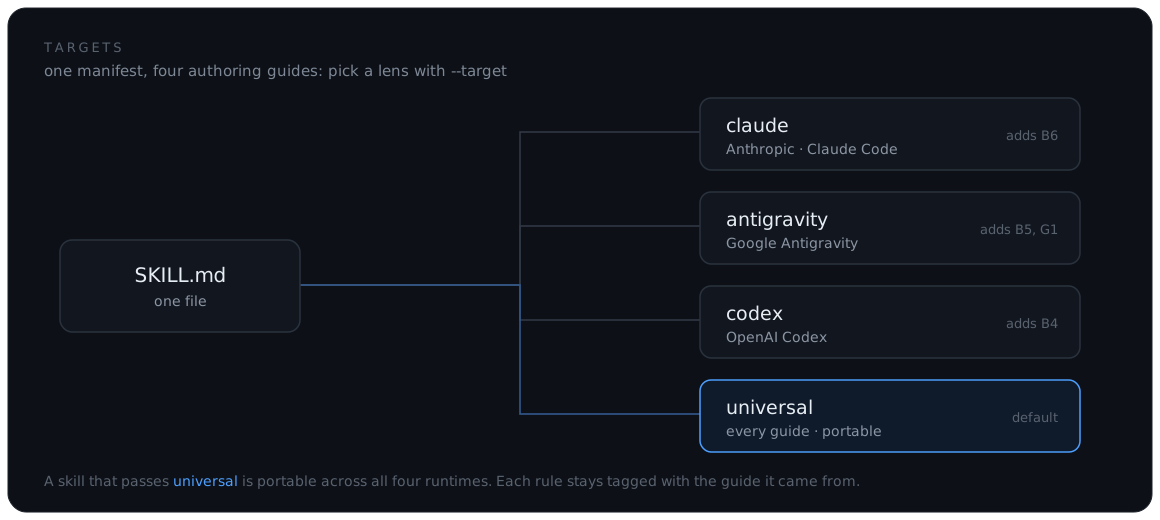
A skill that passes `universal` is portable across all four runtimes, because `universal` activates every guide's rules at once. Each rule stays tagged with its origin, so a finding always tells you which guide it comes from.
## Scoring a whole monorepo
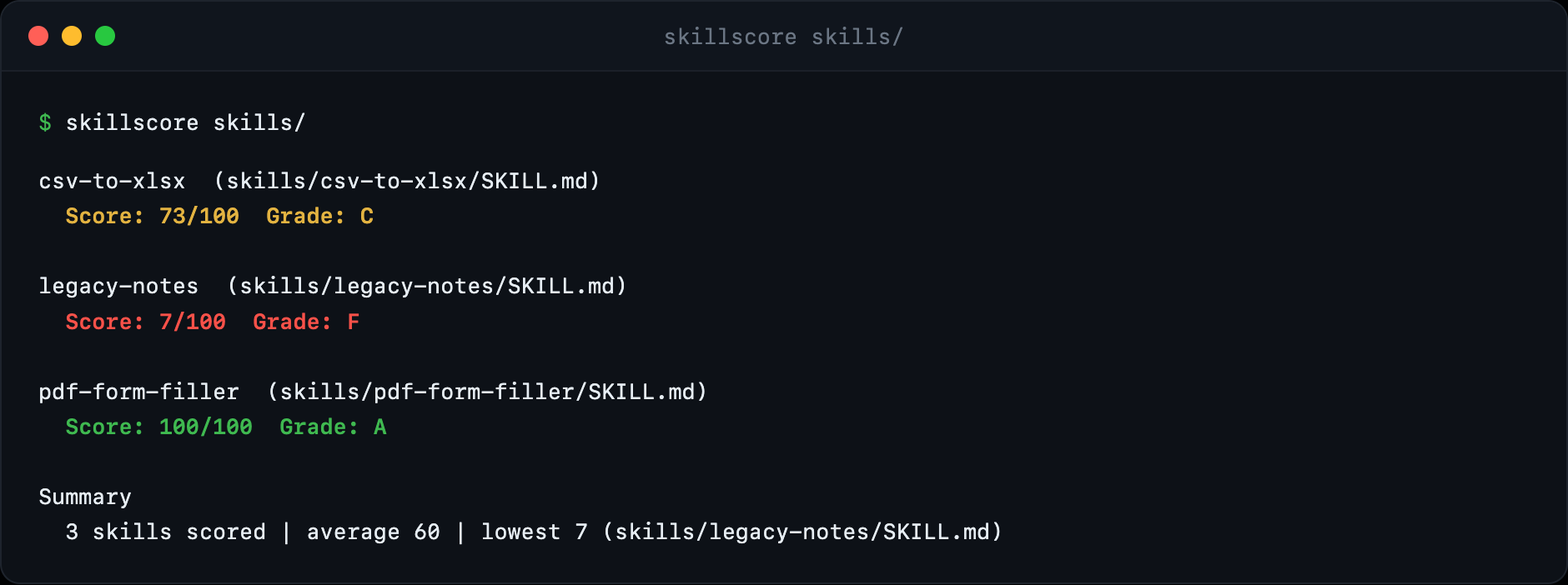
Pass a folder or several paths and skillscore walks the tree, finds every `SKILL.md` (case-insensitive), scores each one, and prints a summary. Overlapping paths are deduplicated; if one path is bad, the rest still score and the bad one is reported as a warning.
## Token budget
Every scorecard shows the BPE token cost of a skill, split by the two scopes in which agent runtimes load `SKILL.md` content:
```text
Tokens description (permanent) 67 gpt-4 ~74 claude
full manifest (active) 1474 gpt-4 ~1622 claude
```
**Permanent** is the per-prompt cost: the agent loads the `description` field on every call so it knows which skills exist. **Active** is the per-invocation cost, paid only when the agent decides to use the skill.
Counts use the **cl100k_base** BPE vocabulary (exact for GPT-4 and Codex). The Claude estimate adds a calibrated 10% overhead, and it appears in `--format json` under a `tokens` key for dashboards and CI.
Validated against the Anthropic count_tokens API
The 10% Claude estimate was checked against the official Anthropic `count_tokens` API across all 31 skills in [google/skills](https://github.com/google/skills):
| Metric | Value |
|---|---|
| Skills validated | 31 (all of google/skills) |
| Mean actual Claude overhead vs cl100k | +10.2% |
| Median | +10.0% |
| Range | +0% to +20% (varies with keyword density) |
Descriptions dense with trigger keywords run toward +18 to +20%; clean prose runs toward 0 to 6%.

## Catching frontmatter typos (rule A5)
The `SKILL.md` frontmatter is a fixed set of keys (`name`, `description`, `license`, `allowed-tools`, `metadata`, `version`), and YAML gives you no protection when you misspell one. Write `descrption:` and YAML happily accepts it as an unknown field while the real `description` goes *missing*. The skill still loads, but with empty metadata it is invocable only by name and is **never auto-triggered**. Strict validators, including Anthropic's own `skill-creator`, reject any unexpected key outright.
Rule **`A5_frontmatter_keys`** catches this. It flags every top-level key outside the recognized set, and when the key is a near-miss for a real one (within an edit distance of two) it tells you which key you meant:
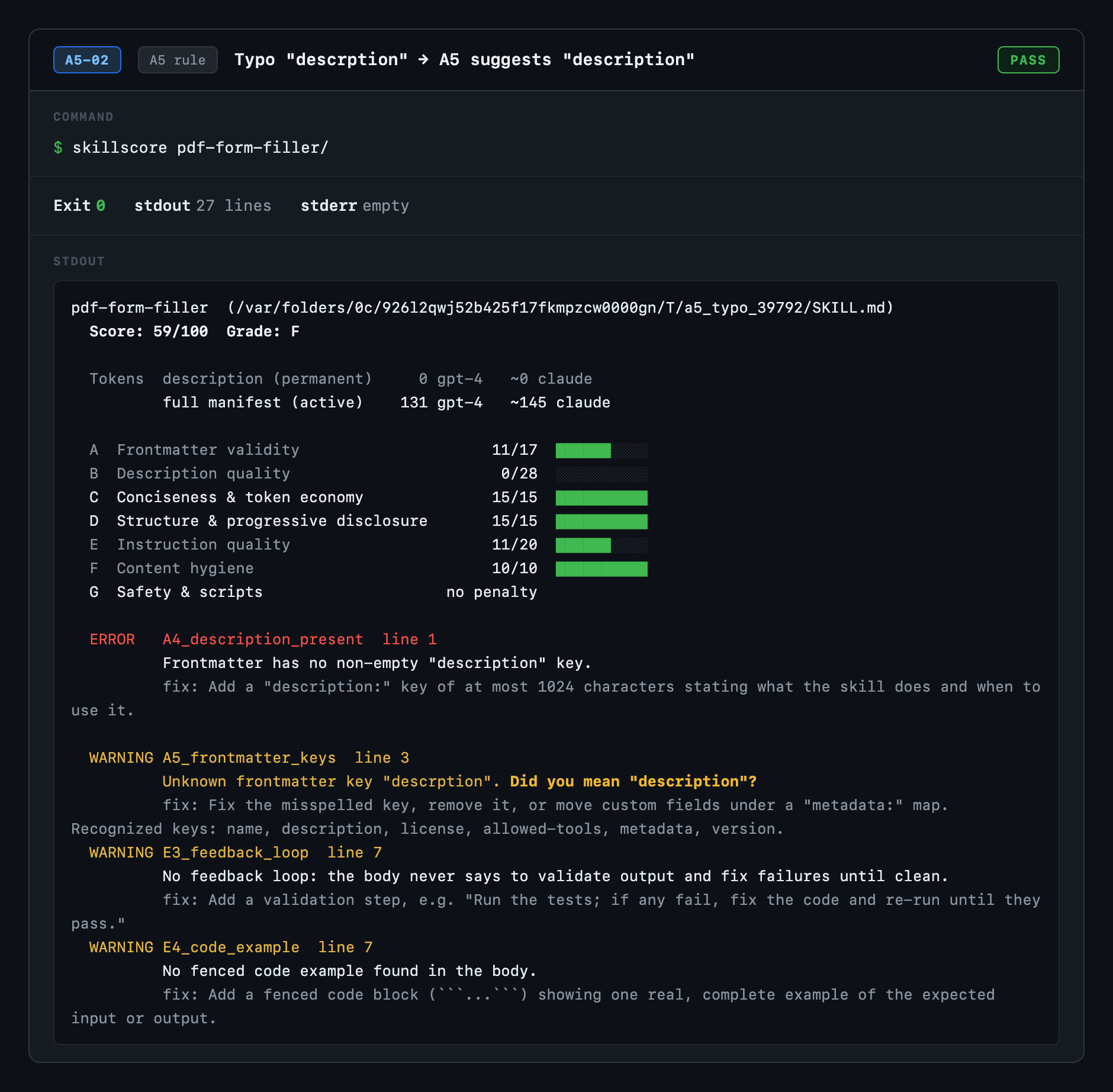
The two findings together tell the whole story: `A4` reports the field is gone, and `A5` points at the typo that swallowed it. Design details:
- **Custom fields are welcome, under `metadata`.** Only top-level keys are checked, so anything nested inside a `metadata:` map is yours to name freely and is never flagged.
- **No false suggestions.** A genuinely unrecognized key such as `author` is flagged without a misleading "did you mean", because it is not close to any real key. (Move it under `metadata`.)
- **No double-counting.** When the frontmatter is missing or malformed entirely, `A5` stays silent and lets `A1` own that failure.
- **Fully offline and deterministic.** The "did you mean" suggestion is a local Levenshtein comparison. No network, no model.
A full QA record for this rule, every case run against the compiled binary with screenshot evidence, lives in [`docs/qa/a5/`](docs/qa/a5/REPORT.md).
### Fix it automatically with `--fix`
When a finding has a safe, mechanical correction, skillscore marks it `[fixable]` and can apply it in place. A misspelled key is the first such fix: `skillscore --fix` renames `descrption:` to `description:`, then re-scores so the report and the exit code reflect the corrected file.
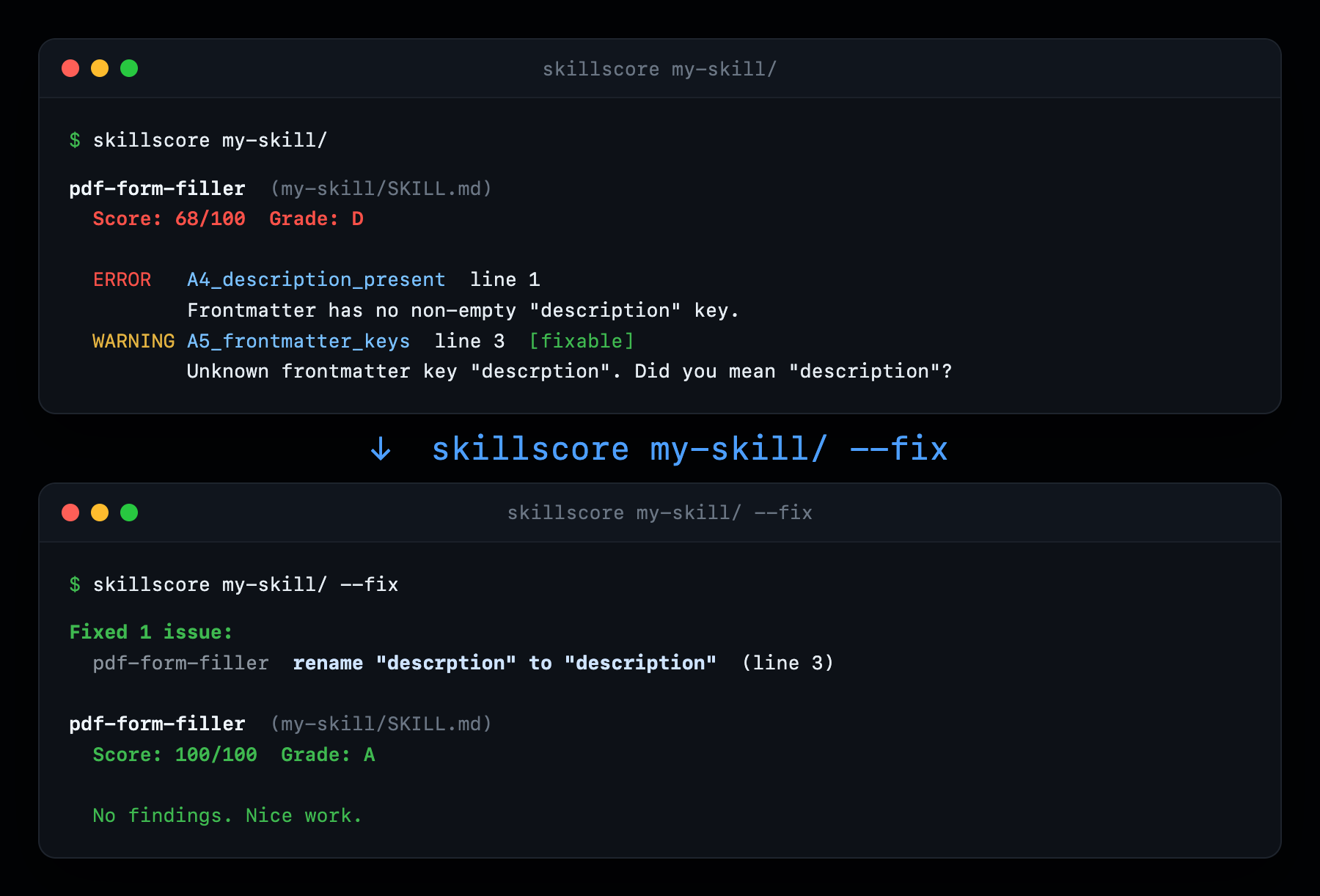
One typo drops the skill to a D (the real `description` is missing, so the description rules all fail); `--fix` recovers it to a perfect A. The fix is deterministic and idempotent, preserves your line endings, and only ever touches a key that has a confident "did you mean" match. Keys with no near match (move them under `metadata` yourself) are left untouched, never guessed at.
## Eval harness
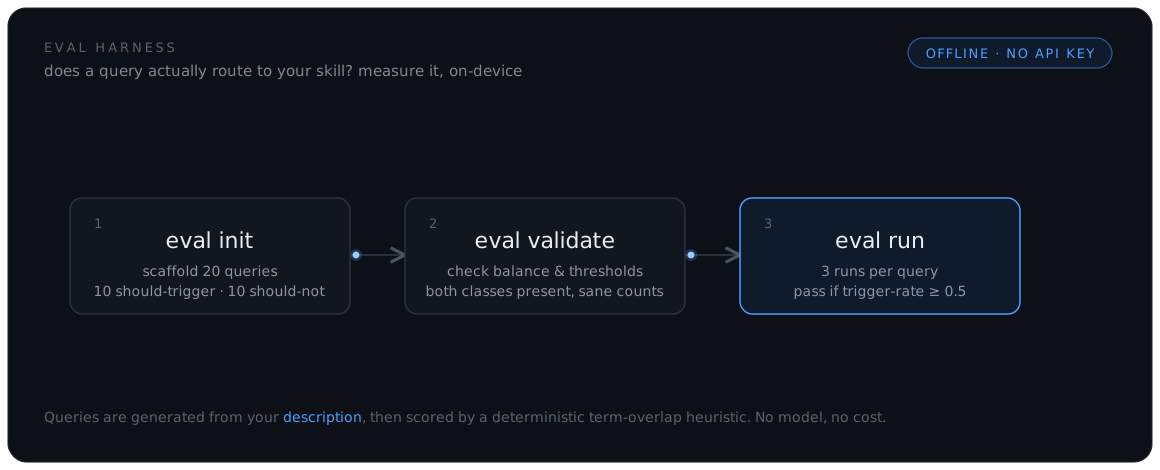
Static linting tells you a skill is well-formed. The eval harness tells you **whether queries actually route to it**, the thing that matters once a skill is deployed. Three commands, one workflow, no API key.
```bash
# 1. Scaffold 20 queries from the skill's description
skillscore eval init my-skill/
# 2. Review and extend the generated queries
cat my-skill/evals.json
# 3. Run the eval, fully offline, no API key, no cost
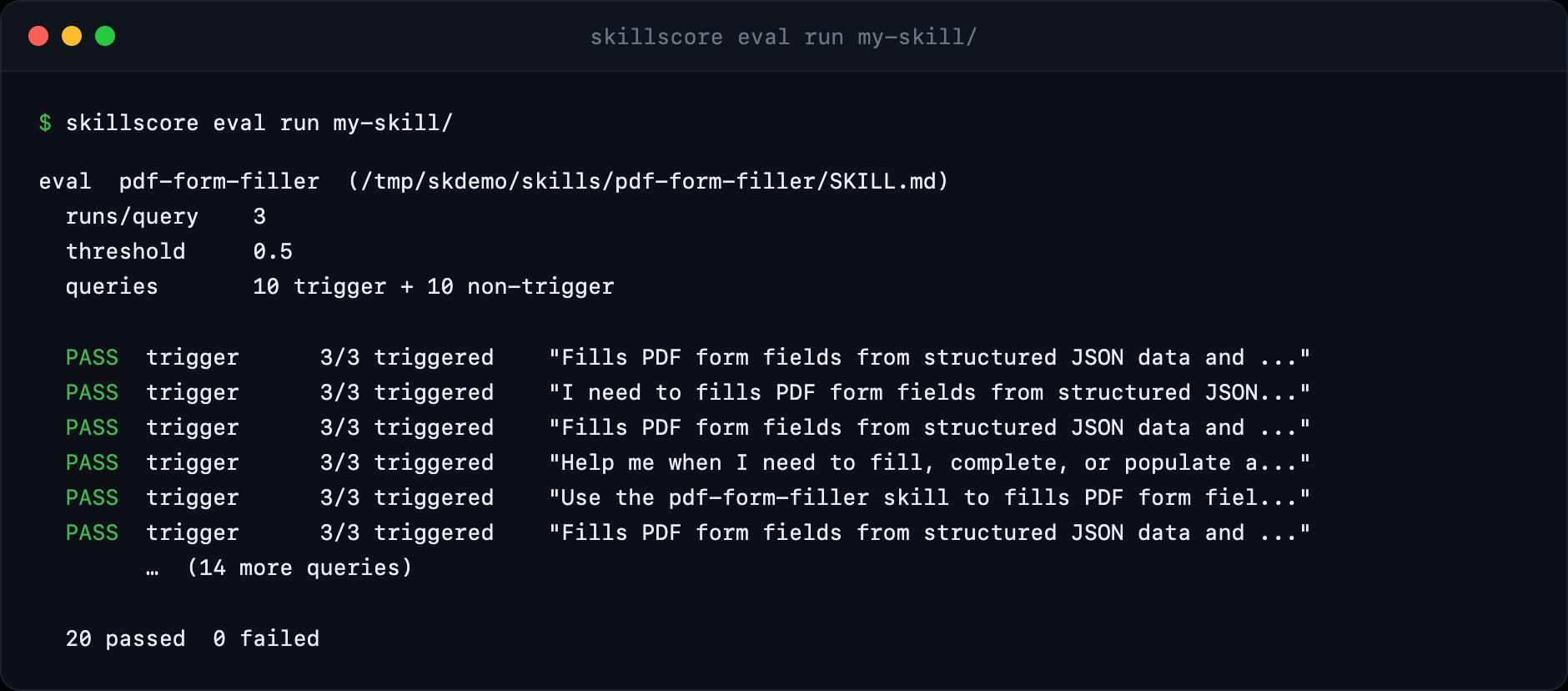
skillscore eval run my-skill/
```
`eval init` reads the `description` and derives 20 queries: 10 that should trigger the skill and 10 that should not. `eval validate` checks the suite has both classes and sane thresholds. `eval run` scores each query 3 times and passes it when the trigger-rate clears (or, for non-trigger queries, stays under) the 0.5 threshold.
How the offline scoring heuristic works
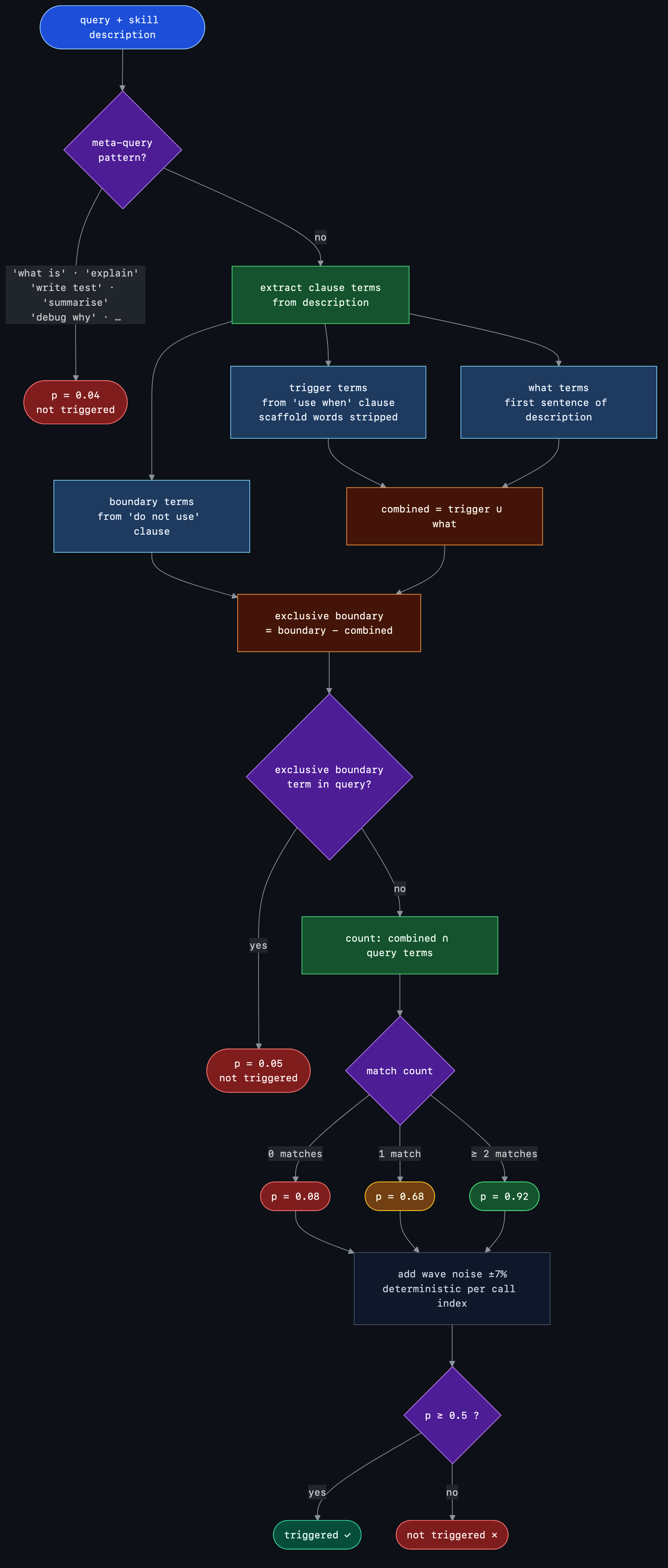
`eval run` uses a **local heuristic**, no model call and no network. It scores each query by matching content words against three regions pulled from the `description`:
| Region | Source | Role |
|---|---|---|
| **Trigger terms** | the "Use when ..." clause, scaffold words stripped | what activates the skill |
| **Boundary terms** | the "Do not use ..." clause | what the skill excludes |
| **What terms** | the first sentence of the description | the skill's primary capability |
All text is lowercased, tokenized, stop-word filtered, and suffix-stemmed before comparison.
**Boundary exclusivity.** A boundary term penalizes a query only when it does not also appear in the trigger or what regions. This stops a shared noun (for example `pdf` in "Do not use for scanned PDFs") from falsely blocking a trigger query that legitimately mentions the same noun.
**Wave noise.** A small deterministic offset cycles through roughly plus or minus 7% across successive calls, so a borderline query may trigger on two runs of three and not the other, modeling the natural variance of a real model.
**What PASS and FAIL mean.** A trigger query passes when its triggered count is at least `trigger_threshold x runs_per_query` (default 2 of 3); a non-trigger query passes when it stays below that. The heuristic measures textual alignment with the skill's declared intent, not live model routing, so use it to catch obvious description problems early.
## Output formats and CI
Three renderers, one flag. `pretty` (the default) is the colored scorecard; `json` is a stable machine shape for dashboards; `sarif` is a valid SARIF 2.1.0 document that GitHub code scanning renders as inline PR annotations.
```yaml
# .github/workflows/skills.yml
- name: Lint agent skills
run: |
dart pub global activate skillscore
skillscore skills/ --min-score 80 --no-color
```
`--min-score` fails the build when any skill scores below the threshold, `--strict` promotes warnings to failures, and the exit codes are designed for pipelines: `0` all good, `1` a quality gate failed, `2` a usage error.
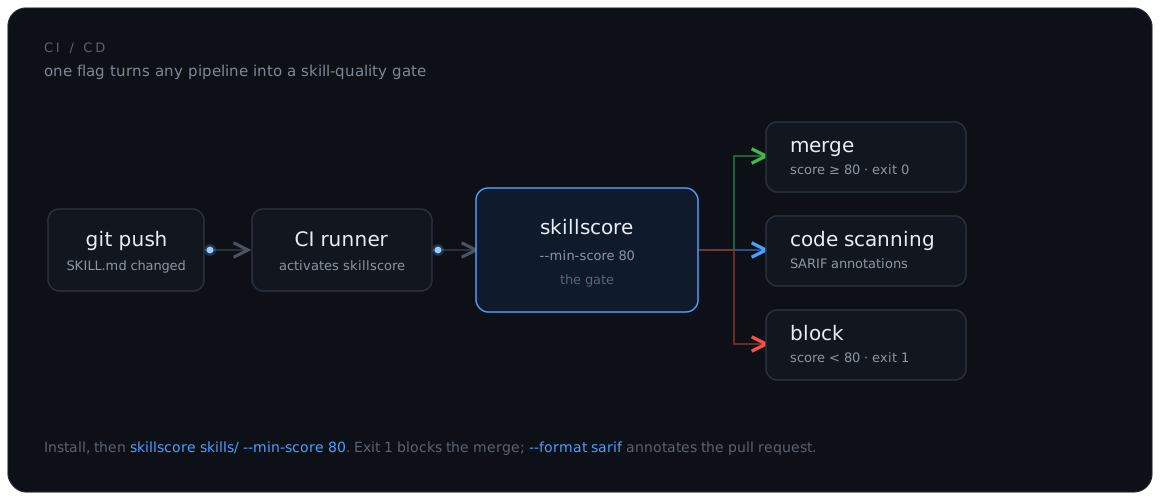
The same three steps drop into any runner. The **[CI/CD guide](docs/ci/README.md)** has copy-paste configs for ten platforms (GitHub Actions, GitLab CI, CircleCI, Jenkins, Azure Pipelines, Bitbucket, Travis, Drone, Google Cloud Build, and pre-commit), a reusable GitHub Action (`uses: sayed3li97/skillscore@v1`), a pre-commit hook, and a container image, with a real GitHub Actions run and its SARIF findings in the Security tab.
## Commands and flags
```text
skillscore [ ...] Score one or more manifests, folders, or trees
skillscore rules List every rule: id, points, severity, targets, source
skillscore explain Print a rule's rationale, the fix, and its source guide
skillscore eval init Scaffold evals.json from the skill's description
skillscore eval validate Validate and summarize evals.json
skillscore eval run Run trigger-rate evals offline (no API key)
skillscore --version
skillscore --help
```
| Flag | Values | Default | Purpose |
|---|---|---|---|
| `--target` | `claude` \| `antigravity` \| `codex` \| `universal` | `universal` | Which guide's ruleset to apply |
| `--format` | `pretty` \| `json` \| `sarif` | `pretty` | Output format (SARIF renders in code-review tools) |
| `--min-score ` | 0 to 100 | unset | Exit non-zero if any skill scores below `n` |
| `--fix` | flag | off | Apply safe auto-fixes in place (rename a misspelled key), then re-score |
| `--strict` | flag | off | Treat warning-level findings as failures |
| `--quiet` | flag | off | Print only the score line per skill |
| `--no-color` | flag | off | Disable ANSI colors |
**Exit codes:** `0` every skill met the gate. `1` a skill is below `--min-score`, or `--strict` found an error or warning, or an eval run failed. `2` a usage error (bad path, unreadable file, unknown rule, invalid flag).
## Editor integration
Prefer to score inside your IDE? The **[Skillscore VS Code extension](https://github.com/sayed3li97/skillscore-vscode)** wraps this CLI and adds inline diagnostics, hover tooltips with the fix and rule id, a sidebar score panel, and a live status-bar indicator. It works in VS Code, Antigravity IDE, VSCodium, and Cursor.
Install from the [VS Marketplace](https://marketplace.visualstudio.com/items?itemName=sayed-ali-alkamel.skillscore) or [Open VSX](https://open-vsx.org/extension/sayed-ali-alkamel/skillscore).
## Library use
skillscore is also a Dart library:
```dart
import 'package:skillscore/skillscore.dart';
void main() {
final doc = SkillParser().parseFile('my-skill/SKILL.md');
final result = Scorer(RuleRegistry()).score(doc, Target.universal);
print('${result.score}/100 ${result.grade}');
}
```
## FAQ
**What is an agent skill?**
A folder with a `SKILL.md` manifest (YAML frontmatter plus Markdown instructions) that teaches an AI agent a repeatable task. Optional subfolders hold references, examples, scripts, and assets.
**Does it work with Claude Code, Codex, Antigravity, Gemini CLI, and Cursor?**
Yes. They share the `SKILL.md` format. Score against one vendor's rules with `--target`, or use the default `universal` profile that a portable skill should pass everywhere.
**Is it offline?**
Completely. Both the linter and the eval harness read local files only and make no network calls. Output is deterministic given the same input.
**Does my skill have to be named a certain way?**
No. skillscore is name-agnostic: the frontmatter `name`, the folder name, and the file name are independent. Unusual and non-ASCII folder names are handled, though rule A2 will tell you if the `name` field itself breaks the official format.
**What happens with malformed frontmatter?**
No crash. The relevant A-category errors are reported and every other rule that can still run does, so you always get a score.
## How does skillscore compare?
- **Vendor skill validators** verify only schema validity (name format, description present). skillscore additionally scores *quality*: discoverability, conciseness, structure, instruction design, hygiene, and safety, with a cited source per rule.
- **Generic Markdown linters** (markdownlint, Vale) check prose style, not skill semantics. They do not know what a frontmatter `description` needs for an agent to find the skill.
- **Asking an LLM to review a skill** is non-deterministic and unsuitable for a CI gate. skillscore is static, reproducible, and exits with pipeline-friendly codes. The two combine well.
## Contributing
A new rule is one class plus one registration. See [CONTRIBUTING.md](CONTRIBUTING.md) for the walkthrough and the project's design principles: every rule cites its source guide, output is deterministic, everything is offline, and nothing assumes a skill's name. Use the ["Propose a new rule" issue template](.github/ISSUE_TEMPLATE/propose_a_rule.yml) to suggest one.
## License
[Apache-2.0](LICENSE). See [CHANGELOG.md](CHANGELOG.md) for release history.