https://github.com/semantica-agi/semantica
Semantica 🧠 • Build AI systems that can explain, trace, and justify every decision. Knowledge graphs, context graphs, reasoning engines, provenance, and governance for production AI.
https://github.com/semantica-agi/semantica
agent-memory agentic-ai ai-agents ai-infrastructure context-graph context-management data-infrastructure developer-tools graph-analytics graph-modeling graphrag knowledge-engineering knowledge-graphs ontology-engineering python-library rag schema-design semantic-layer semantic-web
Last synced: about 1 month ago
JSON representation
Semantica 🧠 • Build AI systems that can explain, trace, and justify every decision. Knowledge graphs, context graphs, reasoning engines, provenance, and governance for production AI.
- Host: GitHub
- URL: https://github.com/semantica-agi/semantica
- Owner: semantica-agi
- License: mit
- Created: 2025-06-25T10:41:00.000Z (about 1 year ago)
- Default Branch: main
- Last Pushed: 2026-06-24T10:06:58.000Z (about 1 month ago)
- Last Synced: 2026-06-24T10:14:29.158Z (about 1 month ago)
- Topics: agent-memory, agentic-ai, ai-agents, ai-infrastructure, context-graph, context-management, data-infrastructure, developer-tools, graph-analytics, graph-modeling, graphrag, knowledge-engineering, knowledge-graphs, ontology-engineering, python-library, rag, schema-design, semantic-layer, semantic-web
- Language: Python
- Homepage: https://getsemantica.ai
- Size: 38.1 MB
- Stars: 1,245
- Watchers: 17
- Forks: 185
- Open Issues: 33
-
Metadata Files:
- Readme: README.md
- Changelog: CHANGELOG.md
- Contributing: CONTRIBUTING.md
- Funding: .github/FUNDING.yml
- License: LICENSE
- Code of conduct: CODE_OF_CONDUCT.md
- Security: SECURITY.md
- Support: .github/SUPPORT.md
- Governance: docs/governance.md
Awesome Lists containing this project
- awesome-infra-for-ai - semantica-agi/semantica - Semantica is an AI-native knowledge graph intelligence framework that provides an auditable, governed, and explainable context and accountability layer for AI agents and LLM systems. (Model Monitoring & Governance / AI Governance & Compliance)
README

### The Context & Accountability Layer for AI Systems
**Auditable · Governed · Explainable · Production-Ready**
[](https://pypi.org/project/semantica/)
[](https://pepy.tech/project/semantica)
[](https://www.python.org/)
[](https://opensource.org/licenses/MIT)
[](https://github.com/semantica-agi/semantica/actions)
[](https://discord.gg/sV34vps5hH)
[](https://docs.getsemantica.ai/)
[](https://deepwiki.com/semantica-agi/semantica)
**[Website](https://getsemantica.ai/)** · **[Docs](https://docs.getsemantica.ai/)** · **[Discord](https://discord.gg/sV34vps5hH)** · **[Twitter/X](https://x.com/BuildSemantica)** · **[YouTube](https://www.youtube.com/watch?v=QfnNZg4-dZA)** · **[PyPI](https://pypi.org/project/semantica/)** · **[Changelog](CHANGELOG.md)**
---
> Most AI agents act without a trail.
>
> They store embeddings, not meaning. They make decisions that cannot be audited, recall context that cannot be explained, and produce outputs that cannot be traced back to a source. Regulators, auditors, and enterprise risk teams ask the same question: **can you prove what your AI did and why?**
>
> Semantica is the **Context and Accountability Layer** that sits alongside your LLM, vector store, and agent framework. It complements your existing stack, not replaces it, adding structured intelligence, causal reasoning, and a full audit trail to every decision your agents make.
**Core capabilities:**
- **Context Graphs:** A structured, queryable graph of everything your agent knows, decides, and reasons about
- **Decision Intelligence:** Every decision is a first-class object: traceable, searchable by precedent, and causally linked
- **AI Governance:** Policy enforcement, SHACL constraints, conflict detection, and compliance rule checks built in
- **Full Auditability:** W3C PROV-O provenance on every fact, with audit trails exportable to JSON, CSV, or RDF
- **Reasoning Engines:** Forward chaining, Rete network, Datalog, and SPARQL with fully explainable paths, not black boxes
- **Drop-in Integrations:** Agno native, 12-tool MCP server, 50+ CLI commands, 109 REST endpoints, plugins for 8 editors
---
**[Quick Start](#quick-start)** · **[Architecture](ARCHITECTURE.md)** · **[Why Semantica](#why-semantica)** · **[Context Graphs](#context-graphs)** · **[Decision Intelligence](#decision-intelligence)** · **[Module Reference](#module-reference)** · **[Recipes](#recipes)** · **[CLI](#cli)** · **[Integrations](#integrations)** · **[Performance](#performance)** · **[Install](#installation)**
---
## See It in Action

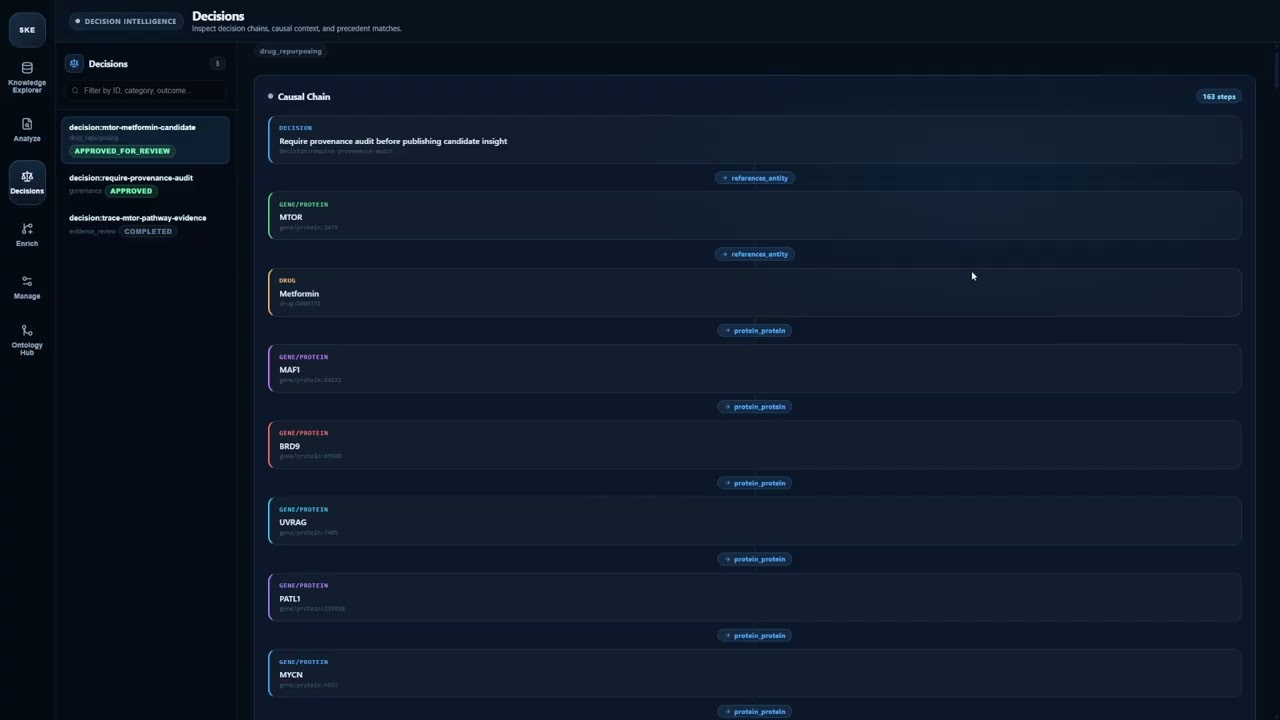
**[Watch the full platform walkthrough →](https://www.youtube.com/watch?v=QfnNZg4-dZA)**
*Knowledge Explorer · Context Graphs · Reasoning Engine · Decision Intelligence · Ontology Hub*
---
## Quick Start
```bash
pip install semantica
```
```python
from semantica.context import ContextGraph
graph = ContextGraph(advanced_analytics=True)
# Every agent decision becomes a queryable, auditable knowledge node
decision_id = graph.record_decision(
category="vendor_selection",
scenario="Choose cloud provider for HIPAA workload",
reasoning="AWS offers BAA, mature HIPAA tooling, and existing team expertise",
outcome="selected_aws",
confidence=0.93,
)
# Ask "why did this happen?" and get a real, structured answer
chain = graph.trace_decision_chain(decision_id) # full causal ancestry
similar = graph.find_similar_decisions("cloud vendor", max_results=5) # precedents
impact = graph.analyze_decision_impact(decision_id) # downstream influence map
compliant = graph.check_decision_rules({"category": "vendor_selection"}) # policy gate
```
**Verify your install in 5 seconds:**
```bash
semantica doctor
# Python 3.11.9 pass
# semantica 0.5.0 pass
# faiss vector store pass
# Config file pass ~/.semantica/config.yaml
```
> [!TIP]
> Run `semantica doctor` immediately after install to verify all backends are wired correctly. It catches misconfigured API keys, missing drivers, and backend connectivity issues before they surface at runtime.
If Semantica solves a real problem for you, a star helps others find it.
**[⭐ Star on GitHub](https://github.com/semantica-agi/semantica)** · **[Join Discord](https://discord.gg/sV34vps5hH)**
---
## Architecture
The full data pipeline and decision intelligence lifecycle are documented with Mermaid flowcharts in **[ARCHITECTURE.md](ARCHITECTURE.md)**:
- [Full data pipeline](ARCHITECTURE.md#full-data-pipeline): all sources → ingest → parse → normalize → split → extract → deduplication → KG → storage → export
- [Decision intelligence lifecycle](ARCHITECTURE.md#decision-intelligence-lifecycle): record → link → query → govern → audit
**→ [View architecture →](ARCHITECTURE.md)**
Every component is independently importable. Use one module or all of them.
---
## Why Semantica
| | Vector DB + RAG | Plain LLM Memory | **Semantica** |
| --- | --- | --- | --- |
| **Recall method** | Embedding similarity | Token window | Graph traversal + semantic search |
| **Decision history** | Not stored | Not stored | First-class queryable objects |
| **Provenance** | None | None | W3C PROV-O, source-linked |
| **Reasoning** | None | Black box | Forward chain, Rete, Datalog, SPARQL |
| **Conflict detection** | Silent overwrite | Silent overwrite | Detected, flagged, resolved |
| **Time travel** | No | No | Point-in-time graph snapshots |
| **Compliance export** | None | None | PROV-O, SHACL, OWL, RDF |
| **Policy enforcement** | None | None | Built-in rule engine + SHACL |
| **Entity resolution** | No | No | Blocking + semantic deduplication |
| **Multi-agent context** | Separate per agent | Separate per agent | Single shared intelligence layer |
> [!IMPORTANT]
> **Semantica complements your existing stack — it does not replace anything you already have.** Keep your LLM, vector store, and agent framework exactly as they are. Semantica sits alongside them as the accountability and intelligence layer, adding structured decision records, causal reasoning, W3C PROV-O provenance, ontology governance, conflict detection, and compliance-grade audit trails. Your stack handles retrieval and generation. Semantica handles accountability and explainability. They are built to work together.
> [!NOTE]
> Semantica is designed for AI agents, GraphRAG systems, enterprise knowledge intelligence, and temporal reasoning applications. The reasoning engines, KG construction, and provenance layer are fully deterministic; no LLM is required to use them.
### How Semantica Compares
Most AI frameworks are built for retrieval. Semantica is built for accountability. The comparison below focuses on the intelligence capabilities that define the difference.
| | LangChain | LlamaIndex | MS GraphRAG | Mem0 | Zep | **Semantica** |
| --- | :---: | :---: | :---: | :---: | :---: | :---: |
| **Knowledge Graph construction** | ⚡ Plugin | ⚡ PropertyGraph | ⚡ Community KG | ❌ | ❌ | ✅ Native, full-stack |
| **Decision tracking** | ❌ | ❌ | ❌ | ❌ | ❌ | ✅ First-class objects |
| **Audit trail & provenance** | ❌ | ❌ | ❌ | ❌ | ❌ | ✅ W3C PROV-O, exportable |
| **Explainable reasoning** | ❌ | ❌ | ❌ | ❌ | ❌ | ✅ Rete · Datalog · SPARQL |
| **Ontology (OWL / SHACL)** | ❌ | ❌ | ❌ | ❌ | ❌ | ✅ Generation + visual editor |
| **Conflict detection** | ❌ | ❌ | ❌ | ❌ | ❌ | ✅ 5 resolution strategies |
| **Bi-temporal graph & time travel** | ❌ | ❌ | ❌ | ❌ | ❌ | ✅ Point-in-time snapshots |
| **Entity resolution** | ❌ | ⚡ Partial | ⚡ Partial | ❌ | ⚡ Partial | ✅ Blocking + semantic dedup |
| **Multi-agent shared context** | ⚡ LangGraph | ⚡ Partial | ❌ | ✅ | ⚡ Partial | ✅ Single shared graph |
| **Policy enforcement** | ❌ | ❌ | ❌ | ❌ | ❌ | ✅ SHACL + rule engine |
> ✅ Full support ⚡ Partial / via plugin ❌ Not supported
**The key distinction:** LangChain, LlamaIndex, and MS GraphRAG are excellent retrieval and orchestration layers. Mem0 and Zep excel at personal agent memory. None of them answer *"prove what your AI decided, why, and whether it complied with policy."* Semantica is built specifically for that question.
---
## Context Graphs
A Context Graph is the structured memory layer that traditional RAG is missing. Instead of flat embeddings that answer *"what is similar?"*, a Context Graph answers *"what is connected, why, and how?"*
Every entity, relationship, decision, and fact is a first-class node, queryable by graph traversal and neighbor expansion. Entities link to source documents. Decisions link to evidence and consequences. Facts carry full provenance. Conflicts are detected, not silently overwritten.
```python
from semantica.context import ContextGraph, AgentContext
from semantica.vector_store import VectorStore
graph = ContextGraph(advanced_analytics=True)
# Add nodes with typed properties
graph.add_node("acme_corp", "Organization", name="Acme Corp", industry="SaaS")
graph.add_node("alice_chen", "Person", name="Alice Chen", role="CTO")
graph.add_node("contract_001", "Contract", value=2_400_000, currency="USD")
# Add typed, weighted edges (extra kwargs become edge metadata)
graph.add_edge("alice_chen", "acme_corp", edge_type="works_for", since="2019-03-01")
graph.add_edge("acme_corp", "contract_001", edge_type="party_to", signed="2024-01-15")
# BFS traversal - hop through the graph from any node
neighbors = graph.get_neighbors("acme_corp", hops=2)
# Point-in-time snapshot - the graph as it existed on any past date
snapshot = graph.state_at("2024-01-01")
# AgentContext - high-level API for agent memory workflows
vs = VectorStore(backend="faiss")
ctx = AgentContext(vector_store=vs, knowledge_graph=graph)
ctx.store("Alice approved the Acme renewal in Q1 2024", conversation_id="conv_001")
retrieved = ctx.retrieve("who approved the Acme contract?")
```
**Why graph over embeddings:**
- Traversal finds connections embeddings miss, including a person 3 hops from a contract
- Every node carries provenance so you can always ask *"where did this come from?"*
- Conflicts are detected and flagged before they corrupt your knowledge base
- Point-in-time snapshots let you replay history without reprocessing
---
## Decision Intelligence
Decision Intelligence turns every AI choice from an ephemeral inference into a permanent, auditable, queryable record. It answers *"what did your AI decide, why, and what happened next?"* The question regulators and enterprise risk teams are asking with increasing urgency.
In Semantica, a decision is not a log line. It is a first-class graph node with a full lifecycle:
> [!IMPORTANT]
> In regulated domains (healthcare, finance, legal, government), every AI decision must be traceable to a source and defensible to an auditor. `record_decision()` creates a permanent, structured record exportable as W3C PROV-O, the format most compliance frameworks accept for regulator submission.
```
record_decision() → stored as a graph node with full structured context
add_causal_relationship() → linked to upstream causes and downstream effects
find_similar_decisions() → semantic precedent search across all past decisions
trace_decision_chain() → full causal ancestry back to root causes
analyze_decision_impact() → downstream influence map - everything this decision affected
check_decision_rules() → policy compliance gate against configurable rule sets
export / audit trail → W3C PROV-O, CSV, or JSON for regulator submission
```
```python
from semantica.context import ContextGraph
graph = ContextGraph(advanced_analytics=True)
# Record decisions with full structured context
app_id = graph.record_decision(
category="credit_application",
scenario="Personal loan, $85k income, 31% DTI, 3yr employment",
reasoning="Income meets threshold; employment stable; no adverse credit events",
outcome="proceed_to_underwriting",
confidence=0.88,
metadata={"applicant_id": "A-7291"},
)
uw_id = graph.record_decision(
category="loan_underwriting",
scenario="Underwriting review for A-7291",
reasoning="DTI within policy; clean 36-month credit history",
outcome="approved",
confidence=0.94,
)
rate_id = graph.record_decision(
category="interest_rate",
scenario="Rate assignment for approved loan A-7291",
outcome="rate_set_8.9pct",
reasoning="Prime + 2.4% based on risk tier B2",
confidence=0.99,
)
# Build the auditable causal chain
graph.add_causal_relationship(app_id, uw_id, relationship_type="triggers")
graph.add_causal_relationship(uw_id, rate_id, relationship_type="enables")
# Query the intelligence
chain = graph.trace_decision_chain(rate_id)
similar = graph.find_similar_decisions("personal loan approval, 31% DTI", max_results=5)
impact = graph.analyze_decision_impact(uw_id)
compliant = graph.check_decision_rules({"category": "loan_underwriting", "confidence": 0.94})
insights = graph.get_decision_insights()
```
---
## Module Reference
Semantica is a full platform. Every module is independently importable and composable. Below are working examples for each.
### `semantica.ingest`: Multi-Source Ingestion
Ingest from files, web, databases, APIs, streams, email, Git repos, Parquet, Snowflake, or MCP servers, all through a unified interface.
```python
from semantica.ingest import FileIngestor, WebIngestor, ParquetIngestor, DBIngestor
# Ingest an entire directory of contracts (PDF, DOCX, HTML, TXT)
docs = FileIngestor().ingest_directory("./contracts/", recursive=True)
# Ingest live web content with robots.txt compliance
pages = WebIngestor().ingest_url("https://example.com/reports/annual-2024.html")
# Ingest structured data from Parquet with Snappy compression
records = ParquetIngestor().ingest("./data/transactions.parquet")
# Ingest from a SQL database - specify which tables to pull
rows = DBIngestor().ingest_database(
connection_string="postgresql://user:pass@localhost/mydb",
include_tables=["customer_events"],
max_rows_per_table=50_000,
)
```
**Supported sources:** Local files (PDF, DOCX, PPTX, HTML, TXT, CSV, JSON, YAML, Excel, XML) · Web pages · RSS/Atom feeds · REST APIs · Databases (PostgreSQL, MySQL, SQLite, Oracle, SQL Server) · Parquet datasets · Snowflake · Git repositories · Email (IMAP/POP3) · Message streams (Kafka, RabbitMQ, Kinesis, Pulsar) · MCP resources
---
### `semantica.semantic_extract`: NER, Relations, Events, Triplets
Extract structured knowledge from raw text in one pass.
```python
from semantica.semantic_extract import (
NamedEntityRecognizer,
RelationExtractor,
EventDetector,
TripletExtractor,
)
text = """
Anthropic CEO Dario Amodei announced a $7.3B Series E funding round in partnership
with Google and Spark Capital, valuing the company at $61.5B as of Q4 2024.
"""
# Named entity recognition with confidence thresholding
ner = NamedEntityRecognizer(confidence_threshold=0.7)
entities = ner.extract_entities(text)
# → [Entity(name="Dario Amodei", type="PERSON"), Entity(name="Anthropic", type="ORG"),
# Entity(name="Google", type="ORG"), Entity(name="$7.3B", type="MONEY"), ...]
# Relationship extraction - bidirectional support
rel_extractor = RelationExtractor(confidence_threshold=0.6, bidirectional=True)
relations = rel_extractor.extract_relations(text, entities=entities)
# → [Relation(subject="Dario Amodei", predicate="ceo_of", object="Anthropic"),
# Relation(subject="Anthropic", predicate="raised", object="$7.3B Series E"), ...]
# Event detection with temporal processing
events = EventDetector(extract_participants=True, extract_time=True).detect_events(text)
# → [Event(type="FUNDING", participants=["Anthropic","Google","Spark Capital"],
# amount="$7.3B", date="Q4 2024")]
# RDF triplets with optional provenance metadata
triplets = TripletExtractor(include_temporal=True, include_provenance=True).extract_triplets(text)
# → [("Anthropic", "valuation", "$61.5B"), ("Dario Amodei", "is_ceo_of", "Anthropic"), ...]
```
---
### `semantica.kg`: Knowledge Graph Construction & Analysis
Build a production knowledge graph from documents and run graph algorithms over it.
```python
from semantica.ingest import FileIngestor
from semantica.kg import (
GraphBuilder,
GraphAnalyzer,
CentralityCalculator,
CommunityDetector,
PathFinder,
LinkPredictor,
BiTemporalFact,
)
from datetime import datetime
# Build KG - merge duplicate entities, track temporal edges
sources = FileIngestor().ingest_directory("./contracts/", recursive=True)
kg = GraphBuilder(merge_entities=True, enable_temporal=True).build(sources)
# Graph analytics
analyzer = GraphAnalyzer()
analysis = analyzer.analyze_graph(kg) # full graph metrics
centrality = CentralityCalculator()
degree = centrality.calculate_degree_centrality(kg) # most-connected entities
betweenness = centrality.calculate_betweenness_centrality(kg)
communities = CommunityDetector().detect_communities(kg, method="louvain") # natural clusters
path = PathFinder().find_shortest_path(kg, "alice_chen", "contract_001")
predictions = LinkPredictor().predict_links(kg, top_k=10) # relationship predictions
# Bi-temporal facts - track valid time vs. recorded time independently
fact = BiTemporalFact(
valid_from=datetime(2024, 3, 1),
valid_until=datetime(2025, 1, 1),
recorded_at=datetime(2024, 3, 5),
)
```
---
### `semantica.reasoning`: Forward Chaining, Rete, Datalog, SPARQL
Run explainable rule-based inference, not a black box.
```python
from semantica.reasoning import ReteEngine, Rule, Fact, RuleType
rete = ReteEngine()
rete.build_network([
Rule(
rule_id="aml_flag",
name="Flag high-risk transactions",
conditions=[
{"field": "amount", "operator": ">", "value": 10_000},
{"field": "country", "operator": "in", "value": ["IR", "KP", "SY"]},
],
conclusion="flag_for_compliance_review",
rule_type=RuleType.IMPLICATION,
),
Rule(
rule_id="velocity_check",
name="Flag rapid sequential transfers",
conditions=[
{"field": "transfers_in_1h", "operator": ">", "value": 5},
{"field": "total_amount", "operator": ">", "value": 50_000},
],
conclusion="flag_velocity_breach",
rule_type=RuleType.IMPLICATION,
),
])
rete.add_fact(Fact("tx_001", "transaction", [{"amount": 15_000, "country": "IR"}]))
flagged = rete.match_patterns()
# → [{"rule": "aml_flag", "matched_facts": ["tx_001"], "conclusion": "flag_for_compliance_review"}]
```
```python
# Recursive Datalog - natural language for graph queries
from semantica.reasoning import DatalogReasoner
engine = DatalogReasoner()
engine.add_fact("parent(tom, bob)")
engine.add_fact("parent(bob, ann)")
engine.add_fact("parent(ann, pat)")
engine.add_rule("ancestor(X, Y) :- parent(X, Y).")
engine.add_rule("ancestor(X, Z) :- parent(X, Y), ancestor(Y, Z).")
ancestors = engine.query("ancestor(tom, ?X)")
# → [{"X": "bob"}, {"X": "ann"}, {"X": "pat"}]
```
```python
# Explainable reasoning - trace the path, not just the answer
from semantica.reasoning import ExplanationGenerator, Reasoner
reasoner = Reasoner()
result = reasoner.infer(kg, rules=[...])
explainer = ExplanationGenerator()
explanation = explainer.generate(result)
# → Explanation(conclusion="...", steps=[ReasoningStep(...)], justification=Justification(...))
```
---
### `semantica.vector_store`: Hybrid & Filtered Semantic Search
Drop-in vector store with 7 backends, hybrid search, and decision-aware retrieval.
```python
from semantica.vector_store import VectorStore, HybridSearch
# Works with FAISS, Qdrant, Weaviate, Milvus, Pinecone, PgVector, or in-memory
vs = VectorStore(backend="qdrant", dimension=1536)
# Store a decision with scenario description and outcome
vs.store_decision(
scenario="Personal loan A-7291, $85k income, 31% DTI, 3yr employment",
outcome="approved",
confidence=0.94,
category="loan_underwriting",
)
# Semantic similarity search
results = vs.search(
query="personal loan approval with low DTI",
limit=10,
)
# Hybrid search - dense + sparse retrieval in one pass with RRF fusion
hs = HybridSearch(vector_store=vs)
hits = hs.search("high-risk transactions 2024")
# Explain why a decision was retrieved
explanation = vs.explain_decision(results[0]["id"])
```
---
> [!CAUTION]
> Mixing vectors generated from different embedding models in the same `VectorStore` index leads to inconsistent similarity scores. Always use a single embedding model per index, or isolate per-model data using namespaces.
### `semantica.split`: GraphRAG-Native Document Chunking
KG-aware splitting that preserves entity boundaries, relation triplets, and ontology concepts, essential for GraphRAG pipelines.
```python
from semantica.split import TextSplitter, EntityAwareChunker, RelationAwareChunker
text = open("contracts/master_agreement.txt").read()
# Standard recursive chunking
chunks = TextSplitter(method="recursive", chunk_size=1000, chunk_overlap=200).split(text)
# Entity-aware chunking - never splits a named entity across chunks (GraphRAG)
chunks = TextSplitter(method="entity_aware", ner_method="llm", chunk_size=1000).split(text)
# Relation-aware chunking - preserves (subject, predicate, object) triplets intact
chunks = RelationAwareChunker(chunk_size=1000, preserve_triplets=True).chunk(text)
# Graph-based chunking - uses centrality to find natural community boundaries
chunks = TextSplitter(method="graph_based", chunk_size=1000).split(text)
# Hierarchical chunking - multi-level (section → paragraph → sentence)
chunks = TextSplitter(method="hierarchical", levels=["section", "paragraph"]).split(text)
```
**Supported methods:** `recursive` · `token` · `sentence` · `paragraph` · `semantic_transformer` · `entity_aware` · `relation_aware` · `graph_based` · `ontology_aware` · `hierarchical` · `community_detection` · `centrality_based` · `llm`
---
### `semantica.provenance`: W3C PROV-O Lineage
Every fact is linked to its source. No black boxes, no mystery outputs.
```python
from semantica.provenance import ProvenanceManager
prov = ProvenanceManager(storage_path="./provenance.db")
# Track where every entity came from
prov.track_entity(
entity_id="acme_corp",
source="contracts/acme_master_agreement_2024.pdf",
metadata={"page": 1, "confidence": 0.97, "extractor": "NamedEntityRecognizer"},
)
prov.track_relationship(
relationship_id="alice_works_for_acme",
source_entity_id="alice_chen",
target_entity_id="acme_corp",
source="hr_records/employees_q1_2024.csv",
)
# Answer "where did this come from?"
lineage = prov.get_lineage("acme_corp")
trail = prov.trace_lineage("alice_chen") # full ancestor chain
entry = prov.get_provenance("acme_corp")
```
---
### `semantica.ontology`: OWL Generation, SHACL Validation
Generate ontologies from data, validate shapes, and manage your vocabulary.
```python
from semantica.ontology import OntologyGenerator, OntologyValidator
data = {
"entities": [
{"id": "acme_corp", "type": "Organization", "industry": "SaaS", "founded": 2012},
{"id": "alice_chen", "type": "Person", "role": "CTO", "since": 2019},
],
"relationships": [
{"source": "alice_chen", "target": "acme_corp", "type": "works_for"},
],
}
gen = OntologyGenerator(base_uri="https://semantica.dev/ontology/")
ontology = gen.generate_ontology(data)
classes = gen.infer_classes(data)
props = gen.infer_properties(data, classes)
optimized = gen.optimize_ontology(ontology)
# Validate against SHACL shapes
validator = OntologyValidator()
report = validator.validate(ontology)
# → ValidationResult(conforms=True, errors=[], warnings=[])
```
---
### `semantica.conflicts`: Conflict Detection & Resolution
Detect and resolve conflicting facts from multiple sources before they corrupt your knowledge base.
```python
from semantica.conflicts import ConflictDetector, ConflictResolver, SourceTracker
entities_from_source_a = [
{"id": "alice_chen", "role": "CTO", "salary": 250_000, "start_date": "2019-03-01"},
]
entities_from_source_b = [
{"id": "alice_chen", "role": "VP Eng", "salary": 275_000, "start_date": "2019-03-01"},
]
# Detect all conflict types: value, type, relationship, temporal, logical
detector = ConflictDetector()
conflicts = detector.detect_conflicts(entities_from_source_a + entities_from_source_b)
# → [Conflict(entity="alice_chen", field="role", values=["CTO","VP Eng"], severity="HIGH"),
# Conflict(entity="alice_chen", field="salary", values=[250000,275000], severity="MEDIUM")]
# Resolve using multiple strategies
resolver = ConflictResolver()
resolved = resolver.resolve(conflicts, strategy="credibility_weighted") # weighted by source trust
resolved = resolver.resolve(conflicts, strategy="temporal") # prefer most recent
resolved = resolver.resolve(conflicts, strategy="voting") # majority wins
# Track source credibility over time
tracker = SourceTracker()
tracker.track("source_a", credibility=0.85)
tracker.track("source_b", credibility=0.72)
```
---
### `semantica.deduplication`: Entity Resolution at Scale
Block, cluster, and merge duplicates with semantic similarity. **6.98× faster** than baseline.
```python
from semantica.deduplication import DuplicateDetector, EntityMerger
entities = [
{"id": "e1", "name": "Acme Corporation", "domain": "acme.com"},
{"id": "e2", "name": "Acme Corp.", "domain": "acme.com"},
{"id": "e3", "name": "ACME Corp", "domain": "acme.co"},
{"id": "e4", "name": "Globex Industries", "domain": "globex.com"},
]
detector = DuplicateDetector(similarity_threshold=0.75, use_clustering=True)
candidates = detector.detect_duplicates(entities)
groups = detector.detect_duplicate_groups(entities)
# → DuplicateGroup(entities=["e1","e2","e3"], confidence=0.91, strategy="semantic+blocking")
merger = EntityMerger(preserve_provenance=True)
ops = merger.merge_duplicates(entities, strategy="keep_most_complete")
history = merger.get_merge_history()
```
---
### `semantica.normalize`: Data Normalization & Cleaning
Standardize text, entities, dates, numbers, and encodings before building your knowledge graph.
```python
from semantica.normalize import (
TextNormalizer,
EntityNormalizer,
DateNormalizer,
NumberNormalizer,
DataCleaner,
)
# Unicode, whitespace, casing, HTML tags, smart quotes
text = TextNormalizer().normalize(" Acme Corp.’s Q4 report… ")
# → "Acme Corp.'s Q4 report..."
# Alias resolution + entity disambiguation with confidence scores
names = EntityNormalizer().normalize_entity("ACME Corp.")
# → NormalizedEntity(canonical="Acme Corporation", type="Organization", confidence=0.91)
# Natural language date parsing with timezone conversion
dt = DateNormalizer().normalize_date("3 weeks ago")
# → datetime(2026, 5, 22, tzinfo=UTC)
# Unit conversion and currency normalization
price = NumberNormalizer().normalize("$1.25M USD")
# → NormalizedNumber(value=1_250_000, currency="USD")
# Deduplicate and impute missing values across a dataset
clean = DataCleaner().clean(records, dedup_threshold=0.9, fill_missing="mean")
```
---
### `semantica.pipeline`: Pipeline DSL
Compose ingestion, extraction, and graph-building into a declarative, parallel pipeline.
```python
from semantica.pipeline import PipelineBuilder, ExecutionEngine
pipeline = (
PipelineBuilder()
.add_step("ingest", step_type="ingest", source="./contracts/", recursive=True)
.add_step("extract", step_type="ner_extract")
.add_step("relations", step_type="relation_extract")
.add_step("build_kg", step_type="kg_build", merge_entities=True)
.add_step("deduplicate", step_type="deduplicate", threshold=0.75)
.add_step("export", step_type="export", format="turtle", output="kg.ttl")
.connect_steps("ingest", "extract")
.connect_steps("extract", "relations")
.connect_steps("relations", "build_kg")
.connect_steps("build_kg", "deduplicate")
.connect_steps("deduplicate", "export")
.set_parallelism(4)
.build(name="contracts_pipeline")
)
engine = ExecutionEngine()
result = engine.execute(pipeline)
status = engine.get_status(pipeline)
progress = engine.get_progress(pipeline)
```
> [!WARNING]
> Large-scale ingestion may require significant memory. For datasets exceeding 500k nodes, use `StreamIngestor` or enable incremental batch mode with `GraphBuilder(incremental=True)`. Use `set_parallelism()` conservatively on memory-constrained machines.
---
### Temporal Intelligence: Bi-Temporal Graphs & Time Travel
Track when facts were true *in the world* vs. when they were *recorded*, and query either axis.
```python
from semantica.context import ContextGraph
from semantica.kg import (
BiTemporalFact,
TemporalGraphQuery,
TemporalVersionManager,
TemporalNormalizer,
)
from datetime import datetime
graph = ContextGraph(advanced_analytics=True)
graph.add_node("alice_chen", "Person", role="VP Engineering")
graph.add_node("acme_corp", "Organization", valuation=1_200_000_000)
# Point-in-time snapshots - replay history without reprocessing
snapshot_2023 = graph.state_at("2023-06-01")
snapshot_2024 = graph.state_at("2024-01-01")
# Bi-temporal facts - valid_time is when true in the world;
# recorded_at is when you learned about it
fact = BiTemporalFact(
valid_from=datetime(2024, 3, 1),
valid_until=datetime(2025, 1, 1),
recorded_at=datetime(2024, 3, 5),
)
# Allen interval algebra - 13 temporal relations (before, during, overlaps, etc.)
tq = TemporalGraphQuery(graph)
facts_in_window = tq.query_time_range("2024-01-01", "2024-12-31")
# Normalize natural language temporal expressions
norm = TemporalNormalizer()
dt = norm.normalize("last quarter") # → datetime range for Q1 2026
```
---
### `semantica.export`: RDF, OWL, Parquet, Cypher, JSON-LD
Export to any format required by regulators, graph databases, or downstream systems.
```python
from semantica.export import (
RDFExporter,
JSONExporter,
ParquetExporter,
LPGExporter,
ReportGenerator,
)
kg = {"entities": [...], "relationships": [...]}
rdf = RDFExporter()
turtle_str = rdf.export_to_rdf(kg, format="turtle") # returns string
jsonld_str = rdf.export_to_rdf(kg, format="json-ld")
rdf.export(kg, "kg_audit.ttl", format="turtle")
rdf.export(kg, "kg_audit.jsonld", format="json-ld")
rdf.export(kg, "kg_audit.nt", format="n-triples")
# Columnar analytics - Snappy-compressed Parquet
ParquetExporter().export(kg, "kg_snapshot.parquet", compression="snappy")
# JSON knowledge graph
JSONExporter().export_knowledge_graph(kg, "kg.json")
# Neo4j / Memgraph Cypher statements for graph database import
LPGExporter().export(kg, "kg_import.cypher", method="cypher")
# Human-readable HTML / Markdown report
ReportGenerator().generate(kg, "audit_report.html", format="html")
```
---
### `semantica.visualization`: Interactive Graph Workbench
Render force-directed graphs, community maps, ontology hierarchies, and temporal dashboards.
```python
from semantica.visualization import (
KGVisualizer,
OntologyVisualizer,
EmbeddingVisualizer,
TemporalVisualizer,
)
import numpy as np
kg = {"entities": [...], "relationships": [...]}
# Interactive force-directed graph (opens in browser)
viz = KGVisualizer(layout="force", color_scheme="default")
viz.visualize_network(kg, output="interactive", file_path="kg.html")
viz.visualize_communities(kg, communities, output="interactive")
viz.visualize_centrality(kg, centrality, centrality_type="degree")
viz.visualize_entity_types(kg, output="html", file_path="entity_types.html")
# Ontology class hierarchy
OntologyVisualizer().visualize_hierarchy(ontology, output="interactive")
# 2D embedding projection (UMAP / t-SNE / PCA)
EmbeddingVisualizer().visualize_2d_projection(
embeddings=np.array([...]),
labels=["entity_a", "entity_b"],
method="umap",
)
# Timeline scrubber - watch the graph evolve
TemporalVisualizer().visualize_timeline(kg, output="interactive")
```
---
### Multi-Agent Shared Context with Agno
One shared intelligence layer. All agents read and write to the same context graph.
```python
# pip install semantica[agno]
from agno.agent import Agent
from agno.team import Team
from agno.models.anthropic import Claude
from semantica.context import ContextGraph
from semantica.vector_store import VectorStore
from integrations.agno import AgnoSharedContext, AgnoDecisionKit, AgnoKGToolkit
shared = AgnoSharedContext(
vector_store=VectorStore(backend="faiss"),
knowledge_graph=ContextGraph(advanced_analytics=True),
decision_tracking=True,
)
researcher = Agent(
name="Researcher",
model=Claude(id="claude-sonnet-4-6"),
memory=shared.bind_agent("researcher"),
tools=[AgnoKGToolkit(context=shared)],
)
analyst = Agent(
name="Analyst",
model=Claude(id="claude-sonnet-4-6"),
memory=shared.bind_agent("analyst"),
tools=[AgnoDecisionKit(context=shared)],
)
team = Team(agents=[researcher, analyst], mode="coordinate")
# Researcher's findings are instantly available to the Analyst - no copy, no sync
```
→ [40+ runnable notebooks in the cookbook](https://github.com/semantica-agi/semantica/tree/main/cookbook)
> [!TIP]
> New to Semantica? Start with the [cookbook notebooks](https://github.com/semantica-agi/semantica/tree/main/cookbook). They walk through each module end-to-end with real datasets before you write production code. Each notebook is self-contained and runnable in under 5 minutes.
---
## Recipes
Copy-paste patterns for the most common use cases.
### End-to-End GraphRAG Pipeline
```python
from semantica.ingest import FileIngestor
from semantica.split import TextSplitter
from semantica.semantic_extract import NamedEntityRecognizer, RelationExtractor
from semantica.kg import GraphBuilder
from semantica.vector_store import VectorStore, HybridSearch
from semantica.context import AgentContext
# 1. Ingest
docs = FileIngestor().ingest_directory("./docs/", recursive=True)
# 2. Entity-aware chunking - never splits an entity across a chunk boundary
splitter = TextSplitter(method="entity_aware", chunk_size=1000)
chunks = [splitter.split(doc["text"]) for doc in docs]
# 3. Extract entities and relations
ner = NamedEntityRecognizer(confidence_threshold=0.7)
rel_ext = RelationExtractor(confidence_threshold=0.6)
entities = [ner.extract_entities(chunk) for chunk_group in chunks for chunk in chunk_group]
# 4. Build KG
kg = GraphBuilder(merge_entities=True, enable_temporal=True).build(docs)
# 5. Hybrid retrieval
vs = VectorStore(backend="faiss")
ctx = AgentContext(vector_store=vs, knowledge_graph=kg)
ctx.store("Alice approved the Acme renewal in Q1 2024", conversation_id="c1")
results = HybridSearch(vector_store=vs).search("who approved the renewal?")
```
---
### Audit Trail for a Regulated Decision
```python
from semantica.context import ContextGraph
from semantica.provenance import ProvenanceManager
from semantica.export import RDFExporter
graph = ContextGraph(advanced_analytics=True)
prov = ProvenanceManager(storage_path="./audit.db")
# Record the decision chain
d1 = graph.record_decision(
category="loan_application", scenario="A-7291, $85k income",
reasoning="Income threshold met", outcome="proceed", confidence=0.88,
)
d2 = graph.record_decision(
category="loan_underwriting", scenario="Underwriting A-7291",
reasoning="Clean credit history", outcome="approved", confidence=0.94,
)
graph.add_causal_relationship(d1, d2, relationship_type="triggers")
# Track provenance for every entity
prov.track_entity("applicant_A7291", source="loan_application_form.pdf",
metadata={"page": 1, "extractor": "NamedEntityRecognizer"})
# Export W3C PROV-O for regulator submission
kg = graph.export_graph()
RDFExporter().export(kg, "audit_trail.ttl", format="turtle")
```
---
### AML Rules Engine
```python
from semantica.reasoning import ReteEngine, Rule, Fact, RuleType
rete = ReteEngine()
rete.build_network([
Rule(
rule_id="sanctions_check",
name="Flag sanctioned-country transactions",
conditions=[
{"field": "amount", "operator": ">", "value": 10_000},
{"field": "country", "operator": "in", "value": ["IR", "KP", "SY", "CU"]},
],
conclusion="flag_for_compliance_review",
rule_type=RuleType.IMPLICATION,
),
])
rete.add_fact(Fact("tx_99", "transaction", [{"amount": 25_000, "country": "IR"}]))
matches = rete.match_patterns()
# → [{"rule": "sanctions_check", "matched_facts": ["tx_99"],
# "conclusion": "flag_for_compliance_review"}]
```
---
### Ontology-to-Knowledge-Graph in One Pass
```python
from semantica.ingest import FileIngestor
from semantica.semantic_extract import NamedEntityRecognizer, RelationExtractor
from semantica.kg import GraphBuilder
from semantica.ontology import OntologyGenerator, OntologyValidator
from semantica.export import RDFExporter
sources = FileIngestor().ingest_directory("./contracts/")
ner = NamedEntityRecognizer(confidence_threshold=0.7)
entities = ner.extract_entities_batch([s["text"] for s in sources])
kg = GraphBuilder(merge_entities=True).build(sources)
gen = OntologyGenerator(base_uri="https://myco.dev/ontology/")
ont = gen.generate_ontology({"entities": entities[0], "relationships": []})
report = OntologyValidator().validate(ont)
if report.conforms:
RDFExporter().export({"entities": entities[0]}, "ontology.ttl", format="turtle")
```
---
## Performance
Benchmarks from v0.5.0 on a 118,000-node production graph:
| Operation | Before | After | Improvement |
| --- | --- | --- | --- |
| Node search (118k nodes) | 24 ms | 0.004 ms | **6,000×** faster |
| Embedding cache hit | cold load | revision-based cache | **10×** throughput |
| Semantic deduplication | baseline | optimized candidate gen | **6.98×** faster |
| Candidate generation | baseline | blocking strategy | **63.6%** faster |
> [!NOTE]
> Benchmarks are from v0.5.0 on a 118,000-node production graph (AMD EPYC, 64 GB RAM). Results vary by hardware, dataset topology, and backend selection. Run `semantica benchmark` to measure performance on your own data.
---
## CLI
Every capability is available from the terminal. The CLI ships with the package, no separate install required.
```bash
pip install semantica
semantica # startup dashboard
semantica --help # full grouped command reference
```

Start with `semantica`, verify with `doctor`, build a graph, and explore the command groups from one terminal.
### Startup Dashboard
```
$ semantica
███████╗███████╗███╗ ███╗ █████╗ ███╗ ██╗████████╗██╗ ██████╗ █████╗
██╔════╝██╔════╝████╗ ████║██╔══██╗████╗ ██║╚══██╔══╝██║██╔════╝ ██╔══██╗
███████╗█████╗ ██╔████╔██║███████║██╔██╗ ██║ ██║ ██║██║ ███████║
╚════██║██╔══╝ ██║╚██╔╝██║██╔══██║██║╚██╗██║ ██║ ██║██║ ██╔══██║
███████║███████╗██║ ╚═╝ ██║██║ ██║██║ ╚████║ ██║ ██║╚██████╗ ██║ ██║
╚══════╝╚══════╝╚═╝ ╚═╝╚═╝ ╚═╝╚═╝ ╚═══╝ ╚═╝ ╚═╝ ╚═════╝ ╚═╝ ╚═╝
╭─────────────────────────────────────────────────────────────────────────────╮
│ │
│ Knowledge Intelligence Platform • v0.5.0 │
│ │
│ 🕸️ Context Graphs ⚡ Decision Intelligence 🔍 Provenance │
│ 🧩 Knowledge Fusion 🧠 Reasoning Engine 📊 Explainability │
│ │
╰─────────────────────────────────────────────────────────────────────────────╯
Graph Store neo4j
Vector Store faiss
Profile default
Config ~/.semantica/config.yaml
Run semantica --help for all commands • semantica shell for interactive mode
```
### Knowledge Graph Build
```
$ semantica kg build -s ./contracts/ -s ./reports/ --store neo4j
contracts/ ████████████████████ 12/12 4.2s
reports/ ████████████████████ 8/8 2.9s
Knowledge graph built 1,847 nodes 4,203 edges 7.1s
```
### `semantica doctor`: Health Check
```
$ semantica doctor
Python 3.11.9 pass
semantica 0.5.0 pass
neo4j backend pass neo4j://localhost:7687
faiss vector store pass
LLM provider warn OPENAI_API_KEY not set
Config file pass ~/.semantica/config.yaml
```
**Command groups:** `ingest` · `parse` · `extract` · `kg` · `reason` · `decision` · `temporal` · `provenance` · `ontology` · `embed` · `deduplicate` · `validate` · `export` · `visualize` · `pipeline` · `server` · `explorer` · `mcp` · `doctor` · `shell` · `init` · `watch`
→ [Full CLI reference](https://docs.getsemantica.ai/)
---
## Integrations
Native plugin bundles for 8 editors · MCP server with 12 tools · 109-endpoint REST API · Agno first-class · All LLM providers already supported: OpenAI · Anthropic · Gemini · Mistral · Llama · Groq · Cohere · Azure · Bedrock · Ollama · DeepSeek · HuggingFace and more via LiteLLM
Native Plugin Bundle
MCP Server + Plugin

Claude Code
17 skills · 3 agents · hooks

Cursor
17 skills · 3 agents

Codex CLI
17 skills · 3 agents

Windsurf
plugin

Cline
plugin

Continue
plugin

VS Code
plugin

OpenClaw
MCP + plugin
MCP Server
REST API
Claude Desktop
MCP server

GitHub Copilot
REST API

Roo Code
REST API

Goose
REST API

Kilo Code
REST API

Aider
REST API

Amazon Q
REST API

Zed
REST API
### Agentic Frameworks
Native Integration

Agno
First-class · pip install semantica[agno]
Already Supported via REST API & MCP

LangChain
REST API · MCP
LangGraph
REST API · MCP

CrewAI
REST API · MCP

LlamaIndex
REST API · MCP
AutoGen
REST API · MCP
OpenAI Agents
REST API · MCP

Google ADK
REST API · MCP
Native SDK Integration — Coming Soon
LangChain
Dedicated toolkit
CrewAI
Dedicated toolkit
LlamaIndex
Dedicated toolkit
AutoGen
Dedicated toolkit
OpenAI Agents
Dedicated toolkit
Google ADK
Dedicated toolkit
---
### MCP Server
Connect any MCP-compatible client (Claude Desktop, Windsurf, Cline, VS Code) in 30 seconds:
```bash
python -m semantica.mcp_server
# or via the installed entry point
semantica-mcp
```
```json
{
"mcpServers": {
"semantica": { "command": "python", "args": ["-m", "semantica.mcp_server"] }
}
}
```
> [!TIP]
> The fastest way to connect Claude Desktop, Windsurf, or Cline is `python -m semantica.mcp_server`. No extra configuration needed for local use; the server auto-discovers `~/.semantica/config.yaml`.
**12 tools exposed over MCP:**
| Tool | What it does |
| --- | --- |
| `extract_entities` | NER on any text |
| `extract_relations` | Relation extraction |
| `record_decision` | Persist a decision node |
| `query_decisions` | Search decision history |
| `find_precedents` | Semantic precedent lookup |
| `get_causal_chain` | Full causal ancestry |
| `add_entity` | Add a KG node |
| `add_relationship` | Add a KG edge |
| `run_reasoning` | Execute rule set |
| `get_graph_analytics` | Centrality, communities |
| `export_graph` | Export to RDF/JSON/Parquet |
| `get_graph_summary` | Graph statistics |
---
### REST API
```bash
# Start the backend
python -m semantica.server # port 8000
# Extract entities via REST
curl -X POST http://localhost:8000/api/extract/entities \
-H "Content-Type: application/json" \
-d '{"text": "Apple CEO Tim Cook announced record earnings."}'
# Record a decision
curl -X POST http://localhost:8000/api/decisions \
-H "Content-Type: application/json" \
-d '{
"category": "vendor_selection",
"scenario": "Choose ML cloud provider",
"reasoning": "Best GPU availability and pricing",
"outcome": "selected_aws",
"confidence": 0.91
}'
# Query the knowledge graph
curl http://localhost:8000/api/graph/neighbors/acme_corp?hops=2
```
**109 endpoints** across: `extract` · `kg` · `decisions` · `reasoning` · `provenance` · `ontology` · `embeddings` · `search` · `export` · `pipeline` · `temporal` · `deduplication`
---
### Plugin Bundles
**17 domain skills:** `extract` · `ingest` · `query` · `ontology` · `validate` · `deduplicate` · `embed` · `reason` · `decision` · `causal` · `temporal` · `provenance` · `policy` · `explain` · `export` · `change` · `visualize`
**3 specialized agents:** `kg-assistant` · `decision-advisor` · `explainability`
Bundles for Claude Code, Cursor, Codex, Windsurf, Cline, Continue, VS Code, and OpenClaw in [`plugins/`](plugins/).
---
## Knowledge Explorer
A browser-based graph workbench. Pan and zoom live graphs, scrub the timeline, review every decision's causal chain, resolve duplicates, and author your ontology visually. Built on React 19 + Sigma.js.
| Workspace | What you can do |
| --- | --- |
| **Knowledge Graph** | Live Sigma.js canvas with ForceAtlas2 layout, Ego Mode, semantic distance heatmap |
| **Timeline** | Scrub through temporal events and watch the graph evolve |
| **Decisions** | Browse the causal chain behind every recorded decision |
| **Registry** | Live audit log of every graph mutation |
| **Entity Resolution** | Review and merge duplicates |
| **Ontology Hub** | SHACL Studio, visual editor, cross-ontology alignments, SKOS browser |
| **Lineage** | W3C PROV-O provenance visualization for any entity |
Quickest way to start (no Node.js required):
```bash
pip install "semantica[explorer]"
semantica-explorer --graph my_graph.json
# Dashboard opens at http://127.0.0.1:8000
```
For contributor / dev-server setup, see the full local setup guide:
→ **[explorer/README.md — Local Setup Guide](explorer/README.md)**
---
## Modules
| Module | What it provides |
| --- | --- |
| `semantica.context` | Context graphs, agent memory, decision tracking, causal analysis, precedent search, policy engine |
| `semantica.kg` | KG construction, graph algorithms, centrality, community detection, temporal queries, link prediction |
| `semantica.semantic_extract` | NER · relation extraction · event detection · coreference · triplet generation |
| `semantica.reasoning` | Forward chaining · Rete · deductive · abductive · SPARQL · Datalog with explainable output |
| `semantica.vector_store` | FAISS · Pinecone · Weaviate · Qdrant · Milvus · PgVector · hybrid + filtered search |
| `semantica.split` | GraphRAG chunking: entity-aware · relation-aware · graph-based · ontology-aware · hierarchical |
| `semantica.provenance` | W3C PROV-O lineage · source tracking · revision history · audit log export |
| `semantica.ontology` | OWL generation · SHACL shape generation & validation · SKOS vocabulary management |
| `semantica.kg` *(temporal)* | Bi-temporal facts · Allen interval algebra · point-in-time snapshots · `TemporalNormalizer` · `TemporalGraphQuery` |
| `semantica.deduplication` | Blocking · hybrid · semantic strategies · entity merging with provenance |
| `semantica.conflicts` | Value/type/temporal conflict detection · credibility-weighted resolution · investigation guides |
| `semantica.normalize` | Text · entity · date · number · encoding normalization · data cleaning |
| `semantica.pipeline` | Pipeline DSL · parallel workers · validation · retry policies · progress tracking |
| `semantica.export` | RDF (Turtle/JSON-LD/N-Triples) · Parquet · OWL · SHACL · GraphML · Cypher · ArangoDB AQL |
| `semantica.ingest` | Files · web · public APIs · databases · Snowflake · MCP · email · Git repos · Parquet · streams |
| `semantica.graph_store` | Neo4j · FalkorDB · Apache AGE · Amazon Neptune |
| `semantica.visualization` | KG · ontology · embedding · temporal · community graph visualization |
| [`explorer/`](explorer/) | React 19 + Sigma.js browser workbench |
---
## Features at a Glance
| Capability | Highlights |
| --- | --- |
| **Context Graphs** | Queryable graph of entities, decisions, relationships; causal links; cross-graph navigation |
| **Decision Intelligence** | `record_decision` · `trace_decision_chain` · `find_similar_decisions` · `analyze_decision_impact` · `check_decision_rules` |
| **Temporal Intelligence** | Point-in-time snapshots · Allen interval algebra (13 relations) · `TemporalNormalizer` · bi-temporal provenance |
| **Distance Intelligence** | N×N semantic distance matrices · ego-mode visualization · distance bands · 10× embedding cache |
| **Semantic Extraction** | NER · relation extraction · event detection · triplet generation · coreference · **6.98×** faster dedup |
| **Reasoning Engines** | Forward chaining · Rete · deductive · abductive · SPARQL · Datalog with explainable output |
| **GraphRAG Chunking** | Entity-aware · relation-aware · graph-based · ontology-aware · community-detection chunking |
| **Conflict Detection** | Value / type / relationship / temporal / logical conflicts · 5 resolution strategies |
| **Provenance** | W3C PROV-O · every fact traced to source · audit log export JSON/CSV/RDF |
| **Ontology Hub** | SHACL Studio · visual editor · cross-ontology alignments · 5-dimension health dashboard |
| **Vector Store** | FAISS · Pinecone · Weaviate · Qdrant · Milvus · PgVector · hybrid + filtered search |
| **Graph Databases** | Neo4j · FalkorDB · Apache AGE · AWS Neptune |
| **LLM Providers** | **All already supported today:** OpenAI (GPT-4o, o1, o3) · Anthropic (Claude 4) · Google Gemini · Mistral · Meta Llama · Groq · Cohere · Azure OpenAI · AWS Bedrock · Ollama · DeepSeek · Perplexity · Together AI · Fireworks AI · Replicate · HuggingFace · via `semantica.llms` and LiteLLM |
---
## What's New in v0.5.0
- **Distance Intelligence:** 10× embedding cache, N×N semantic distance matrix, Ego Mode explorer, 5 new API endpoints
- **Complete Ontology Hub:** SHACL Studio, visual drag-and-drop editor, cross-ontology alignments, 5-dimension health dashboard, 16 new endpoints
- **Modern CLI:** Startup dashboard, `semantica doctor`, `semantica init`, `semantica watch`, `semantica shell`, progress bars, structured error cards
- **Security:** 12 vulnerabilities fixed (eval injection, pickle, SQL injection, XXE, SSRF, prompt injection, ReDoS, path traversal)
- **6,000× search speedup:** O(log n) inverted index; 118k-node graphs: 24ms → 0.004ms
→ [Full release notes](RELEASE_NOTES.md) · [Changelog](CHANGELOG.md)
---
## Built for High-Stakes Domains
Semantica is designed for environments where AI outputs must be explainable, auditable, and defensible.
- **Healthcare:** Clinical decision support, drug interaction graphs, and patient safety audit trails
- **Finance:** Fraud detection, AML compliance, regulatory risk knowledge graphs, and loan decision audit trails
- **Legal:** Evidence-backed research, contract analysis, case law reasoning, and privilege tracking
- **Cybersecurity:** Threat attribution, incident response timelines, and IOC provenance tracking
- **Government:** Policy decision records, classified information governance, and regulatory reporting
- **Autonomous Systems:** Decision logs, safety validation, and explainable AI for certification
---
## Installation
```bash
pip install semantica # core
pip install semantica[all] # everything
```
```bash
pip install semantica[agno] # Agno multi-agent integration
pip install semantica[llm-litellm] # OpenAI, Anthropic, Gemini, Mistral, Llama, Groq, Cohere, Bedrock, Ollama, DeepSeek, and more
pip install semantica[graph-neo4j] # Neo4j graph store
pip install semantica[vectorstore-qdrant] # Qdrant vector store
pip install semantica[vectorstore-pinecone] # Pinecone vector store
pip install semantica[db-snowflake] # Snowflake
pip install semantica[ingest-parquet] # Parquet / PyArrow
pip install semantica[viz] # HTML interactive visualization
pip install semantica[watch] # Directory file watcher
```
> [!IMPORTANT]
> For production deployments, use Docker or Kubernetes rather than a local `pip install`. Set `SEMANTICA_SECRET_KEY`, configure a persistent graph store (Neo4j / FalkorDB), and point the vector store at a hosted backend (Qdrant / Pinecone). See [ARCHITECTURE.md](ARCHITECTURE.md) for the full deployment topology.
```bash
# From source
git clone https://github.com/semantica-agi/semantica.git
cd semantica && pip install -e ".[dev]" && pytest tests/
```
---
## Enterprise
On-premises deployment · Private cloud · Custom domain implementations · SLA-backed support · Professional services for regulated industries (healthcare, finance, legal, government).
**[getsemantica.ai](https://getsemantica.ai/)** for enterprise solutions and pricing.
---
## Community & Support
| | |
| --- | --- |
| **Discord** | [discord.gg/sV34vps5hH](https://discord.gg/sV34vps5hH): real-time help, showcases, and announcements |
| **GitHub Discussions** | [Q&A and feature requests](https://github.com/semantica-agi/semantica/discussions) |
| **GitHub Issues** | [Bug reports](https://github.com/semantica-agi/semantica/issues) |
| **Documentation** | [docs.getsemantica.ai](https://docs.getsemantica.ai/) |
| **Cookbook** | [40+ runnable Jupyter notebooks](https://github.com/semantica-agi/semantica/tree/main/cookbook) |
| **Changelog** | [CHANGELOG.md](CHANGELOG.md) · [Release Notes](RELEASE_NOTES.md) |
---
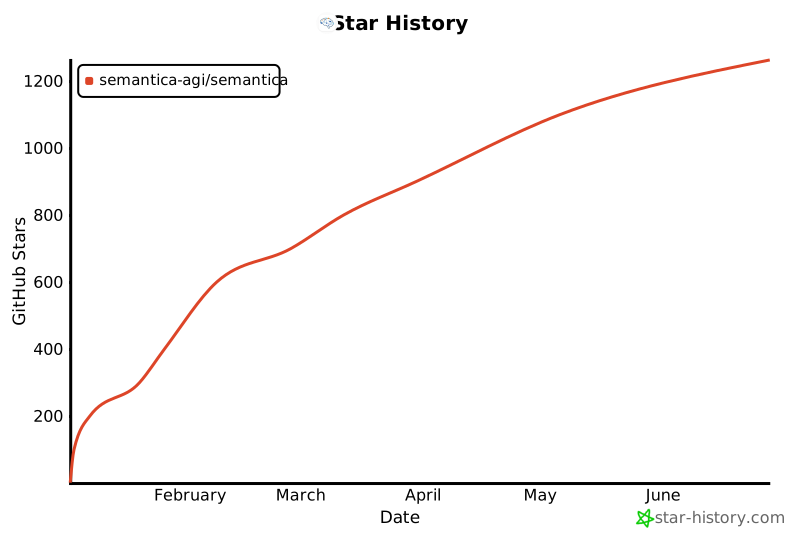
## Star History
---
## Contributors
[](https://github.com/semantica-agi/semantica/graphs/contributors)
---
## Contributing
All contributions are welcome: bug fixes, features, tests, and documentation.
1. Fork the repo and create a branch
2. `pip install -e ".[dev]"`
3. Write tests alongside your changes (`pytest tests/`)
4. Open a PR and tag `@KaifAhmad1` for review
See [CONTRIBUTING.md](CONTRIBUTING.md) for full guidelines.
---
MIT License · Built by [Semantica](https://github.com/semantica-agi)
[GitHub](https://github.com/semantica-agi/semantica) ·
[Discord](https://discord.gg/sV34vps5hH) ·
[Twitter/X](https://x.com/BuildSemantica) ·
[Website](https://getsemantica.ai/) ·
[Docs](https://docs.getsemantica.ai/) ·
[PyPI](https://pypi.org/project/semantica/)
If this project helps you build better AI, a star means a lot.
**[⭐ Star on GitHub →](https://github.com/semantica-agi/semantica)**
[English](https://readme-i18n.com/semantica-agi/semantica?lang=en) · [Deutsch](https://readme-i18n.com/semantica-agi/semantica?lang=de) · [Français](https://readme-i18n.com/semantica-agi/semantica?lang=fr) · [Español](https://readme-i18n.com/semantica-agi/semantica?lang=es) · [Italiano](https://readme-i18n.com/semantica-agi/semantica?lang=it) · [Português](https://readme-i18n.com/semantica-agi/semantica?lang=pt) · [العربية](https://readme-i18n.com/semantica-agi/semantica?lang=ar) · [اردو](https://readme-i18n.com/semantica-agi/semantica?lang=ur) · [हिन्दी](https://readme-i18n.com/semantica-agi/semantica?lang=hi) · [中文](https://readme-i18n.com/semantica-agi/semantica?lang=zh) · [日本語](https://readme-i18n.com/semantica-agi/semantica?lang=ja) · [한국어](https://readme-i18n.com/semantica-agi/semantica?lang=ko)