https://github.com/servirtium/servirtium-java
Service Virtualized HTTP - to help service test automation stay fast and consistent
https://github.com/servirtium/servirtium-java
mock-server mocking-framework service-virtualization servirtium tck test-automation test-doubles testing-tools
Last synced: 5 months ago
JSON representation
Service Virtualized HTTP - to help service test automation stay fast and consistent
- Host: GitHub
- URL: https://github.com/servirtium/servirtium-java
- Owner: servirtium
- License: other
- Created: 2018-11-08T12:51:22.000Z (over 7 years ago)
- Default Branch: master
- Last Pushed: 2023-03-10T01:59:38.000Z (over 3 years ago)
- Last Synced: 2025-07-24T09:45:04.791Z (11 months ago)
- Topics: mock-server, mocking-framework, service-virtualization, servirtium, tck, test-automation, test-doubles, testing-tools
- Language: Java
- Homepage: https://servirtium.dev/
- Size: 1020 KB
- Stars: 18
- Watchers: 4
- Forks: 5
- Open Issues: 9
-
Metadata Files:
- Readme: README.md
- License: LICENSE.txt
Awesome Lists containing this project
README
# Servirtium

Servirtium == Service Virtualized HTTP (for Java) in a record/playback style, with plain
Markdown recordings
Utilization of "Service Virtualization" is best practice towards fast and
consistent test automation. This tech should be used in conjunction with
JUnit/TestNG, etc. Versus alternate technologies, Servirtium utilizes Markdown
for recorded HTTP conversations, which aids readability allows for diffing
to quickly determine if contracts are broken. That last is an important aspect
when Service Virtualization is part of a **Technology Compatibility Kit**
## Design goals
1. By being a "man in the middle" it enables the recording of HTTP conversations and store them in Markdown under
source-control co-located with the automated tests themselves.
2. In playback, Servirtium allows the functionality tested in the service tests to be isolated from potentially flaky
and unquestionably slower "down stack" and external remote services.
3. A diffable format (regular Markdown files) to clearly show the differences between two recordings of the same
conversation, that is co-located with test logic (no database of any sort)
4. Agnostic about other test frameworks: use JUnit 4, JUnit5, TestNG, Cucumber for Java, or JBehave.
5. No process spawning/killing orchestration.
6. One recording per test method, even if that means duplicate sections of markdown over many tests
7. No conditionals or flow control in the recording - no DSL at all.
8. Allowance for modification of recording or playback for simplification/redaction purposes.
9. For use **in the same process** as the test-runner. It is not designed to be a
standalone server, although it can be used that way.
## Design Limitations
1. Just for Java teams presently (needs porting)
3. Not for playback use in "for humans" environments like QA or UAT
## What do recordings look like?
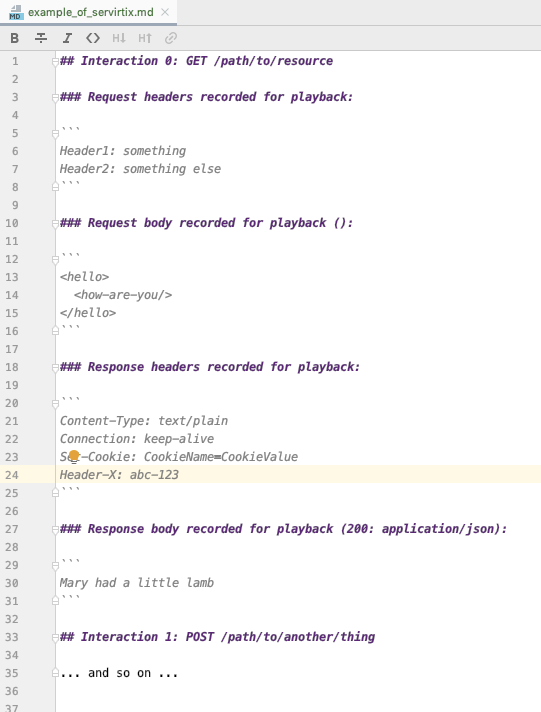
### Raw recording source (Markdown)
Here's a shorted source form for a recorded conversation
### Rendered Markdown in the GitHub UI
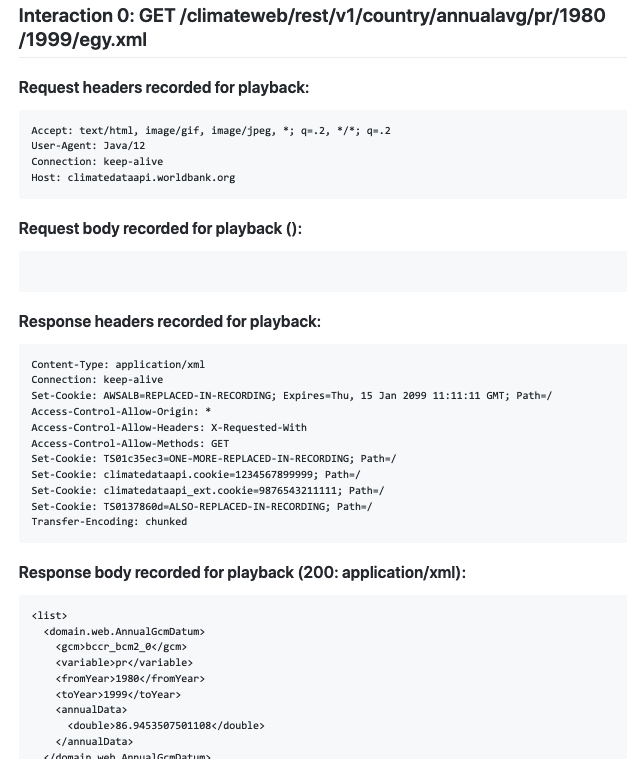
Best to see a real one here [in situ on GitHub](https://github.com/paul-hammant/climate-data-tck/blob/master/src/test/mocks/averageRainfallForEgyptFrom1980to1999Exists.md)
rather than the minimal example above. You can see the rendering there (best for human eyes), but also a snap-shot of
that here:
### More info
See [ExampleSubversionCheckoutRecording.md](https://github.com/paul-hammant/servirtium/blob/master/src/test/resources/ExampleSubversionCheckoutRecording.md)
which was recorded from a real Subversion 'svn' command line client doing it's thing, but
thru Servirtium as a HTTP-proxy. After the recording of that, the replay side of Servirtium was able
to pretend to be Apache+Subversion for a fresh 'svn checkout' command.
[This one](https://github.com/paul-hammant/servirtium/blob/master/src/test/java/com/paulhammant/servirtium/SubversionCheckoutRecorderMain.java)
was the recorder, and [this one](https://github.com/paul-hammant/servirtium/blob/master/src/test/java/com/paulhammant/servirtium/SubversionCheckoutReplayerMain.java)
the replayer for that recorded conversation.
## Implementation Limitations
1. Java only for now, though usable in the broader JVM ecosystem. Ports to other languages
is a direction I'd like to go in. Perhaps a rewrite in Rust, and then bindings back to Java, C#,
Python, Ruby and NodeJs would be a more sustainable route long term.
2. The recorder **isn't very good at handling parallel requests**. Most of the
things you want to test will be serial (and short) but if your client is a browser,
then you should half expect for parallelized operations.
3. Servirtium can't yet listen on over HTTPS.
4. Servirtium can't yet function as a HTTP Proxy server. It must be a "man in the middle",
meaning you have to be able to override the endpoints of services during JUnit/TestNG invocation
in order to be able to record them (and play them back).
5. Some server technologies (like Amazon S3) sign payloads in a way that breaks for middle-man
deployments. See [S3](https://github.com/paul-hammant/servirtium/wiki/S3).
# Notable examples of use
## SvnMerkleizer project - emulation of Subversion in tests
[Read more about two seprate uses of Servirtium for this project](docs/SvnMerkleizer_More_Info.md)
## Climate API demo
The World Bank's Climate Data service turned into a Java library with Servirtium tests:
https://github.com/paul-hammant/climate-data-tck. Direct, record and playback modes of
operation for the same tests.
## Todobackend record and playback
[TodobackendDotComServiceRecording.md](https://github.com/paul-hammant/servirtium/blob/master/src/test/resources/TodobackendDotComServiceRecording.md)
is a recording of the Mocha test site of "TodoBackend.com" against a real Ruby/Sinatra/Heroku
endpoint. This is not an example of something you'd orchestrate in Java/JUnit, but it is
an example of a sophisticated series of interactions over HTTP between a client (the browser)
and that Heroku server. Indeed, the intent of the site is show that multiple backends should be
compatible with that JavaScript/Browser test suite.
[Here's the code for the recorder](https://github.com/paul-hammant/servirtium/blob/master/src/test/java/com/paulhammant/servirtium/SubversionCheckoutRecorderMain.java)
of that, and [here's the code for the replayer](https://github.com/paul-hammant/servirtium/blob/master/src/test/java/com/paulhammant/servirtium/SubversionCheckoutReplayerMain.java)
for that.
Note: playback does not pass all the tests because there's a randomized GUID in the request
payload that changes every time you run the test suite. It gets one third of the way through though.
**Note: this limitation is being resolved, presently**
## Readiness for general industry by lovers of test automation?
A pre 1.0 release is used by a startup Paul is involved with for multiple unrelated external services.
## Servirtium's default listening port
As per [the default port calculator](https://paul-hammant.github.io/default-port-calculator/#servirtium) for 'servirtium': 61417
# Further Wiki Documentation
[Servirtium in Technology Compatibility Kits](../../wiki/Servirtium-in-Technology-Compatibility-Kits)
[Adding-notes-to-a-recording](../../wiki/Adding-notes-to-a-recording)
# Building Servirtium
This builds the binaries, but skips integration tests as they rely on Wikipedia, Reddit
and others which are moving targets sometimes.
```
mvn clean install
```
This builds the binaries, and includes integration tests (that use various services on the web)
```
mvn clean install -Ptests
```
## License
BSD 2-Clause license (open source). Refer to [LICENSE.txt](/paul-hammant/servirtium/blob/master/LICENSE.txt)
## Legal warning
Be careful: your contracts and EULAs with service providers
(as well as application/server makers for on-premises) might not allow you to
reverse engineer their over-the-wire APIs.
A real case: [Reverse engineering of competitor’s software cost company big](http://blog.internetcases.com/2017/10/24/reverse-engineering-of-competitors-software-cost-company-big/) - and you might say that such clauses are needed to prevent licensees from competing with the original company with arguably "stolen" IP.
We (developers and test engineers) might morally think that we should be OK for this, as we're just doing it for
test-automation purposes. No matter, the contracts that are signed often make no such distinction, but
the case above was where the original maker of an API went after a company that was trying to make
something for the same ecosystem without a commercial relation on that specifically.
## Code of Conduct
Be Nice (in lieu of something longer)