https://github.com/sidneys/macos-onscreen-keyboard
macOS On-Screen Keyboard
https://github.com/sidneys/macos-onscreen-keyboard
Last synced: over 1 year ago
JSON representation
macOS On-Screen Keyboard
- Host: GitHub
- URL: https://github.com/sidneys/macos-onscreen-keyboard
- Owner: sidneys
- License: mit
- Created: 2018-06-08T03:47:04.000Z (about 8 years ago)
- Default Branch: master
- Last Pushed: 2018-06-08T03:48:10.000Z (about 8 years ago)
- Last Synced: 2025-02-14T17:58:07.889Z (over 1 year ago)
- Language: JavaScript
- Size: 1.56 MB
- Stars: 0
- Watchers: 3
- Forks: 0
- Open Issues: 0
-
Metadata Files:
- Readme: README.md
- Contributing: CONTRIBUTING.md
- License: LICENSE
Awesome Lists containing this project
README
# PB for Desktop [](http://travis-ci.org/sidneys/pb-for-desktop) [](https://ci.appveyor.com/project/sidneys/pb-for-desktop) [](https://npmjs.com/package/pb-for-desktop)
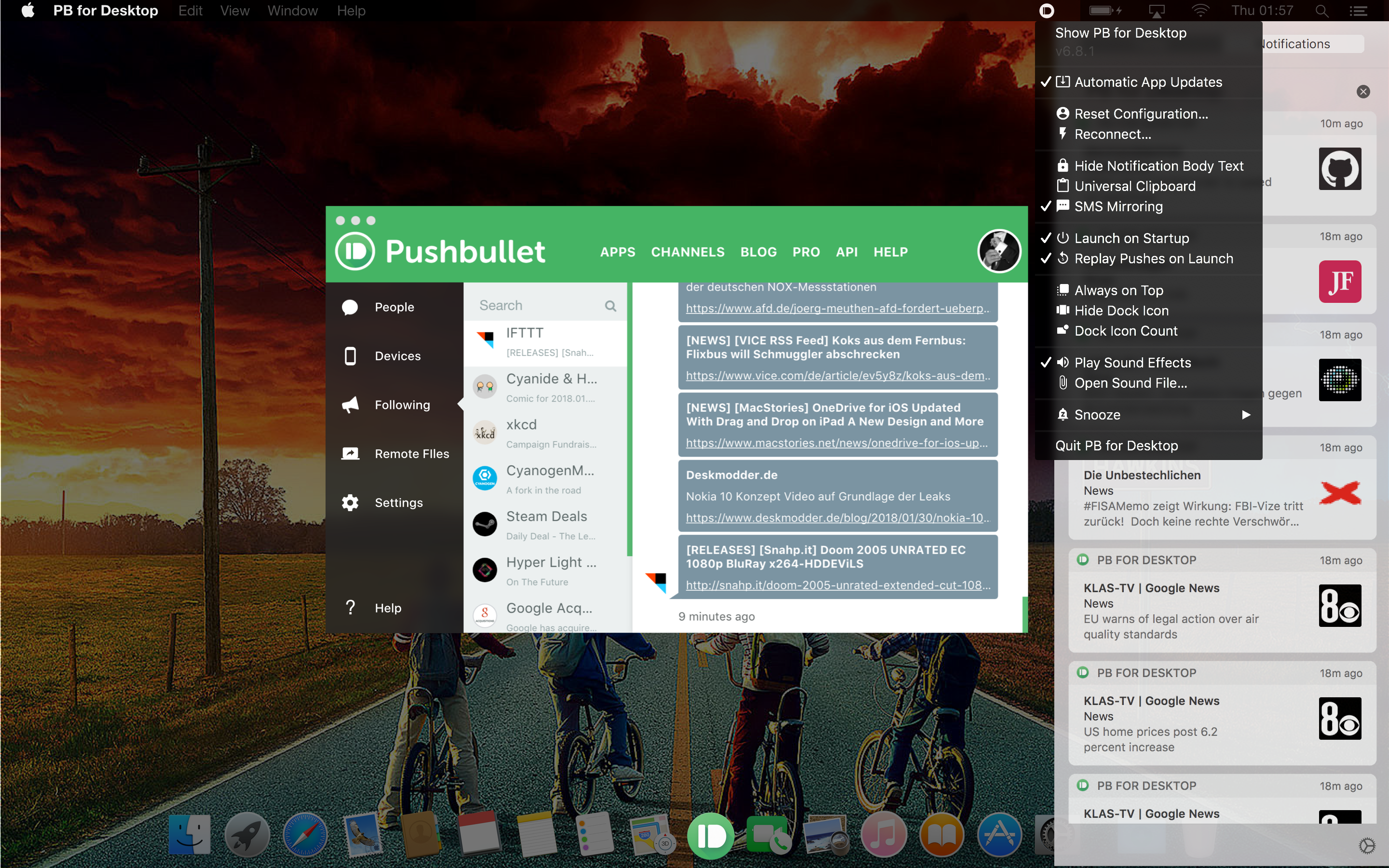
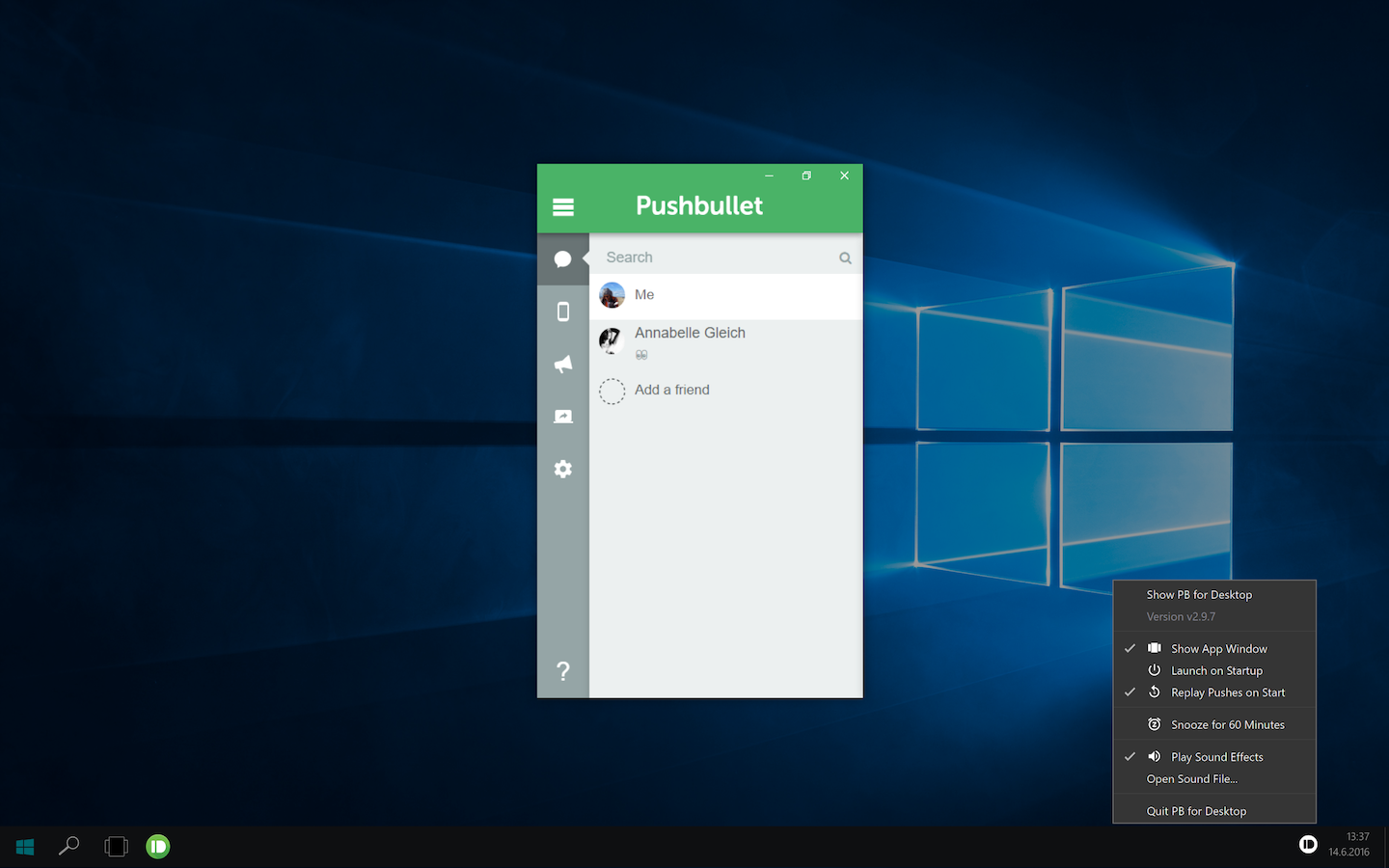
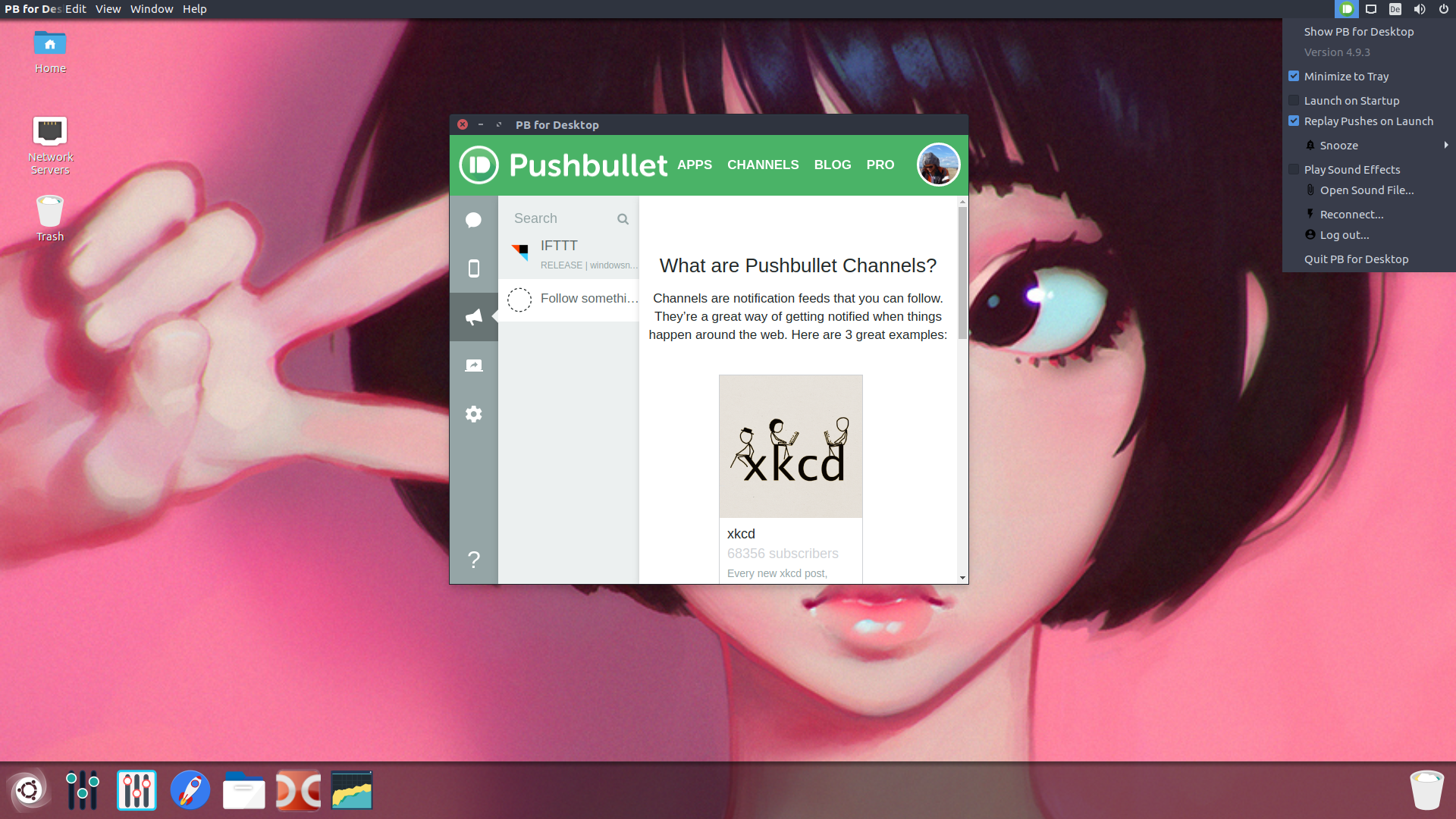
PB for Desktop is a lightweight open-source Desktop app for PushBullet.
Receive native push notifications on macOS, Windows and Linux.

Not affiliated with PushBullet Incorporated.
------
------
> **Native Notifications**
Uses the macOS [Notification Center](https://en.wikipedia.org/wiki/Notification_Center), the Windows 10 [Action Center](https://en.wikipedia.org/wiki/Action_Center) and [libnotify](https://launchpad.net/ubuntu/+source/libnotify) for Linux.
> **Cross-Platform**
Tested on:
- macOS: 10.11, 10.12, 10.13
- Windows 10: 1607, 1703, 1709
- Linux: Ubuntu 16.04/17.04, elementaryOS 0.4, Linuxmint 18
> **Unobtrusive**
Small resource footprint - runs as a macOS Menu Bar app or a Windows System Tray app.
> **Simple Setup**
No wrestling with API-Keys or other technical knowledge required.
Login to Pushbullet using Google or Facebook.
> **Channel Images**
Channel-specific (e.g. [IFTTT](https://ifttt.com/), [Zapier](https://zapier.com/), [Chat](http://lifehacker.com/huge-pushbullet-update-adds-instant-messaging-chat-hea-1714870644)) icon images for most notifications.
> **Push Previews**
Preview thumbnails for pushes containing images.
> **Custom Notification Sound Effect**
Use the default Pushbullet notification sound effect or one of your choice.
Supports `.m4a`, `.mp3`, `.mp4`, `.ogg` and `.wav`.
> **Dedicated Push Target**
Use the *PB for Desktop* PushBullet device to only send pushes to your desktop.
> **Inline Notification SMS Message Reply**
Reply to SMS messages directly within native Desktop notifications (macOS).
> **Mirroring**
Mirror Android notifications (Android).
> **SMS** []()
Send & receive SMS to Android devices.
> **Emoji** []()
Use tags to add emoji to notifications, e.g.: add `{video}` to show a 📺 with every notification.
## Contents
1. [Installation](#installation)
1. [Developers](#development)
1. [Continuous Integration](#continuous-integration)
1. [Roadmap](#roadmap)
1. [Contribute](#contribute)
1. [Author](#author)
### Standard Installation
Grab the latest version here: [Download Pushbullet for Desktop](https://sidneys.github.io/pb-for-desktop/#download)
### Installation as global nodejs module
```bash
npm install --global pb-for-desktop
```
### Sources
Clone the repo and install dependencies.
```shell
git clone https://github.com/sidneys/pb-for-desktop.git pb-for-desktop
cd pb-for-desktop
npm install
```
### Scripts
#### *start*
Runs the app in development mode.
Usage:
```bash
npm run start
```
Parameters:
- `--debug` Start with development tools
- `--livereload` Start with live reload
#### *localsetup*
Install the app in the System app folder and start it.
Usage:
```bash
npm run localsetup
```
Parameters:
- `--build` Rebuild project before installation
- `--debug` Start with development tools
#### *build*
Builds the application and creates platform-specific installation packages (see [requirements](#build-requirements)).
If no parameter is supplied, the current platform is built.
Usage:
```bash
npm run build
```
Parameters:
- `--macos` Build & Package for macOS
- `--windows` Build & Package for Windows
- `--linux` Build & Package for Linux
- `--metadata` Generate Auto-Updater metadata
### Build Requirements
- Building for Windows requires [`wine`](https://winehq.org) and [`mono`](https://nsis.sourceforge.net/Docs/Chapter3.htm) (on macOS, Linux)
- Building for Linux requires [`fakeroot`](https://wiki.debian.org/FakeRoot) and [`dpkg `](https://wiki.ubuntuusers.de/dpkg/) (on macOS, Windows)
- Only macOS can build for other platforms.
#### macOS Build Setup
Install [Homebrew](https://brew.sh), then run:
```bash
brew install wine mono fakeroot dpkg
```
#### Linux Build Setup
```bash
sudo apt-get install wine mono fakeroot dpkg
```
> Turnkey **build-in-the-cloud** integration.
The CI deployment is managed by a custom layer of node scripts and Electron-optimized configuration templates.
Completed Installation packages are deployed to [GitHub Releases](https://github.com/sidneys/pb-for-desktop/masters). Builds for all platforms and architectures take about 5 minutes.
Backed by the open-source-friendly guys at [Travis](http://travis-ci.org/) and AppVeyor](https://ci.appveyor.com/) and running [electron-packager](https://github.com/electron-userland/electron-packager) under the hood.
### Setup
1. [Fork](https://github.com/sidneys/pb-for-desktop/fork) the repo
1. Generate your GitHub [Personal Access Token](https://github.com/settings/tokens) using "repo" as scope. Copy it to the clipboard.
1. **macOS + Linux**
1. Sign in to [Travis](http://travis-ci.org/) using GitHub.
2. Open your [Travis Profile](https://travis-ci.org/profile), click "Sync Account" and wait for the process to complete.
3. Find this repository in the list, enable it and click "⚙" to open its settings.
4. Create a new Environment Variable named **GITHUB_TOKEN**. Paste your Token from step 2 as *value*.
1. **Windows**
1. Sign in to [AppVeyor](https://ci.appveyor.com/) using GitHub.
2. Click on ["New Project"](https://ci.appveyor.com/projects/new), select "GitHub", look up this repo in the list and click "Add".
3. After import navigate to the *Settings* > *Environment* subsection
4. Select "Add Variable", insert **GITHUB_TOKEN** for *name*, paste your Token as *value*. Save.
### Triggering Builds
1. Add a new Tag to start the build process:
```shell
git tag -a v1.0.1
git push --tags
```
The builds are started in parallel and added to the "Releases" page of the GitHub repo (in draft mode).
1. Use the editing feature to publish the new app version.
1. There is no step 3
- [ ] Signed binaries
- [ ] End-To-End Tests (see [Spectron](https://github.com/electron/spectron))
## Contribute 
Read the [contribution documentation](https://github.com/sidneys/pb-for-desktop/blob/master/CONTRIBUTING.md) first.
- [Dev Chat](http://gitter.im/sidneys/pb-for-desktop): Talk about features and suggestions.
- [Issues](http;//github.com/sidneys/pb-for-desktop/issues) File bugs and document issues.
MIT
[sidneys](http://sidneys.github.io) 2017