https://github.com/sileneer/nrp_2022_eee12
LSTM and GRU model to predict the SOH of the batteries
https://github.com/sileneer/nrp_2022_eee12
electrical-engineering electronics-engineering gru lstm machine-learning python
Last synced: 30 days ago
JSON representation
LSTM and GRU model to predict the SOH of the batteries
- Host: GitHub
- URL: https://github.com/sileneer/nrp_2022_eee12
- Owner: sileneer
- License: mit
- Created: 2022-11-15T09:11:03.000Z (over 3 years ago)
- Default Branch: main
- Last Pushed: 2025-08-22T00:10:06.000Z (10 months ago)
- Last Synced: 2025-08-22T02:26:53.836Z (10 months ago)
- Topics: electrical-engineering, electronics-engineering, gru, lstm, machine-learning, python
- Language: Jupyter Notebook
- Homepage:
- Size: 28.6 MB
- Stars: 57
- Watchers: 3
- Forks: 9
- Open Issues: 1
-
Metadata Files:
- Readme: README.md
Awesome Lists containing this project
README
# Data-Driven Method for Li-Ion Battery Health Monitoring
[](https://opensource.org/licenses/MIT)
[](https://www.python.org/downloads/release/python-3100/)
[](https://pytorch.org/)
## Table of Contents
- [Description](#description)
- [Key Features](#key-features)
- [Prerequisites](#prerequisites)
- [Getting Started](#getting-started)
- [Download the Dataset](#download-the-dataset)
- [Setup](#setup)
- [Usage](#usage)
- [Project Structure](#project-structure)
- [Results](#results)
- [Contributing](#contributing)
- [Credits](#credits)
- [Acknowledgement](#acknowledgement)
- [Star History](#star-history)
## Description
Li-Ion batteries are increasingly being used due to sustainable development goals and the numerous benefits they provide compared to other battery technologies. Accurate prediction of State-of-Health (SOH) for Li-Ion batteries has become critically important, and data-driven online SOH prediction models offer an efficient approach to address this challenge.
**We propose a simple yet effective machine learning framework utilizing Long Short-Term Memory (LSTM) and Gated Recurrent Unit (GRU) models for SOH prediction, addressing the common issues of high complexity, low interpretability, and high training costs. Our GRU-based predictions demonstrate high accuracy with an average Root Mean Squared Error (RMSE) of 0.724%.**
## Key Features
- 🔋 **Battery Health Monitoring**: Advanced SOH prediction for Li-Ion batteries
- 🧠 **Deep Learning Models**: Implementation of LSTM and GRU architectures
- 📊 **High Accuracy**: Achieves 0.724% RMSE with GRU model
- 📈 **Data-Driven Approach**: Utilizes real battery degradation data
- 🚀 **Easy to Use**: Simple setup and execution with Jupyter notebooks
- 📚 **Well Documented**: Comprehensive documentation and examples
## Prerequisites
Before you begin, ensure you have the following installed:
- **Python 3.10** or higher
- **Jupyter Notebook** or **JupyterLab**
- **Git** (for cloning the repository)
- At least **4GB RAM** (recommended for dataset processing)
- **500MB disk space** for dataset and dependencies
## Getting Started
### Download the Dataset
This project uses the open source [Oxford Battery Degradation Dataset 1](https://ora.ox.ac.uk/objects/uuid:03ba4b01-cfed-46d3-9b1a-7d4a7bdf6fac) [1].
> **Important**: These data are copyright (c) 2017, The Chancellor, Masters and Scholars of the University of Oxford, and the 'Oxford Battery Degradation Dataset 1' researchers. All rights reserved.
> The dataset is made available under the [Open Database License](http://opendatacommons.org/licenses/odbl/1.0/) with individual contents licensed under the [Database Contents License](http://opendatacommons.org/licenses/dbcl/1.0/).
**Steps to download:**
1. Visit the [dataset download page](https://ora.ox.ac.uk/objects/uuid:03ba4b01-cfed-46d3-9b1a-7d4a7bdf6fac/files/m5ac36a1e2073852e4f1f7dee647909a7)
2. Download the file `Oxford_Battery_Degradation_Dataset_1.mat` (⚠️ **262MB file**)
3. Place the downloaded file in the `./datasets/` directory
📝 **Note**: The [dataset readme file](https://github.com/sileneer/NRP_2022_EEE12/blob/main/datasets/Readme.txt) contains detailed information about the data structure and format.
### Setup
Follow these steps to set up your development environment:
1. **Clone the repository:**
```bash
git clone https://github.com/sileneer/NRP_2022_EEE12.git
cd NRP_2022_EEE12
```
2. **Create a virtual environment:**
```bash
python3.10 -m venv venv
source venv/bin/activate # On Windows: venv\Scripts\activate
```
3. **Install dependencies:**
```bash
pip install -r requirements.txt
```
4. **Launch Jupyter Notebook:**
```bash
jupyter notebook
```
## Usage
Once you have completed the setup and downloaded the dataset:
1. **Open the main notebook:**
- Launch Jupyter Notebook: `jupyter notebook`
- Open `main_torch.ipynb`
2. **Run the analysis:**
- Execute cells sequentially to load data, train models, and generate predictions
- The notebook includes both LSTM and GRU model implementations
- Results and visualizations will be generated inline
3. **Model Training:**
- The notebook automatically loads the Oxford dataset
- Preprocessing steps include data normalization and sequence preparation
- Both LSTM and GRU models are trained and compared
## Project Structure
```
NRP_2022_EEE12/
├── datasets/ # Dataset directory
│ ├── Readme.txt # Dataset documentation
│ └── Oxford_Battery_...mat # Main dataset (download required)
├── literature_reviews/ # Research papers and references
├── saved_models/ # Trained model checkpoints
├── main_torch.ipynb # Main analysis notebook
├── requirements.txt # Python dependencies
├── README.md # This file
└── LICENCE # MIT License
```
## Results
Our machine learning framework demonstrates excellent performance in predicting Li-Ion battery State-of-Health:
- **GRU Model Performance**:
- Average RMSE: **0.724%**
- High accuracy in SOH prediction
- Efficient training time
- **LSTM Model Performance**:
- Competitive accuracy
- Good generalization across different battery cells
The models successfully address common challenges in battery health monitoring:
- ✅ **Low Complexity**: Simple architecture easy to understand and implement
- ✅ **High Interpretability**: Clear model behavior and prediction rationale
- ✅ **Low Training Cost**: Efficient training process with minimal computational requirements
## Contributing
Contributions are what make the open source community such an amazing place to learn, inspire, and create. Any contributions you make are **greatly appreciated**.
If you have a suggestion that would make this better, please fork the repo and create a pull request. You can also simply open an issue with the tag "enhancement".
Don't forget to give the project a star! Thanks again!
**How to contribute:**
1. **Fork the Project**
2. **Create your Feature Branch** (`git checkout -b feature/AmazingFeature`)
3. **Commit your Changes** (`git commit -m 'Add some AmazingFeature'`)
4. **Push to the Branch** (`git push origin feature/AmazingFeature`)
5. **Open a Pull Request**
## Credits
This project uses the following open source libraries and frameworks:
- **[PyTorch](https://pytorch.org/)** - Deep learning framework for model implementation
- **[NumPy](https://numpy.org/)** - Numerical computing library
- **[Pandas](https://pandas.pydata.org/)** - Data manipulation and analysis
- **[Matplotlib](https://matplotlib.org/)** - Plotting and visualization
- **[Scikit-learn](https://scikit-learn.org/)** - Machine learning utilities
- **[SciPy](https://scipy.org/)** - Scientific computing library
## Acknowledgement
This project is licensed under the [MIT License](https://github.com/sileneer/NRP_2022_EEE12/blob/main/LICENCE).
We extend our sincere appreciation to **David Howey** and **Christoph Birkl** for their invaluable work in collecting the `Oxford_Battery_Degradation_Dataset_1` and their ongoing research contributions. Their work can be found at: https://scholar.google.co.uk/citations?hl=en&user=AZdBXIkAAAAJ&view_op=list_works&sortby=pubdate
### References
[1] Christoph R. Birkl, "Diagnosis and Prognosis of Degradation in Lithium-Ion Batteries", PhD thesis, Department of Engineering Science, University of Oxford, 2017.
## Star History
[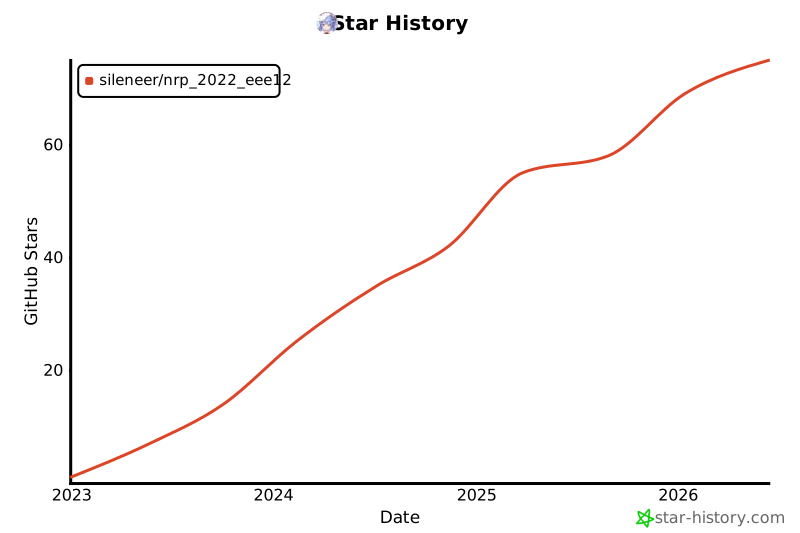](https://star-history.com/#sileneer/NRP_2022_EEE12&Date)