https://github.com/sinzlab/laminr
Learning and Aligning Manifolds using Implicit Neural Representations
https://github.com/sinzlab/laminr
Last synced: 6 months ago
JSON representation
Learning and Aligning Manifolds using Implicit Neural Representations
- Host: GitHub
- URL: https://github.com/sinzlab/laminr
- Owner: sinzlab
- License: other
- Created: 2025-02-05T18:40:48.000Z (over 1 year ago)
- Default Branch: main
- Last Pushed: 2025-11-21T13:05:03.000Z (8 months ago)
- Last Synced: 2025-11-21T15:10:30.991Z (8 months ago)
- Language: Python
- Size: 1.12 MB
- Stars: 5
- Watchers: 4
- Forks: 4
- Open Issues: 1
-
Metadata Files:
- Readme: README.md
- License: LICENSE.md
- Citation: CITATION.cff
Awesome Lists containing this project
README

[](https://colab.research.google.com/github/sinzlab/laminr/blob/main/examples/laminr_quick_start.ipynb)
[](https://pypi.org/project/laminr/)
[-CA3FE6.svg?style=flat)](https://openreview.net/forum?id=kbjJ9ZOakb)
[](https://youtu.be/psCQ65zjqPc?si=TjOVdUhLTYQ6JeVn)
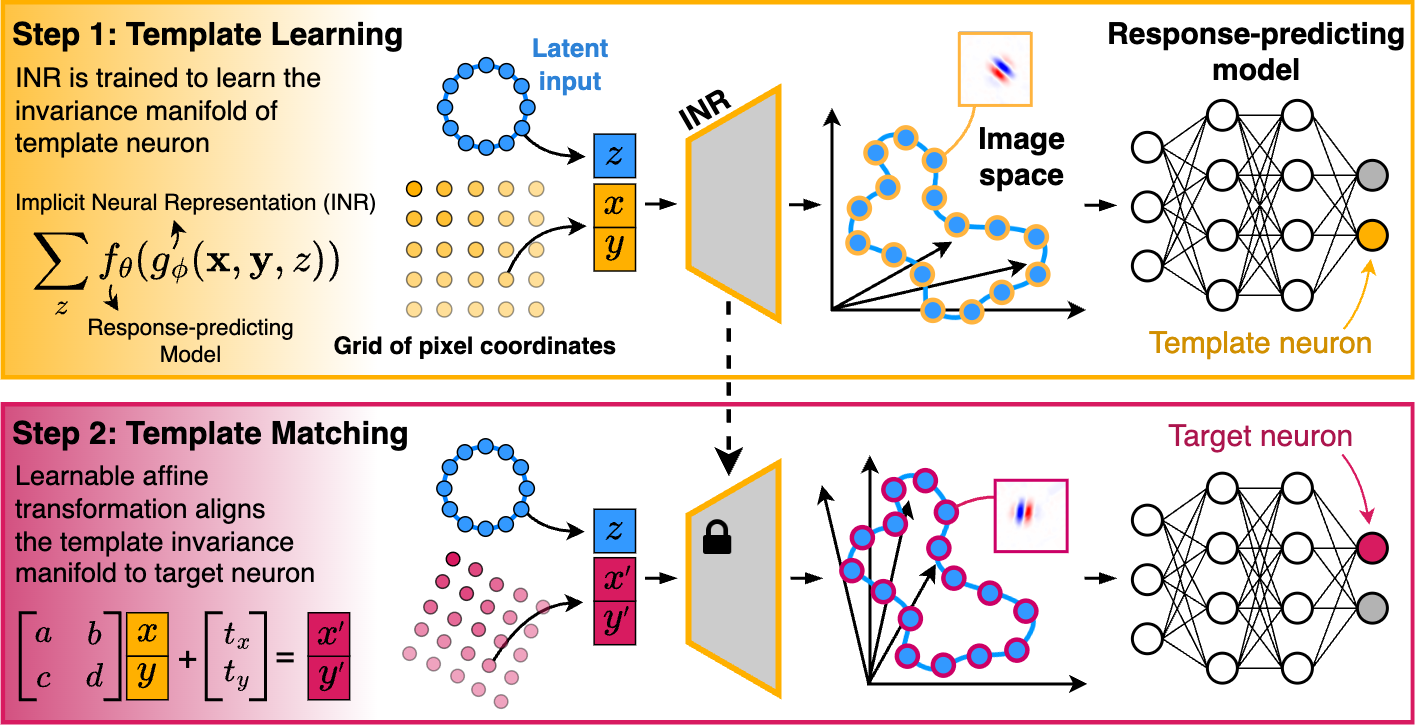
**LAMINR** (**L**earning and **A**ligning **M**anifolds of Single-Neuron Invariances using **I**mplicit **N**eural **R**epresentations) enables the **systematic discovery and alignment of invariance manifolds** in stimulus space for visual sensory neurons, providing a principled way to characterize and compare neuronal invariances at the **population level**, independent of nuisance receptive field properties such as position, size, and orientation.
### 🚀 Highlights
- **Continuous Invariance Manifold Learning:** Identifies the full space of stimuli that elicit near-maximal responses from a neuron.
- **Alignment Across Neurons:** Learns transformations that align invariance manifolds across neurons, revealing shared invariance properties.
- **Functional Clustering:** Enables clustering neurons into distinct functional types based on their invariance properties.
- **Model-Agnostic:** Can be applied to any robust response-predicting model of biological neurons.
## 🛠 Installation
You can install LAMINR using one of the following methods:
### 1️⃣ Using `pip`
```bash
pip install laminr
```
### 2️⃣ Via GitHub (Latest Version)
```bash
pip install git+https://github.com/sinzlab/laminr.git
```
## 🔥 Quick Start
Here's a simple example of how to use **LAMINR** to learn and align invariance manifolds.
[](https://colab.research.google.com/github/sinzlab/laminr/blob/main/examples/laminr_quick_start.ipynb)
```python
from laminr import neuron_models, get_mei_dict, InvarianceManifold
device = "cuda"
input_shape = [1, 100, 100] # (channels, height, width)
# Load the trained neuron model
model = neuron_models.simulated("demo1", img_res=input_shape[1:]).to(device)
# Generate MEIs (Maximally Exciting Inputs)
image_constraints = {
"pixel_value_lower_bound": -1.0,
"pixel_value_upper_bound": 1.0,
"required_img_norm": 1.0,
}
meis_dict = get_mei_dict(model, input_shape, **image_constraints)
# Initialize the invariance manifold pipeline
inv_manifold = InvarianceManifold(model, meis_dict, **image_constraints)
# Learn invariance manifold for neuron 0 (template)
template_idx = 0
template_imgs, template_activations = inv_manifold.learn(template_idx)
# Align the template to neurons 1 and 2
target_idxs = [1, 2]
aligned_imgs, aligned_activations = inv_manifold.match(target_idxs)
```
## 🐳 Running with Docker
We have provided a Dockerfile for building an image with LAMINR pre-installed. Ensure that both **`docker`** and **`docker-compose`** are installed on your system.
Follow the steps below to run **LAMINR** inside a Docker container with **Jupyter Lab**.
**1. Clone the repository and navigate to the project directory:**
```bash
git clone https://github.com/sinzlab/laminr.git
cd laminr
```
**2. Run the following command inside the directory:**
```bash
docker compose run -p 10101:8888 examples
```
This command:
- **Builds the Docker image** and creates a container.
- **Exposes Jupyter Lab** on port **10101**.
**3. Access Jupyter Lab:**
Jupyter Lab will launch in the **examples folder**, which you can open in your browser via
[localhost:10101](http://localhost:10101) (the token can be found in the terminal logs).
## 🛠 Questions & Contributions
If you encounter any issues while using the method, please create an [Issue](https://github.com/sinzlab/laminr/issues) on GitHub.
We welcome and appreciate contributions to the package! Feel free to open an [Issue](https://github.com/sinzlab/laminr/issues) or submit a [Pull Request](https://github.com/sinzlab/laminr/pulls) for new features.
For other questions or project collaboration inquiries, please contact mohammadbashiri93@gmail.com or loocabaroni@gmail.com.
## 📜 License
This package is licensed under the **Creative Commons Attribution-NonCommercial 4.0 International (CC BY-NC 4.0) License**. Briefly:
- **Attribution Required**: You must credit the original authors and indicate if changes were made.
- **NonCommercial Use Only**: This package may not be used for commercial purposes without explicit permission.
- **No Additional Restrictions**: You may not apply legal terms that prevent others from using this package under these terms.
For full details, see the [CC BY-NC 4.0 License](https://creativecommons.org/licenses/by-nc/4.0/).
For commercial use inquiries, please contact: mohammadbashiri93@gmail.com.
## 📖 Paper
**ICLR 2025 (Oral)**: [Learning and Aligning Single-Neuron Invariance Manifolds in Visual Cortex](https://openreview.net/forum?id=kbjJ9ZOakb)
**Authors**: Mohammad Bashiri*, Luca Baroni*, Ján Antolík, Fabian H. Sinz. (* denotes equal contribution)
Please cite our work if you find it useful:
```bibtex
@inproceedings{bashiri2025laminr,
title={Learning and Aligning Single-Neuron Invariance Manifolds in Visual Cortex},
author={Bashiri, Mohammad and Baroni, Luca and Antolík, Ján and Sinz, Fabian H.},
booktitle={International Conference on Learning Representations (ICLR)},
year={2025}
}
```