https://github.com/slkiser/opencode-quota
OpenCode quota & tokens usage with zero context window pollution. Supports OpenCode Go, Cursor, GitHub Copilot, OpenAl (Plus/Pro), Kimi Code, Alibaba Coding Plan, Chutes Al, Google Antigravity, Z.ai Coding Plan and more.
https://github.com/slkiser/opencode-quota
opencode opencode-plugin opencode-plugins quota quota-monitor token-usage tokens usage
Last synced: about 1 month ago
JSON representation
OpenCode quota & tokens usage with zero context window pollution. Supports OpenCode Go, Cursor, GitHub Copilot, OpenAl (Plus/Pro), Kimi Code, Alibaba Coding Plan, Chutes Al, Google Antigravity, Z.ai Coding Plan and more.
- Host: GitHub
- URL: https://github.com/slkiser/opencode-quota
- Owner: slkiser
- License: mit
- Created: 2026-01-22T22:45:14.000Z (6 months ago)
- Default Branch: main
- Last Pushed: 2026-05-15T23:19:42.000Z (2 months ago)
- Last Synced: 2026-05-15T23:39:09.366Z (about 2 months ago)
- Topics: opencode, opencode-plugin, opencode-plugins, quota, quota-monitor, token-usage, tokens, usage
- Language: TypeScript
- Homepage:
- Size: 11.4 MB
- Stars: 439
- Watchers: 1
- Forks: 33
- Open Issues: 4
-
Metadata Files:
- Readme: README.md
- Contributing: CONTRIBUTING.md
- License: LICENSE
Awesome Lists containing this project
README

Quota, usage, and token visibility for OpenCode.




[](https://github.com/slkiser/opencode-quota)
---
## Install
```bash
npx @slkiser/opencode-quota init
```
> [!IMPORTANT]
> OpenCode `>= 1.4.3` and Node.js `>= 20` are required.
The installer adds missing plugin/config entries and keeps your unrelated settings. Re-running it updates only installer-owned Quota UI choices.
### What the installer asks
| Question | Pick this when you want... |
| --- | --- |
| Install scope | This repo/worktree only, or your global OpenCode config. |
| Quota UI | Sidebar panel, toasts, compact status line, terminal/slash-command only, or a mix. |
| Provider mode | Auto-detect providers, or choose a provider list yourself. |
| Quota reset periods | Show one reset period per provider, or all known reset periods. |
| Quota percentage meaning | Show quota remaining, or quota already used. |
| Session token details | Hide token counts for shorter output, or show them when available. |
| Maintainer announcements | Keep bundled maintainer announcements enabled, or opt out. Yes is the default; Sidebar or Compact status installs the TUI plugin, where home notices can appear. |
### After install
1. Restart OpenCode.
2. Run `/quota`.
3. If something looks wrong, run `/quota_status`.
4. If you kept maintainer announcements enabled and installed the TUI plugin, the home screen can show `Notice: Maintainer announcement available. Run /quota_announcements.` or the plural count form. Without the TUI plugin, the same count-only notice can appear once after the first visible quota toast. Run `/quota_announcements` to read active notices.
5. If you enabled the Sidebar panel, open the session sidebar and look for `Quota`.
6. If you enabled Compact status line, look for the home-bottom quota line and the chat/session prompt quota line.
### Terminal-only check
Run without installing the binary first:
```bash
npx @slkiser/opencode-quota show
```
Or, if `opencode-quota` is already on your `PATH`:
```bash
opencode-quota show --provider copilot
```
## What you get
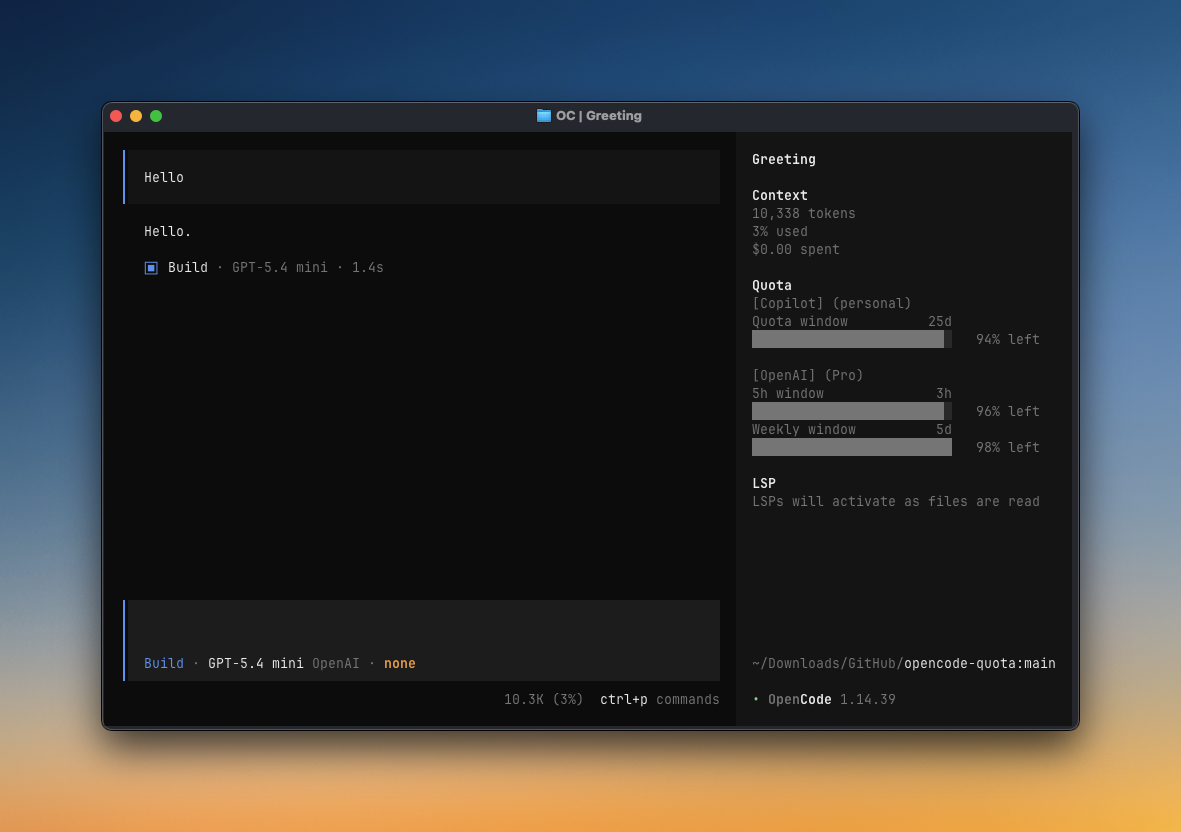
- A `Quota` Sidebar panel in the TUI
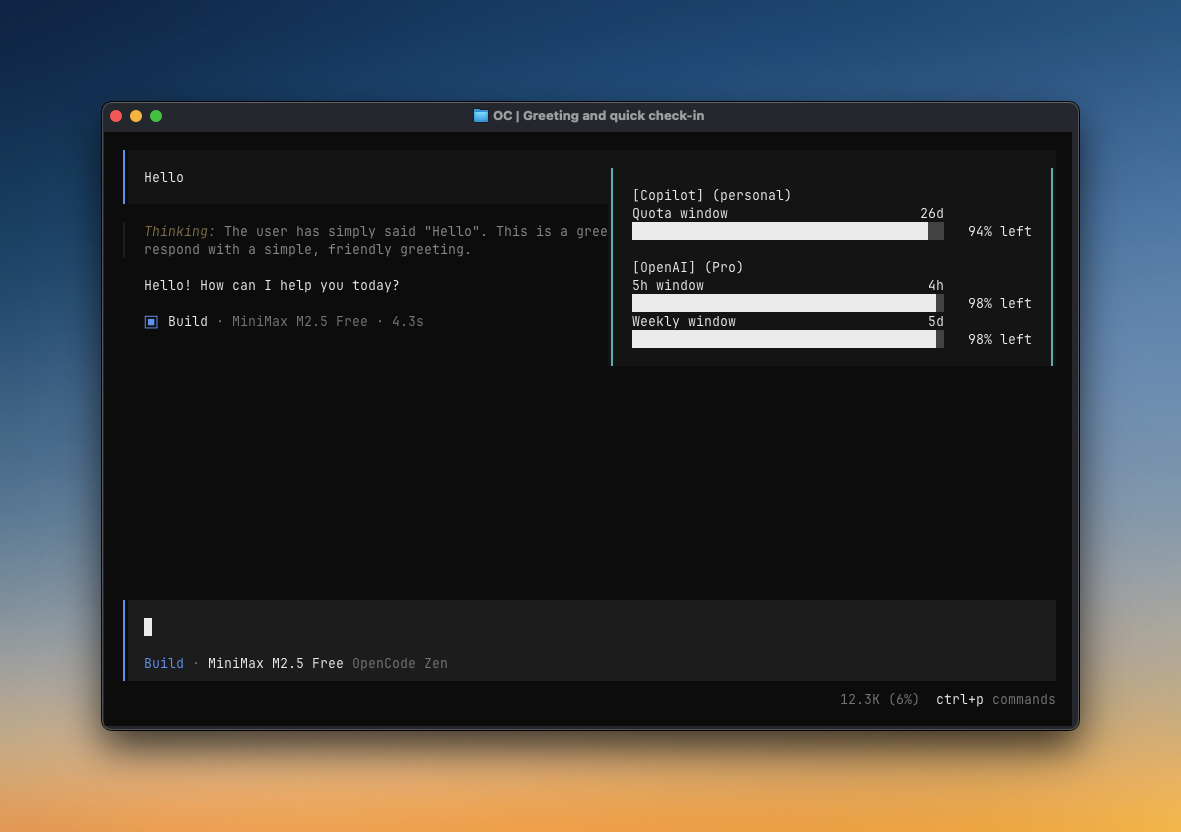
- Popup quota toasts in OpenCode
- A Compact status line in the TUI
- `/quota`, `/quota_status`, and `/quota_announcements` slash commands
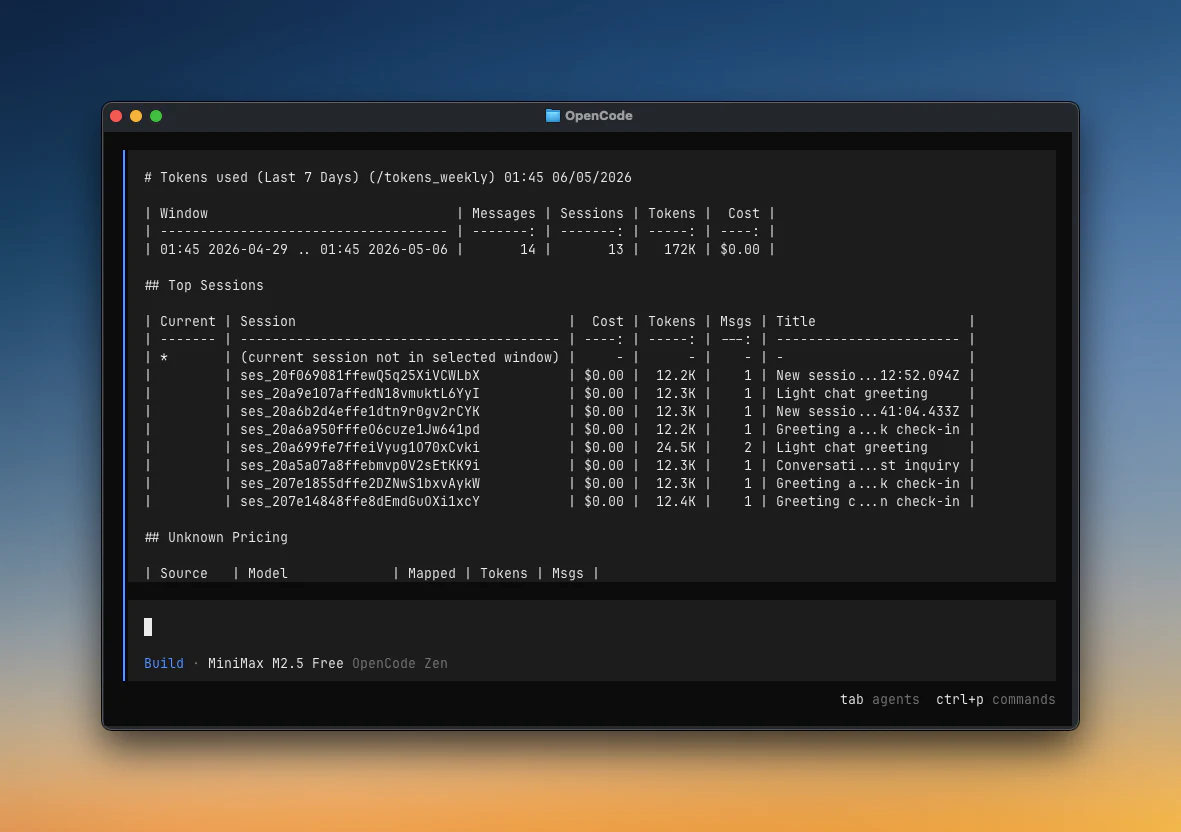
- Token reports such as `/tokens_today` and `/tokens_weekly`
- Provider diagnostics for auth, quota sources, pricing, and bundled maintainer announcements

Sidebar panel
Toast
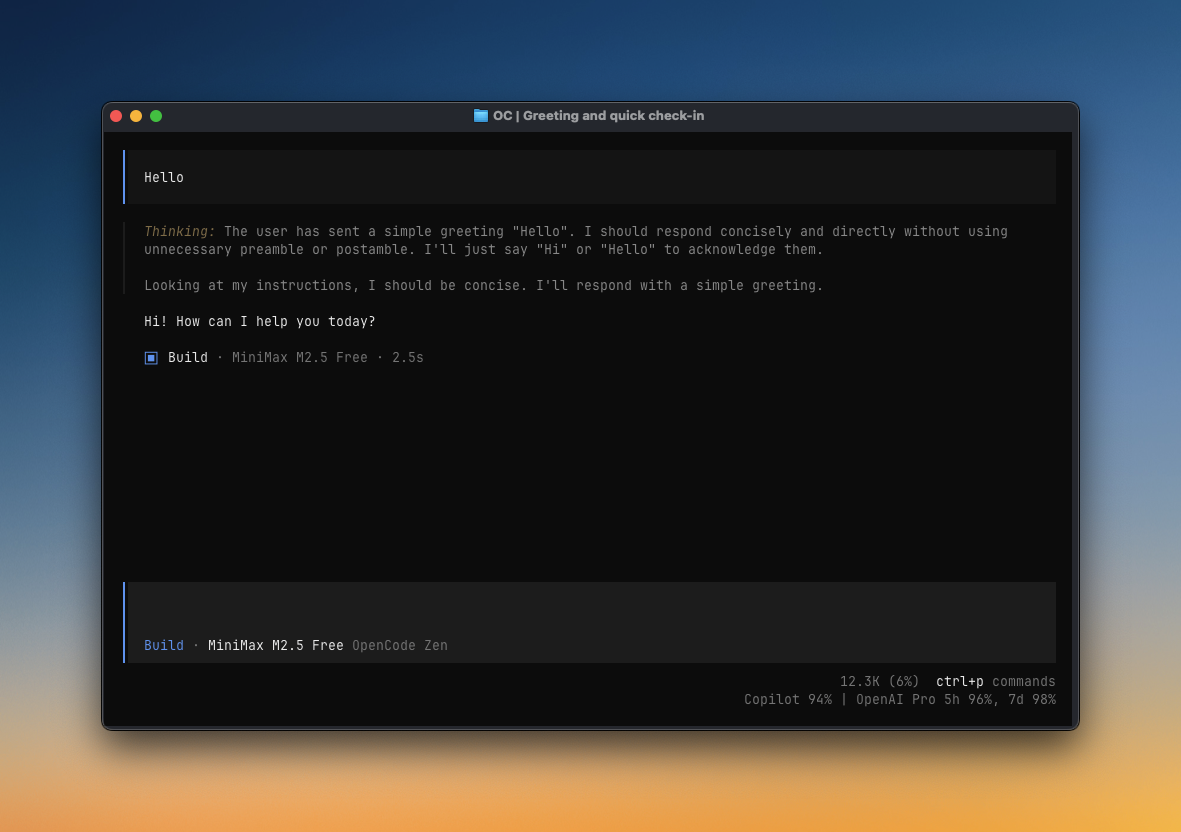
Compact status line
/tokens_weekly report
## Manual setup
Use the installer when possible. For manual setup, use the same OpenCode config location you would pick in the installer:
- **Project install:** files live in your repo/worktree.
- **Global install:** files live in your OpenCode config directory, usually `~/.config/opencode`.
- If you set `OPENCODE_CONFIG_DIR`, use that directory instead.
### 1. Add the server plugin (required)
This enables providers, slash commands, terminal checks, and popup toasts. Add this to `opencode.json` or `opencode.jsonc`:
```jsonc
{
"$schema": "https://opencode.ai/config.json",
"plugin": ["@slkiser/opencode-quota"],
}
```
### 2. Add the TUI plugin (for Sidebar panel, Compact status line, or announcement home notices)
If you want the Sidebar panel, Compact status line, or maintainer announcement home notices, also add this to `tui.json` or `tui.jsonc`:
```jsonc
{
"$schema": "https://opencode.ai/tui.json",
"plugin": ["@slkiser/opencode-quota"],
}
```
### 3. Add quota settings
Create or edit `opencode-quota/quota-toast.json` **next to the `opencode.json` / `tui.json` file above**. For a project install, that means:
```text
/opencode-quota/quota-toast.json
```
Start with this, then adjust the UI choices in the next section:
```jsonc
{
"enabledProviders": "auto",
"enableToast": true,
"tuiSidebarPanel": {
"enabled": true,
},
"tuiCompactStatus": {
"enabled": false,
},
"maintainerAnnouncements": {
"enabled": true,
"home": true,
},
}
```
> [!TIP]
> Run `/quota_status` to see the exact config paths OpenCode Quota loaded.
## Choose your UI surfaces
All UI surfaces use the same quota data. Put these settings in `opencode-quota/quota-toast.json`, not `tui.json`.
| UI surface | Config | Notes |
| --- | --- | --- |
| Sidebar panel | `tuiSidebarPanel.enabled: true` | Full `Quota` panel in OpenCode's session sidebar. Requires the TUI plugin entry above. |
| Toast | `enableToast: true` | Popup toast after idle/question/compact events. Requires the server plugin entry above. |
| Compact status line | `tuiCompactStatus.enabled: true` | Short text-only quota line at the home bottom and chat/session prompt locations, for example `Copilot 94% | OpenAI Pro 5h 100%, 7d 100%`. Requires the TUI plugin entry above. |
| Maintainer announcement notice | `maintainerAnnouncements.enabled: true`, `maintainerAnnouncements.home: true` | Prefers the TUI home notice when the quota TUI plugin is configured. Without the TUI plugin, shows the same count-only notice once after the first visible quota toast. |
| Terminal/slash only | `enableToast: false`, `tuiSidebarPanel.enabled: false`, `tuiCompactStatus.enabled: false`, `maintainerAnnouncements.enabled: false` | Keeps `/quota`, `/quota_status`, `/quota_announcements`, and terminal checks. |
Selecting Compact status line in the installer enables both compact surfaces by default. To keep compact status home-only, set `tuiCompactStatus.sessionPrompt: false`.
In the sidebar panel, click the `Quota` header to switch between the compact summary (`▶ Quota`) and the detailed all-windows view (`▼ Quota`). OpenCode remembers the last sidebar state for the plugin.
For more examples, see [Common configuration](#common-configuration). For every option, see [Full configuration reference](#full-configuration-reference).
## Commands
| Command | What it shows |
| --- | --- |
| `opencode-quota show` | Terminal quota-only quick glance |
| `/quota` | Detailed quota report |
| `/quota_status` | Config, provider, auth, pricing, `enabled`/`home` announcement config, `source=bundled_only`, `network=false`, and active/future/expired announcement counts |
| `/quota_announcements` | List active bundled maintainer notices |
| `/pricing_refresh` | Refresh local runtime pricing from `models.dev` |
| `/tokens_today` | Tokens used today |
| `/tokens_daily` | Tokens used in the last 24 hours |
| `/tokens_weekly` | Tokens used in the last 7 days |
| `/tokens_monthly` | Tokens used in the last 30 days, including pricing |
| `/tokens_all` | Tokens used across all local history |
| `/tokens_session` | Tokens used in the current session |
| `/tokens_session_all` | Current session plus descendant sessions |
| `/tokens_between` | Tokens used between `YYYY-MM-DD YYYY-MM-DD` |
## Providers
Most providers work automatically. If a provider has a “Needs setup” link, open that setup note only if you use that provider.
| Provider | Setup | Quota source |
| --- | --- | --- |
| Anthropic (Claude) | [Needs setup](#anthropic-claude) | Local CLI or OAuth usage |
| GitHub Copilot | Usually automatic | Remote API |
| OpenAI | Automatic | Remote API |
| Cursor | [Needs setup](#cursor) | Local estimation |
| Qwen Code | [Needs setup](#qwen-code) | Local estimation |
| Alibaba Coding Plan | Automatic | Local estimation |
| MiniMax Coding Plan | Automatic | Remote API |
| MiniMax Coding Plan (CN) | Automatic | Remote API |
| Kimi Code | Automatic | Remote API |
| Chutes AI | Usually automatic | Remote API |
| Crof.ai | Manual env/config/auth | Remote API |
| Synthetic | Automatic | Remote API |
| Google Antigravity | [Needs setup](#google-antigravity) | Remote API |
| Gemini CLI | [Needs setup](#gemini-cli) | Remote API |
| Z.ai Coding Plan | Automatic | Remote API |
| Zhipu Coding Plan | Automatic | Remote API |
| NanoGPT | Usually automatic | Remote API |
| DeepSeek | Usually automatic | Remote API balance |
| Ollama Cloud | [Needs setup](#ollama-cloud) | Dashboard scraping |
| OpenCode Go | [Needs setup](#opencode-go) | Dashboard scraping |
## Common configuration
Customize these settings in `opencode-quota/quota-toast.json`, next to the OpenCode config for your install scope.
Common locations:
- Project install: `/opencode-quota/quota-toast.json`
- Global install: usually `~/.config/opencode/opencode-quota/quota-toast.json`
- Custom config dir: `$OPENCODE_CONFIG_DIR/opencode-quota/quota-toast.json`
If you are unsure, run `/quota_status`; it prints the config path it loaded.
### Maintainer announcements and privacy
Announcements are bundled only: no remote fetches, announcement telemetry, or persisted dismiss state. Use `/quota_announcements` to read active notices and `/quota_status` for counts/diagnostics. See **Configure maintainer announcements** below for options.
Choose providers explicitly
```jsonc
{
"enabledProviders": ["copilot", "openai", "google-gemini-cli"],
}
```
Show all quota reset periods
```jsonc
{
"formatStyle": "allWindows",
}
```
Show used percentages
```jsonc
{
"percentDisplayMode": "used",
}
```
Turn off popup toasts
Keeps `/quota`, `/quota_status`, terminal checks, and any enabled UI surfaces.
```jsonc
{
"enableToast": false,
}
```
Configure maintainer announcements
```jsonc
{
"maintainerAnnouncements": {
"enabled": true,
"home": true,
},
}
```
Set `enabled: false` to disable automatic announcement surfaces. `/quota_announcements` lists active bundled notices when announcements are enabled.
Turn off the Sidebar panel
Useful when you want Compact status line only, toasts only, or slash commands only.
```jsonc
{
"tuiSidebarPanel": {
"enabled": false,
},
}
```
Keep Compact status line on home only
Useful when you want the compact line on the home screen but not in the chat/session prompt area.
```jsonc
{
"tuiCompactStatus": {
"enabled": true,
"homeBottom": true,
"sessionPrompt": false,
},
}
```
Increase provider request timeout
```jsonc
{
"requestTimeoutMs": 12000,
}
```
Advanced: legacy config sync
By default, the installer writes quota settings only to `opencode-quota/quota-toast.json`. If you also want it to write the legacy OpenCode block, run:
```bash
npx @slkiser/opencode-quota init --sync-legacy-config
```
This is only for users who intentionally want `experimental.quotaToast` mirrored into `opencode.json` / `opencode.jsonc`.
## Full configuration reference
Settings go in the same `opencode-quota/quota-toast.json` sidecar described above.
Existing `experimental.quotaToast` settings still work when no sidecar file exists. Quota settings do not live in `tui.json`.
All settings
### Core/shared settings
| Option | Default | Meaning |
| --- | --- | --- |
| `enabled` | `true` | Master switch for quota collection and handled slash commands. When `false`, `/quota`, `/quota_status`, `/pricing_refresh`, and `/tokens_*` are handled as no-ops. |
| `enabledProviders` | `"auto"` | Auto-detect providers, or set an explicit provider list. |
| `minIntervalMs` | `300000` | Minimum fetch interval between provider updates. |
| `requestTimeoutMs` | `5000` | Remote provider request timeout in milliseconds. |
| `formatStyle` | `singleWindow` | Shared quota reset-period display for popup toasts and the Sidebar panel: `singleWindow` shows one reset period per provider; `allWindows` shows all reset periods per provider. Legacy `classic`/`grouped` aliases are still accepted. |
| `percentDisplayMode` | `remaining` | Shared quota percentage meaning for popup toasts and the Sidebar panel: `remaining` shows quota left; `used` shows quota consumed. `/quota` keeps its existing remaining-percent output. |
| `onlyCurrentModel` | `false` | Filter quota rows to the current model/provider when that session selection can be resolved. |
| `showSessionTokens` | `true` | Show the `Session input/output tokens` section when session token data is available. When cached input is present, the section keeps the legacy `in/out` layout and appends cached input in parentheses next to the input amount. |
| `pricingSnapshot.source` | `"auto"` | Token pricing snapshot selection for `/tokens_*`: `auto`, `bundled`, or `runtime`. |
| `pricingSnapshot.autoRefresh` | `7` | Refresh stale local pricing data after this many days. |
### Toast settings
| Option | Default | Meaning |
| --- | --- | --- |
| `enableToast` | `true` | Show popup toasts. Disabling this does not disable `/quota` or UI surfaces. |
| `toastDurationMs` | `9000` | Toast duration in milliseconds. |
| `showOnIdle` | `true` | Show a toast on the idle trigger. |
| `showOnQuestion` | `true` | Show a toast after a question/assistant response. |
| `showOnCompact` | `true` | Show a toast after session compaction. |
| `showOnBothFail` | `true` | Show a fallback toast when providers attempted quota reads and all failed. |
| `layout.maxWidth` | `50` | Toast formatting width target. |
| `layout.narrowAt` | `42` | Toast compact-layout breakpoint. |
| `layout.tinyAt` | `32` | Toast tiny-layout breakpoint. |
| `debug` | `false` | Append toast debug context when troubleshooting. |
### TUI settings
| Option | Default | Meaning |
| --- | --- | --- |
| `tuiSidebarPanel.enabled` | `true` | Show the Sidebar `Quota` panel when the TUI plugin is installed. Click the panel header to toggle between compact summary and detailed all-windows views; OpenCode remembers the last state. |
| `tuiCompactStatus.enabled` | `false` | Opt in to Compact status line UI surfaces. |
| `tuiCompactStatus.homeBottom` | `true` | Show the Compact status line at the home bottom location. |
| `tuiCompactStatus.sessionPrompt` | `true` | Show the Compact status line by wrapping the TUI session prompt. Disable this if you only want the home-bottom line. |
| `tuiCompactStatus.suppressWhenNativeProviderQuota` | `true` | Hide the Compact status line when OpenCode exposes native provider-quota support. |
| `tuiCompactStatus.maxWidth` | `96` | Maximum Compact status line text width. |
### Maintainer announcement settings
| Option | Default | Meaning |
| --- | --- | --- |
| `maintainerAnnouncements.enabled` | `true` | Enable bundled maintainer announcements. |
| `maintainerAnnouncements.home` | `true` | Show the count-only notice on TUI home when the quota TUI plugin is configured, or as a one-shot toast fallback after a visible quota toast when it is not. |
### Provider-specific settings
| Option | Default | Meaning |
| --- | --- | --- |
| `anthropicBinaryPath` | `"claude"` | Command/path used for local Claude CLI probing. |
| `googleModels` | `["CLAUDE"]` | Google model keys to query: `CLAUDE`, `G3PRO`, `G3FLASH`, `G3IMAGE`. |
| `opencodeGoWindows` | `["rolling", "weekly", "monthly"]` | OpenCode Go usage windows to display. |
| `alibabaCodingPlanTier` | `"lite"` | Fallback Alibaba Coding Plan tier when auth does not include `tier`. |
| `cursorPlan` | `"none"` | Cursor included API budget preset: `none`, `pro`, `pro-plus`, `ultra`. |
| `cursorIncludedApiUsd` | unset | Override Cursor monthly included API budget in USD. |
| `cursorBillingCycleStartDay` | unset | Local billing-cycle anchor day `1..28`; when unset, Cursor usage resets on the local calendar month. |
## Provider setup notes
Anthropic (Claude)
Install Claude Code, authenticate it, and make sure `claude` is on your `PATH`:
```bash
claude auth login
claude auth status
```
If Claude lives at a custom path, set `anthropicBinaryPath` in `opencode-quota/quota-toast.json`.
Cursor
Use companion plugin [`@playwo/opencode-cursor-oauth`](https://github.com/PoolPirate/opencode-cursor#readme). Add it before `@slkiser/opencode-quota` in `opencode.json`, then authenticate once:
```bash
opencode auth login --provider cursor
```
Qwen Code
Use companion plugin [`opencode-qwencode-auth`](https://github.com/gustavodiasdev/opencode-qwencode-auth#readme). Add it before `@slkiser/opencode-quota` in `opencode.json`.
Google Antigravity
Use companion plugin [`opencode-antigravity-auth`](https://github.com/NoeFabris/opencode-antigravity-auth#readme). Add it before `@slkiser/opencode-quota` in `opencode.json`.
Gemini CLI
Use companion plugin [`opencode-gemini-auth`](https://github.com/jenslys/opencode-gemini-auth#readme). Add it before `@slkiser/opencode-quota` in `opencode.json`, then authenticate Google once:
```bash
opencode auth login --provider google
```
If you use manual provider selection, include `google-gemini-cli` in `enabledProviders`.
DeepSeek
DeepSeek shows the current on-demand account balance from `GET https://api.deepseek.com/user/balance`.
Use one of these trusted API-key sources:
```bash
export DEEPSEEK_API_KEY="your-api-key"
```
Or put the key in trusted user/global OpenCode config, not repo-local config:
```jsonc
{
"provider": {
"deepseek": {
"options": { "apiKey": "{env:DEEPSEEK_API_KEY}" },
},
},
}
```
If you use manual provider selection, include `deepseek` in `enabledProviders`.
Ollama Cloud
Ollama Cloud quota scrapes the Ollama Cloud settings page and needs a `__Secure-session` cookie:
```bash
export OLLAMA_USAGE_COOKIE="your-session-cookie-value"
```
Or use one of these config files (cookie without the `__Secure-session=` prefix, or with — the plugin normalizes it):
- `~/.config/opencode/opencode-quota/ollama-cloud.json`: `{ "cookie": "..." }`
- `~/.config/ollama-usage/config.yaml`: `cookie: "..."`
To find the cookie, open `ollama.com/settings` in your browser, open Developer Tools → Storage → Cookies, and copy the value of `__Secure-session`.
OpenCode Go
OpenCode Go quota scrapes the dashboard and needs a workspace ID plus an `auth` cookie:
```bash
export OPENCODE_GO_WORKSPACE_ID="your-workspace-id"
export OPENCODE_GO_AUTH_COOKIE="your-auth-cookie"
```
Use `opencodeGoWindows` to choose **5h**, **Weekly**, and/or **Monthly** windows. Environment variables take precedence over the optional `opencode-go.json` file.
## Troubleshooting
Start here when quota or token data looks wrong.
1. Run `/quota_status`.
2. Confirm the expected provider appears in the detected provider list.
3. Confirm companion auth plugins are before `@slkiser/opencode-quota` in `opencode.json`.
4. If token reports are empty, start OpenCode once so it creates `opencode.db`, then run a session with model usage.
5. Use the provider-specific table below for the failing provider.
### Common symptoms
| Symptom | Try this |
| --- | --- |
| `/quota` shows no providers | Run `/quota_status`, then check provider detection and auth. |
| Sidebar panel does not appear | Confirm `tui.json` includes `@slkiser/opencode-quota`, restart OpenCode, and check `tuiSidebarPanel.enabled`. |
| Compact status line does not appear anywhere | Confirm `tui.json` includes `@slkiser/opencode-quota`, restart OpenCode, check `tuiCompactStatus.enabled`, and check whether `tuiCompactStatus.suppressWhenNativeProviderQuota` is hiding it because OpenCode exposes native provider-quota support. |
| Compact status appears on home but not in chat/session | Check `tuiCompactStatus.sessionPrompt`; set it to `true` to show the chat/session prompt line. |
| Popup toasts do not appear | Check `enableToast`, `showOnIdle`, `showOnQuestion`, and `showOnCompact`. |
| Announcement home notice does not appear | Confirm `tui.json` includes `@slkiser/opencode-quota`, restart OpenCode, then check `maintainerAnnouncements.enabled`, `maintainerAnnouncements.home`, and the active count in the `maintainer_announcements` section of `/quota_status`. |
| Token reports are empty | Start OpenCode once so `opencode.db` exists, then run a session with model usage. |
| Pricing looks stale | Run `/pricing_refresh`. |
### Provider troubleshooting
Anthropic (Claude)
Run `/quota_status` and check the Anthropic section.
| Symptom | Fix |
| --- | --- |
| `claude` not found | Install Claude Code and make sure `claude` is on your `PATH`. |
| Claude is installed at a custom path | Set `anthropicBinaryPath` in `opencode-quota/quota-toast.json`. |
| Not authenticated | Run `claude auth login`, then confirm `claude auth status` works. |
| Auth works but no quota rows appear | Check `quota_source` and `message` in `/quota_status`; re-authenticate Claude if the OAuth credential fallback is missing or stale. |
| Provider not detected | Confirm OpenCode is configured to use the `anthropic` provider. |
GitHub Copilot
Run `/quota_status` and check `copilot_quota_auth`, `billing_mode`, `billing_scope`, and `quota_api`.
| Symptom | Fix |
| --- | --- |
| Personal quota missing | Confirm OpenCode Copilot auth works. The plugin can read OpenCode's Copilot OAuth token. |
| Business or Enterprise quota missing | Add `copilot-quota-token.json` in the OpenCode runtime config directory shown by `opencode debug paths`. |
| PAT config exists but quota fails | Fix `copilot-quota-token.json`; when present, it takes precedence over OAuth and does not silently fall back. |
| Enterprise usage missing | Use a classic PAT with the required billing access. Fine-grained PATs and GitHub App tokens are not supported for Enterprise premium usage. |
OpenAI
Run `/quota_status` and check the OpenAI auth source and token status.
| Symptom | Fix |
| --- | --- |
| OpenAI quota missing | Confirm OpenCode native OpenAI OAuth is present in `auth.json`. |
| Token expired | Re-run OpenCode's OpenAI auth flow. |
| Provider not detected | Confirm your OpenCode config uses the `openai` provider or a compatible OpenAI auth entry. |
Cursor
Run `/quota_status` and check the Cursor section.
| Symptom | Fix |
| --- | --- |
| Cursor not detected | Put `@playwo/opencode-cursor-oauth` before `@slkiser/opencode-quota` in `opencode.json`. |
| Cursor auth missing | Run `opencode auth login --provider cursor`. |
| Quota appears but no remaining percentage | Set `cursorPlan` or `cursorIncludedApiUsd` in `opencode-quota/quota-toast.json`. |
| Billing cycle looks wrong | Set `cursorBillingCycleStartDay` in `opencode-quota/quota-toast.json` to your local billing anchor day. |
| Unknown Cursor pricing | Run `/pricing_refresh`; if still unknown, check `/quota_status` for unknown model ids. |
Qwen Code
Run `/quota_status` and check `qwen_oauth_source`, `qwen_local_plan`, and the `qwen_code` live probe section.
| Symptom | Fix |
| --- | --- |
| Qwen not detected | Put `opencode-qwencode-auth` before `@slkiser/opencode-quota` in `opencode.json`. |
| Auth missing | Complete the Qwen companion plugin auth flow. |
| Counters do not move | Confirm the current model is `qwen-code/*`; Qwen quota is local request estimation for matching model usage. |
| Usage looks stale | Check the local state file path shown by `/quota_status`. |
Alibaba Coding Plan
Run `/quota_status` and check the Alibaba auth, resolved tier, state-file path, and `alibaba_coding_plan` live probe section.
| Symptom | Fix |
| --- | --- |
| API key not detected | Use `ALIBABA_CODING_PLAN_API_KEY`, `ALIBABA_API_KEY`, trusted user/global OpenCode config, or OpenCode auth. Repo-local provider secrets are ignored. |
| Wrong tier | Set `alibabaCodingPlanTier` to `lite` or `pro` in `opencode-quota/quota-toast.json`. |
| Counters do not move | Confirm the current model is `alibaba/*` or `alibaba-cn/*`. |
| Quota seems stale | Check the state-file path shown in `/quota_status`. |
MiniMax, Kimi, Chutes AI, Crof.ai, Synthetic, Z.ai, Zhipu, NanoGPT, and DeepSeek
These providers use trusted env vars, trusted user/global OpenCode config, or native OpenCode auth. Run `/quota_status` and check the provider-specific API-key diagnostics.
| Provider | Useful checks |
| --- | --- |
| MiniMax Coding Plan | Use `MINIMAX_CODING_PLAN_API_KEY` or `MINIMAX_API_KEY` for the international endpoint. Runtime/config ids like `minimax` and `minimax-coding-plan` use this provider. Repo-local provider secrets are ignored. |
| MiniMax Coding Plan (CN) | Use `MINIMAX_CHINA_CODING_PLAN_API_KEY` or trusted user/global OpenCode config under `minimax-china-coding-plan`, `minimax-cn-coding-plan`, `minimax-cn`, or `minimax-china`. Runtime id `minimax-cn-coding-plan` uses this provider. |
| Kimi Code | Use `KIMI_API_KEY` or `KIMI_CODE_API_KEY`; repo-local provider secrets are ignored. |
| Chutes AI | Use `CHUTES_API_KEY`, trusted user/global config, or OpenCode auth. |
| Crof.ai | Use `CROF_API_KEY`, `CROFAI_API_KEY`, trusted user/global config, or OpenCode auth. |
| Synthetic | Use `SYNTHETIC_API_KEY`, trusted user/global config, or OpenCode auth. |
| Z.ai Coding Plan | Use `ZAI_API_KEY` or `ZAI_CODING_PLAN_API_KEY`; malformed fallback auth is surfaced as an auth error. |
| Zhipu Coding Plan | Use `ZHIPU_API_KEY` or `ZHIPU_CODING_PLAN_API_KEY`; malformed fallback auth is surfaced as an auth error. |
| NanoGPT | Use `NANOGPT_API_KEY`, `NANO_GPT_API_KEY`, trusted user/global config, or OpenCode auth. |
| DeepSeek | Use `DEEPSEEK_API_KEY`, trusted user/global config under `provider.deepseek.options.apiKey`, or OpenCode auth. This provider shows balance only because DeepSeek does not expose a quota reset window. |
For security, repo-local `opencode.json` / `opencode.jsonc` is ignored for provider secrets in these integrations. Put secrets in environment variables or trusted user/global config. OpenCode auth fallbacks for API-key providers require `{ "type": "api", "key": "..." }` entries.
Google Antigravity
Run `/quota_status` and check the `google_antigravity` section.
| Symptom | Fix |
| --- | --- |
| Companion missing | Put `opencode-antigravity-auth` before `@slkiser/opencode-quota` in `opencode.json`. |
| Accounts not found | Check the selected `antigravity-accounts.json` path shown by `/quota_status`. |
| Refresh tokens invalid | Re-authenticate with the companion plugin. |
| Provider returns no rows | Check `live_probe`, `live_entry_*`, and `live_error_*` in `/quota_status`. |
Gemini CLI
Run `/quota_status` and check the Gemini CLI live probe rows.
| Symptom | Fix |
| --- | --- |
| Companion missing | Put `opencode-gemini-auth` before `@slkiser/opencode-quota` in `opencode.json`. |
| Provider not enabled in manual mode | Include `google-gemini-cli` in `enabledProviders` in `opencode-quota/quota-toast.json`. |
| Auth missing | Run `opencode auth login --provider google`. |
| Project missing | Set `provider.google.options.projectId`, `OPENCODE_GEMINI_PROJECT_ID`, `GOOGLE_CLOUD_PROJECT`, or `GOOGLE_CLOUD_PROJECT_ID`. |
OpenCode Go
Run `/quota_status` and check the `opencode_go` section.
| Symptom | Fix |
| --- | --- |
| Config not detected | Set both `OPENCODE_GO_WORKSPACE_ID` and `OPENCODE_GO_AUTH_COOKIE`, then rerun `/quota_status`. |
| Incomplete config | `workspaceId` and `authCookie` must come from the same source. |
| Scrape returns no data | Refresh the browser `auth` cookie from `opencode.ai`. |
| Selected window missing | Check `/quota_status` for `selected_windows` and `live_fetch_error`; remove unavailable windows from `opencodeGoWindows` in `opencode-quota/quota-toast.json` or refresh the dashboard cookie. |
| Dashboard format changed | This integration scrapes the dashboard, so it can break if the dashboard markup changes. |
Token reports
Run `/quota_status` and check pricing snapshot health plus OpenCode database paths.
| Symptom | Fix |
| --- | --- |
| `/tokens_*` is empty | Start OpenCode once so it creates `opencode.db`, then run a session with model usage. |
| Pricing looks stale | Run `/pricing_refresh`. |
| Runtime pricing does not change output | Check `pricingSnapshot.source` in `opencode-quota/quota-toast.json`; `bundled` keeps packaged pricing active. |
| Cursor model has unknown pricing | Run `/pricing_refresh`; Cursor `auto` and `composer*` use bundled deterministic pricing. |
## Contributors
Thanks to everyone who has contributed to OpenCode Quota.
## License
MIT
## Remarks
OpenCode Quota is not built by the OpenCode team and is not affiliated with OpenCode or any provider listed above.
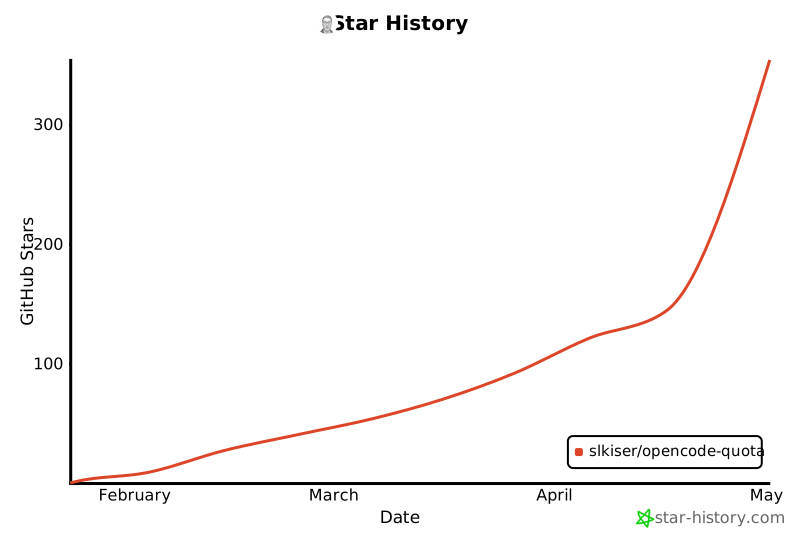
## Star history
[](https://www.star-history.com/?repos=slkiser%2Fopencode-quota&type=date&legend=bottom-right)