https://github.com/sockudo/sockudo
Blazingly fast pusher drop-in replacement written in rust
https://github.com/sockudo/sockudo
abbly broadcasting pusher realtime rust rust-lang websocket websockets ws
Last synced: 3 months ago
JSON representation
Blazingly fast pusher drop-in replacement written in rust
- Host: GitHub
- URL: https://github.com/sockudo/sockudo
- Owner: sockudo
- License: mit
- Created: 2024-11-09T22:01:43.000Z (over 1 year ago)
- Default Branch: master
- Last Pushed: 2026-03-29T19:27:55.000Z (3 months ago)
- Last Synced: 2026-03-29T21:24:25.181Z (3 months ago)
- Topics: abbly, broadcasting, pusher, realtime, rust, rust-lang, websocket, websockets, ws
- Language: Rust
- Homepage: https://sockudo.io/
- Size: 5.72 MB
- Stars: 526
- Watchers: 7
- Forks: 35
- Open Issues: 3
-
Metadata Files:
- Readme: README.md
- Contributing: CONTRIBUTING.md
- Funding: .github/FUNDING.yml
- License: LICENSE
- Code of conduct: CODE_OF_CONDUCT.md
Awesome Lists containing this project
README

Sockudo
A high-performance, scalable WebSocket server for real-time applications, built in Rust.


## Star History
[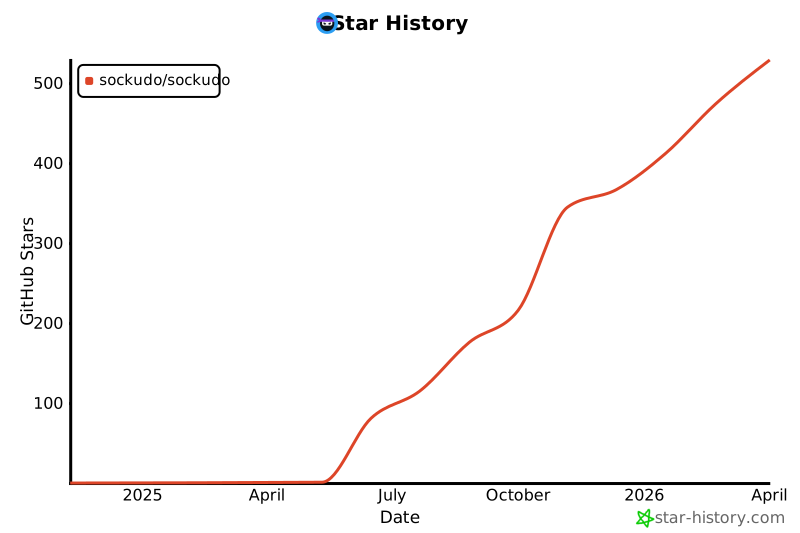](https://star-history.com/#Sockudo/sockudo&Date)
## Features
- **🚀 High Performance** - Handle 100K+ concurrent connections
- **🔄 Dual Protocol** - V1 for Pusher compatibility, V2 for Sockudo-native with serial numbers, message IDs, and connection recovery
- **🔗 Connection Recovery** - Ably-style serial-based message replay for exactly-once delivery (V2)
- **🆔 Message Idempotency** - Automatic `message_id` on every broadcast, HTTP-level `idempotency_key` deduplication
- **🏗️ Scalable Architecture** - Redis, Redis Cluster, NATS adapters
- **🛡️ Production Ready** - Rate limiting, SSL/TLS, metrics
- **⚡ Async Cleanup** - Non-blocking disconnect handling
- **📊 Real-time Metrics** - Prometheus integration
- **🧠 Delta Compression + Conflation** - Fossil and Xdelta3 (VCDIFF) with per-channel controls
- **🏷️ Tag Filtering** - High-performance server-side filtering with optional tag emission controls
- **🌐 Native WebSocket Engine** - `sockudo_ws` with advanced runtime tuning
- **📦 Official SDKs** - Client and server SDKs for all major platforms
## What's New in v4
Sockudo v4 introduces **dual protocol versioning**, making Sockudo its own platform while retaining full Pusher compatibility:
| | Protocol V1 (default) | Protocol V2 |
|---|---|---|
| Event prefix | `pusher:` / `pusher_internal:` | `sockudo:` / `sockudo_internal:` |
| `serial` | Never sent | Always on every message |
| `message_id` | Never sent | Always on every broadcast |
| Connection recovery | Not available | Always available |
| Delta compression | Not available | Native |
| Tag filtering | Not available | Native |
| Compatible SDKs | Official Pusher SDKs | Sockudo client SDKs |
Additional v4 changes:
- **TOML configuration** (preferred over JSON) - `config/config.toml`
- **Rebranded SDKs** - All server and client SDKs renamed from `pusher-*` to `sockudo-*`
- **HTTP idempotency** - Atomic `idempotency_key` deduplication via `SET NX` (no race conditions)
- **Replay buffer** - Per-channel message buffer with configurable TTL and max size
## Official Client SDKs
| Client | Package | Default Protocol |
|---|---|---|
| JavaScript / TypeScript | `@sockudo/client` | V2 |
| Swift | `SockudoSwift` (SPM) | V2 |
| Kotlin | `io.sockudo:sockudo-kotlin` | V2 |
| Flutter / Dart | `sockudo_flutter` | V2 |
All Sockudo client SDKs default to protocol V2 (`sockudo:` prefix, serial tracking, connection recovery). Set `protocolVersion: 1` to use Pusher-compatible mode. For V1 you can also use the official Pusher SDKs directly.
## Official Server SDKs
| Language | Package |
|---|---|
| Node.js | `sockudo` |
| PHP | `sockudo/sockudo-php-server` |
| Ruby | `sockudo` gem |
| Go | `github.com/sockudo/sockudo-http-go` |
| Rust | `sockudo-http` |
| Java | `io.sockudo:sockudo-http-java` |
| .NET | `SockudoServer` |
| Swift | `Sockudo` (SPM) |
All server SDKs support `idempotency_key` for safe publish retries.
## Quick Start
### Docker (Recommended)
```bash
git clone https://github.com/sockudo/sockudo.git
cd sockudo
make up
# Server runs on http://localhost:6001
# Metrics on http://localhost:9601/metrics
```
### Kubernetes (Helm)
```bash
helm install sockudo ./charts/sockudo
# Production with Redis adapter and autoscaling
helm install sockudo ./charts/sockudo \
--set config.adapterDriver=redis \
--set redis.host=redis-master \
--set redis.existingSecret=my-redis-secret \
--set defaultApp.existingSecret=my-default-app-secret \
--set autoscaling.enabled=true \
--set pdb.enabled=true \
--set ingress.enabled=true \
--set serviceMonitor.enabled=true
```
When `defaultApp.existingSecret` is set, the Secret must contain `default-app-secret` and can optionally include `default-app-id` and `default-app-key`.
See [`charts/sockudo/values.yaml`](charts/sockudo/values.yaml) for all configurable options.
### From Source
```bash
curl --proto '=https' --tlsv1.2 -sSf https://sh.rustup.rs | sh
git clone https://github.com/sockudo/sockudo.git
cd sockudo
# Fast local development build (default - no external dependencies)
cargo run --release
# Production build with all features
cargo run --release --features full
```
### Feature Flags
```bash
# Local development (fastest - default)
cargo build # ~30-50% faster compile
# With specific backends
cargo build --features "redis,postgres" # Redis + PostgreSQL
cargo build --features "redis-cluster,mysql" # Redis Cluster + MySQL
cargo build --features "redis,surrealdb" # Redis + SurrealDB 3
cargo build --features "rabbitmq,postgres" # RabbitMQ + PostgreSQL
cargo build --features "google-pubsub,mysql" # Google Pub/Sub + MySQL
cargo build --features "kafka,postgres" # Kafka + PostgreSQL
# Full production build
cargo build --release --features full # All backends
```
**Available Features:**
- `local` (default) - In-memory implementations only
- `v2` (default) - All Sockudo V2 features (delta, tag-filtering, recovery)
- `delta` - Delta compression (V2)
- `tag-filtering` - Server-side tag filtering (V2)
- `recovery` - Connection recovery with serial numbers and message IDs (V2)
- `redis` - Redis adapter, cache, queue, rate limiter
- `redis-cluster` - Redis Cluster support
- `nats` - NATS adapter
- `rabbitmq` - RabbitMQ adapter
- `google-pubsub` - Google Cloud Pub/Sub adapter
- `kafka` - Kafka adapter
- `mysql` / `postgres` / `dynamodb` / `surrealdb` / `scylladb` - App manager backends
- `sqs` / `lambda` - AWS integrations
- `full` - All features enabled
```bash
# Pure Pusher-only server (no V2 features, smallest binary)
cargo build --no-default-features
# V2 with only delta compression
cargo build --no-default-features --features delta
# V2 with recovery only (serial + message_id + replay buffer)
cargo build --no-default-features --features recovery
```
## Basic Usage
### Protocol V2 (Sockudo-native, default for Sockudo SDKs)
```javascript
import { SockudoClient } from '@sockudo/client';
const client = new SockudoClient('app-key', {
wsHost: 'localhost',
wsPort: 6001,
forceTLS: false,
// protocolVersion: 2 is the default
});
const channel = client.subscribe('my-channel');
channel.bind('my-event', (data) => {
console.log('Received:', data);
});
```
```swift
import SockudoSwift
let client = try SockudoClient(
"app-key",
options: .init(
cluster: "local",
forceTLS: false,
enabledTransports: [.ws],
wsHost: "127.0.0.1",
wsPort: 6001,
wssPort: 6001
)
)
let channel = client.subscribe("my-channel")
channel.bind("my-event") { data, _ in
print(data ?? "")
}
client.connect()
```
### Protocol V1 (Pusher-compatible)
```javascript
import Pusher from 'pusher-js';
const pusher = new Pusher('app-key', {
wsHost: 'localhost',
wsPort: 6001,
cluster: '',
forceTLS: false
});
const channel = pusher.subscribe('my-channel');
channel.bind('my-event', (data) => {
console.log('Received:', data);
});
```
## Configuration
Sockudo uses TOML configuration (preferred) with JSON as a fallback. The server tries `config/config.toml` first, then `config/config.json`.
### Core Configuration (`config/config.toml`)
```toml
port = 6001
host = "0.0.0.0"
debug = false
[app_manager]
driver = "memory"
[app_manager.array]
[[app_manager.array.apps]]
id = "app-id"
key = "app-key"
secret = "app-secret"
enabled = true
[app_manager.array.apps.policy.limits]
max_connections = 100000
max_client_events_per_second = 1000
[app_manager.array.apps.policy.features]
enable_client_messages = true
[app_manager.array.apps.policy.channels]
allowed_origins = ["*"]
[[app_manager.array.apps.policy.channels.channel_namespaces]]
name = "ticker"
channel_name_pattern = "^ticker:[A-Za-z0-9._-]+$"
max_channel_name_length = 200
[[app_manager.array.apps.policy.channels.channel_namespaces]]
name = "chat"
channel_name_pattern = "^chat:[A-Za-z0-9._-]+$"
max_channel_name_length = 200
allow_user_limited_channels = true
[adapter]
driver = "local"
[cache]
driver = "memory"
[queue]
driver = "memory"
```
Per-app app-manager entries are where V2 channel semantics live, now grouped under `app.policy`: `policy.channels.allowed_origins`, `policy.channels.channel_namespaces`, app-level `policy.idempotency`, `policy.connection_recovery`, and `policy.channels.channel_delta_compression`.
For existing MySQL/PostgreSQL app tables, use the explicit migration scripts under [`migrations/mysql`](/Users/radudiaconu/Desktop/Code/Rust/sockudo/migrations/mysql) and [`migrations/postgresql`](/Users/radudiaconu/Desktop/Code/Rust/sockudo/migrations/postgresql) to backfill `policy` and then drop legacy columns during a maintenance window.
### Environment Variables
```bash
# Basic settings
PORT=6001
HOST=0.0.0.0
DEBUG=false
# Default app credentials
SOCKUDO_DEFAULT_APP_ID=app-id
SOCKUDO_DEFAULT_APP_KEY=app-key
SOCKUDO_DEFAULT_APP_SECRET=app-secret
# Scaling drivers
ADAPTER_DRIVER=redis # local, redis, redis-cluster, nats, rabbitmq, google-pubsub, kafka
CACHE_DRIVER=redis # memory, redis, redis-cluster, none
QUEUE_DRIVER=redis # memory, redis, redis-cluster, sqs, none
APP_MANAGER_DRIVER=surrealdb # memory, mysql, postgres, dynamodb, surrealdb, scylladb
RABBITMQ_URL=amqp://guest:guest@127.0.0.1:5672/%2f
GOOGLE_PUBSUB_PROJECT_ID=my-gcp-project
KAFKA_BROKERS=127.0.0.1:9092
DATABASE_SURREALDB_URL=ws://127.0.0.1:8000
DATABASE_SURREALDB_NAMESPACE=sockudo
DATABASE_SURREALDB_DATABASE=sockudo
DATABASE_SURREALDB_USERNAME=root
DATABASE_SURREALDB_PASSWORD=root
DATABASE_SURREALDB_TABLE_NAME=applications
# V2 feature gates
EPHEMERAL_ENABLED=true
ECHO_CONTROL_ENABLED=true
ECHO_CONTROL_DEFAULT_ECHO_MESSAGES=true
EVENT_NAME_FILTERING_ENABLED=true
```
### Delta Compression (`config/config.toml`)
```toml
[delta_compression]
enabled = true
algorithm = "Fossil"
full_message_interval = 10
min_message_size = 100
max_state_age_secs = 300
max_channel_states_per_socket = 100
max_conflation_states_per_channel = 100
cluster_coordination = true
omit_delta_algorithm = true
```
### Tag Filtering (`config/config.toml`)
```toml
[tag_filtering]
enabled = true
enable_tags = false
```
### V2 Message Features (`config/config.toml`)
```toml
[ephemeral]
enabled = true
[echo_control]
enabled = true
default_echo_messages = true
[event_name_filtering]
enabled = true
max_events_per_filter = 50
max_event_name_length = 200
```
### WebSocket Runtime (`config/config.toml`)
```toml
[websocket]
max_messages = 1000
max_bytes = 1048576
disconnect_on_buffer_full = false
max_message_size = 67108864
max_frame_size = 16777216
write_buffer_size = 16384
max_backpressure = 1048576
auto_ping = true
ping_interval = 30
idle_timeout = 120
compression = "disabled"
```
### Performance Tuning
```bash
SOCKUDO_DEFAULT_APP_MAX_CONNECTIONS=100000
SOCKUDO_DEFAULT_APP_MAX_CLIENT_EVENTS_PER_SECOND=10000
CLEANUP_QUEUE_BUFFER_SIZE=50000
CLEANUP_BATCH_SIZE=25
CLEANUP_WORKER_THREADS=auto
ADAPTER_BUFFER_MULTIPLIER_PER_CPU=128
```
### Database Pooling
```toml
[database_pooling]
enabled = true
min = 2
max = 10
[database.mysql]
pool_min = 4
pool_max = 32
[database.postgres]
pool_min = 2
pool_max = 16
```
## Deployment Scenarios
| Scenario | CPU/RAM | Adapter | Cache | Queue | Max Connections |
|----------|---------|---------|-------|-------|-----------------|
| **Development** | 1vCPU/1GB | local | memory | memory | 1K |
| **Small Production** | 2vCPU/2GB | redis | redis | redis | 10K |
| **High Traffic** | 4vCPU/4GB+ | redis | redis | redis | 50K+ |
| **Multi-Region** | 8vCPU/8GB+ | redis-cluster | redis-cluster | redis-cluster | 100K+ |
All scenarios can be deployed via Docker Compose or the included [Helm chart](charts/sockudo/) on Kubernetes with built-in HPA autoscaling.
## Architecture
```
┌─────────────────┐ ┌─────────────────┐ ┌─────────────────┐
│ Load Balancer │────│ Sockudo Node │────│ Redis Cluster │
│ (Nginx) │ │ (Rust/Tokio) │ │ (State Store) │
└─────────────────┘ └─────────────────┘ └─────────────────┘
│ │ │
│ ┌─────────────────┐ │
└──────────────│ Sockudo Node │─────────────┘
│ (Rust/Tokio) │
└─────────────────┘
```
## Documentation
- **[Full Documentation](docs/)** - Complete setup and configuration guide
- **[Client Overview](docs/content/3.client/1.overview.md)** - Official SDKs and runtime targets
- **[Docker Deployment](docker-compose.yml)** - Production-ready containers
- **[Helm Charts](charts/sockudo/)** - Kubernetes deployment with HPA, PDB, ServiceMonitor
## Testing
```bash
# Run all server tests
make test
# Interactive WebSocket testing
cd test/interactive && npm install && npm start
# Open http://localhost:3000
# Load testing
make benchmark
```
Client and server SDK tests are run from their respective repositories. See each SDK's README for instructions.
## Contributing
1. Fork the repository
2. Create a feature branch (`git checkout -b feature/amazing-feature`)
3. Commit your changes (`git commit -m 'Add amazing feature'`)
4. Push to the branch (`git push origin feature/amazing-feature`)
5. Open a Pull Request
## License
Licensed under the [MIT License](LICENSE).
## Support
- **Issues**: [GitHub Issues](https://github.com/sockudo/sockudo/issues)
- **Discussions**: [GitHub Discussions](https://github.com/sockudo/sockudo/discussions)
- **Documentation**: [sockudo.io](https://sockudo.io)
- **Discord**: [Join our Discord](https://discord.gg/ySfNxfh2gZ)
- **X**: [@sockudorealtime](https://x.com/sockudorealtime)
- **Email**: [sockudorealtime](mailto:office@sockudo.io)