https://github.com/somecho/tanbone-app-documentation
https://github.com/somecho/tanbone-app-documentation
Last synced: 4 months ago
JSON representation
- Host: GitHub
- URL: https://github.com/somecho/tanbone-app-documentation
- Owner: somecho
- Created: 2022-12-19T17:26:33.000Z (over 3 years ago)
- Default Branch: master
- Last Pushed: 2024-01-04T13:00:01.000Z (over 2 years ago)
- Last Synced: 2025-07-18T06:24:59.478Z (11 months ago)
- Size: 354 KB
- Stars: 0
- Watchers: 1
- Forks: 0
- Open Issues: 0
-
Metadata Files:
- Readme: README.md
Awesome Lists containing this project
README
# Tan Bone Application
## Development
The development of the companion web application to the Tan Bone installation
took place, for the most part, independently from the that of the installation
itself. In fact, the initial intention was not to develop a companion
application at all, but to provide a platform for engaging with the field
recordings LiLi (KSA) made from the protests in Myanmar.
On the 3rd of February, LiLi (KSA) sent recording made from his mobile phone to
Sam Tsao, with the idea that it could "be use(d) as art". The recordings from
this period were of the nightly 8 P.M. sound protests, with various kitchenwares
and utensils. Tsao suggested the creation of a site (the web application) to
engage with these recordings.
On the 5th of February, Tsao sent LiLi (KSA) a video demonstrating a prototype
of their idea. In the video, Tsao shakes their mobile phone. As the phone
shakes, a field recording plays. At this point in time, a UI (user interface)
had not yet been designed. Tsao shared an initial design and there were also
plans to work with a Myanmar designer. This idea was eventually abandoned.
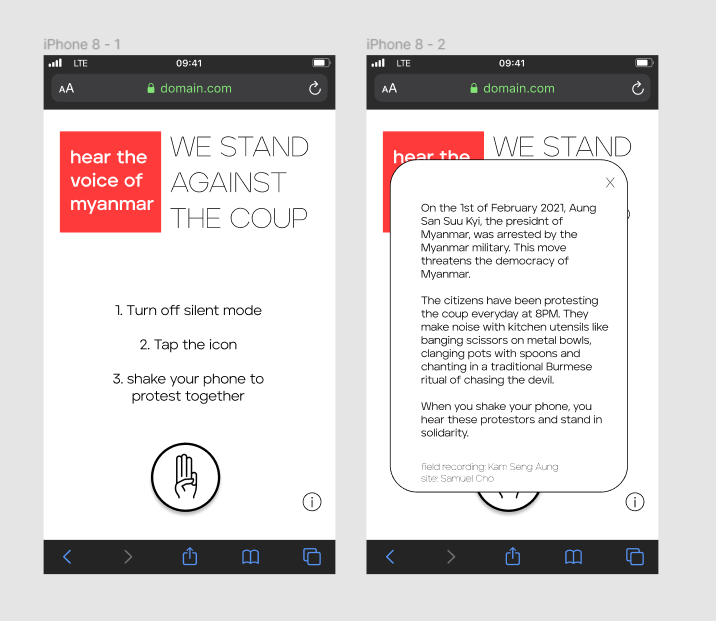
First design of the web application
On the 7th of February, LiLi (KSA) notified Tsao of a possible exhibition of
Tan Bone, which he had been working together with Joshua Weitzel. This marked
the beginning of LiLi (KSA), Joshua Weitzel and Sam Tsao's collaboration as a
small collective.
## First Iteration
The version of the web application that was used for the first exhibition of Tan
Bone was created with a design by French designer Louziness, who lived in
Myanmar at the time.
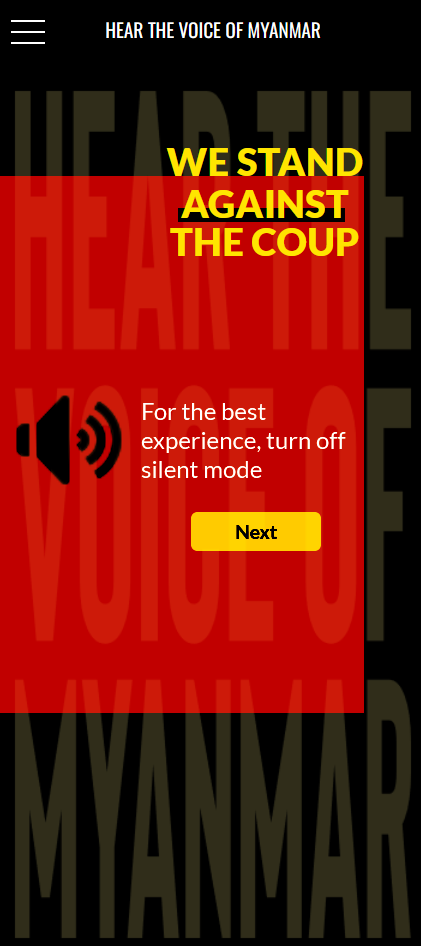
First iteration of the web application
The web application was a mobile only website, where, upon loading, the user was
prompted to unsilent the phone and click start before the recordings could be
accessed via shaking the phone. This mode of interacting with the field
recordings was chosen deliberately as a conscious mode of interaction with sound
material on the internet. The act of shaking the phone, possibly in close
proximity to the users ear for the recordings to be audible, puts the user in a
stance somewhat similar to the stance of someone in rage. It is also a conscious
decision on the part of the user to symbolically show solidarity, either in
public at an exhibition or in the privacy of their own homes, to the people
protesting in Myanmar.
The first iteration of the web application also featured a short introductory
text written by Thun Bohn Naing, photographs by Hae That Htet and Emily Fishbein
and a page with links that was to be constantly updated with the latest mediao
coverage of the situation in Myanmar. This version acted as a hub of media and
information for users and is still online as of the time of this writing with
the link:
https://tanbonev1.soch.cc. The page with links is, however, no longer
kept up to date.
## Second Iteration
For the second version, Tsao redesigned the user interface from scratch. This
time, they opted for a design that could be accessed from both mobile and
desktop devices. It featured a responsive web layout with a realtime artwork as
the centerpiece. The centerpiece was inspired by traditional Myanmar textile
patterns and is a minimal representation of them, using colors associated with
the ongoing protests.
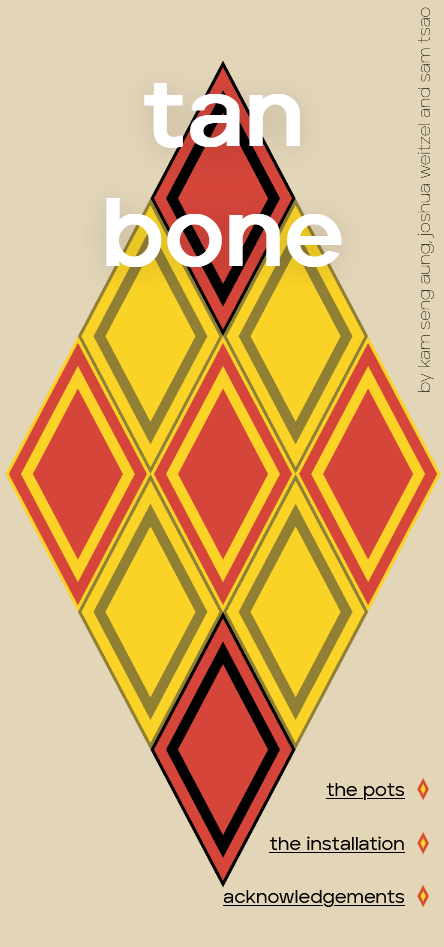
Mobile view of the second iteration
This iteration of the web application kept the short introductory text by Thun
Bohn Naing but forgoed the page with links in favor of a dedicated page
documenting the lives of the martyrs, who used the pots at the protests in
Myanmar. It was designed to identify more with the Tan Bone installation and
truly function as a companion application.
Unlike its predecessor, the field recordings are already accessible via shaking directly
upon loading the application. There was no need for the user to click on any
button to activate it. The played recording was also chosen randomly upon the
loading the page, so that the chance of multiple viewers engaging with the same
recording at the same time was reduced. The idea was that, with enough willing
participants, the viewers could provide an additional dimension of sound to the
installation, one which they themselves actively contributed to.
## Considerations
With the development of this project having started out as an ad hoc project to
give the sounds of the protests in Myanmar presence in Europe, little
conscious thought was given to the choice of medium for achieving this.
In retrospect, Tsao felt that it was the right medium. With mobile devices being
ubiquitous and access to the internet just as much so, the web application
tested whether solidarity through such a medium and mode of interaction was
possible. Ultimately, the level of solidarity and compassion shown fluctuates
depending on various factors, and it is not exactly possible to measure viewer
response with regards to this.