https://github.com/sovit-123/robust_neural_networks_by_adding_noise_to_data
PyTorch implementation of building robust deep learning neural networks by adding noise to image data before training.
https://github.com/sovit-123/robust_neural_networks_by_adding_noise_to_data
computer-vision convolutional-neural-networks deep-learning image-classification image-processing image-recognition neural-networks paper-implementations pytorch
Last synced: 3 months ago
JSON representation
PyTorch implementation of building robust deep learning neural networks by adding noise to image data before training.
- Host: GitHub
- URL: https://github.com/sovit-123/robust_neural_networks_by_adding_noise_to_data
- Owner: sovit-123
- Created: 2020-02-25T06:26:03.000Z (over 6 years ago)
- Default Branch: master
- Last Pushed: 2020-04-01T04:22:32.000Z (over 6 years ago)
- Last Synced: 2025-06-16T19:08:52.013Z (about 1 year ago)
- Topics: computer-vision, convolutional-neural-networks, deep-learning, image-classification, image-processing, image-recognition, neural-networks, paper-implementations, pytorch
- Language: Python
- Homepage:
- Size: 123 KB
- Stars: 2
- Watchers: 1
- Forks: 0
- Open Issues: 0
-
Metadata Files:
- Readme: README.md
Awesome Lists containing this project
README
* # README
## 1) Research Paper Implementation
* This project is an attempt to ***Building Robust Neural Network Models by Adding Noise to Image Data.***
* The following are the research papers that I have tried the replicate the results and ideas from:
* [**An empirical study on the effects of different types of noise in image classification tasks**](https://arxiv.org/pdf/1609.02781.pdf), Gabriel B. Paranhos da Costa, Welinton A. Contato, Tiago S. Nazare, Jo ̃ao E. S. Batista Neto, Moacir Ponti.
* [**Deep networks for robust visual recognition**](http://citeseerx.ist.psu.edu/viewdoc/download?doi=10.1.1.170.1765&rep=rep1&type=pdf), Yichuan Tang, Chris Eliasmith.
* [**Deep Convolutional Neural Networks and Noisy Images**](https://www.researchgate.net/publication/322915518_Deep_Convolutional_Neural_Networks_and_Noisy_Images), Tiago S. Nazare, Gabriel B. Paranhos da Costa, Welinton A. Contato, and Moacir Ponti (2018).
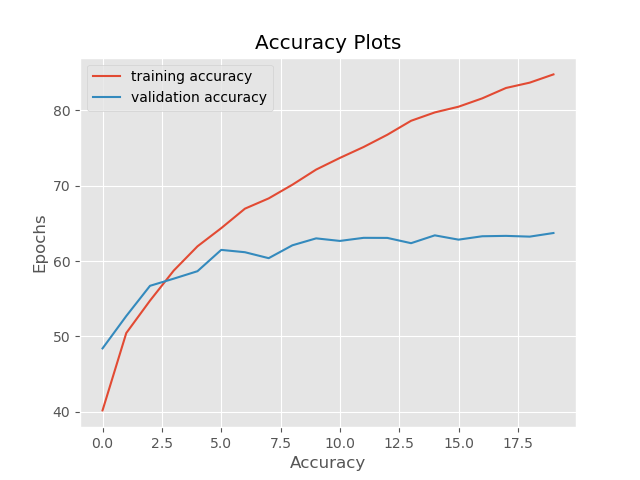
***Note:*** *I have included plots (inside `outputs/plots`) for both training files after training for 20 epochs. Take a loot at those for gaining faster insights into the project results.*
## 2) What is the Project About?
* Neural networks are good at image recognition but are bad at handling noise.
* *So, to make them generalize better on noisy images, we can train them noisy images*.
* And this project is an attempt to build robust image recognition neural networks by training them noisy data.
## 3) What Neural Network Model are We Using?
* All of the training happens using the ResNet18 pre-trained models.
* We are not using ImageNet weights, but are making all the hidden layer weights learnable.
## 4) Python Files Included and Ways to Execute Them
* If the datasets are not present, then they will be downloaded to `inputs/data` directory. So, make sure the availability of internet connection before running any of the files.
* All the executable python (`.py`) files are inside `src/` directory. All the python files can be executed from the command line. Different argument parsers are used for easy facilitation of training the neural networks.
* There are three python files:
* `add_noise.py`:
* You can use this file to add ***gaussian, speckle, and salt & pepper noise*** to image data. *This file does not play any part in training of neural network models. Instead, the user can use this visualize how different types noise looks like.*
* Execute the file:
```
# to add noise to CIFAR10 dataset
python src/add_noise.py --dataset=cifar10 --gauss_noise=0.5 --salt_pep=0.5 --speckle_noise=0.5
# to add noise to MNIST dataset
python src/add_noise.py --dataset=mnist --gauss_noise=0.5 --salt_pep=0.5 --speckle_noise=0.5
# to add noise to FashionMIST dataset
python src/add_noise.py --dataset=fashionmnist --gauss_noise=0.5 --salt_pep=0.5 --speckle_noise=0.5
```
* `--gauss_noise`, `--salt_pet`, `--speckle_noise` arguments define the amount of noise to add. They are optional arguments with default values already defined inside the python file.
* All the preprocessing inside the file is done according to the dataset provided in the command line argument.
* The resulting images will get stored inside `outputs/plots`.
* `train_rnd_noise.py`:
* You can execute this python file to train neural network model by applying ***random noise to image data***.
* Execute the file:
```
# training without random noise, validating without random noise
python src/train_rnd_noise.py --epochs=20 --train_noise=no --test_noise=no
# training with random noise, validating without random noise
python src/train_rnd_noise.py --epochs=20 --train_noise=yes --test_noise=no
# training without random noise, validating with random noise
python src/train_rnd_noise.py --epochs=1 --train_noise=no --test_noise=yes
# training with random noise, validating with random noise
python src/train_rnd_noise.py --epochs=1 --train_noise=yes --test_noise=yes
```
* `train_gauss_noise.py`:
* You can execute this python file to train neural network model by applying ***gaussian noise to image data***.
* Execute the file:
```
# train with variance 0.5, validate with variance 0.5
python src/train_gauss_noise.py --epochs=10 --train_noise=0.5 --test_noise=0.5
```
* `--test_noise`: variance for validation images for the gaussian noise.
* `--train_noise`: variance for training images for the gaussian noise.