https://github.com/stevenshave/pybindingcurve
Binding curve simulation and experimental data fitting for multi component protein-ligand systems
https://github.com/stevenshave/pybindingcurve
binding binding-curve competition hyperbolic protein-ligand-binding simulation
Last synced: 4 months ago
JSON representation
Binding curve simulation and experimental data fitting for multi component protein-ligand systems
- Host: GitHub
- URL: https://github.com/stevenshave/pybindingcurve
- Owner: stevenshave
- License: mit
- Created: 2019-10-17T09:21:26.000Z (almost 7 years ago)
- Default Branch: master
- Last Pushed: 2024-11-16T11:15:18.000Z (over 1 year ago)
- Last Synced: 2026-03-05T19:59:22.442Z (5 months ago)
- Topics: binding, binding-curve, competition, hyperbolic, protein-ligand-binding, simulation
- Language: Python
- Homepage:
- Size: 417 KB
- Stars: 18
- Watchers: 2
- Forks: 4
- Open Issues: 1
-
Metadata Files:
- Readme: README.md
- License: LICENSE
Awesome Lists containing this project
README
# PyBindingCurve
*Shave, Steven, et al. "PyBindingCurve, simulation, and curve fitting to complex binding systems at equilibrium." Journal of Chemical Information and Modeling (2021).* https://doi.org/10.1021/acs.jcim.1c00216
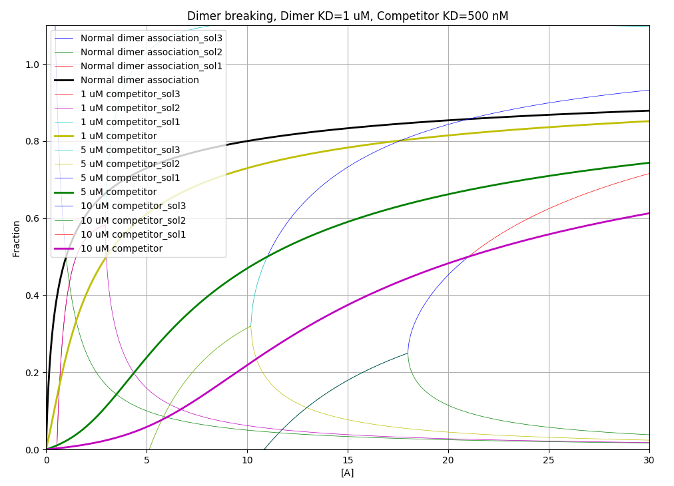
PyBindingCurve is a Python package for simulation, plotting and fitting of experimental parameters to protein-ligand binding systems at equilibrium. In simple terms, the most basic functionality allows simulation of a two species binding to each other as a function of their concentrations and the dissociation constant (KD) between the two species. A number of systems are built in and can be solved using direct analytical, kinetic, or Langrange multiplier based techniques. User-defined custom systems can also be specified using a simple syntax.
Try without installing on Google colab! https://colab.research.google.com/drive/1upxm56mGYWo8jvTTJjZLOEq6DT0lRy8d
# Installation
PyBindingCurve may be installed from source present in the GitHub repository https://github.com/stevenshave/pybindingcurve via git pull, or from the Python Package Index (https://pypi.org/project/pybindingcurve/) using the command :
> pip install pybindingcurve
# Requirements
PyBindingCurve requires Python 3.9 or later. The following packages are also required
- numpy>=1.26
- matplotlib>=3.8
- lmfit>=1.2.2
- mpmath>=1.3.0
- autograd>=1.6.2
# License
[MIT License](https://github.com/stevenshave/pybindingcurve/blob/master/LICENSE)
# Usage
A tutorial and API documentation can be found [here](https://stevenshave.github.io/pybindingcurve/)
A quickstart example for simulation of protein-ligand binding is as follows:
```
import numpy as np
import pybindingcurve as pbc
my_system = pbc.BindingCurve("1:1")
system_parameters = {"p": np.linspace(0, 20), "l": 10, "kdpl": 1}
my_system.add_curve(system_parameters)
my_system.show_plot()
```
Tests written using the pytest framework may be run with 'pytest' (ensure pytest is installed in your python environment, or pip install it)
# Authors
PyBindingCurve was written by Steven Shave

Please get in contact for custom solutions, integration to existing workflows and training.