https://github.com/stla/numerical-integration
Numerical integration in Haskell.
https://github.com/stla/numerical-integration
haskell numerical-integration
Last synced: 4 months ago
JSON representation
Numerical integration in Haskell.
- Host: GitHub
- URL: https://github.com/stla/numerical-integration
- Owner: stla
- License: other
- Created: 2023-08-28T08:51:00.000Z (almost 3 years ago)
- Default Branch: main
- Last Pushed: 2023-11-06T08:35:51.000Z (over 2 years ago)
- Last Synced: 2025-09-19T15:35:28.190Z (9 months ago)
- Topics: haskell, numerical-integration
- Language: C++
- Homepage:
- Size: 3.52 MB
- Stars: 1
- Watchers: 2
- Forks: 1
- Open Issues: 0
-
Metadata Files:
- Readme: README.md
- Changelog: CHANGELOG.md
- License: LICENSE
Awesome Lists containing this project
README
# numerical-integration
[](https://github.com/stla/numerical-integration/actions/workflows/Stack-lts.yml)
[](https://github.com/stla/numerical-integration/actions/workflows/Stack-lts-Mac.yml)
[](https://github.com/stla/numerical-integration/actions/workflows/Stack-nightly.yml)
One-dimensional numerical integration using the
['NumericalIntegration'](https://github.com/tbs1980/NumericalIntegration) C++ library.
___
***Example.*** Integrate x² between 0 and 1 with desired absolute error 0,
desired relative error 1e-5 and using 200 subdivisions. Exact value: 1/3.
```haskell
example :: IO IntegralResult -- value, error estimate, error code
example = integration (\x -> x*x) 0 1 0.0 1e-5 200
-- IntegralResult {
-- _value = 0.3333333333333334,
-- _error = 3.7007434154171895e-15,
-- _code = 0
-- }
```
The error code 0 indicates the success.
___
***A highly oscillatory function.*** The function shown below is highly
oscillatory. It is know that the exact value of its integral from `0` to `1`
is `π exp(-10) / 2 ≈ 7.131404e-05`.
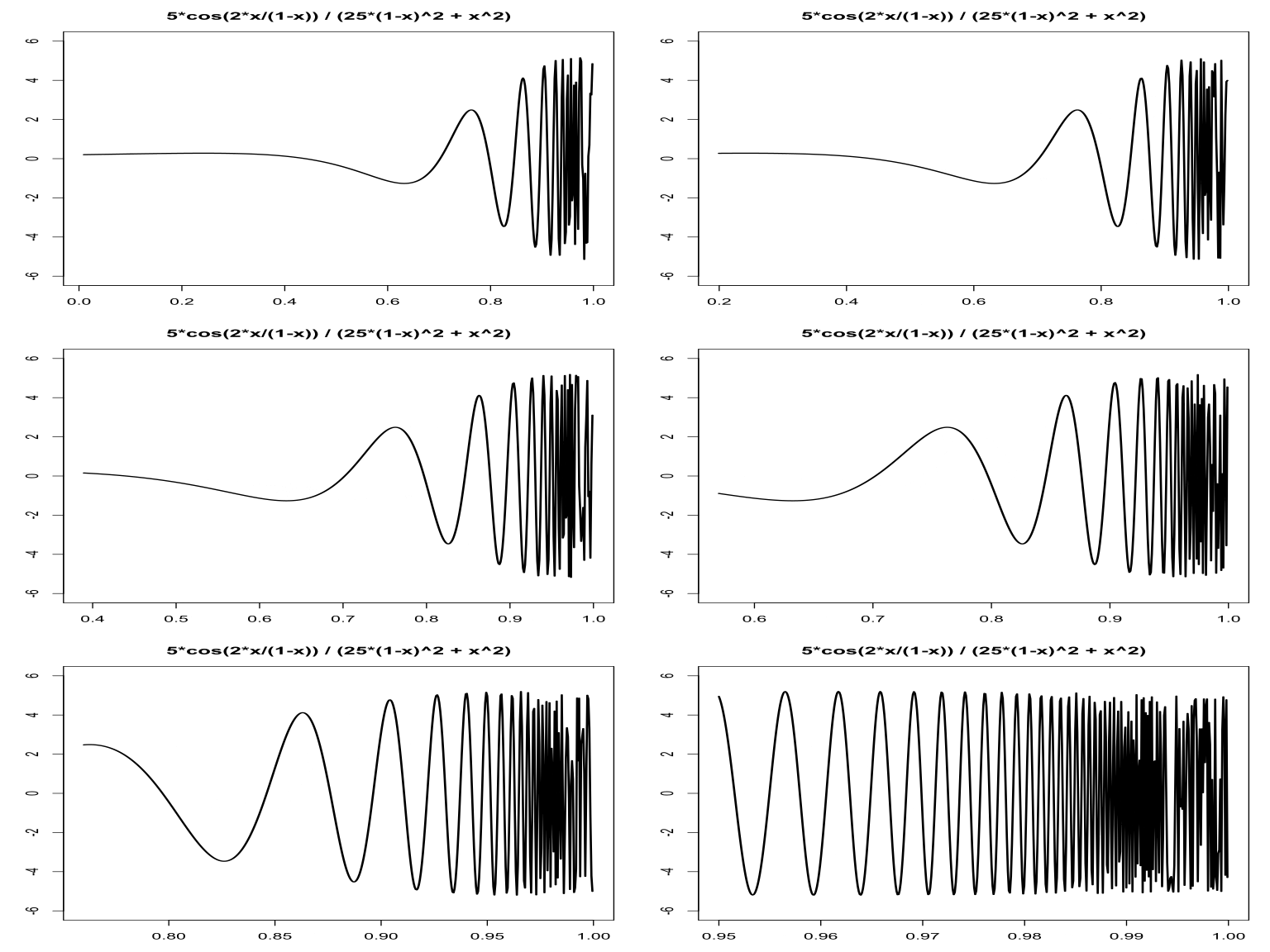
Let's try to evaluate it with R with 200000 subdivisions.
```r
f <- function(x) {
5*cos(2*x/(1-x)) / (25*(1-x)**2 + x**2)
}
integrate(f, 0, 1, subdivisions = 200000)
# 7.76249e-05 with absolute error < 3.7e-05
```
R does not complain, however the result is not very good.
Now let's try with the present library, with 100000 subdivisions.
```haskell
intgr :: IO IntegralResult
intgr = integration (\t -> 5 * cos(2*t/(1-t)) / (25*(1-t)**2 + t**2)) 0 1 0.0 1e-4 100000
-- IntegralResult {
-- _value = 7.131328051415349e-5,
-- _error = 4.991435083852171e-7,
-- _code = 2
-- }
```
As compared to R, the computation is very slow. But the result is quite better.
Note that the error code is 2, thereby indicating a failure of convergence.
So let's try 250000 subdivisions. This will take a while.
```haskell
intgr :: IO IntegralResult
intgr = integration (\t -> 5 * cos(2*t/(1-t)) / (25*(1-t)**2 + t**2)) 0 1 0.0 1e-4 250000
-- IntegralResult {
-- _value = 7.131328051415349e-5,
-- _error = 4.991435083852171e-7,
-- _code = 2
-- }
```
The result is the same!
___
***The tanh-sinh procedure.***
I don't master the Haskell library 'integration' but I give it a try below.
It implements the tanh-sinh quadrature.
```haskell
import Numeric.Integration.TanhSinh
tanhsinh :: Result
tanhsinh = absolute 1e-6 $ parTrap (\t -> 5 * cos(2*t/(1-t)) / (25*(1-t)**2 + t**2)) 0 1
-- Result {
-- result = -6.463872646093162e-3,
-- errorEstimate = 2.577460946077898e-2,
-- evaluations = 769
-- }
```
The result is totally wrong, which is not surprising in view of the weak
number of evaluations. But again, I don't master this library so I will
not conclude anything from this result.