https://github.com/struct78/the-poseidon-ensemble
A project that generates an orchestral score from global seismic activity.
https://github.com/struct78/the-poseidon-ensemble
Last synced: 3 months ago
JSON representation
A project that generates an orchestral score from global seismic activity.
- Host: GitHub
- URL: https://github.com/struct78/the-poseidon-ensemble
- Owner: struct78
- License: mit
- Created: 2014-09-23T07:16:47.000Z (over 11 years ago)
- Default Branch: master
- Last Pushed: 2014-10-22T00:36:42.000Z (over 11 years ago)
- Last Synced: 2025-05-19T04:08:59.286Z (about 1 year ago)
- Language: Processing
- Homepage:
- Size: 54.2 MB
- Stars: 9
- Watchers: 2
- Forks: 1
- Open Issues: 0
-
Metadata Files:
- Readme: README.md
- License: LICENSE.txt
Awesome Lists containing this project
README
# The Poseidon Ensemble
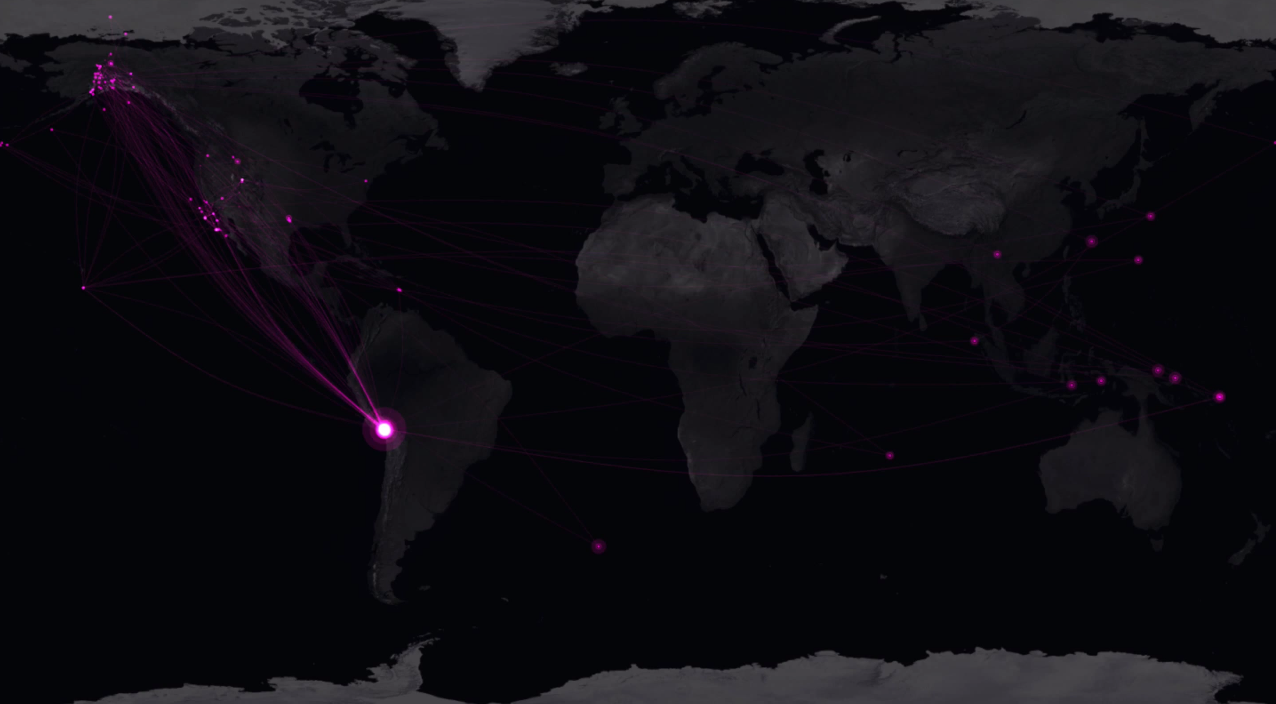
The Poseidon Ensemble is a project that generates an orchestral composition and data visualisation from over 100 years of global seismic data.
It is made up of over 780,000 data points and runs for nearly 8 days.
## How it works
The globe is divided into 8 segments with each representing a single or group of instruments. Each seismic event constitutes a single note, with pitch determined by the depth of the event, and the velocity determined by the magnitude.
## Timing
Due to the fact that density of data points increased as the years went on, the composition has been broken up into 7 different tempos.
| Start Year | End Year | Time Acceleration |
|------------|----------|-------------------|
| - | 1939 | 500,000x |
| 1940 | 1959 | 250,000x |
| 1960 | 1972 | 100,000x |
| 1973 | 1989 | 10,000x |
| 1990 | 1999 | 5,000x |
| 2000 | 2009 | 1,250x |
| 2010 | Present | 750x |
Bezier curves between sites identify patterns between seismic events. Stronger lines indicate that events in one region tend to follow another.
5 remaining MIDI channels are reserved for special events (earthquakes > magnitude 8, low and high RMS, etc.)
## Video
[](http://youtu.be/nItISSSzORQ)
## Processing
The Processing sketch requires the [themidibus](https://github.com/sparks/themidibus) library to run. It uses 13 MIDI channels on a virtual MIDI port named Poseidon, but you can use your own by modifying this line of code in Poseidon.pde
```
bus = new MidiBus(this, -1, "Poseidon");
```
[How to create virtual MIDI ports](https://www.ableton.com/en/articles/using-virtual-MIDI-buses-live/)
## Python
A Python script to download and merge all the seismic data from the [U.S. Geological Survey](http://earthquake.usgs.gov/earthquakes/search/) has been included.
You can manipulate the URL query string in get-data.py if you wish to filter the data further. You will need to look at the input names on the search page and adjust the URL accordingly: http://earthquake.usgs.gov/earthquakes/search/
```
url = "http://comcat.cr.usgs.gov/fdsnws/event/1/query?starttime={0}%2000:00:00&minmagnitude=0.1&format=csv&endtime={1}%2023:59:59&maxmagnitude=10&orderby=time-asc"
```
## Ableton Live
To use the Ableton set provided, you will need [Ableton Live 9 Suite](https://www.ableton.com/en/live/new-in-9/) with the [following packs](https://www.ableton.com/en/packs/#?genres=orchestral).
* Orchestral Brass
* Orchestral Mallets
* Orchestral Strings
* Orchestral Woodwind
* Samplification
Or create your own live set!