https://github.com/synaptiai/uim-protocol
The Unified Intent Mediator (UIM) protocol standardizes interactions between AI agents and web services, streamlining how intents are discovered, executed, and managed. It provides a secure and efficient framework, simplifying integration and enabling scalable, autonomous AI-driven applications and workflows.
https://github.com/synaptiai/uim-protocol
actions ai ai-agents aiagents api framework odrl protocols standards tools webservices
Last synced: 9 months ago
JSON representation
The Unified Intent Mediator (UIM) protocol standardizes interactions between AI agents and web services, streamlining how intents are discovered, executed, and managed. It provides a secure and efficient framework, simplifying integration and enabling scalable, autonomous AI-driven applications and workflows.
- Host: GitHub
- URL: https://github.com/synaptiai/uim-protocol
- Owner: danielbentes
- License: apache-2.0
- Created: 2024-08-28T09:58:50.000Z (almost 2 years ago)
- Default Branch: main
- Last Pushed: 2024-09-30T19:02:46.000Z (almost 2 years ago)
- Last Synced: 2025-02-05T06:49:20.007Z (over 1 year ago)
- Topics: actions, ai, ai-agents, aiagents, api, framework, odrl, protocols, standards, tools, webservices
- Language: Python
- Homepage: https://uimprotocol.com
- Size: 8.73 MB
- Stars: 26
- Watchers: 6
- Forks: 2
- Open Issues: 0
-
Metadata Files:
- Readme: README.md
- Contributing: CONTRIBUTING.md
- License: LICENSE
- Code of conduct: CODE_OF_CONDUCT.md
Awesome Lists containing this project
README
  The Unified Intent Mediator Protocol

  A standardized framework for AI agents to interact with web services through well-defined intents


## Getting Started

1. Get familiar with the [concepts and motivations](https://synaptiai.github.io/uim-protocol/specification/) behind the UIM protocol

2. Explore the [prototype implementations](https://synaptiai.github.io/uim-protocol/prototypes/) to see the UIM protocol in action

## Development Setup

This project uses [Poetry](https://python-poetry.org/) for dependency management. Poetry provides a better way to manage Python dependencies with features like dependency resolution, virtual environments, and more.

### Prerequisites

- Python 3.10 or higher

- [Poetry](https://python-poetry.org/docs/#installation)

### Installation

1. Clone the repository:

   ```bash

   git clone https://github.com/synaptiai/uim-protocol.git

   cd uim-protocol

   ```

2. Install dependencies with Poetry:

   ```bash

   poetry install

   ```

   This will create a virtual environment and install all dependencies.

3. Activate the virtual environment:

   ```bash

   poetry shell

   ```

### Dependency Groups

The project uses Poetry's dependency groups to organize dependencies:

- **Main**: Core dependencies for the UIM Protocol

- **Dev**: Development dependencies (testing, linting, etc.)

- **Docs**: Documentation dependencies (MkDocs, etc.)

- **NLP**: Natural language processing dependencies (spaCy, etc.)

To install only specific groups:

```bash

# Install only documentation dependencies

poetry install --only docs

# Install main dependencies and development dependencies

poetry install --with dev

```

### Building Documentation

```bash

cd uim-docs

poetry run mkdocs build

```

### Running Tests

```bash

poetry run pytest

```

## Get Involved: We Need Your Feedback

We're inviting developers, AI providers, service operators, and tech/AI enthusiasts to review the draft specification, test the implementation, and share feedback. Your input is crucial to refining and improving the protocol.

### How to Contribute

1. **Review the Draft Proposal**: Check out the [draft specification](https://synaptiai.github.io/uim-protocol/specification/uim-specification.txt) and explore the protocol's design and implementation.

2. **Join the Discussion**: Start a conversation in the [Discussions](https://github.com/synaptiai/uim-protocol/discussions) tab. We'd love to hear your thoughts on the protocol's design, potential use cases, or any concerns.

3. **Raise Issues**: Found a bug or have suggestions? Open an [Issue](https://github.com/synaptiai/uim-protocol/issues) to let us know or contribute directly by submitting a Pull Request. See our [Contributing Guidelines](CONTRIBUTING.md) for more information.

4. **Share the Word**: Help us spread the word about the UIM protocol by sharing this repository with your network. Write a blog post, tweet, or share the project with your colleagues. We appreciate your support!

## Protocol Overview

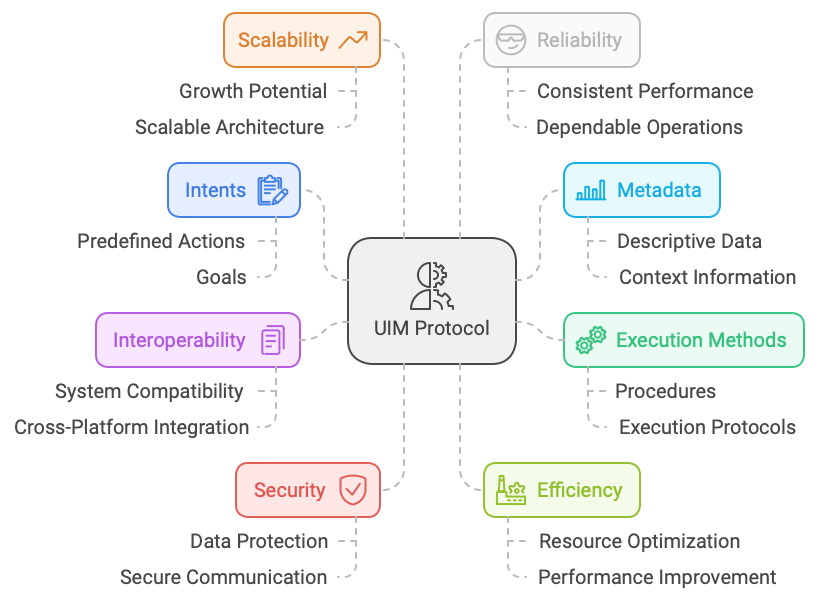
The Unified Intent Mediator (UIM) protocol defines a standardized framework for AI agents to interact with web services through well-defined intents, metadata, and execution methods. By introducing consistency and security in these interactions, UIM enhances efficiency, scalability, and reliability for AI-driven applications.

### Key Components

- **Intents**: Structured actions that web services can expose, defining specific tasks such as searching products, placing orders, or retrieving data.

- **Metadata and Parameters**: Each intent comes with metadata (name, description, category) and defined parameters, providing context and specific input requirements.

- **Policy Adherence Tokens (PATs)**: Digitally signed tokens that encapsulate permissions, billing, and compliance rules.

- **Discovery and Execution APIs**: AI agents can query discovery APIs to find available intents and use execution APIs to perform actions.

- **DNS TXT Records and agents.json Files**: Innovative methods for endpoint discovery, allowing AI agents to find and authenticate API endpoints.

### Architecture Options

The UIM Protocol supports multiple architectural approaches:

1. **Centralized Architecture**: A central repository manages intent registration, discovery, execution, and policy management.

2. **Decentralized Architecture**: AI agents interact directly with web services without a central intermediary.

3. **Hybrid Approach**: Combines centralized discovery with decentralized execution and PAT issuance.

## Repository Structure

```

uim-protocol/

├── implementations/       # Reference implementations

│   ├── centralized-discovery-service/

│   ├── uim-mock-agent/

│   └── uim-mock-webservice/

├── examples/              # Usage examples and demos

├── uim-docs/              # Documentation

│   ├── docs/              # Documentation source files

│   │   ├── specification/ # Protocol specifications

│   │   ├── assets/        # Documentation assets (images, etc.)

│   │   └── reference/     # API reference documentation

│   └── site/              # Generated documentation site

├── pyproject.toml         # Poetry configuration

└── poetry.lock            # Poetry lock file

```

## Current Status & Roadmap

The UIM Protocol is currently in the draft proposal phase. See our roadmap for the development roadmap.

## License

This project is licensed under the Apache License 2.0 - see the [LICENSE](LICENSE) file for details.