https://github.com/syncable-dev/memtrace-public
Structural memory for AI coding agents. Bi-temporal graph, MCP-native, zero LLM calls. Cursor · Claude Code · Codex · Hermes · VS Code · Windsurf.
https://github.com/syncable-dev/memtrace-public
agent-memory ai-agents bi-temporal-graph claude-code code-intelligence code-search coding-agents cursor developer-tools knowledge-graph llm local-first mcp mcp-server rag rust semantic-search structural-memory temporal-analysis tree-sitter
Last synced: about 2 months ago
JSON representation
Structural memory for AI coding agents. Bi-temporal graph, MCP-native, zero LLM calls. Cursor · Claude Code · Codex · Hermes · VS Code · Windsurf.
- Host: GitHub
- URL: https://github.com/syncable-dev/memtrace-public
- Owner: syncable-dev
- License: other
- Created: 2026-04-11T11:49:55.000Z (3 months ago)
- Default Branch: main
- Last Pushed: 2026-05-05T23:54:24.000Z (2 months ago)
- Last Synced: 2026-05-06T00:39:11.225Z (2 months ago)
- Topics: agent-memory, ai-agents, bi-temporal-graph, claude-code, code-intelligence, code-search, coding-agents, cursor, developer-tools, knowledge-graph, llm, local-first, mcp, mcp-server, rag, rust, semantic-search, structural-memory, temporal-analysis, tree-sitter
- Language: Python
- Homepage: https://memtrace.io
- Size: 8.58 MB
- Stars: 140
- Watchers: 3
- Forks: 8
- Open Issues: 0
-
Metadata Files:
- Readme: README.md
- Contributing: CONTRIBUTING.md
- License: LICENSE
Awesome Lists containing this project
- awesome-mcp-zh - memtrace
README

Your agents deserve structural memory.
📖 Docs ·
⭐ Star us ·
memtrace.io ·
npm ·
Discord
Memtrace turns your codebase into a live knowledge graph that AI coding agents can query in milliseconds — every function, class, call edge, and version, across every session, without re-reading files or breaking things they can't see.
Get your fleet on shared structural memory in under 90 seconds.
Structural · zero LLM calls · Bi-temporal · time-travel queries · Replay-aware · zero blind refactors








---
## What it does
**Three things, every release.**
🧭 **Run a fleet of coding agents on the same repo without merge hell.**
Each agent reads the same call graph, sees the same blast radius, inherits the same temporal history. No collisions. No stale context.
🔁 **Replay any refactor with full causal awareness.**
Agents see exactly what depends on what, and what changed when. No more *"I refactored a function and 14 tests broke that nobody saw."*
⚡ **Index a 50k-file repo in under 90 seconds.**
Rust + Tree-sitter, $0 in API costs, 20+ languages plus framework-aware scanners (Vapor, Lapis, Kong, GitHub Actions, Terraform, RLS policies, …), fully local. Your code never leaves your machine.
🆕 **LeanCTX Native — compressed reads, smart trees, and a value ledger.**
Four new compression modes on `get_source_window`, single-call directory maps, real-time token-savings dashboard, and an opt-in adaptive learner that beats the static table by ~14%. Full breakdown: [`docs/leanctx-native.md`](docs/leanctx-native.md). Available in v0.3.57+.
https://github.com/user-attachments/assets/e7d6a1e9-c912-4e65-a421-bd0256dffa5a
---
## Numbers
| Operation | Memtrace | Best alternative | Δ |
|---|---|---|---|
| Index 1,500 files | **1.5s · $0** | Mem0: 31 min · $10–50 | **~1,200× faster** |
| Exact symbol query (acc@1, lat) | **96.6% · 0.07 ms** | GitNexus: 97.0% · 8.95 ms | 128× lower latency |
| Graph callers recall (Django) | **81.6%** | GitNexus: 5.3% | **15.4×** |
| Incremental re-index p95 | **42.5 ms** | CodeGrapher: 613.7 ms | 14.4× |
| Hybrid acc@1 (Django, 3K cases) | **73.9%** | GitNexus: 38.6% | 1.91× |
| RSS / process | **26 MB** | ChromaDB: 1,060 MB | **41× tighter** |
| Languages | **16+** (Tree-sitter) | varies | — |
Reproducible benchmark suite: [`benchmarks/`](benchmarks/README.md). Same machine, same corpora, same adapter contract. Ground truth from Python's `ast` and `pyright` LSP — never from any tool's own index. **No system gets a home-field advantage in the dataset.**
Detailed breakdowns: [BENCHMARKS-v0.3.22.md](BENCHMARKS-v0.3.22.md) · [BENCHMARKS-v0.3.29.md](BENCHMARKS-v0.3.29.md)
---
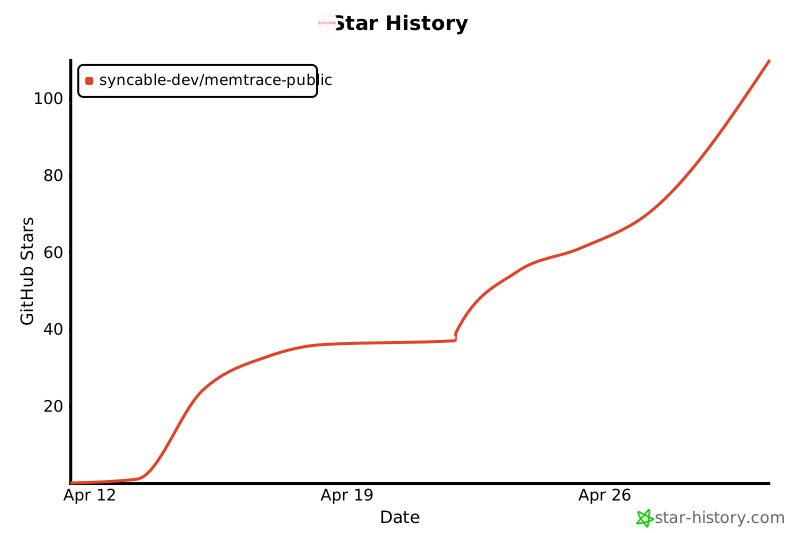
## GitHub Star Growth
---
## Get access
Memtrace is in **private beta**. We're rolling out access in batches to keep the feedback loop tight — every cohort lands in a Discord channel where we ship fixes from real bug reports inside a week.
→ **Join the waitlist at [memtrace.io](https://memtrace.io).**
Already have access? `npm install -g memtrace` and you're indexing in 90 seconds. Full setup below.
> 🔒 **Privacy.** Memtrace runs entirely on your machine. Source code never leaves it. The only network traffic is license validation, aggregate node/edge counts, and opt-out crash telemetry — no source, no file paths, no symbol names. Full breakdown: [PRIVACY.md](PRIVACY.md), [TELEMETRY.md](TELEMETRY.md). Disable telemetry with `MEMTRACE_TELEMETRY=off`.
---
## Why Memtrace exists
Good code-intelligence tools already exist. GitNexus and CodeGrapherContext build AST-based graphs that work for *"what's in my repo right now."*
**Memtrace is a bi-temporal episodic structural knowledge graph.** It builds on the same AST foundation and adds two dimensions:
- **Temporal memory** — every symbol carries its full version history. Six scoring algorithms (impact, novelty, recency, directional, compound, overview) let agents ask different temporal questions: *"what changed?"*, *"what's unexpected?"*, *"what'll break?"*.
- **Cross-service API topology** — Memtrace maps HTTP call graphs *between* repositories, detecting which services call which endpoints across your architecture.
On top of that, the structural layer is comprehensive:
| | |
|---|---|
| **Symbols are nodes** | functions, classes, interfaces, types, endpoints |
| **Relationships are edges** | `CALLS`, `IMPLEMENTS`, `IMPORTS`, `EXPORTS`, `CONTAINS` |
| **Community detection** | Louvain algorithm identifies architectural modules automatically |
| **Hybrid retrieval** | Tantivy BM25 + vector embeddings + Reciprocal Rank Fusion + cross-encoder rerank |
| **Rust-native** | compiled binary, no Python/JS runtime overhead, sub-8 ms p95 query latency |
The agent doesn't just search your code. **It remembers it.**
---
## Memtrace vs. general memory systems (Mem0, Graphiti)
Mem0 and Graphiti are strong conversational memory engines designed for tracking entity knowledge (e.g. `User -> Likes -> Apples`). They excel at that. For code intelligence specifically, the tradeoff is that they rely on LLM inference to build their graphs — which adds cost and time when processing thousands of source files.
**Graphiti** processes data through `add_episode()`, which triggers multiple LLM calls per episode — entity extraction, relationship resolution, deduplication. At ~50 episodes/minute ([source](https://github.com/getzep/graphiti)), ingesting 1,500 code files takes **1–2 hours**.
**Mem0** processes data through `client.add()`, which queues async LLM extraction and conflict resolution per memory item ([source](https://mem0.ai)). Bulk ingestion with `infer=True` (default) means every file passes through an LLM pipeline. Throughput is bounded by your LLM provider's rate limits.
**Both** accumulate $10–50+ in API costs for large codebases because every relationship is inferred rather than parsed.
**Memtrace takes a different approach:** it indexes 1,500 files in 1.2–1.8 seconds for $0.00 — no LLM calls, no API costs, no rate limits. Native Tree-sitter AST parsers resolve deterministic symbol references (`CALLS`, `IMPLEMENTS`, `IMPORTS`) locally. The tradeoff is that Memtrace is purpose-built for code — it doesn't handle conversational entity memory the way Mem0 and Graphiti do.
---
## 25+ MCP tools
Memtrace exposes a full structural toolkit via the Model Context Protocol.
**Search & Discovery**
- `find_code` — hybrid BM25 + semantic + RRF
- `find_symbol` — exact / fuzzy with Levenshtein
**Relationships**
- `analyze_relationships` — callers, callees, hierarchy, imports
- `get_symbol_context` — 360° view in one call
**Impact Analysis**
- `get_impact` — blast radius with risk rating
- `detect_changes` — diff-to-symbols scope mapping
**Code Quality**
- `find_dead_code` — zero-caller detection
- `find_most_complex_functions` — complexity hotspots
- `calculate_cyclomatic_complexity`
- `get_repository_stats`
**Temporal Analysis**
- `get_evolution` — 6 scoring modes
- `get_timeline` — full version history
- `detect_changes` — diff-based scope
**Graph Algorithms**
- `find_bridge_symbols` — betweenness centrality
- `find_central_symbols` — PageRank / degree
- `list_communities` — Louvain modules
- `list_processes` / `get_process_flow`
**API Topology**
- `get_api_topology` — cross-repo HTTP graph
- `find_api_endpoints`
- `find_api_calls`
**Indexing & Watch**
- `index_directory` — parse, resolve, embed
- `watch_directory` — live incremental
- `execute_cypher` — direct graph queries
---
## 17 agent skills
Memtrace ships skills/guidance that teach agents how to use the graph. They fire automatically based on what you ask — no prompt engineering required.
| Skill | You say… |
|---|---|
| `memtrace-search` | "find this function", "where is X defined" |
| `memtrace-relationships` | "who calls this", "show class hierarchy" |
| `memtrace-evolution` | "what changed this week", "how did this evolve" |
| `memtrace-impact` | "what breaks if I change this", "blast radius" |
| `memtrace-quality` | "find dead code", "complexity hotspots" |
| `memtrace-graph` | "show me the architecture", "find bottlenecks" |
| `memtrace-api-topology` | "list API endpoints", "service dependencies" |
| `memtrace-index` | "index this project", "parse this codebase" |
| `memtrace-cochange` | "what else changes with this", "hidden coupling" |
Plus 8 workflow skills that chain multiple tools with decision logic: `memtrace-first`, `codebase-exploration`, `change-impact-analysis`, `incident-investigation`, `refactoring-guide`, `continuous-memory`, `episode-replay`, and `session-continuity`.
---
## Temporal Engine
Six scoring algorithms for different temporal questions:
| Mode | Best for |
|---|---|
| `compound` | General-purpose "what changed?" — weighted blend of impact, novelty, recency |
| `impact` | "What broke?" — ranks by blast radius (`in_degree^0.7 × (1 + out_degree)^0.3`) |
| `novel` | "What's unexpected?" — anomaly detection via surprise scoring |
| `recent` | "What changed near the incident?" — exponential time decay |
| `directional` | "What was added vs removed?" — asymmetric scoring |
| `overview` | Quick module-level summary |
Uses **Structural Significance Budgeting** to surface the minimum set of changes covering ≥80% of total significance.
---
## Compatibility
| Editor / Agent | MCP Tools (25+) | Skills / Guidance | Install |
|---|---|---|---|
| Claude Code | ✅ | ✅ | `npm install -g memtrace` — fully automatic |
| Claude Desktop | ✅ | ✅ | Automatic — shared with Claude Code |
| Cursor (v2.4+) | ✅ | ✅ | `npm install -g memtrace` — fully automatic |
| Codex CLI | ✅ | ✅ | `npm install -g memtrace` — fully automatic |
| Windsurf | ✅ | ✅ | `npm install -g memtrace` — fully automatic |
| VS Code (Copilot) | ✅ | ✅ | `npm install -g memtrace` — fully automatic |
| Hermes | ✅ | ✅ | `npm install -g memtrace` — fully automatic |
| OpenCode | ✅ | ✅ | `npm install -g memtrace` — fully automatic |
| Kiro | ✅ | Steering | `npm install -g memtrace` — fully automatic |
| Cline / Roo Code | ✅ | — | Add MCP server manually |
| Any MCP client | ✅ | — | Add MCP server manually |
Skills are workflow prompts that teach the agent how to chain tools. Kiro does not use `SKILL.md`, so Memtrace writes equivalent auto steering files instead.
---
## Setup
### Claude Code + Claude Desktop
```bash
npm install -g memtrace
```
Handles everything — binary, 17 skills, MCP server, plugin, marketplace. One command, both editors.
For manual setup:
```bash
claude plugin marketplace add https://github.com/syncable-dev/memtrace-public.git
claude plugin install memtrace-skills@memtrace --scope user
claude mcp add memtrace -- memtrace mcp -e MEMTRACE_ARCADEDB_BOLT_URL=bolt://localhost:7687
```
### Cursor
`npm install -g memtrace` handles everything automatically. Cursor v2.4+ reads the same `SKILL.md` format as Claude.
For project-local install (skills travel with your repo):
```bash
npx memtrace-skills install --only cursor --local
```
### Codex, Windsurf, VS Code, Hermes, OpenCode, and Kiro
The installer also writes skills/guidance and MCP configuration for the newer agent surfaces:
| Agent | Global skills / guidance | Global MCP config | Project-local support |
|---|---|---|---|
| Codex | `~/.agents/skills/` | `~/.codex/config.toml` | `.agents/skills/`, `.codex/config.toml` |
| Windsurf | `~/.codeium/windsurf/skills/` | `~/.codeium/windsurf/mcp_config.json` | `.windsurf/skills/`; MCP remains user-level |
| VS Code / Copilot | `~/.copilot/skills/` | VS Code user `mcp.json` | `.github/skills/`, `.vscode/mcp.json` |
| Hermes | `~/.hermes/skills/` | `~/.hermes/config.yaml` | user-level only |
| OpenCode | `~/.config/opencode/skills/` | `~/.config/opencode/opencode.json` | `.opencode/skills/`, `opencode.json` |
| Kiro | `~/.kiro/steering/` | `~/.kiro/settings/mcp.json` | `.kiro/steering/`, `.kiro/settings/mcp.json` |
Install only selected integrations:
```bash
npx memtrace-skills install --only codex,windsurf,vscode,hermes,opencode,kiro
```
Install project-local config where supported:
```bash
npx memtrace-skills install --only codex,vscode,opencode,kiro --local
```
### Other MCP clients
For Cline, Roo Code, or any client that only needs MCP tools, add this server manually:
```json
{
"mcpServers": {
"memtrace": {
"command": "memtrace",
"args": ["mcp"],
"env": {
"MEMTRACE_ARCADEDB_BOLT_URL": "bolt://localhost:7687"
}
}
}
}
```
| Editor | Config file |
|---|---|
| Windsurf | `~/.codeium/windsurf/mcp_config.json` |
| VS Code (Copilot) | `.vscode/mcp.json` in your project root |
| Codex | `~/.codex/config.toml` or `.codex/config.toml` |
| Hermes | `~/.hermes/config.yaml` |
| OpenCode | `~/.config/opencode/opencode.json` or project `opencode.json` |
| Kiro | `~/.kiro/settings/mcp.json` or `.kiro/settings/mcp.json` |
| Cline | Cline MCP settings in the extension panel |
### Uninstall
```bash
memtrace uninstall # removes skills, MCP server, plugin, settings
npm uninstall -g memtrace
```
Already ran `npm uninstall` first? The cleanup script is at `~/.memtrace/uninstall.js`:
```bash
node ~/.memtrace/uninstall.js
```
### Install troubleshooting
`npm install -g memtrace` ships a small main package + a platform-specific binary (one of `@memtrace/darwin-arm64`, `@memtrace/linux-x64`, `@memtrace/win32-x64`). If `memtrace start` ever says *"Could not find binary for your platform"*:
```bash
# Re-run install, asking npm to keep optional deps
npm install -g memtrace --include=optional
# Or refresh from latest
memtrace install # built-in self-update
npm install -g memtrace@latest --force
# Or install the platform binary directly (Apple Silicon shown — swap for your platform)
npm install -g @memtrace/darwin-arm64
```
This typically only happens on machines where npm is configured to skip optional dependencies (corporate npmrc, certain CI caches).
---
## Languages
**Programming:** Rust · Go · TypeScript · JavaScript · Python · Java · C · C++ · C# · Swift · Kotlin · Ruby · PHP · Dart · Scala · Perl · **Lua** — full AST: functions, classes, types, calls, complexity.
**Infrastructure & config:** **YAML** · **HCL / Terraform** · **JSON** · **TOML** · **SQL** (including PostgreSQL `CREATE POLICY` for RLS, with cross-language edges from policies to Drizzle / Prisma / TS schema symbols).
**Framework-aware scanners** on top of the AST layer:
- **Backend HTTP:** Express · NestJS · Encore · Fastify · Vapor · Hummingbird · FastAPI · Flask · Django · Gin · Chi · Echo · Actix · Lapis · Kong · OpenResty · Rails routes
- **Frontend / client:** RTK Query · TanStack Query · SWR · URLSession · AsyncHTTPClient · axios · fetch · SwiftUI views
- **CI / infra:** GitHub Actions workflows (jobs, steps, `needs:` edges) · Terraform variables / modules / data sources · Helm charts · K8s manifests
- **Package & dependency graphs:** `package.json` scripts + deps · `Cargo.toml` deps · `pyproject.toml` (best-effort)
- **Database:** PostgreSQL RLS policies + triggers + functions, with heuristic edges to ORM schema
---
## Requirements
Memtrace runs locally — first index is CPU/RAM intensive, subsequent queries and incremental indexing are much lighter.
| | Minimum | Recommended |
|---|---|---|
| CPU | 4 cores | 8+ cores for large monorepos |
| Memory | 8 GB RAM | 16–32 GB RAM |
| Disk | 5 GB free | 10–20 GB free |
| GPU | Not required | Not required |
| Node.js | ≥ 18 | Current LTS |
| Git | Required for temporal analysis | Full repo history for best results |
---
## Telemetry
Since v0.3.17 Memtrace ships with **opt-out** telemetry that helps us catch crashes, regressions, and performance issues before someone files an issue.
- **Collected:** app-start events, indexing/embedding durations, panic reports, WARN/ERROR log lines from Memtrace's own crates.
- **NOT collected:** source code, file contents, symbol names, embeddings, repository names or paths, branch names, commit data.
- **Sanitisation:** every payload is run through a sanitiser that strips home-dir paths, token-shaped strings, and email addresses before it touches disk.
Disable with one env var:
```bash
MEMTRACE_TELEMETRY=off memtrace start # per-run
export MEMTRACE_TELEMETRY=off # permanent (~/.zshrc, ~/.bashrc)
```
Or in your editor's MCP config: `"env": { "MEMTRACE_TELEMETRY": "off" }`.
Full breakdown — including the on-disk queue layout, where data is stored on the receiving end, and how to inspect what would have shipped — is in [TELEMETRY.md](TELEMETRY.md).
---
## License & ownership
**Proprietary EULA.** Free to use during private beta and after general availability for individual developers. Indexer + database (MemDB) are closed-source.
Benchmark suite under MIT in [`benchmarks/`](benchmarks/) — fully reproducible, no proprietary code required to run them.
---
memtrace.io ·
Discord ·
npm ·
Issues
Built by Syncable · Copenhagen 🇩🇰
[](https://mseep.ai/app/syncable-dev-memtrace-public)