https://github.com/tatyshev/given2
Lazy variable evaluation for Jasmine, Mocha, Jest specs, inspired by Ruby and Rspec 💎
https://github.com/tatyshev/given2
Last synced: 10 months ago
JSON representation
Lazy variable evaluation for Jasmine, Mocha, Jest specs, inspired by Ruby and Rspec 💎
- Host: GitHub
- URL: https://github.com/tatyshev/given2
- Owner: tatyshev
- License: mit
- Created: 2017-09-14T05:35:27.000Z (over 8 years ago)
- Default Branch: master
- Last Pushed: 2023-07-05T10:01:00.000Z (over 2 years ago)
- Last Synced: 2025-04-14T08:06:02.848Z (11 months ago)
- Language: JavaScript
- Homepage:
- Size: 3.91 MB
- Stars: 54
- Watchers: 1
- Forks: 5
- Open Issues: 10
-
Metadata Files:
- Readme: README.md
- License: LICENSE
- Code of conduct: CODE_OF_CONDUCT.md
Awesome Lists containing this project
- awesome-web-dev-resources - given2
README
Given2




Yet another way to make the process of testing in JavaScript better.
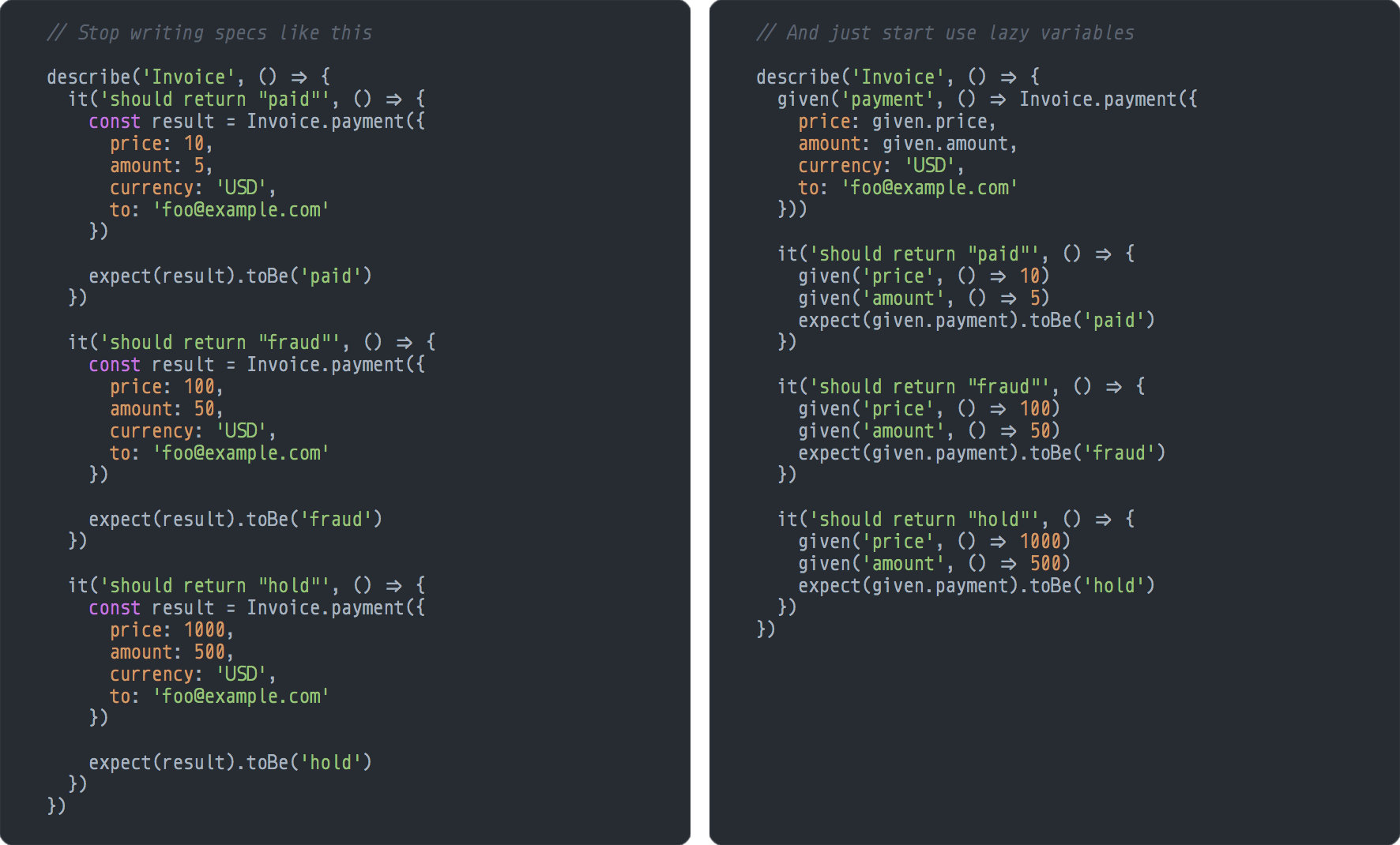
> ⚠️Currently `given2` supports only `jasmine`, `mocha` and `jest`.
Basically the given helper will register a beforeEach and a afterEach hook that will create a memoized get accessor with the given name. The value will be cached across multiple test suits in the same example but not across examples.
Note that `given` variables is lazy-evaluated: data in the variables are not calculated until they are accessed for the first time.
## Installation
You can install `given2` using `npm` or `yarn`
```js
npm install given2
yarn add given2
```
## Global namespace `>= 2.1.2`
`given2` also can be imported into global namespace by simply requiring `given2/setup`.
```js
import 'given2/setup';
```
Or configure your testing framework.
```js
// Config example for jest
{
"setupTestFrameworkScriptFile": "given2/setup"
}
```
Аfter that you can use `given` in your spec files without importing
## Usage
To use given you just need to require or import the `given2` module in your spec files
```js
import given from 'given2'
describe('Example', () => {
given('foo', () => 'bar');
it('foo should be "bar"', () => {
expect(given.foo).toBe('bar');
})
})
```
## More examples
The `given2` variables are evaluated only once and are cached within a single test suite, and reset the cache after each suite.
```js
let count = 0;
describe('given', () => {
given('count', () => count += 1);
// The values cached in same examples
it('memoizes the value', () => {
expect(given.count).toBe(1);
expect(given.count).toBe(1);
});
// But do not cached across examples
it('is not cached across examples', () => {
expect(given.count).toBe(2);
});
});
```
The values must be functions otherwise you will get an error.
```js
describe('given', () => {
it('should throw error', () => {
// Such use will cause an error
expect(() => given('value', 123)).toThrow();
});
});
```
When you try to use the variable given, recursively `given2` tells you about it.
```js
describe('given', () => {
// Such use will cause an error
given('one', () => given.one);
it('should throw error', () => {
expect(() => given.one).toThrow();
});
});
```
If you want the variable values not to be cached, use `@` prefix. All variables that begin with this prefix will not be cached.
```js
describe('given', () => {
given('@random', () => Math.random());
it('should not cache', () => {
const cached = given.random;
// values not cached
expect(given.random).not.toBe(cached);
expect(given.random).not.toBe(cached);
});
});
```
Also you can get the values of the variables immediately, right after the declaration, with the prefix `!`
```js
let counter = 1;
describe('given', () => {
given('!next', () => counter += 1);
it('should be 2', () => {
expect(counter).toBe(2);
});
});
```