https://github.com/thk2b/malloc
A malloc implementation
https://github.com/thk2b/malloc
Last synced: about 1 year ago
JSON representation
A malloc implementation
- Host: GitHub
- URL: https://github.com/thk2b/malloc
- Owner: thk2b
- Created: 2018-12-18T16:49:01.000Z (over 7 years ago)
- Default Branch: master
- Last Pushed: 2019-08-12T04:11:28.000Z (almost 7 years ago)
- Last Synced: 2024-10-11T14:22:06.448Z (almost 2 years ago)
- Language: C
- Size: 818 KB
- Stars: 0
- Watchers: 0
- Forks: 0
- Open Issues: 0
-
Metadata Files:
- Readme: README.md
Awesome Lists containing this project
README
# malloc
A malloc implementation
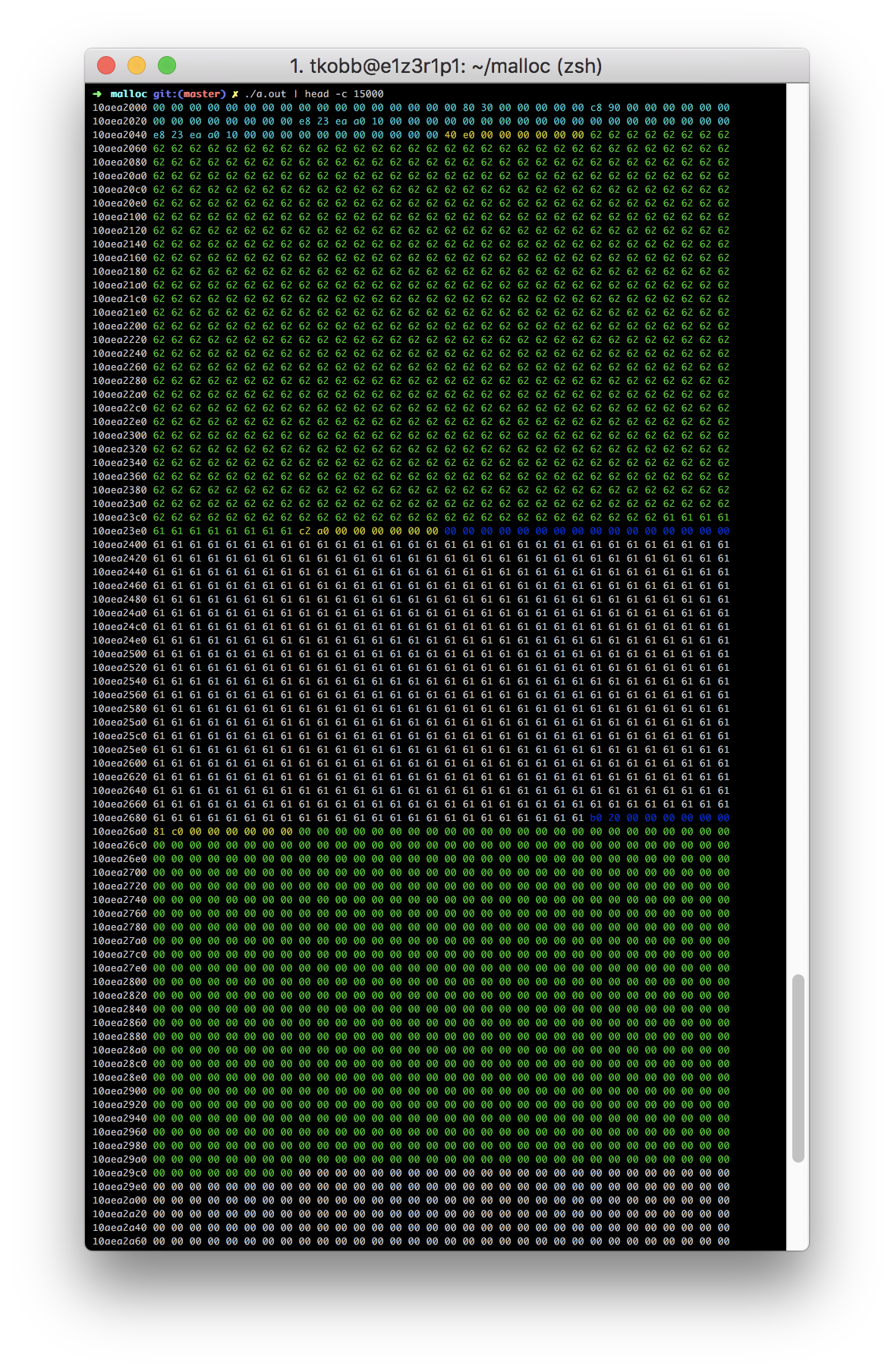
This screenshots displays the memory managed by the library. Yellow represents block headers, green client data and blue free block headers and trailers.
# API
```c
void *malloc(size_t size);
void free(void *ptr);
void *realloc(void *ptr, size_t size);
void show_alloc_mem(void); /* print a summary of allocated blocks */
void hexdump_mem(void); /* semantic hexdump of the allocated memory */
```
# Usage & testing
To create the library:
```sh
make
```
To run a program, dynamically link it by running
```sh
scripts/inject.sh COMMAND
```
Or link with `libft_malloc.so`.
# Strategy
- Memory is managed via `mmap(2)` and `mmunmap(2)`.
- mmaped areas are managed via the `area` struct and `area__*` functions. Areas are a doubly linked list containing individual `blocks`, which are taken from an available `area`.
- `blocks` have a 1 word header encoding size, free status, and free status of the previous block. An additional 3 word minimum size is required to store free list nodes.
- `free_blocks` are doubly-linked list nodes. They have the same header as the underlying `block`, 2 pointers to adjacent free_blocks, an an additional footer encoding the block's size. This footer, in addition to `block.prev_free` allows for linear time coalescing of neighboring blocks.
- Free blocks are stored in an adress-ordered linked list, such that `free_block->prev < free_block < free_block->next` is true for all free blocks for a free list. This ensures that the memory close to the begining of the mmaped areas gets reused sooner, reducing memory fragmentation and improving locality.
- When freeing the last `block` of an `area`, the block is destroyed and `area.cur_size` is reduced, effectively destroying the block. This significantly reduces external fragmentation.
- 3 free lists are used. Each list contains blocks of a specific size range (0-255, 256-1023, 1024+).
- Free blocks are selected on a first fit basis.
- Memory is defragmented at allocation size. When searching the free list for a block of the requested size, neighboring free blocks are included in the current blocks's size, and merged if the combined size is sufficient.
# Further improvements
- [ ] Block checksums for fast freeing