https://github.com/thma/ltupatternfactory
Lambda the ultimate Pattern Factory: FP, Haskell, Typeclassopedia vs Software Design Patterns
https://github.com/thma/ltupatternfactory
builder-pattern category-theory design-patterns factory-pattern function-composition functional-languages functor functors gof-patterns haskell iterator-pattern monad monad-transformers monoids pattern-language reader-monad strategy-pattern traversable typeclasses typeclassopedia
Last synced: about 1 year ago
JSON representation
Lambda the ultimate Pattern Factory: FP, Haskell, Typeclassopedia vs Software Design Patterns
- Host: GitHub
- URL: https://github.com/thma/ltupatternfactory
- Owner: thma
- License: apache-2.0
- Created: 2018-10-05T19:32:13.000Z (almost 8 years ago)
- Default Branch: master
- Last Pushed: 2024-01-17T23:42:42.000Z (over 2 years ago)
- Last Synced: 2025-04-03T10:12:59.644Z (over 1 year ago)
- Topics: builder-pattern, category-theory, design-patterns, factory-pattern, function-composition, functional-languages, functor, functors, gof-patterns, haskell, iterator-pattern, monad, monad-transformers, monoids, pattern-language, reader-monad, strategy-pattern, traversable, typeclasses, typeclassopedia
- Language: Haskell
- Size: 588 KB
- Stars: 999
- Watchers: 25
- Forks: 38
- Open Issues: 11
-
Metadata Files:
- Readme: README.md
- License: LICENSE
Awesome Lists containing this project
README
# Lambda the Ultimate Pattern Factory
[](https://github.com/thma/LtuPatternFactory/actions)
My first programming languages were Lisp, Scheme, and ML. When I later started to work in OO languages like C++ and Java I noticed that idioms that are standard vocabulary in functional programming (fp) were not so easy to achieve and required sophisticated structures. Books like [Design Patterns: Elements of Reusable Object-Oriented Software](https://en.wikipedia.org/wiki/Design_Patterns) were a great starting point to reason about those structures. One of my earliest findings was that several of the GoF-Patterns had a stark resemblance of structures that are built into in functional languages: for instance the strategy pattern corresponds to higher order functions in fp (more details see [below](#strategy)).
Recently, while re-reading through the [Typeclassopedia](https://wiki.haskell.org/Typeclassopedia) I thought it would be a good exercise to map the structure of software [design-patterns](https://en.wikipedia.org/wiki/Software_design_pattern#Classification_and_list) to the concepts found in the Haskell type class library and in functional programming in general.
By searching the web I found some blog entries studying specific patterns, but I did not come across any comprehensive study. As it seemed that nobody did this kind of work yet I found it worthy to spend some time on it and write down all my findings on the subject.
I think this kind of exposition could be helpful if you are:
* a programmer with an OO background who wants to get a better grip on how to implement more complex designs in functional programming
* a functional programmer who wants to get a deeper intuition for type classes.
* studying the [Typeclassopedia](https://wiki.haskell.org/Typeclassopedia) and are looking for an accompanying reading providing example use cases and working code.
>This project is work in progress, so please feel free to contact me with any corrections, adjustments, comments, suggestions and additional ideas you might have.
> Please use the [Issue Tracker](https://github.com/thma/LtuPatternFactory/issues) to enter your requests.
## Table of contents
* [Lambda the ultimate pattern factory](#lambda-the-ultimate-pattern-factory)
* [The Patternopedia](#the-patternopedia)
* [Data Transfer Object → Functor](#data-transfer-object--functor)
* [Singleton → Applicative](#singleton--applicative)
* [Pipeline → Monad](#pipeline--monad)
* [NullObject → Maybe Monad](#nullobject--maybe-monad)
* [Interpreter → Reader Monad](#interpreter--reader-monad)
* [Aspect Weaving → Monad Transformers](#aspect-weaving--monad-transformers)
* [Composite → SemiGroup → Monoid](#composite--semigroup--monoid)
* [Visitor → Foldable](#visitor--foldable)
* [Iterator → Traversable](#iterator--traversable)
* [The Pattern behind the Patterns → Category](#the-pattern-behind-the-patterns--category)
* [Fluent Api → Comonad](#fluent-api--comonad)
* [Beyond type class patterns](#beyond-type-class-patterns)
* [Dependency Injection → Parameter Binding, Partial Application](#dependency-injection--parameter-binding-partial-application)
* [Command → Functions as First Class Citizens](#command--functions-as-first-class-citizens)
* [Adapter → Function Composition](#adapter--function-composition)
* [Template Method → type class default functions](#template-method--type-class-default-functions)
* [Creational Patterns](#creational-patterns)
* [Abstract Factory → functions as data type values](#abstract-factory--functions-as-data-type-values)
* [Builder → record syntax, smart constructor](#builder--record-syntax-smart-constructor)
* [Functional Programming Patterns](#functional-programming-patterns)
* [Higher Order Functions](#higher-order-functions)
* [Map Reduce](#map-reduce)
* [Lazy Evaluation](#lazy-evaluation)
* [Reflection](#reflection)
* [Conclusions](#conclusions)
* [Some related links](#some-interesting-links)
## The Patternopedia
The [Typeclassopedia](https://wiki.haskell.org/wikiupload/8/85/TMR-Issue13.pdf) is a now classic paper that introduces the Haskell type classes by clarifying their algebraic and category-theoretic background. In particular it explains the relationships among those type classes.
In this chapter I'm taking a tour through the Typeclassopedia from a design pattern perspective.
For each of the Typeclassopedia type classes I try to explain how it corresponds to structures applied in software design patterns.
As a reference map I have included the following chart that depicts the Relationships between type classes covered in the Typeclassopedia:
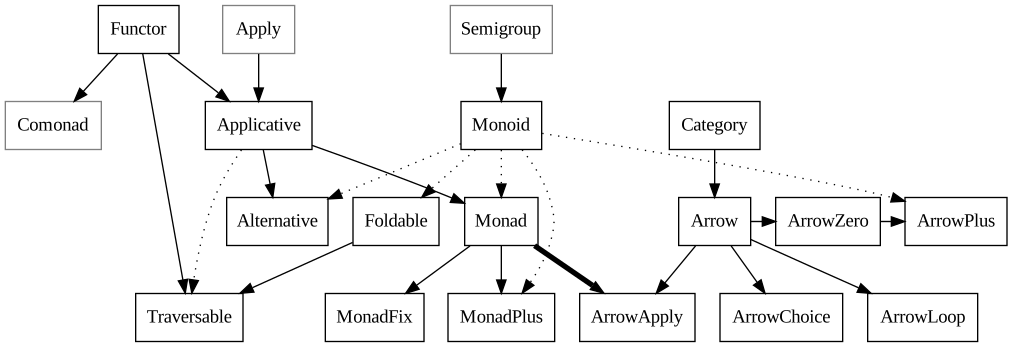
* Solid arrows point from the general to the specific; that is, if there is an arrow from Foo to Bar it means that every Bar is (or should be, or can be made into) a Foo.
* Dotted lines indicate some other sort of relationship.
* Monad and ArrowApply are equivalent.
* Apply and Comonad are greyed out since they are not actually (yet?) in the standard Haskell libraries ∗.
### Data Transfer Object → Functor
> In the field of programming a data transfer object (DTO) is an object that carries data between processes.
> The motivation for its use is that communication between processes is usually done resorting to remote interfaces
> (e.g., web services), where each call is an expensive operation.
> Because the majority of the cost of each call is related to the round-trip time between the client and the server,
> one way of reducing the number of calls is to use an object (the DTO) that aggregates the data that would have been
> transferred by the several calls, but that is served by one call only.
> (quoted from [Wikipedia](https://en.wikipedia.org/wiki/Data_transfer_object)
Data Transfer Object is a pattern from Martin Fowler's [Patterns of Enterprise Application Architecture](https://martinfowler.com/eaaCatalog/dataTransferObject.html).
It is typically used in multi-layered applications where data is transferred between backends and frontends.
The aggregation of data usually also involves a denormalization of data structures. As an example, please refer to the following
diagram where two entities from the backend (`Album` and `Artist`) are assembled to a compound denormalized DTO `AlbumDTO`:
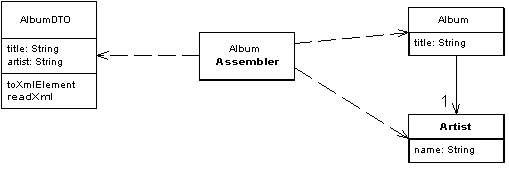
Of course, there is also an inverse mapping from `AlbumDTO` to `Album` which is not shown in this diagram.
In Haskell `Album`, `Artist` and `AlbumDTO` can be represented as data types with record notation:
```haskell
data Album = Album {
title :: String
, publishDate :: Int
, labelName :: String
, artist :: Artist
} deriving (Show)
data Artist = Artist {
publicName :: String
, realName :: Maybe String
} deriving (Show)
data AlbumDTO = AlbumDTO {
albumTitle :: String
, published :: Int
, label :: String
, artistName :: String
} deriving (Show, Read)
```
The transfer from an `Album` to an `AlbumDTO` and vice versa can be achieved by two simple functions, that perfom the
intended field wise mappings:
```haskell
toAlbumDTO :: Album -> AlbumDTO
toAlbumDTO Album {title = t, publishDate = d, labelName = l, artist = a} =
AlbumDTO {albumTitle = t, published = d, label = l, artistName = (publicName a)}
toAlbum :: AlbumDTO -> Album
toAlbum AlbumDTO {albumTitle = t, published = d, label = l, artistName = n} =
Album {title = t, publishDate = d, labelName = l, artist = Artist {publicName = n, realName = Nothing}}
```
In this few lines we have covered the basic idea of the DTO pattern.
Now, let's consider the typical situation that you don't have to transfer only a *single* `Album` instance but a whole
list of `Album` instances, e.g.:
```haskell
albums :: [Album]
albums =
[
Album {title = "Microgravity",
publishDate = 1991,
labelName = "Origo Sound",
artist = Artist {publicName = "Biosphere", realName = Just "Geir Jenssen"}}
, Album {title = "Apollo - Atmospheres & Soundtracks",
publishDate = 1983,
labelName = "Editions EG",
artist = Artist {publicName = "Brian Eno", realName = Just "Brian Peter George St. John le Baptiste de la Salle Eno"}}
]
```
In this case we have to apply the `toAlbumDTO` function to all elements of the list.
In Haskell this *higher order* operation is called `map`:
```haskell
map :: (a -> b) -> [a] -> [b]
map _f [] = []
map f (x:xs) = f x : map f xs
```
`map` takes a function `f :: (a -> b)` (a function from type `a` to type `b`) and an `[a]` list and returns a `[b]` list.
The `b` elements are produced by applying the function `f` to each element of the input list.
Applying `toAlbumDTO` to a list of albums can thus be done in the Haskell REPL GHCi as follows:
```haskell
λ> map toAlbumDTO albums
[AlbumDTO {albumTitle = "Microgravity", published = 1991, label = "Origo Sound", artistName = "Biosphere"},
AlbumDTO {albumTitle = "Apollo - Atmospheres & Soundtracks", published = 1983, label = "Editions EG", artistName = "Brian Eno"}]
```
This mapping of functions over lists is a basic technique known in many functional languages.
In Haskell further generalises this technique with the concept of the `Functor` type class.
> The `Functor` class is the most basic and ubiquitous type class in the Haskell libraries.
> A simple intuition is that a `Functor` represents a “container” of some sort, along with the ability to apply a
> function uniformly to every element in the container. For example, a list is a container of elements,
> and we can apply a function to every element of a list, using `map`.
> As another example, a binary tree is also a container of elements, and it’s not hard to come up with a way to
> recursively apply a function to every element in a tree.
>
> Another intuition is that a Functor represents some sort of “computational context”.
> This intuition is generally more useful, but is more difficult to explain, precisely because it is so general.
>
> Quoted from [Typeclassopedia](https://wiki.haskell.org/Typeclassopedia#Functor)
Basically, all instances of the `Functor` type class must provide a function `fmap`:
```haskell
class Functor f where
fmap :: (a -> b) -> f a -> f b
```
For Lists the implementation is simply the `map` function that we already have seen above:
```haskell
instance Functor [] where
fmap = map
```
Functors have interesting properties, they fulfill the two so called *functor laws*,
which are part of the definition of a mathematical functor:
```haskell
fmap id = id -- (1)
fmap (g . h) = (fmap g) . (fmap h) -- (2)
```
The first law `(1)` states that mapping the identity function over every item in a container has no effect.
The second `(2)` says that mapping a composition of two functions over every item in a container is the same as first
mapping one function, and then mapping the other.
These laws are very useful when we consider composing complex mappings from simpler operations.
Say we want to extend our DTO mapping functionality by also providing some kind of marshalling. For a single album instance,
we can use function composition `(f . g) x == f (g x)`, which is defined in Haskell as:
```haskell
(.) :: (b -> c) -> (a -> b) -> a -> c
(.) f g x = f (g x)
```
In the following GHCi session we are using `(.)` to first convert an `Album` to its `AlbumDTO` representation and then
turn that into a `String` by using the `show` function:
```haskell
λ> album1 = albums !! 0
λ> print album1
Album {title = "Microgravity", publishDate = 1991, labelName = "Origo Sound", artist = Artist {publicName = "Biosphere", realName = Just "Geir Jenssen"}}
λ> marshalled = (show . toAlbumDTO) album1
λ> :t marshalled
marshalled :: String
λ> print marshalled
"AlbumDTO {albumTitle = \"Microgravity\", published = 1991, label = \"Origo Sound\", artistName = \"Biosphere\"}"
```
As we can rely on the functor law `fmap (g . h) = (fmap g) . (fmap h)` we can use fmap to use the same composed
function on any functor, for example our list of albums:
```haskell
λ> fmap (show . toAlbumDTO) albums
["AlbumDTO {albumTitle = \"Microgravity\", published = 1991, label = \"Origo Sound\", artistName = \"Biosphere\"}",
"AlbumDTO {albumTitle = \"Apollo - Atmospheres & Soundtracks\", published = 1983, label = \"Editions EG\", artistName = \"Brian Eno\"}"]
```
We can build more complex mappings by chaining multiple functions, to produce for example a gzipped byte string output:
```haskell
λ> gzipped = (compress . pack . show . toAlbumDTO) album1
```
As the sequence of operation must be read from right to left for the `(.)` operator this becomes quite unintuitive for longer sequences.
Thus, Haskellers often use the flipped version of `(.)`, `(>>>)` which is defined as:
```haskell
f >>> g = g . f
```
Using `(>>>)` the intent of our composition chain becomes much clearer (at least when you are trained to read from left to right):
```haskell
λ> gzipped = (toAlbumDTO >>> show >>> pack >>> compress) album1
```
Unmarshalling can be defined using the inverse operations:
```haskell
λ> unzipped = (decompress >>> unpack >>> read >>> toAlbum) gzipped
λ> :t unzipped
unzipped :: Album
λ> print unzipped
Album {title = "Microgravity", publishDate = 1991, labelName = "Origo Sound", artist = Artist {publicName = "Biosphere", realName = Nothing}}
```
Of course, we can use `fmap` to apply such composed mapping function to any container type instantiating the `Functor`
type class:
```haskell
λ> marshalled = fmap (toAlbumDTO >>> show >>> pack >>> compress) albums
λ> unmarshalled = fmap (decompress >>> unpack >>> read >>> toAlbum) marshalled
λ> print unmarshalled
[Album {title = "Microgravity", publishDate = 1991, labelName = "Origo Sound", artist = Artist {publicName = "Biosphere", realName = Nothing}},
Album {title = "Apollo - Atmospheres & Soundtracks", publishDate = 1983, labelName = "Editions EG", artist = Artist {publicName = "Brian Eno", realName = Nothing}}]
```
[Sourcecode for this section](https://github.com/thma/LtuPatternFactory/blob/master/src/DataTransferObject.hs)
### Singleton → Applicative
> "The singleton pattern is a software design pattern that restricts the instantiation of a class to one object. This is useful when exactly one object is needed to coordinate actions across the system."
> (quoted from [Wikipedia](https://en.wikipedia.org/wiki/Singleton_pattern)
The singleton pattern ensures that multiple requests to a given object always return one and the same singleton instance.
In functional programming this semantics can be achieved by `let`:
```haskell
let singleton = someExpensiveComputation
in mainComputation
--or in lambda notation:
(\singleton -> mainComputation) someExpensiveComputation
```
Via the `let`-Binding we can thread the singleton through arbitrary code in the `in` block. All occurences of `singleton` in the `mainComputation`will point to the same instance.
Type classes provide several tools to make this kind of threading more convenient or even to avoid explicit threading of instances.
#### Using Applicative Functor for threading of singletons
The following code defines a simple expression evaluator:
```haskell
data Exp e = Var String
| Val e
| Add (Exp e) (Exp e)
| Mul (Exp e) (Exp e)
-- the environment is a list of tuples mapping variable names to values of type e
type Env e = [(String, e)]
-- a simple evaluator reducing expression to numbers
eval :: Num e => Exp e -> Env e -> e
eval (Var x) env = fetch x env
eval (Val i) env = i
eval (Add p q) env = eval p env + eval q env
eval (Mul p q) env = eval p env * eval q env
```
`eval` is a classic evaluator function that recursively evaluates sub-expression before applying `+` or `*`.
Note how the explicit `env`parameter is threaded through the recursive eval calls. This is needed to have the
environment avalailable for variable lookup at any recursive call depth.
If we now bind `env` to a value as in the following snippet it is used as an immutable singleton within the recursive evaluation of `eval exp env`.
```haskell
main = do
let exp = Mul (Add (Val 3) (Val 1))
(Mul (Val 2) (Var "pi"))
env = [("pi", pi)]
print $ eval exp env
```
Experienced Haskellers will notice the ["eta-reduction smell"](https://wiki.haskell.org/Eta_conversion) in `eval (Var x) env = fetch x env` which hints at the possibilty to remove `env` as an explicit parameter. We can not do this right away as the other equations for `eval` do not allow eta-reduction. In order to do so we have to apply the combinators of the `Applicative Functor`:
```haskell
class Functor f => Applicative f where
pure :: a -> f a
(<*>) :: f (a -> b) -> f a -> f b
instance Applicative ((->) a) where
pure = const
(<*>) f g x = f x (g x)
```
This `Applicative` allows us to rewrite `eval` as follows:
```haskell
eval :: Num e => Exp e -> Env e -> e
eval (Var x) = fetch x
eval (Val i) = pure i
eval (Add p q) = pure (+) <*> eval p <*> eval q
eval (Mul p q) = pure (*) <*> eval p <*> eval q
```
Any explicit handling of the variable `env` is now removed.
(I took this example from the classic paper [Applicative programming with effects](http://www.soi.city.ac.uk/~ross/papers/Applicative.pdf) which details how `pure` and `<*>` correspond to the combinatory logic combinators `K` and `S`.)
[Sourcecode for this section](https://github.com/thma/LtuPatternFactory/blob/master/src/Singleton.hs)
### Pipeline → Monad
> In software engineering, a pipeline consists of a chain of processing elements (processes, threads, coroutines, functions, etc.), arranged so that the output of each element is the input of the next; the name is by analogy to a physical pipeline.
> (Quoted from: [Wikipedia](https://en.wikipedia.org/wiki/Pipeline_(software))
The concept of pipes and filters in Unix shell scripts is a typical example of the pipeline architecture pattern.
```bash
$ echo "hello world" | wc -w | xargs printf "%d*3\n" | bc -l
6
```
This works exactly as stated in the wikipedia definition of the pattern: the output of `echo "hello world"` is used as input for the next command `wc -w`. The ouptput of this command is then piped as input into `xargs printf "%d*3\n"` and so on.
On the first glance this might look like ordinary function composition. We could for instance come up with the following approximation in Haskell:
```haskell
((3 *) . length . words) "hello world"
6
```
But with this design we missed an important feature of the chain of shell commands: The commands do not work on elementary types like Strings or numbers but on input and output streams that are used to propagate the actual elementary data around. So we can't just send a String into the `wc` command as in `"hello world" | wc -w`. Instead we have to use `echo` to place the string into a stream that we can then use as input to the `wc` command:
```bash
> echo "hello world" | wc -w
```
So we might say that `echo` *injects* the String `"hello world"` into the stream context.
We can capture this behaviour in a functional program like this:
```haskell
-- The Stream type is a wrapper around an arbitrary payload type 'a'
newtype Stream a = Stream a deriving (Show)
-- echo injects an item of type 'a' into the Stream context
echo :: a -> Stream a
echo = Stream
-- the 'andThen' operator used for chaining commands
infixl 7 |>
(|>) :: Stream a -> (a -> Stream b) -> Stream b
Stream x |> f = f x
-- echo and |> are used to create the actual pipeline
pipeline :: String -> Stream Int
pipeline str =
echo str |> echo . length . words |> echo . (3 *)
-- now executing the program in ghci repl:
ghci> pipeline "hello world"
Stream 6
```
The `echo` function injects any input into the `Stream` context:
```haskell
ghci> echo "hello world"
Stream "hello world"
```
The `|>` (pronounced as "andThen") does the function chaining:
```haskell
ghci> echo "hello world" |> echo . words
Stream ["hello","world"]
```
The result of `|>` is of type `Stream b` that's why we cannot just write `echo "hello world" |> words`. We have to use echo to create a `Stream` output that can be digested by a subsequent `|>`.
The interplay of a Context type `Stream a` and the functions `echo` and `|>` is a well known pattern from functional languages: it's the legendary *Monad*. As the [Wikipedia article on the pipeline pattern](https://en.wikipedia.org/wiki/Pipeline_(software)) states:
> Pipes and filters can be viewed as a form of functional programming, using byte streams as data objects; more specifically, they can be seen as a particular form of monad for I/O.
There is an interesting paper available elaborating on the monadic nature of Unix pipes: [Monadic Shell](http://okmij.org/ftp/Computation/monadic-shell.html).
Here is the definition of the Monad type class in Haskell:
```Haskell
class Applicative m => Monad m where
-- | Sequentially compose two actions, passing any value produced
-- by the first as an argument to the second.
(>>=) :: m a -> (a -> m b) -> m b
-- | Inject a value into the monadic type.
return :: a -> m a
return = pure
```
By looking at the types of `>>=` and `return` it's easy to see the direct correspondence to `|>` and `echo` in the pipeline example above:
```haskell
(|>) :: Stream a -> (a -> Stream b) -> Stream b
echo :: a -> Stream a
```
Mhh, this is nice, but still looks a lot like ordinary composition of functions, just with the addition of a wrapper.
In this simplified example that's true, because we have designed the `|>` operator to simply unwrap a value from the Stream and bind it to the formal parameter of the subsequent function:
```haskell
Stream x |> f = f x
```
But we are free to implement the `andThen` operator in any way that we seem fit as long we maintain the type signature and the [monad laws](https://en.wikipedia.org/wiki/Monad_%28functional_programming%29#Monad_laws).
So we could for instance change the semantics of `>>=` to keep a log along the execution pipeline:
```haskell
-- The DeriveFunctor Language Pragma provides automatic derivation of Functor instances
{-# LANGUAGE DeriveFunctor #-}
-- a Log is just a list of Strings
type Log = [String]
-- the Stream type is extended by a Log that keeps track of any logged messages
newtype LoggerStream a = LoggerStream (a, Log) deriving (Show, Functor)
instance Applicative LoggerStream where
pure = return
LoggerStream (f, _) <*> r = fmap f r
-- our definition of the Logging Stream Monad:
instance Monad LoggerStream where
-- returns a Stream wrapping a tuple of the actual payload and an empty Log
return a = LoggerStream (a, [])
-- we define (>>=) to return a tuple (composed functions, concatenated logs)
m1 >>= m2 = let LoggerStream(f1, l1) = m1
LoggerStream(f2, l2) = m2 f1
in LoggerStream(f2, l1 ++ l2)
-- compute length of a String and provide a log message
logLength :: String -> LoggerStream Int
logLength str = let l = length(words str)
in LoggerStream (l, ["length(" ++ str ++ ") = " ++ show l])
-- multiply x with 3 and provide a log message
logMultiply :: Int -> LoggerStream Int
logMultiply x = let z = x * 3
in LoggerStream (z, ["multiply(" ++ show x ++ ", 3" ++") = " ++ show z])
-- the logging version of the pipeline
logPipeline :: String -> LoggerStream Int
logPipeline str =
return str >>= logLength >>= logMultiply
-- and then in Ghci:
> logPipeline "hello logging world"
LoggerStream (9,["length(hello logging world) = 3","multiply(3, 3) = 9"])
```
What's noteworthy here is that Monads allow to make the mechanism of chaining functions *explicit*. We can define what `andThen` should mean in our pipeline by choosing a different Monad implementation.
So in a sense Monads could be called [programmable semicolons](http://book.realworldhaskell.org/read/monads.html#id642960)
To make this statement a bit clearer we will have a closer look at the internal workings of the `Maybe` Monad in the next section.
[Sourcecode for this section](https://github.com/thma/LtuPatternFactory/blob/master/src/Pipeline.hs)
### NullObject → Maybe Monad
>[...] a null object is an object with no referenced value or with defined neutral ("null") behavior. The null object design pattern describes the uses of such objects and their behavior (or lack thereof).
> [Quoted from Wikipedia](https://en.wikipedia.org/wiki/Null_object_pattern)
In functional programming the null object pattern is typically formalized with option types:
> [...] an option type or maybe type is a polymorphic type that represents encapsulation of an optional value; e.g., it is used as the return type of functions which may or may not return a meaningful value when they are applied. It consists of a constructor which either is empty (named None or `Nothing`), or which encapsulates the original data type `A` (written `Just A` or Some A).
> [Quoted from Wikipedia](https://en.wikipedia.org/wiki/Option_type)
(See also: [Null Object as Identity](http://blog.ploeh.dk/2018/04/23/null-object-as-identity/))
In Haskell the most simple option type is `Maybe`. Let's directly dive into an example. We define a reverse index, mapping songs to album titles.
If we now lookup up a song title we may either be lucky and find the respective album or not so lucky when there is no album matching our song:
```haskell
import Data.Map (Map, fromList)
import qualified Data.Map as Map (lookup) -- avoid clash with Prelude.lookup
-- type aliases for Songs and Albums
type Song = String
type Album = String
-- the simplified reverse song index
songMap :: Map Song Album
songMap = fromList
[("Baby Satellite","Microgravity")
,("An Ending", "Apollo: Atmospheres and Soundtracks")]
```
We can lookup this map by using the function `Map.lookup :: Ord k => k -> Map k a -> Maybe a`.
If no match is found it will return `Nothing` if a match is found it will return `Just match`:
```haskell
ghci> Map.lookup "Baby Satellite" songMap
Just "Microgravity"
ghci> Map.lookup "The Fairy Tale" songMap
Nothing
```
Actually the `Maybe` type is defined as:
```haskell
data Maybe a = Nothing | Just a
deriving (Eq, Ord)
```
All code using the `Map.lookup` function will never be confronted with any kind of Exceptions, null pointers or other nasty things. Even in case of errors a lookup will always return a properly typed `Maybe` instance. By pattern matching for `Nothing` or `Just a` client code can react on failing matches or positive results:
```haskell
case Map.lookup "Ancient Campfire" songMap of
Nothing -> print "sorry, could not find your song"
Just a -> print a
```
Let's try to apply this to an extension of our simple song lookup.
Let's assume that our music database has much more information available. Apart from a reverse index from songs to albums, there might also be an index mapping album titles to artists.
And we might also have an index mapping artist names to their websites:
```haskell
type Song = String
type Album = String
type Artist = String
type URL = String
songMap :: Map Song Album
songMap = fromList
[("Baby Satellite","Microgravity")
,("An Ending", "Apollo: Atmospheres and Soundtracks")]
albumMap :: Map Album Artist
albumMap = fromList
[("Microgravity","Biosphere")
,("Apollo: Atmospheres and Soundtracks", "Brian Eno")]
artistMap :: Map Artist URL
artistMap = fromList
[("Biosphere","http://www.biosphere.no//")
,("Brian Eno", "http://www.brian-eno.net")]
lookup' :: Ord a => Map a b -> a -> Maybe b
lookup' = flip Map.lookup
findAlbum :: Song -> Maybe Album
findAlbum = lookup' songMap
findArtist :: Album -> Maybe Artist
findArtist = lookup' albumMap
findWebSite :: Artist -> Maybe URL
findWebSite = lookup' artistMap
```
With all this information at hand we want to write a function that has an input parameter of type `Song` and returns a `Maybe URL` by going from song to album to artist to website url:
```haskell
findUrlFromSong :: Song -> Maybe URL
findUrlFromSong song =
case findAlbum song of
Nothing -> Nothing
Just album ->
case findArtist album of
Nothing -> Nothing
Just artist ->
case findWebSite artist of
Nothing -> Nothing
Just url -> Just url
```
This code makes use of the pattern matching logic described before. It's worth to note that there is some nice circuit breaking happening in case of a `Nothing`. In this case `Nothing` is directly returned as result of the function and the rest of the case-ladder is not executed.
What's not so nice is *"the dreaded ladder of code marching off the right of the screen"* [(quoted from Real World Haskell)](http://book.realworldhaskell.org/).
For each find function we have to repeat the same ceremony of pattern matching on the result and either return `Nothing` or proceed with the next nested level.
The good news is that it is possible to avoid this ladder.
We can rewrite our search by applying the `andThen` operator `>>=` as `Maybe` is an instance of `Monad`:
```haskell
findUrlFromSong' :: Song -> Maybe URL
findUrlFromSong' song =
findAlbum song >>= \album ->
findArtist album >>= \artist ->
findWebSite artist
```
or even shorter as we can eliminate the lambda expressions by applying [eta-conversion](https://wiki.haskell.org/Eta_conversion):
```haskell
findUrlFromSong'' :: Song -> Maybe URL
findUrlFromSong'' song =
findAlbum song >>= findArtist >>= findWebSite
```
Using it in GHCi:
```haskell
ghci> findUrlFromSong'' "All you need is love"
Nothing
ghci> findUrlFromSong'' "An Ending"
Just "http://www.brian-eno.net"
```
The expression `findAlbum song >>= findArtist >>= findWebSite` and the sequencing of actions in the [pipeline](#pipeline---monad) example `return str >>= return . length . words >>= return . (3 *)` have a similar structure.
But the behaviour of both chains is quite different: In the Maybe Monad `a >>= b` does not evaluate b if `a == Nothing` but stops the whole chain of actions by simply returning `Nothing`.
The pattern matching and 'short-circuiting' is directly coded into the definition of `(>>=)` in the Monad implementation of `Maybe`:
```haskell
instance Monad Maybe where
(Just x) >>= k = k x
Nothing >>= _ = Nothing
```
This elegant feature of `(>>=)` in the `Maybe` Monad allows us to avoid ugly and repetetive coding.
#### Avoiding partial functions by using Maybe
Maybe is often used to avoid the exposure of partial functions to client code. Take for example division by zero or computing the square root of negative numbers which are undefined (at least for real numbers).
Here come safe – that is total – definitions of these functions that return `Nothing` for undefined cases:
```haskell
safeRoot :: Double -> Maybe Double
safeRoot x
| x >= 0 = Just (sqrt x)
| otherwise = Nothing
safeReciprocal :: Double -> Maybe Double
safeReciprocal x
| x /= 0 = Just (1/x)
| otherwise = Nothing
```
As we have already learned the monadic `>>=` operator allows to chain such function as in the following example:
```haskell
safeRootReciprocal :: Double -> Maybe Double
safeRootReciprocal x = return x >>= safeReciprocal >>= safeRoot
```
This can be written even more terse as:
```haskell
safeRootReciprocal :: Double -> Maybe Double
safeRootReciprocal = safeReciprocal >=> safeRoot
```
The use of the [Kleisli 'fish' operator `>=>`](https://www.stackage.org/haddock/lts-13.0/base-4.12.0.0/Control-Monad.html#v:-62--61--62-) makes it more evident that we are actually aiming at a composition of the monadic functions `safeReciprocal` and `safeRoot`.
There are many predefined Monads available in the Haskell curated libraries and it's also possible to combine their effects by making use of `MonadTransformers`. But that's a [different story...](#aspect-weaving--monad-transformers)
[Sourcecode for this section](https://github.com/thma/LtuPatternFactory/blob/master/src/NullObject.hs)
### Interpreter → Reader Monad
> In computer programming, the interpreter pattern is a design pattern that specifies how to evaluate sentences in a language. The basic idea is to have a class for each symbol (terminal or nonterminal) in a specialized computer language. The syntax tree of a sentence in the language is an instance of the composite pattern and is used to evaluate (interpret) the sentence for a client.
>
> [Quoted from Wikipedia](https://en.wikipedia.org/wiki/Interpreter_pattern)
In the section [Singleton → Applicative](#singleton--applicative) we have already written a simple expression evaluator. From that section it should be obvious how easy the definition of evaluators and interpreters is in functional programming languages.
The main ingredients are:
* Algebraic Data Types (ADT) used to define the expression data type which is to be evaluated
* An evaluator function that uses pattern matching on the expression ADT
* 'implicit' threading of an environment
In the section on Singleton we have seen that some kind of 'implicit' threading of the environment can be already achieved with `Applicative Functors.
We still had the environment as an explicit parameter of the eval function:
```haskell
eval :: Num e => Exp e -> Env e -> e
```
but we could omit it in the pattern matching equations:
```haskell
eval (Var x) = fetch x
eval (Val i) = pure i
eval (Add p q) = pure (+) <*> eval p <*> eval q
eval (Mul p q) = pure (*) <*> eval p <*> eval q
```
By using Monads the handling of the environment can be made even more implicit.
I'll demonstrate this with a slightly extended version of the evaluator. In the first step we extend the expression syntax to also provide let expressions and generic support for binary operators:
```haskell
-- | a simple expression ADT
data Exp a =
Var String -- a variable to be looked up
| BinOp (BinOperator a) (Exp a) (Exp a) -- a binary operator applied to two expressions
| Let String (Exp a) (Exp a) -- a let expression
| Val a -- an atomic value
-- | a binary operator type
type BinOperator a = a -> a -> a
-- | the environment is just a list of mappings from variable names to values
type Env a = [(String, a)]
```
With this data type we can encode expressions like:
```haskell
let x = 4+5
in 2*x
```
as:
```haskell
Let "x" (BinOp (+) (Val 4) (Val 5))
(BinOp (*) (Val 2) (Var "x"))
```
In order to evaluate such expression we must be able to modify the environment at runtime to create a binding for the variable `x` which will be referred to in the `in` part of the expression.
Next we define an evaluator function that pattern matches the above expression ADT:
```haskell
eval :: MonadReader (Env a) m => Exp a -> m a
eval (Val i) = return i
eval (Var x) = asks (fetch x)
eval (BinOp op e1 e2) = liftM2 op (eval e1) (eval e2)
eval (Let x e1 e2) = eval e1 >>= \v -> local ((x,v):) (eval e2)
```
Let's explore this dense code line by line.
```haskell
eval :: MonadReader (Env a) m => Exp a -> m a
```
The most simple instance for `MonadReader` is the partially applied function type `((->) env)`.
Let's assume the compiler will choose this type as the `MonadReader` instance. We can then rewrite the function signature as follows:
```haskell
eval :: Exp a -> ((->) (Env a)) a -- expanding m to ((->) (Env a))
eval :: Exp a -> Env a -> a -- applying infix notation for (->)
```
This is exactly the signature we were using for the `Applicative` eval function which matches our original intent to eval an expression of type `Exp a` in an environment of type `Env a` to a result of type `a`.
```haskell
eval (Val i) = return i
```
In this line we are pattern matching for a `(Val i)`. The atomic value `i` is `return`ed, that is lifted to a value of the type `Env a -> a`.
```haskell
eval (Var x) = asks (fetch x)
```
`asks` is a helper function that applies its argument `f :: env -> a` (in our case `(fetch x)` which looks up variable `x`) to the environment. `asks` is thus typically used to handle environment lookups:
```haskell
asks :: (MonadReader env m) => (env -> a) -> m a
asks f = ask >>= return . f
```
Now to the next line handling the application of a binary operator:
```haskell
eval (BinOp op e1 e2) = liftM2 op (eval e1) (eval e2)
```
`op` is a binary function of type `a -> a -> a` (typical examples are binary arithmetic functions like `+`, `-`, `*`, `/`).
We want to apply this operation on the two expressions `(eval e1)` and `(eval e2)`.
As these expressions both are to be executed within the same monadic context we have to use `liftM2` to lift `op` into this context:
```haskell
-- | Promote a function to a monad, scanning the monadic arguments from
-- left to right. For example,
--
-- > liftM2 (+) [0,1] [0,2] = [0,2,1,3]
-- > liftM2 (+) (Just 1) Nothing = Nothing
--
liftM2 :: (Monad m) => (a1 -> a2 -> r) -> m a1 -> m a2 -> m r
liftM2 f m1 m2 = do { x1 <- m1; x2 <- m2; return (f x1 x2) }
```
The last step is the evaluation of `Let x e1 e2` expressions like `Let "x" (Val 7) (BinOp (+) (Var "x") (Val 5))`. To make this work we have to evaluate `e1` and extend the environment by a binding of the variable `x` to the result of that evaluation.
Then we have to evaluate `e2` in the context of the extended environment:
```haskell
eval (Let x e1 e2) = eval e1 >>= \v -> -- bind the result of (eval e1) to v
local ((x,v):) (eval e2) -- add (x,v) to the env, eval e2 in the extended env
```
The interesting part here is the helper function `local f m` which applies `f` to the environment and then executes `m` against the (locally) changed environment.
Providing a locally modified environment as the scope of the evaluation of `e2` is exactly what the `let` binding intends:
```haskell
-- | Executes a computation in a modified environment.
local :: (r -> r) -- ^ The function to modify the environment.
-> m a -- ^ @Reader@ to run in the modified environment.
-> m a
instance MonadReader r ((->) r) where
local f m = m . f
```
Now we can use `eval` to evaluate our example expression:
```haskell
interpreterDemo = do
putStrLn "Interpreter -> Reader Monad + ADTs + pattern matching"
let exp1 = Let "x"
(BinOp (+) (Val 4) (Val 5))
(BinOp (*) (Val 2) (Var "x"))
print $ runReader (eval exp1) env
-- an then in GHCi:
> interpreterDemo
18
```
By virtue of the `local` function we used `MonadReader` as if it provided modifiable state. So for many use cases that require only *local* state modifications its not required to use the somewhat more tricky `MonadState`.
Writing the interpreter function with a `MonadState` looks like follows:
```haskell
eval1 :: (MonadState (Env a) m) => Exp a -> m a
eval1 (Val i) = return i
eval1 (Var x) = gets (fetch x)
eval1 (BinOp op e1 e2) = liftM2 op (eval1 e1) (eval1 e2)
eval1 (Let x e1 e2) = eval1 e1 >>= \v ->
modify ((x,v):) >>
eval1 e2
```
This section was inspired by ideas presented in [Quick Interpreters with the Reader Monad](https://donsbot.wordpress.com/2006/12/11/quick-interpreters-with-the-reader-monad/).
[Sourcecode for this section](https://github.com/thma/LtuPatternFactory/blob/master/src/Interpreter.hs)
### Aspect Weaving → Monad Transformers
> In computing, aspect-oriented programming (AOP) is a programming paradigm that aims to increase modularity by allowing the separation of cross-cutting concerns. It does so by adding additional behavior to existing code (an advice) without modifying the code itself, instead separately specifying which code is modified via a "pointcut" specification, such as "log all function calls when the function's name begins with 'set'". This allows behaviors that are not central to the business logic (such as logging) to be added to a program without cluttering the code, core to the functionality.
>
> [Quoted from Wikipedia](https://en.wikipedia.org/wiki/Aspect-oriented_programming)
### Stacking Monads
In section
[Interpreter -> Reader Monad](#interpreter--reader-monad)
we specified an Interpreter of a simple expression language by defining a monadic `eval` function:
```haskell
eval :: Exp a -> Reader (Env a) a
eval (Var x) = asks (fetch x)
eval (Val i) = return i
eval (BinOp op e1 e2) = liftM2 op (eval e1) (eval e2)
eval (Let x e1 e2) = eval e1 >>= \v -> local ((x,v):) (eval e2)
```
Using the `Reader` Monad allows to thread an environment through all recursive calls of `eval`.
A typical extension to such an interpreter would be to provide a log mechanism that allows tracing of the actual sequence of all performed evaluation steps.
In Haskell the typical way to provide such a log is by means of the `Writer Monad`.
But how to combine the capabilities of the `Reader` monad code with those of the `Writer` monad?
The answer is `MonadTransformer`s: specialized types that allow us to stack two monads into a single one that shares the behavior of both.
In order to stack the `Writer` monad on top of the `Reader` we use the transformer type `WriterT`:
```haskell
-- adding a logging capability to the expression evaluator
eval :: Show a => Exp a -> WriterT [String] (Reader (Env a)) a
eval (Var x) = tell ["lookup " ++ x] >> asks (fetch x)
eval (Val i) = tell [show i] >> return i
eval (BinOp op e1 e2) = tell ["Op"] >> liftM2 op (eval e1) (eval e2)
eval (Let x e1 e2) = do
tell ["let " ++ x]
v <- eval e1
tell ["in"]
local ((x,v):) (eval e2)
```
The signature of `eval` has been extended by Wrapping `WriterT [String]` around `(Reader (Env a))`. This denotes a Monad that combines a `Reader (Env a)` with a `Writer [String]`. `Writer [String]` is a `Writer` that maintains a list of strings as log.
The resulting Monad supports function of both `MonadReader` and `MonadWriter` typeclasses. As you can see in the equation for `eval (Var x)` we are using `MonadWriter.tell` for logging and `MonadReader.asks` for obtaining the environment and compose both monadic actions by `>>`:
```haskell
eval (Var x) = tell ["lookup " ++ x] >> asks (fetch x)
```
In order to execute this stacked up monads we have to apply the `run` functions of `WriterT` and `Reader`:
```haskell
ghci> runReader (runWriterT (eval letExp)) [("pi",pi)]
(6.283185307179586,["let x","let y","Op","5.0","7.0","in","Op","lookup y","6.0","in","Op","lookup pi","lookup x"])
````
For more details on MonadTransformers please have a look at the following tutorials:
[MonadTransformers Wikibook](https://en.wikibooks.org/wiki/Haskell/Monad_transformers)
[Monad Transformers step by step](https://page.mi.fu-berlin.de/scravy/realworldhaskell/materialien/monad-transformers-step-by-step.pdf)
### Specifying AOP semantics with MonadTransformers
What we have seen so far is that it possible to form Monad stacks that combine the functionality of the Monads involved: In a way a MonadTransformer adds capabilities that are cross-cutting to those of the underlying Monad.
In the following lines I want to show how MonadTransformers can be used to specify the formal semantics of Aspect Oriented Programming. I have taken the example from Mark P. Jones paper
[The Essence of AspectJ](https://pdfs.semanticscholar.org/c4ce/14364d88d533fac6aa53481b719aa661ce73.pdf).
#### An interpreter for MiniPascal
We start by defining a simple imperative language – MiniPascal:
```haskell
-- | an identifier type
type Id = String
-- | Integer expressions
data IExp = Lit Int
| IExp :+: IExp
| IExp :*: IExp
| IExp :-: IExp
| IExp :/: IExp
| IVar Id deriving (Show)
-- | Boolean expressions
data BExp = T
| F
| Not BExp
| BExp :&: BExp
| BExp :|: BExp
| IExp :=: IExp
| IExp :<: IExp deriving (Show)
-- | Staments
data Stmt = Skip -- no op
| Id := IExp -- variable assignment
| Begin [Stmt] -- a sequence of statements
| If BExp Stmt Stmt -- an if statement
| While BExp Stmt -- a while loop
deriving (Show)
```
With this igredients its possible to write imperative programs like the following `while` loop that sums up the natural numbers from 1 to 10:
```haskell
-- an example program: the MiniPascal equivalent of `sum [1..10]`
program :: Stmt
program =
Begin [
"total" := Lit 0,
"count" := Lit 0,
While (IVar "count" :<: Lit 10)
(Begin [
"count" := (IVar "count" :+: Lit 1),
"total" := (IVar "total" :+: IVar "count")
])
]
```
We define the semantics of this language with an interpreter:
```haskell
-- | the store used for variable assignments
type Store = Map Id Int
-- | evaluate numeric expression.
iexp :: MonadState Store m => IExp -> m Int
iexp (Lit n) = return n
iexp (e1 :+: e2) = liftM2 (+) (iexp e1) (iexp e2)
iexp (e1 :*: e2) = liftM2 (*) (iexp e1) (iexp e2)
iexp (e1 :-: e2) = liftM2 (-) (iexp e1) (iexp e2)
iexp (e1 :/: e2) = liftM2 div (iexp e1) (iexp e2)
iexp (IVar i) = getVar i
-- | evaluate logic expressions
bexp :: MonadState Store m => BExp -> m Bool
bexp T = return True
bexp F = return False
bexp (Not b) = fmap not (bexp b)
bexp (b1 :&: b2) = liftM2 (&&) (bexp b1) (bexp b2)
bexp (b1 :|: b2) = liftM2 (||) (bexp b1) (bexp b2)
bexp (e1 :=: e2) = liftM2 (==) (iexp e1) (iexp e2)
bexp (e1 :<: e2) = liftM2 (<) (iexp e1) (iexp e2)
-- | evaluate statements
stmt :: MonadState Store m => Stmt -> m ()
stmt Skip = return ()
stmt (i := e) = do x <- iexp e; setVar i x
stmt (Begin ss) = mapM_ stmt ss
stmt (If b t e) = do
x <- bexp b
if x then stmt t
else stmt e
stmt (While b t) = loop
where loop = do
x <- bexp b
when x $ stmt t >> loop
-- | a variable assignments updates the store (which is maintained in the state)
setVar :: (MonadState (Map k a) m, Ord k) => k -> a -> m ()
setVar i x = do
store <- get
put (Map.insert i x store)
-- | lookup a variable in the store. return 0 if no value is found
getVar :: MonadState Store m => Id -> m Int
getVar i = do
s <- get
case Map.lookup i s of
Nothing -> return 0
(Just v) -> return v
-- | evaluate a statement
run :: Stmt -> Store
run s = execState (stmt s) (Map.fromList [])
-- and then in GHCi:
ghci> run program
fromList [("count",10),("total",55)]
```
So far this is nothing special, just a minimal interpreter for an imperative language. Side effects in form of variable assignments are modelled with an environment that is maintained in a state monad.
In the next step we want to extend this language with features of aspect oriented programming in the style of *AspectJ*: join points, point cuts, and advices.
#### An Interpreter for AspectPascal
To keep things simple we will specify only two types of joint points: variable assignment and variable reading:
```haskell
data JoinPointDesc = Get Id | Set Id
```
`Get i` describes a join point at which the variable `i` is read, while `Set i` described a join point at which
a value is assigned to the variable `i`.
Following the concepts of ApectJ pointcut expressions are used to describe sets of join points.
The abstract syntax for pointcuts is as follows:
```haskell
data PointCut = Setter -- the pointcut of all join points at which a variable is being set
| Getter -- the pointcut of all join points at which a variable is being read
| AtVar Id -- the point cut of all join points at which a the variable is being set or read
| NotAt PointCut -- not a
| PointCut :||: PointCut -- a or b
| PointCut :&&: PointCut -- a and b
```
For example this syntax can be used to specify the pointcut of
all join points at which the variable `x` is set:
```haskell
(Setter :&&: AtVar "x")
```
The following function computes whether a `PointCut` contains a given `JoinPoint`:
```haskell
includes :: PointCut -> (JoinPointDesc -> Bool)
includes Setter (Set i) = True
includes Getter (Get i) = True
includes (AtVar i) (Get j) = i == j
includes (AtVar i) (Set j) = i == j
includes (NotAt p) d = not (includes p d)
includes (p :||: q) d = includes p d || includes q d
includes (p :&&: q) d = includes p d && includes q d
includes _ _ = False
```
In AspectJ aspect oriented extensions to a program are described using the notion of advices.
We follow the same design here: each advice includes a pointcut to specify the join points at which the
advice should be used, and a statement (in MiniPascal syntax) to specify the action that should be performed at each matching join point.
In AspectPascal we only support two kinds of advice: `Before`, which will be executed on entry to a join point, and
`After` which will be executed on the exit from a join point:
```haskell
data Advice = Before PointCut Stmt
| After PointCut Stmt
```
This allows to define `Advice`s like the following:
```haskell
-- the countSets Advice traces each setting of a variable and increments the counter "countSet"
countSets = After (Setter :&&: NotAt (AtVar "countSet") :&&: NotAt (AtVar "countGet"))
("countSet" := (IVar "countSet" :+: Lit 1))
-- the countGets Advice traces each lookup of a variable and increments the counter "countGet"
countGets = After (Getter :&&: NotAt (AtVar "countSet") :&&: NotAt (AtVar "countGet"))
("countGet" := (IVar "countGet" :+: Lit 1))
```
The rather laborious PointCut definition is used to select access to all variable apart from `countGet` and `countSet`.
This is required as the action part of the `Advices` are normal MiniPascal statements that are executed by the same interpreter as the main program which is to be extended by advices. If those filters were not present execution of those advices would result in non-terminating loops, as the action statements also access variables.
A complete AspectPascal program will now consist of a `stmt` (the original program) plus a list of `advices` that should be executed to implement the cross-cutting aspects:
```haskell
-- | Aspects are just a list of Advices
type Aspects = [Advice]
```
In order to extend our interpreter to execute additional behaviour decribed in `advices` we will have to provide all evaluating functions with access to the `Aspects`.
As the `Aspects` will not be modified at runtime the typical solution would be to provide them by a `Reader Aspects` monad.
We already have learnt that we can use a MonadTransformer to stack our existing `State` monad with a `Reader` monad. The respective Transformer is `ReaderT`.
We thus extend the signature of the evaluation functions accordingly, eg:
```haskell
-- from:
iexp :: MonadState Store m => IExp -> m Int
-- to:
iexp :: MonadState Store m => IExp -> ReaderT Aspects m Int
```
Apart from extendig the signatures we have to modify all places where variables are accessed to apply the matching advices.
So for instance in the equation for `iexp (IVar i)` we specify that `(getVar i)` should be executed with applying all advices that match the read access to variable `i` – that is `(Get i)` by writing:
```haskell
iexp (IVar i) = withAdvice (Get i) (getVar i)
```
So the complete definition of `iexp` is:
```haskell
iexp :: MonadState Store m => IExp -> ReaderT Aspects m Int
iexp (Lit n) = return n
iexp (e1 :+: e2) = liftM2 (+) (iexp e1) (iexp e2)
iexp (e1 :*: e2) = liftM2 (*) (iexp e1) (iexp e2)
iexp (e1 :-: e2) = liftM2 (-) (iexp e1) (iexp e2)
iexp (e1 :/: e2) = liftM2 div (iexp e1) (iexp e2)
iexp (IVar i) = withAdvice (Get i) (getVar i)
```
> [...] if `c` is a computation corresponding to some join point with description `d`, then `withAdvice d c` wraps the
execution of `c` with the execution of the appropriate Before and After advice, if any:
```haskell
withAdvice :: MonadState Store m => JoinPointDesc -> ReaderT Aspects m a -> ReaderT Aspects m a
withAdvice d c = do
aspects <- ask -- obtaining the Aspects from the Reader monad
mapM_ stmt (before d aspects) -- execute the statements of all Before advices
x <- c -- execute the actual business logic
mapM_ stmt (after d aspects) -- execute the statements of all After advices
return x
-- collect the statements of Before and After advices matching the join point
before, after :: JoinPointDesc -> Aspects -> [Stmt]
before d as = [s | Before c s <- as, includes c d]
after d as = [s | After c s <- as, includes c d]
```
In the same way the equation for variable assignment `stmt (i := e)` we specify that `(setVar i x)` should be executed with applying all advices that match the write access to variable `i` – that is `(Set i)` by noting:
```haskell
stmt (i := e) = do x <- iexp e; withAdvice (Set i) (setVar i x)
```
The complete implementation for `stmt` then looks like follows:
```haskell
stmt :: MonadState Store m => Stmt -> ReaderT Aspects m ()
stmt Skip = return ()
stmt (i := e) = do x <- iexp e; withAdvice (Set i) (setVar i x)
stmt (Begin ss) = mapM_ stmt ss
stmt (If b t e) = do
x <- bexp b
if x then stmt t
else stmt e
stmt (While b t) = loop
where loop = do
x <- bexp b
when x $ stmt t >> loop
```
Finally we have to extend `run` function to properly handle the monad stack:
```haskell
run :: Aspects -> Stmt -> Store
run a s = execState (runReaderT (stmt s) a) (Map.fromList [])
-- and then in GHCi:
ghci> run [] program
fromList [("count",10),("total",55)]
ghci> run [countSets] program
fromList [("count",10),("countSet",22),("total",55)]
ghci> run [countSets, countGets] program
fromList [("count",10),("countGet",41),("countSet",22),("total",55)]
```
So executing the program with an empty list of advices yields the same result as executing the program with initial interpreter. Once we execute the program with the advices `countGets` and `countSets` the resulting map contains values for the variables `countGet` and `countSet` which have been incremented by the statements of both advices.
We have utilized Monad Transformers to extend our original interpreter in a minamally invasive way, to provide a formal and executable semantics for a simple aspect-oriented language in the style of AspectJ.
### Composite → SemiGroup → Monoid
>In software engineering, the composite pattern is a partitioning design pattern. The composite pattern describes a group of objects that is treated the same way as a single instance of the same type of object. The intent of a composite is to "compose" objects into tree structures to represent part-whole hierarchies. Implementing the composite pattern lets clients treat individual objects and compositions uniformly.
> (Quoted from [Wikipedia](https://en.wikipedia.org/wiki/Composite_pattern))
A typical example for the composite pattern is the hierarchical grouping of test cases to TestSuites in a testing framework. Take for instance the following class diagram from the [JUnit cooks tour](http://junit.sourceforge.net/doc/cookstour/cookstour.htm) which shows how JUnit applies the Composite pattern to group `TestCases` to `TestSuites` while both of them implement the `Test` interface:

In Haskell we could model this kind of hierachy with an algebraic data type (ADT):
```haskell
-- the composite data structure: a Test can be either a single TestCase
-- or a TestSuite holding a list of Tests
data Test = TestCase TestCase
| TestSuite [Test]
-- a test case produces a boolean when executed
type TestCase = () -> Bool
```
The function `run` as defined below can either execute a single TestCase or a composite TestSuite:
```haskell
-- execution of a Test.
run :: Test -> Bool
run (TestCase t) = t () -- evaluating the TestCase by applying t to ()
run (TestSuite l) = all (True ==) (map run l) -- running all tests in l and return True if all tests pass
-- a few most simple test cases
t1 :: Test
t1 = TestCase (\() -> True)
t2 :: Test
t2 = TestCase (\() -> True)
t3 :: Test
t3 = TestCase (\() -> False)
-- collecting all test cases in a TestSuite
ts = TestSuite [t1,t2,t3]
```
As run is of type `run :: Test -> Bool` we can use it to execute single `TestCases` or complete `TestSuites`.
Let's try it in GHCI:
```haskell
ghci> run t1
True
ghci> run ts
False
```
In order to aggregate TestComponents we follow the design of JUnit and define a function `addTest`. Adding two atomic Tests will result in a TestSuite holding a list with the two Tests. If a Test is added to a TestSuite, the test is added to the list of tests of the suite. Adding TestSuites will merge them.
```haskell
-- adding Tests
addTest :: Test -> Test -> Test
addTest t1@(TestCase _) t2@(TestCase _) = TestSuite [t1,t2]
addTest t1@(TestCase _) (TestSuite list) = TestSuite ([t1] ++ list)
addTest (TestSuite list) t2@(TestCase _) = TestSuite (list ++ [t2])
addTest (TestSuite l1) (TestSuite l2) = TestSuite (l1 ++ l2)
```
If we take a closer look at `addTest` we will see that it is a associative binary operation on the set of `Test`s.
In mathemathics a set with an associative binary operation is a [Semigroup](https://en.wikipedia.org/wiki/Semigroup).
We can thus make our type `Test` an instance of the type class `Semigroup` with the following declaration:
```haskell
instance Semigroup Test where
(<>) = addTest
```
What's not visible from the JUnit class diagram is how typical object oriented implementations will have to deal with null-references. That is the implementations would have to make sure that the methods `run` and `addTest` will handle empty references correctly.
With Haskells algebraic data types we would rather make this explicit with a dedicated `Empty` element.
Here are the changes we have to add to our code:
```haskell
-- the composite data structure: a Test can be Empty, a single TestCase
-- or a TestSuite holding a list of Tests
data Test = Empty
| TestCase TestCase
| TestSuite [Test]
-- execution of a Test.
run :: Test -> Bool
run Empty = True -- empty tests will pass
run (TestCase t) = t () -- evaluating the TestCase by applying t to ()
--run (TestSuite l) = foldr ((&&) . run) True l
run (TestSuite l) = all (True ==) (map run l) -- running all tests in l and return True if all tests pass
-- addTesting Tests
addTest :: Test -> Test -> Test
addTest Empty t = t
addTest t Empty = t
addTest t1@(TestCase _) t2@(TestCase _) = TestSuite [t1,t2]
addTest t1@(TestCase _) (TestSuite list) = TestSuite ([t1] ++ list)
addTest (TestSuite list) t2@(TestCase _) = TestSuite (list ++ [t2])
addTest (TestSuite l1) (TestSuite l2) = TestSuite (l1 ++ l2)
```
From our additions it's obvious that `Empty` is the identity element of the `addTest` function. In Algebra a Semigroup with an identity element is called *Monoid*:
> In abstract algebra, [...] a monoid is an algebraic structure with a single associative binary operation and an identity element.
> [Quoted from Wikipedia](https://en.wikipedia.org/wiki/Monoid)
With haskell we can declare `Test` as an instance of the `Monoid` type class by defining:
```haskell
instance Monoid Test where
mempty = Empty
```
We can now use all functions provided by the `Monoid` type class to work with our `Test`:
```haskell
compositeDemo = do
print $ run $ t1 <> t2
print $ run $ t1 <> t2 <> t3
```
We can also use the function `mconcat :: Monoid a => [a] -> a` on a list of `Tests`: mconcat composes a list of Tests into a single Test. That's exactly the mechanism of forming a TestSuite from atomic TestCases.
```haskell
compositeDemo = do
print $ run $ mconcat [t1,t2]
print $ run $ mconcat [t1,t2,t3]
```
This particular feature of `mconcat :: Monoid a => [a] -> a` to condense a list of Monoids to a single Monoid can be used to drastically simplify the design of our test framework.
We need just one more hint from our mathematician friends:
> Functions are monoids if they return monoids
> [Quoted from blog.ploeh.dk](http://blog.ploeh.dk/2018/05/17/composite-as-a-monoid-a-business-rules-example/)
Currently our `TestCases` are defined as functions yielding boolean values:
```haskell
type TestCase = () -> Bool
```
If `Bool` was a `Monoid` we could use `mconcat` to form test suite aggregates. `Bool` in itself is not a Monoid; but together with a binary associative operation like `(&&)` or `(||)` it will form a Monoid.
The intuitive semantics of a TestSuite is that a whole Suite is "green" only when all enclosed TestCases succeed. That is the conjunction of all TestCases must return `True`.
So we are looking for the Monoid of boolean values under conjunction `(&&)`. In Haskell this Monoid is called `All`):
```haskell
-- | Boolean monoid under conjunction ('&&').
-- >>> getAll (All True <> mempty <> All False)
-- False
-- >>> getAll (mconcat (map (\x -> All (even x)) [2,4,6,7,8]))
-- False
newtype All = All { getAll :: Bool }
instance Semigroup All where
(<>) = coerce (&&)
instance Monoid All where
mempty = All True
```
Making use of `All` our improved definition of TestCases is as follows:
```haskell
type SmartTestCase = () -> All
```
Now our test cases do not directly return a boolean value but an `All` wrapper, which allows automatic conjunction of test results to a single value.
Here are our redefined TestCases:
```haskell
tc1 :: SmartTestCase
tc1 () = All True
tc2 :: SmartTestCase
tc2 () = All True
tc3 :: SmartTestCase
tc3 () = All False
```
We now implement a new evaluation function `run'` which evaluates a `SmartTestCase` (which may be either an atomic TestCase or a TestSuite assembled by `mconcat`) to a single boolean result.
```haskell
run' :: SmartTestCase -> Bool
run' tc = getAll $ tc ()
```
This version of `run` is much simpler than the original and we can completely avoid the rather laborious `addTest` function. We also don't need any composite type `Test`.
By just sticking to the Haskell built-in type classes we achieve cleanly designed functionality with just a few lines of code.
```haskell
compositeDemo = do
-- execute a single test case
print $ run' tc1
--- execute a complex test suite
print $ run' $ mconcat [tc1,tc2]
print $ run' $ mconcat [tc1,tc2,tc3]
```
For more details on Composite as a Monoid please refer to the following blog:
[Composite as Monoid](http://blog.ploeh.dk/2018/03/12/composite-as-a-monoid/)
[Sourcecode for this section](https://github.com/thma/LtuPatternFactory/blob/master/src/Composite.hs)
### Visitor → Foldable
> [...] the visitor design pattern is a way of separating an algorithm from an object structure on which it operates. A practical result of this separation is the ability to add new operations to existent object structures without modifying the structures. It is one way to follow the open/closed principle.
> (Quoted from [Wikipedia](https://en.wikipedia.org/wiki/Visitor_pattern))
In functional languages - and Haskell in particular - we have a whole armada of tools serving this purpose:
* higher order functions like map, fold, filter and all their variants allow to "visit" lists
* The Haskell type classes `Functor`, `Foldable`, `Traversable`, etc. provide a generic framework to allow visiting any algebraic datatype by just deriving one of these type classes.
#### Using Foldable
```haskell
-- we are re-using the Exp data type from the Singleton example
-- and transform it into a Foldable type:
instance Foldable Exp where
foldMap f (Val x) = f x
foldMap f (Add x y) = foldMap f x `mappend` foldMap f y
foldMap f (Mul x y) = foldMap f x `mappend` foldMap f y
filterF :: Foldable f => (a -> Bool) -> f a -> [a]
filterF p = foldMap (\a -> if p a then [a] else [])
visitorDemo = do
let exp = Mul (Add (Val 3) (Val 2))
(Mul (Val 4) (Val 6))
putStr "size of exp: "
print $ length exp
putStrLn "filter even numbers from tree"
print $ filterF even exp
```
By virtue of the instance declaration Exp becomes a Foldable instance an can be used with arbitrary functions defined on Foldable like `length` in the example.
`foldMap` can for example be used to write a filtering function `filterF`that collects all elements matching a predicate into a list.
##### Alternative approaches
[Visitory as Sum type](http://blog.ploeh.dk/2018/06/25/visitor-as-a-sum-type/)
[Sourcecode for this section](https://github.com/thma/LtuPatternFactory/blob/master/src/Visitor.hs)
### Iterator → Traversable
> [...] the iterator pattern is a design pattern in which an iterator is used to traverse a container and access the container's elements. The iterator pattern decouples algorithms from containers; in some cases, algorithms are necessarily container-specific and thus cannot be decoupled.
> [Quoted from Wikipedia](https://en.wikipedia.org/wiki/Iterator_pattern)
#### Iterating over a Tree
The most generic type class enabling iteration over algebraic data types is `Traversable` as it allows combinations of `map` and `fold` operations.
We are re-using the `Exp` type from earlier examples to show what's needed for enabling iteration in functional languages.
```haskell
instance Functor Exp where
fmap f (Var x) = Var x
fmap f (Val a) = Val $ f a
fmap f (Add x y) = Add (fmap f x) (fmap f y)
fmap f (Mul x y) = Mul (fmap f x) (fmap f y)
instance Traversable Exp where
traverse g (Var x) = pure $ Var x
traverse g (Val x) = Val <$> g x
traverse g (Add x y) = Add <$> traverse g x <*> traverse g y
traverse g (Mul x y) = Mul <$> traverse g x <*> traverse g y
```
With this declaration we can traverse an `Exp` tree:
```haskell
iteratorDemo = do
putStrLn "Iterator -> Traversable"
let exp = Mul (Add (Val 3) (Val 1))
(Mul (Val 2) (Var "pi"))
env = [("pi", pi)]
print $ traverse (\x c -> if even x then [x] else [2*x]) exp 0
```
In this example we are touching all (nested) `Val` elements and multiply all odd values by 2.
#### Combining traversal operations
Compared with `Foldable` or `Functor` the declaration of a `Traversable` instance looks a bit intimidating. In particular the type signature of `traverse`:
```haskell
traverse :: (Traversable t, Applicative f) => (a -> f b) -> t a -> f (t b)
```
looks like quite a bit of over-engineering for simple traversals as in the above example.
In oder to explain the real power of the `Traversable` type class we will look at a more sophisticated example in this section. This example was taken from the paper
[The Essence of the Iterator Pattern](https://www.cs.ox.ac.uk/jeremy.gibbons/publications/iterator.pdf).
The Unix utility `wc` is a good example for a traversal operation that performs several different tasks while traversing its input:
```bash
echo "counting lines, words and characters in one traversal" | wc
1 8 54
```
The output simply means that our input has 1 line, 8 words and a total of 54 characters.
Obviously an efficients implementation of `wc` will accumulate the three counters for lines, words and characters in a single pass of the input and will not run three iterations to compute the three counters separately.
Here is a Java implementation:
```java
private static int[] wordCount(String str) {
int nl=0, nw=0, nc=0; // number of lines, number of words, number of characters
boolean readingWord = false; // state information for "parsing" words
for (Character c : asList(str)) {
nc++; // count just any character
if (c == '\n') {
nl++; // count only newlines
}
if (c == ' ' || c == '\n' || c == '\t') {
readingWord = false; // when detecting white space, signal end of word
} else if (readingWord == false) {
readingWord = true; // when switching from white space to characters, signal new word
nw++; // increase the word counter only once while in a word
}
}
return new int[]{nl,nw,nc};
}
private static List asList(String str) {
return str.chars().mapToObj(c -> (char) c).collect(Collectors.toList());
}
```
Please note that the `for (Character c : asList(str)) {...}` notation is just syntactic sugar for
```java
for (Iterator iter = asList(str).iterator(); iter.hasNext();) {
Character c = iter.next();
...
}
```
For efficiency reasons this solution may be okay, but from a design perspective the solution lacks clarity as the required logic for accumulating the three counters is heavily entangled within one code block. Just imagine how the complexity of the for-loop will increase once we have to add new features like counting bytes, counting white space or counting maximum line width.
So we would like to be able to isolate the different counting algorithms (*separation of concerns*) and be able to combine them in a way that provides efficient one-time traversal.
We start with the simple task of character counting:
```haskell
type Count = Const (Sum Integer)
count :: a -> Count b
count _ = Const 1
cciBody :: Char -> Count a
cciBody = count
cci :: String -> Count [a]
cci = traverse cciBody
-- and then in ghci:
> cci "hello world"
Const (Sum {getSum = 11})
```
For each character we just emit a `Const 1` which are elements of type `Const (Sum Integer)`.
As `(Sum Integer)` is the monoid of Integers under addition, this design allows automatic summation over all collected `Const` values.
The next step of counting newlines looks similar:
```haskell
-- return (Sum 1) if true, else (Sum 0)
test :: Bool -> Sum Integer
test b = Sum $ if b then 1 else 0
-- use the test function to emit (Sum 1) only when a newline char is detected
lciBody :: Char -> Count a
lciBody c = Const $ test (c == '\n')
-- define the linecount using traverse
lci :: String -> Count [a]
lci = traverse lciBody
-- and the in ghci:
> lci "hello \n world"
Const (Sum {getSum = 1})
```
Now let's try to combine character counting and line counting.
In order to match the type declaration for `traverse`:
```haskell
traverse :: (Traversable t, Applicative f) => (a -> f b) -> t a -> f (t b)
```
We had to define `cciBody` and `lciBody` so that their return types are `Applicative Functors`.
The good news is that the product of two `Applicatives` is again an `Applicative` (the same holds true for Composition of `Applicatives`).
With this knowledge we can now use `traverse` to use the product of `cciBody` and `lciBody`:
```haskell
import Data.Functor.Product -- Product of Functors
-- define infix operator for building a Functor Product
(<#>) :: (Functor m, Functor n) => (a -> m b) -> (a -> n b) -> (a -> Product m n b)
(f <#> g) y = Pair (f y) (g y)
-- use a single traverse to apply the Product of cciBody and lciBody
clci :: String -> Product Count Count [a]
clci = traverse (cciBody <#> lciBody)
-- and then in ghci:
> clci "hello \n world"
Pair (Const (Sum {getSum = 13})) (Const (Sum {getSum = 1}))
```
So we have achieved our aim of separating line counting and character counting in separate functions while still being able to apply them in only one traversal.
The only piece missing is the word counting. This is a bit tricky as we can not just increase a counter by looking at each single character but we have to take into account the status of the previously read character as well:
- If the previous character was non-whitespace and the current is also non-whitespace we are still reading the same word and don't increment the word count.
- If the previous character was non-whitespace and the current is a whitespace character the last word was ended but we don't increment the word count.
- If the previous character was whitespace and the current is also whitespace we are still reading whitespace between words and don't increment the word count.
- If the previous character was whitespace and the current is a non-whitespace character the next word has started and we increment the word count.
Keeping track of the state of the last character could be achieved by using a state monad (and wrapping it as an Applicative Functor to make it compatible with `traverse`). The actual code for this solution is kept in the sourcecode for this section (functions `wciBody'` and `wci'` in particular). But as this approach is a bit noisy I'm presenting a simpler solution suggested by [Noughtmare](https://www.reddit.com/r/haskell/comments/cfjnyu/type_classes_and_software_design_patterns/eub06p5?utm_source=share&utm_medium=web2x).
In his approach we'll define a data structure that will keep track of the changes between whitespace and non-whitespace:
```haskell
data SepCount = SC Bool Bool Integer
deriving Show
mkSepCount :: (a -> Bool) -> a -> SepCount
mkSepCount pred x = SC p p (if p then 0 else 1)
where
p = pred x
getSepCount :: SepCount -> Integer
getSepCount (SC _ _ n) = n
```
We then define the semantics for `(<>)` which implements the actual bookkeeping needed when `mappend`ing two `SepCount` items:
```haskell
instance Semigroup SepCount where
(SC l0 r0 n) <> (SC l1 r1 m) = SC l0 r1 x where
x | not r0 && not l1 = n + m - 1
| otherwise = n + m
```
Based on these definitions we can then implement the wordcounting as follows:
```haskell
wciBody :: Char -> Const (Maybe SepCount) Integer
wciBody = Const . Just . mkSepCount isSpace where
isSpace :: Char -> Bool
isSpace c = c == ' ' || c == '\n' || c == '\t'
-- using traverse to count words in a String
wci :: String -> Const (Maybe SepCount) [Integer]
wci = traverse wciBody
-- Forming the Product of character counting, line counting and word counting
-- and performing a one go traversal using this Functor product
clwci :: String -> (Product (Product Count Count) (Const (Maybe SepCount))) [Integer]
clwci = traverse (cciBody <#> lciBody <#> wciBody)
-- extracting the actual Integer value from a `Const (Maybe SepCount) a` expression
extractCount :: Const (Maybe SepCount) a -> Integer
extractCount (Const (Just sepCount)) = getSepCount sepCount
-- the actual wordcount implementation.
-- for any String a triple of linecount, wordcount, charactercount is returned
wc :: String -> (Integer, Integer, Integer)
wc str =
let raw = clwci str
cc = coerce $ pfst (pfst raw)
lc = coerce $ psnd (pfst raw)
wc = extractCount (psnd raw)
in (lc,wc,cc)
```
This sections was meant to motivate the usage of the `Traversable` type. Of course the word count example could be solved in much simpler ways. Here is one solution suggested by [NoughtMare](https://www.reddit.com/r/haskell/comments/cfjnyu/type_classes_and_software_design_patterns/ev4m6u6?utm_source=share&utm_medium=web2x).
We simply use `foldMap` to perform a map / reduce based on our already defined `cciBody`, `lciBody` and `wciBody` functions. As `clwci''` now returns a simple tuple instead of the more clumsy `Product` type also the final wordcound function `wc''` now looks way simpler:
```haskell
clwci'' :: Foldable t => t Char -> (Count [a], Count [a], Const (Maybe SepCount) Integer)
clwci'' = foldMap (\x -> (cciBody x, lciBody x, wciBody x))
wc'' :: String -> (Integer, Integer, Integer)
wc'' str =
let (rawCC, rawLC, rawWC) = clwci'' str
cc = coerce rawCC
lc = coerce rawLC
wc = extractCount rawWC
in (lc,wc,cc)
```
As map / reduce with `foldMap` is such a powerful tool I've written a [dedicated section on this topic](#map-reduce) further down in this study.
[Sourcecode for this section](https://github.com/thma/LtuPatternFactory/blob/master/src/Iterator.hs)
### The Pattern behind the Patterns → Category
> If you've ever used Unix pipes, you'll understand the importance and flexibility of composing small reusable programs to get powerful and emergent behaviors. Similarly, if you program functionally, you'll know how cool it is to compose a bunch of small reusable functions into a fully featured program.
>
>Category theory codifies this compositional style into a design pattern, the category.
> [Quoted from HaskellForAll](http://www.haskellforall.com/2012/08/the-category-design-pattern.html)
In most of the patterns and type classes discussed so far we have seen a common theme: providing means to
compose behaviour and structure is one of the most important tools to design complex software by combining
simpler components.
#### Function Composition
Function composition is a powerful and elegant tool to compose complex functionality out of simpler building blocks. We already have seen several examples of it in the course of this study.
Functions can be composed by using the binary `(.)` operator:
```haskell
ghci> :type (.)
(.) :: (b -> c) -> (a -> b) -> a -> c
```
It is defined as:
```haskell
(f . g) x = f (g x)
```
This operator can be used to combine simple functions to awesome one-liners (and of course much more useful stuff):
```haskell
ghci> product . filter odd . map length . words . reverse $ "function composition is awesome"
77
```
Function composition is associative `(f . g) . h = f . (g . h)`:
```haskell
ghci> (((^2) . length) . words) "hello world"
4
ghci> ((^2) . (length . words)) "hello world"
4
```
And composition has a neutral (or identity) element `id` so that `f . id = id . f`:
```haskell
ghci> (length . id) [1,2,3]
3
ghci> (id . length) [1,2,3]
3
```
The definitions of `(.)` and `id` plus the laws of associativity and identity match exactly the definition of a category:
> In mathematics, a category [...] is a collection of "objects" that are linked by "arrows". A category has two basic properties: the ability to compose the arrows associatively and the existence of an identity arrow for each object.
>
> [Quoted from Wikipedia](https://en.wikipedia.org/wiki/Category_(mathematics))
In Haskell a category is defined as as a type class:
```haskell
class Category cat where
-- | the identity morphism
id :: cat a a
-- | morphism composition
(.) :: cat b c -> cat a b -> cat a c
```
> Please note: The name `Category` may be a bit misleading, since this type class cannot represent arbitrary categories, but only categories whose objects are objects of [`Hask`, the category of Haskell types](https://wiki.haskell.org/Hask).
Instances of `Category` should satisfy that `(.)` and `id` form a Monoid – that is `id` should be the identity of `(.)` and `(.)` should be associative:
```haskell
f . id = f -- (right identity)
id . f = f -- (left identity)
f . (g . h) = (f . g) . h -- (associativity)
```
As function composition fulfills these category laws the function type constructor `(->)` can be defined as an instance of the category type class:
```haskell
instance Category (->) where
id = GHC.Base.id
(.) = (GHC.Base..)
```
#### Monadic Composition
In the section on the [Maybe Monad](#avoiding-partial-functions-by-using-maybe) we have seen that monadic operations can be chained with the Kleisli operator `>=>`:
```haskell
safeRoot :: Double -> Maybe Double
safeRoot x
| x >= 0 = Just (sqrt x)
| otherwise = Nothing
safeReciprocal :: Double -> Maybe Double
safeReciprocal x
| x /= 0 = Just (1/x)
| otherwise = Nothing
safeRootReciprocal :: Double -> Maybe Double
safeRootReciprocal = safeReciprocal >=> safeRoot
```
The operator `<=<` just flips the arguments of `>=>` and thus provides right-to-left composition.
When we compare the signature of `<=<` with the signature of `.` we notice the similarity of both concepts:
```haskell
(.) :: (b -> c) -> (a -> b) -> a -> c
(<=<) :: Monad m => (b -> m c) -> (a -> m b) -> a -> m c
```
Even the implementation of `<=<` is quite similar to the definition of `.`
```haskell
(f . g) x = f (g x)
(f <=< g) x = f =<< (g x)
```
The essential diffenerce is that `<=<` maintains a monadic structure when producing its result.
Next we compare signatures of `id` and its monadic counterpart `return`:
```haskell
id :: (a -> a)
return :: (Monad m) => (a -> m a)
```
Here again `return` always produces a monadic structure.
So the category for Monads can simply be defined as:
```haskell
-- | Kleisli arrows of a monad.
newtype Kleisli m a b = Kleisli { runKleisli :: a -> m b }
instance Monad m => Category (Kleisli m) where
id = Kleisli return
(Kleisli f) . (Kleisli g) = Kleisli (f <=< g)
```
So if monadic actions form a category we expect that the law of identity and associativity hold:
```haskell
return <=< f = f -- left identity
f <=< return = f -- right identity
(f <=< g) <=< h = f <=< (g <=< h) -- associativity
```
Let's try to prove it by applying some equational reasoning.
First we take the definition of `<=<`: `(f <=< g) x = f =<< (g x)`
to expand the above equations:
```haskell
-- 1. left identity
return <=< f = f -- left identity (to be proven)
(return <=< f) x = f x -- eta expand
return =<< (f x) = f x -- expand <=< by above definition
return =<< f = f -- eta reduce
f >>= return = f -- replace =<< with >>= and flip arguments
-- 2 right identity
f <=< return = f -- right identity (to be proven)
(f <=< return) x = f x -- eta expand
f =<< (return x) = f x -- expand <=< by above definition
return x >>= f = f x -- replace =<< with >>= and flip arguments
-- 3. associativity
(f <=< g) <=< h = f <=< (g <=< h) -- associativity (to be proven)
((f <=< g) <=< h) x = (f <=< (g <=< h)) x -- eta expand
(f <=< g) =<< (h x) = f =<< ((g <=< h) x) -- expand outer <=< on both sides
(\y -> (f <=< g) y) =<< h x = f =<< ((g <=< h) x) -- eta expand on left hand side
(\y -> f =<< (g y)) =<< h x = f =<< ((g <=< h) x) -- expand inner <=< on the lhs
(\y -> f =<< (g y)) =<< h x = f =<< (g =<< (h x)) -- expand inner <=< on the rhs
h x >>= (\y -> f =<< (g y)) = f =<< (g =<< (h x)) -- replace outer =<< with >>= and flip arguments on lhs
h x >>= (\y -> g y >>= f) = f =<< (g =<< (h x)) -- replace inner =<< with >>= and flip arguments on lhs
h x >>= (\y -> g y >>= f) = (g =<< (h x)) >>= f -- replace outer =<< with >>= and flip arguments on rhs
h x >>= (\y -> g y >>= f) = ((h x) >>= g) >>= f -- replace inner =<< with >>= and flip arguments on rhs
h >>= (\y -> g y >>= f) = (h >>= g) >>= f -- eta reduce
```
So we have transformed our three formulas to the following form:
```haskell
f >>= return = f
return x >>= f = f x
h >>= (\y -> g y >>= f) = (h >>= g) >>= f
```
These three equations are equivalent to the [Monad Laws](https://wiki.haskell.org/Monad_laws), which all Monad instances are required to satisfy:
```haskell
m >>= return = m
return a >>= k = k a
m >>= (\x -> k x >>= h) = (m >>= k) >>= h
```
So by virtue of this equivalence any Monad that satisfies the Monad laws automatically satisfies the Category laws.
> If you have ever wondered where those monad laws came from, now you know! They are just the category laws in disguise.
> Consequently, every new Monad we define gives us a category for free!
>
> Quoted from [The Category Design Pattern](http://www.haskellforall.com/2012/08/the-category-design-pattern.html)
#### Conclusion
> Category theory codifies [the] compositional style into a design pattern, the category. Moreover, category theory gives us a precise
> prescription for how to create our own abstractions that follow this design pattern: the category laws. These laws differentiate category
> theory from other design patterns by providing rigorous criteria for what does and does not qualify as compositional.
>
> One could easily dismiss this compositional ideal as just that: an ideal, something unsuitable for "real-world" scenarios. However, the
> theory behind category theory provides the meat that shows that this compositional ideal appears everywhere and can rise to the challenge of > messy problems and complex business logic.
>
> Quoted from [The Category Design Pattern](http://www.haskellforall.com/2012/08/the-category-design-pattern.html)
### Fluent Api → Comonad
> In software engineering, a fluent interface [...] is a method for designing object oriented APIs based extensively on method chaining with the goal of making the readability of the source code close to that of ordinary written prose, essentially creating a domain-specific language within the interface.
>
> [Quoted from Wikipedia](https://en.wikipedia.org/wiki/Fluent_interface)
The [Builder Pattern](#builder--record-syntax-smart-constructor) is a typical example for a fluent API. The following short Java snippet show the essential elements:
* creating a builder instance
* invoking a sequence of mutators `with...` on the builder instance
* finally calling `build()` to let the Builder create an object
```java
ConfigBuilder builder = new ConfigBuilder();
Config config = builder
.withProfiling() // Add profiling
.withOptimization() // Add optimization
.build();
}
```
The interesting point is that all the `with...` methods are not implemented as `void` method but instead all return the Builder instance, which thus allows to fluently chain the next `with...` call.
Let's try to recreate this fluent chaining of calls in Haskell.
We start with a configuration type `Config` that represents a set of option strings (`Options`):
```haskell
type Options = [String]
newtype Config = Conf Options deriving (Show)
```
Next we define a function `configBuilder` which takes `Options` as input and returns a `Config` instance:
```haskell
configBuilder :: Options -> Config
configBuilder options = Conf options
-- we can use this to construct a Config instance from a list of Option strings:
ghci> configBuilder ["-O2", "-prof"]
Conf ["-O2","-prof"]
```
In order to allow chaining of the `with...` functions they always must return a new `Options -> Config` function. So for example `withProfiling` would have the following signature:
```haskell
withProfiling :: (Options -> Config) -> (Options -> Config)
```
This signature is straightforward but the implementation needs some thinking: we take a function `builder` of type `Options -> Config` as input and must return a new function of the same type that will use the same builder but will add profiling options to the `Options` parameter `opts`:
```haskell
withProfiling builder = \opts -> builder (opts ++ ["-prof", "-auto-all"])
```
HLint tells us that this can be written more terse as:
```haskell
withProfiling builder opts = builder (opts ++ ["-prof", "-auto-all"])
```
In order to keep notation dense we introduce a type alias for the function type `Options -> Config`:
```haskell
type ConfigBuilder = Options -> Config
```
With this shortcut we can implement the other `with...` functions as:
```haskell
withWarnings :: ConfigBuilder -> ConfigBuilder
withWarnings builder opts = builder (opts ++ ["-Wall"])
withOptimization :: ConfigBuilder -> ConfigBuilder
withOptimization builder opts = builder (opts ++ ["-O2"])
withLogging :: ConfigBuilder -> ConfigBuilder
withLogging builder opts = builder (opts ++ ["-logall"])
```
The `build()` function is also quite straightforward. It constructs the actual `Config` instance by invoking a given `ConfigBuilder` on an empty list:
```haskell
build :: ConfigBuilder -> Config
build builder = builder mempty
-- now we can use it in ghci:
ghci> print (build (withOptimization (withProfiling configBuilder)))
Conf ["-O2","-prof","-auto-all"]
```
This does not yet look quite object oriented but with a tiny tweak we'll get quite close. We introduce a special operator `#` that allows to write functional expression in an object-oriented style:
```haskell
(#) :: a -> (a -> b) -> b
x # f = f x
infixl 0 #
```
With this operator we can write the above example as:
```haskell
config = configBuilder
# withProfiling -- add profiling
# withOptimization -- add optimizations
# build
```
So far so good. But what does this have to do with Comonads?
In the following I'll demonstrate how the chaining of functions as shown in our `ConfigBuilder` example follows a pattern that is covered by the `Comonad` type class.
Let's have a second look at the `with*` functions:
```haskell
withWarnings :: ConfigBuilder -> ConfigBuilder
withWarnings builder opts = builder (opts ++ ["-Wall"])
withProfiling :: ConfigBuilder -> ConfigBuilder
withProfiling builder opts = builder (opts ++ ["-prof", "-auto-all"])
```
These functions all are containing code for explicitely concatenating the `opts` argument with additional `Options`.
In order to reduce repetitive coding we are looking for a way to factor out the concrete concatenation of `Options`.
Going this route the `with*` function could be rewritten as follows:
```haskell
withWarnings'' :: ConfigBuilder -> ConfigBuilder
withWarnings'' builder = extend' builder ["-Wall"]
withProfiling'' :: ConfigBuilder -> ConfigBuilder
withProfiling'' builder = extend' builder ["-prof", "-auto-all"]
```
Here `extend'` is a higher order function that takes a `ConfigBuilder` and an `Options` argument (`opts2`) and returns a new function that returns a new `ConfigBuilder` that concatenates its input `opts1` with the original `opts2` arguments:
```haskell
extend' :: ConfigBuilder -> Options -> ConfigBuilder
extend' builder opts2 = \opts1 -> builder (opts1 ++ opts2)
-- or even denser without explicit lambda:
extend' builder opts2 opts1 = builder (opts1 ++ opts2)
```
We could carry this idea of refactoring repetitive code even further by eliminating the `extend'` from the `with*` functions. Of course this will change the signature of the functions:
```haskell
withWarnings' :: ConfigBuilder -> Config
withWarnings' builder = builder ["-Wall"]
withProfiling' :: ConfigBuilder -> Config
withProfiling' builder = builder ["-prof", "-auto-all"]
```
In order to form fluent sequences of such function calls we need an improved version of the `extend` function which transparently handles the concatenation of `Option` arguments and also keeps the chain of `with*` functions open for the next `with*` function being applied:
```haskell
extend'' :: (ConfigBuilder -> Config) -> ConfigBuilder -> ConfigBuilder
extend'' withFun builder opt2 = withFun (\opt1 -> builder (opt1 ++ opt2))
```
In order to use `extend''` efficiently in user code we have to modify our `#` operator slightly to transparently handle the extending of `ConfigBuilder` instances when chaining functions of type `ConfigBuilder -> Config`:
```haskell
(#>>) :: ConfigBuilder -> (ConfigBuilder -> Config) -> ConfigBuilder
x #>> f = extend'' f x
infixl 0 #>>
```
User code would then look like follows:
```haskell
configBuilder
#>> withProfiling'
#>> withOptimization'
#>> withLogging'
# build
# print
```
Now let's have a look at the definition of the `Comonad` type class. Being the dual of `Monad` it defines two functions `extract` and `extend` which are the duals of `return` and `(>>=)`:
```haskell
class Functor w => Comonad w where
extract :: w a -> a
extend :: (w a -> b) -> w a -> w b
```
With the knowledge that `((->) a)` is an instance of `Functor` we can define a `Comonad` instance for `((->) Options)`:
```haskell
instance {-# OVERLAPPING #-} Comonad ((->) Options) where
extract :: (Options -> config) -> config
extract builder = builder mempty
extend :: ((Options -> config) -> config') -> (Options -> config) -> (Options -> config')
extend withFun builder opt2 = withFun (\opt1 -> builder (opt1 ++ opt2))
```
Now let's again look at the functions `build` and `extend''`:
```haskell
build :: (Options -> Config) -> Config
build builder = builder mempty
extend'' :: ((Options -> Config) -> Config) -> (Options -> Config) -> (Options -> Config)
extend'' withFun builder opt2 = withFun (\opt1 -> builder (opt1 ++ opt2))
```
It's obvious that `build` and `extract` are equivalent as well as `extend''` and `extend`. So we have been inventing a `Comonad` without knowing about it.
But we are even more lucky! Our `Options` type (being just a synonym for `[String]`) together with the concatenation operator `(++)` forms a `Monoid`.
And for any `Monoid m` `((->) m)` is a Comonad:
```haskell
instance Monoid m => Comonad ((->) m) -- as defined in Control.Comonad
```
So we don't have to define our own instance of Comonad but can rely on the predefined and more generic `((->) m)`.
Equipped with this knowledge we define a more generic version of our `#>>` chaining operator:
```haskell
(#>) :: Comonad w => w a -> (w a -> b) -> w b
x #> f = extend f x
infixl 0 #>
```
Based on this definition we can finally rewrite the user code as follows
```haskell
configBuilder
#> withProfiling'
#> withOptimization'
#> withLogging'
# extract -- # build would be fine as well
# print
```
This section is based on examples from [You could have invented Comonads](http://www.haskellforall.com/2013/02/you-could-have-invented-comonads.html). Please also check this [blogpost](http://gelisam.blogspot.com/2013/07/comonads-are-neighbourhoods-not-objects.html) which comments on the notion of *comonads as objects* in Gabriel Gonzales original posting.
[Sourcecode for this section](https://github.com/thma/LtuPatternFactory/blob/master/src/FluentApi.hs).
## Beyond type class patterns
The patterns presented in this chapter don't have a direct correspondence to specific type classes. They rather map to more general concepts of functional programming.
### Dependency Injection → Parameter Binding, Partial Application
> [...] Dependency injection is a technique whereby one object (or static method) supplies the dependencies of another object. A dependency is an object that can be used (a service). An injection is the passing of a dependency to a dependent object (a client) that would use it. The service is made part of the client's state. Passing the service to the client, rather than allowing a client to build or find the service, is the fundamental requirement of the pattern.
>
> This fundamental requirement means that using values (services) produced within the class from new or static methods is prohibited. The client should accept values passed in from outside. This allows the client to make acquiring dependencies someone else's problem.
> (Quoted from [Wikipedia](https://en.wikipedia.org/wiki/Dependency_injection))
In functional languages this is achieved by binding the formal parameters of a function to values.
Let's see how this works in a real world example. Say we have been building a renderer that allows to produce a markdown representation of a data type that represents the table of contents of a document:
```haskell
-- | a table of contents consists of a heading and a list of entries
data TableOfContents = Section Heading [TocEntry]
-- | a ToC entry can be a heading or a sub-table of contents
data TocEntry = Head Heading | Sub TableOfContents
-- | a heading can be just a title string or an url with a title and the actual link
data Heading = Title String | Url String String
-- | render a ToC entry as a Markdown String with the proper indentation
teToMd :: Int -> TocEntry -> String
teToMd depth (Head head) = headToMd depth head
teToMd depth (Sub toc) = tocToMd depth toc
-- | render a heading as a Markdown String with the proper indentation
headToMd :: Int -> Heading -> String
headToMd depth (Title str) = indent depth ++ "* " ++ str ++ "\n"
headToMd depth (Url title url) = indent depth ++ "* [" ++ title ++ "](" ++ url ++ ")\n"
-- | convert a ToC to Markdown String. The parameter depth is used for proper indentation.
tocToMd :: Int -> TableOfContents -> String
tocToMd depth (Section heading entries) = headToMd depth heading ++ concatMap (teToMd (depth+2)) entries
-- | produce a String of length n, consisting only of blanks
indent :: Int -> String
indent n = replicate n ' '
-- | render a ToC as a Text (consisting of properly indented Markdown)
tocToMDText :: TableOfContents -> T.Text
tocToMDText = T.pack . tocToMd 0
```
We can use these definitions to create a table of contents data structure and to render it to markdown syntax:
```haskell
demoDI = do
let toc = Section (Title "Chapter 1")
[ Sub $ Section (Title "Section a")
[Head $ Title "First Heading",
Head $ Url "Second Heading" "http://the.url"]
, Sub $ Section (Url "Section b" "http://the.section.b.url")
[ Sub $ Section (Title "UnderSection b1")
[Head $ Title "First", Head $ Title "Second"]]]
putStrLn $ T.unpack $ tocToMDText toc
-- and the in ghci:
ghci > demoDI
* Chapter 1
* Section a
* First Heading
* [Second Heading](http://the.url)
* [Section b](http://the.section.b.url)
* UnderSection b1
* First
* Second
```
So far so good. But of course we also want to be able to render our `TableOfContent` to HTML.
As we don't want to repeat all the coding work for HTML we think about using an existing Markdown library.
But we don't want any hard coded dependencies to a specific library in our code.
With these design ideas in mind we specify a rendering processor:
```haskell
-- | render a ToC as a Text with html markup.
-- we specify this function as a chain of parse and rendering functions
-- which must be provided externally
tocToHtmlText :: (TableOfContents -> T.Text) -- 1. a renderer function from ToC to Text with markdown markups
-> (T.Text -> MarkDown) -- 2. a parser function from Text to a MarkDown document
-> (MarkDown -> HTML) -- 3. a renderer function from MarkDown to an HTML document
-> (HTML -> T.Text) -- 4. a renderer function from HTML to Text
-> TableOfContents -- the actual ToC to be rendered
-> T.Text -- the Text output (containing html markup)
tocToHtmlText tocToMdText textToMd mdToHtml htmlToText =
tocToMdText >>> -- 1. render a ToC as a Text (consisting of properly indented Markdown)
textToMd >>> -- 2. parse text with Markdown to a MarkDown data structure
mdToHtml >>> -- 3. convert the MarkDown dat