https://github.com/thomasahle/tensorgrad
Machine Learning with Symbolic Tensors
https://github.com/thomasahle/tensorgrad
autograd derivatives neurosymbolic probability symbolic-computation tensor
Last synced: over 1 year ago
JSON representation
Machine Learning with Symbolic Tensors
- Host: GitHub
- URL: https://github.com/thomasahle/tensorgrad
- Owner: thomasahle
- License: agpl-3.0
- Created: 2024-04-02T18:16:37.000Z (over 2 years ago)
- Default Branch: main
- Last Pushed: 2025-03-03T15:37:27.000Z (over 1 year ago)
- Last Synced: 2025-04-01T07:53:40.435Z (over 1 year ago)
- Topics: autograd, derivatives, neurosymbolic, probability, symbolic-computation, tensor
- Language: Python
- Homepage: http://tensorcookbook.com
- Size: 20.3 MB
- Stars: 264
- Watchers: 8
- Forks: 12
- Open Issues: 18
-
Metadata Files:
- Readme: README.md
- License: LICENSE
Awesome Lists containing this project
README
[Book](https://tensorcookbook.com) | [Documentation](https://tensorcookbook.com/docs) | [API Reference](https://tensorcookbook.com/docs/api)
# Tensorgrad
A Tensor & Deep Learning framework - It's like PyTorch meets SymPy.
Tensorgrad is an open-source python package for symbolic tensor manipulation.
It performs any simplification described in the [Tensor Cookbook (draft)](https://github.com/thomasahle/tensorgrad/blob/main/paper/cookbook.pdf) automatically, and can even be used as a machine learning framework.
## Examples
To run the examples for yourself, use [the playground](https://tensorcookbook.com/playground.html) or
see [this notebook](https://colab.research.google.com/drive/10Lk39tTgRd-cCo5gNNe3KvdDcVP2F5aB?usp=sharing).
Install tensorgrad with
```bash
pip install tensorgrad
```
For visualizations we need some latex packages:
```bash
apt-get install texlive-luatex
apt-get install texlive-latex-extra
apt-get install texlive-fonts-extra
apt-get install poppler-utils
```
### Derivative of L2 Loss
```python
from tensorgrad import Variable
import tensorgrad.functions as F
# ||Ax - y||_2^2
b, x, y = sp.symbols("b x y")
X = tg.Variable("X", b, x)
Y = tg.Variable("Y", b, y)
W = tg.Variable("W", x, y)
XWmY = X @ W - Y
l2 = XWmY @ XWmY
grad = l2.grad(W)
display_pdf_image(to_tikz(grad.full_simplify()))
```
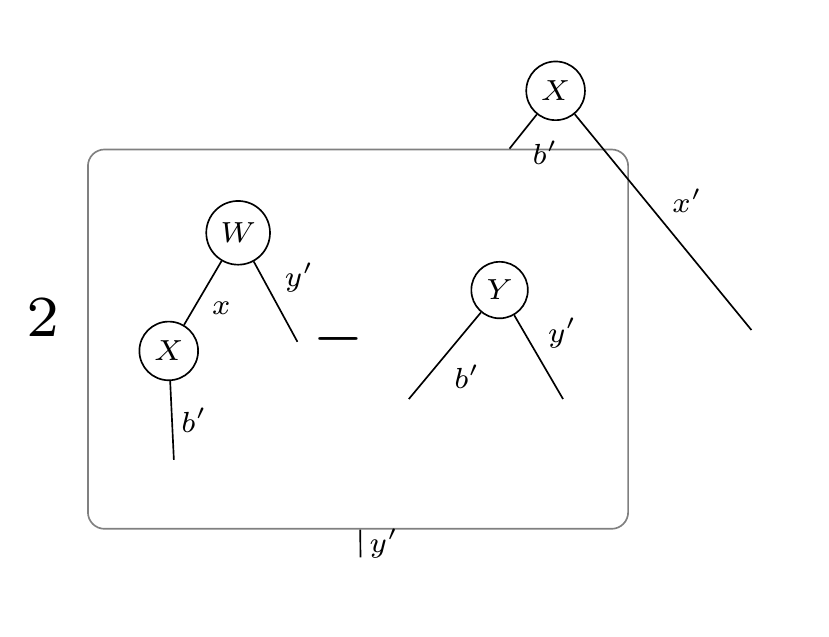
This will output the tensor diagram:
Tensorgrad can also output pytorch code for numerically computing the gradient with respect to W:
```python
>>> to_pytorch(grad)
import torch
WX = torch.einsum('xy,bx -> by', W, X)
subtraction = WX - Y
X_subtraction = torch.einsum('bx,by -> xy', X, subtraction)
final_result = 2 * X_subtraction
```
### Hessian of CE Loss
For a more complicated example, consider the following program for computing the Entropy of Cross Entropy Loss:
```python
from tensorgrad import Variable
import tensorgrad.functions as F
logits = Variable("logits", ["C"])
target = Variable("target", ["C"])
e = F.exp(logits)
softmax = e / F.sum(e)
ce = -F.sum(target * F.log(softmax))
H = ce.grad(logits).grad(logits)
display_pdf_image(to_tikz(H.full_simplify()))
```
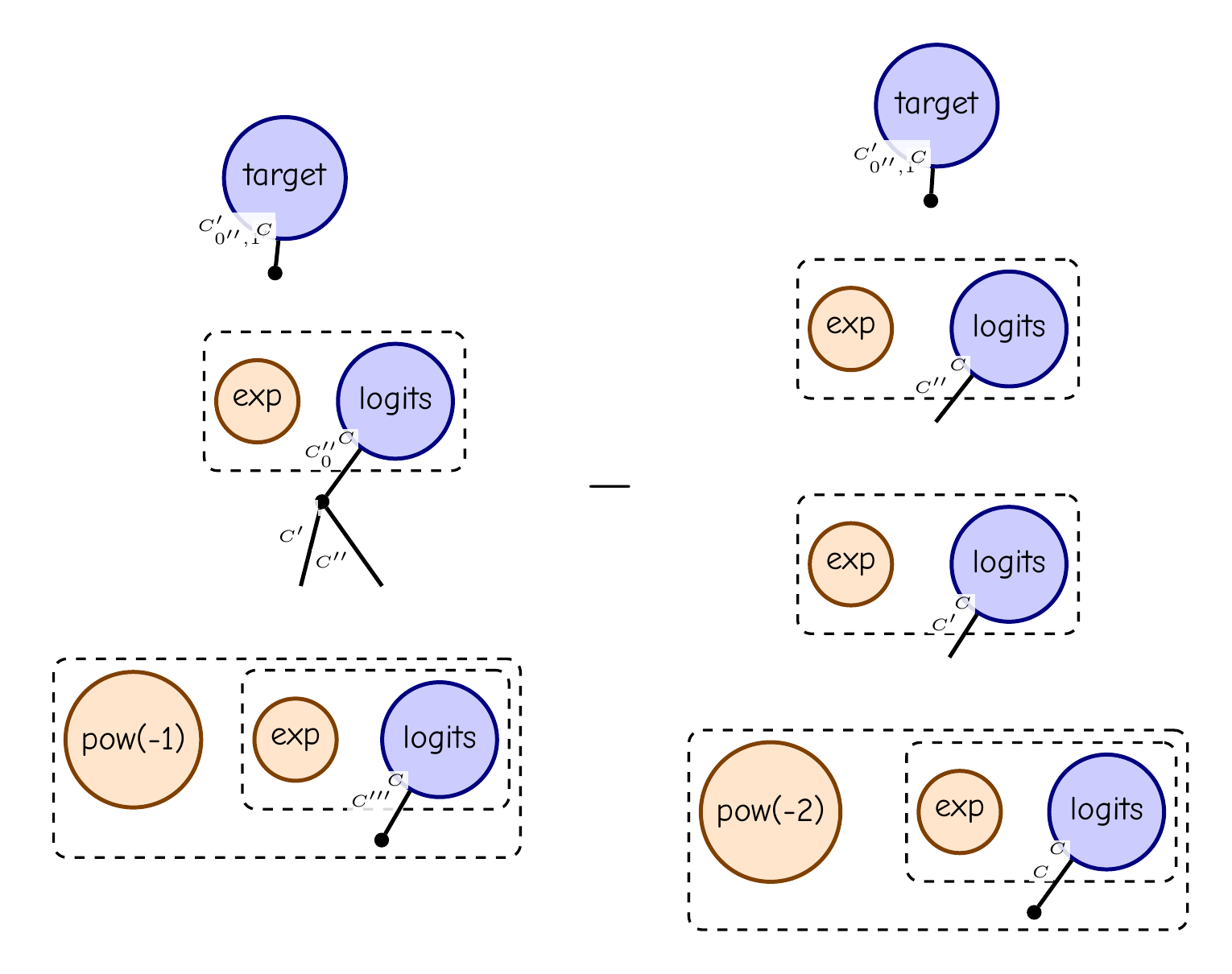
This is tensor diagram notation for `(diag(p) - pp^T) sum(target)`, where `p = softmax(logits)`.
### Expectations
Tensorgrad can also take expectations of arbitrary functions with respect to Gaussian tensors.
As an example, consider the L2 Loss program from before:
```python
X = Variable("X", "b, x")
Y = Variable("Y", "b, y")
W = Variable("W", "x, y")
mu = Variable("mu", "x, y")
C = Variable("C", "x, y, x2, y2")
XWmY = X @ W - Y
l2 = F.sum(XWmY * XWmY)
E = Expectation(l2, W, mu, C)
display_pdf_image(to_tikz(E.full_simplify()))
```
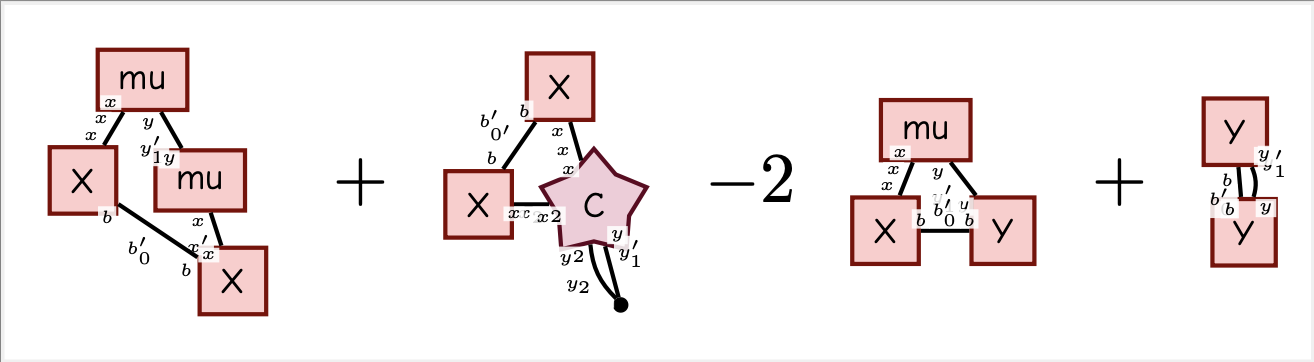
Note that the covariance is a rank-4 tensor (illustrated with a star) since we take the expectation with respect to a matrix.
This is different from the normal "matrix shaped" covariance you get if you take expectation with respect to a vector.
### Evaluation
Tensorgrad can evaluate your diagrams using [Pytorch Named Tensors](https://pytorch.org/docs/stable/named_tensor.html).
It uses graph isomorphism detection to eliminated common subexpressions.
### Code Generation
Tensorgrad can convert your diagrams back into pytorch code.
This gives a super optimized way to do gradients and higher order derivatives in neural networks.
### Matrix Calculus
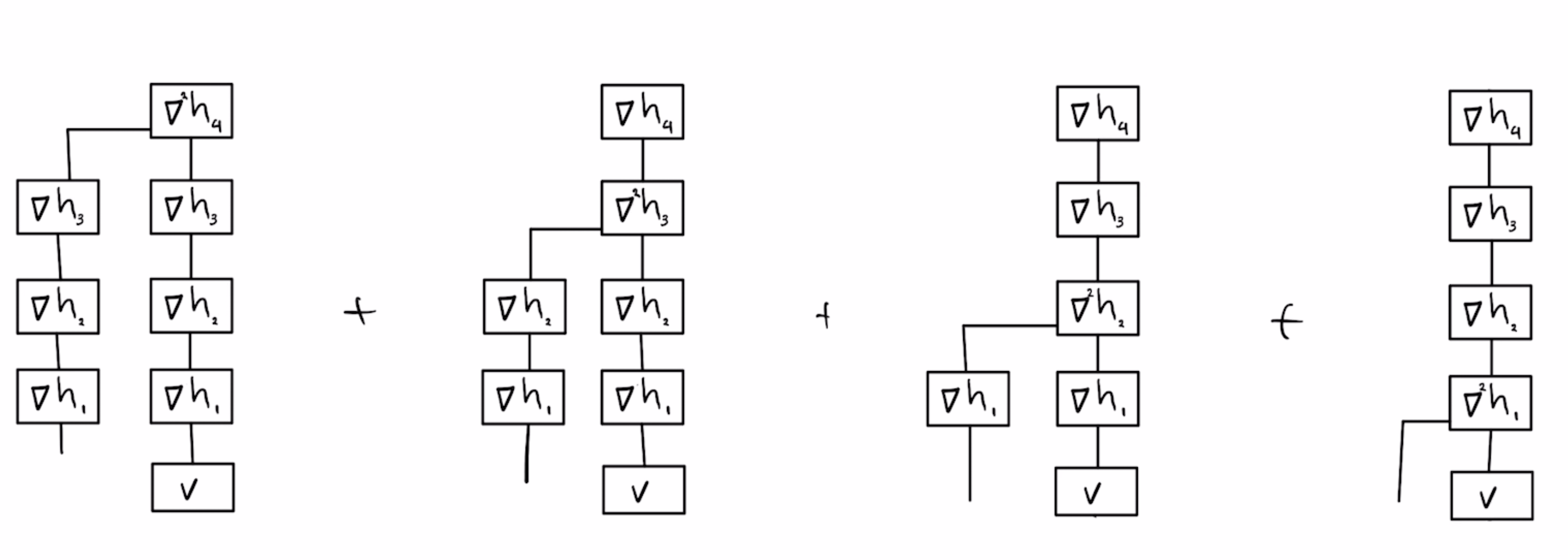
In Penrose's book, The Road to Reality: A Complete Guide to the Laws of the Universe, he introduces a notation for taking derivatives on tensor networks. In this library we try to follow Penrose's notation, expanding it as needed to handle a full "chain rule" on tensor functions.

Another source of inspiration was Yaroslav Bulatov's [derivation of the hessian of neural networks](https://community.wolfram.com/groups/-/m/t/2437093):
# More stuff
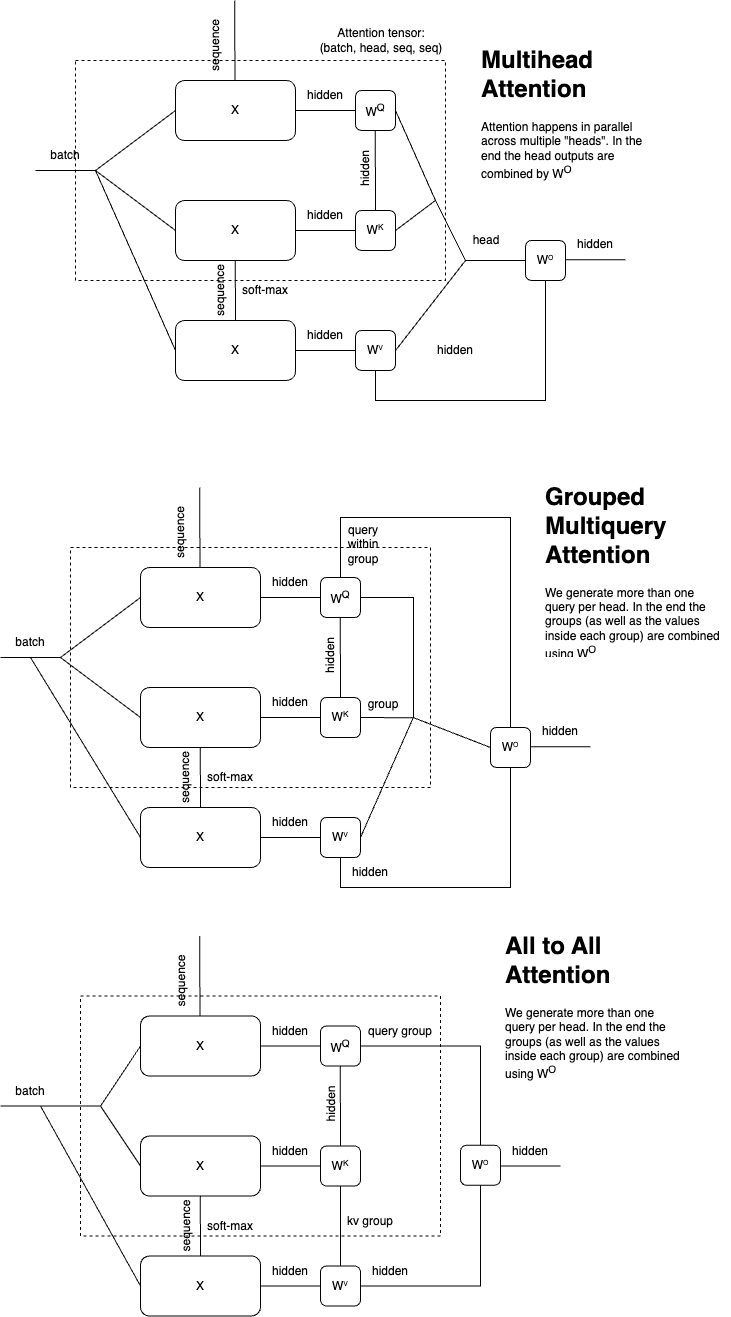
## Transformers
## Convolutional Neural Networks
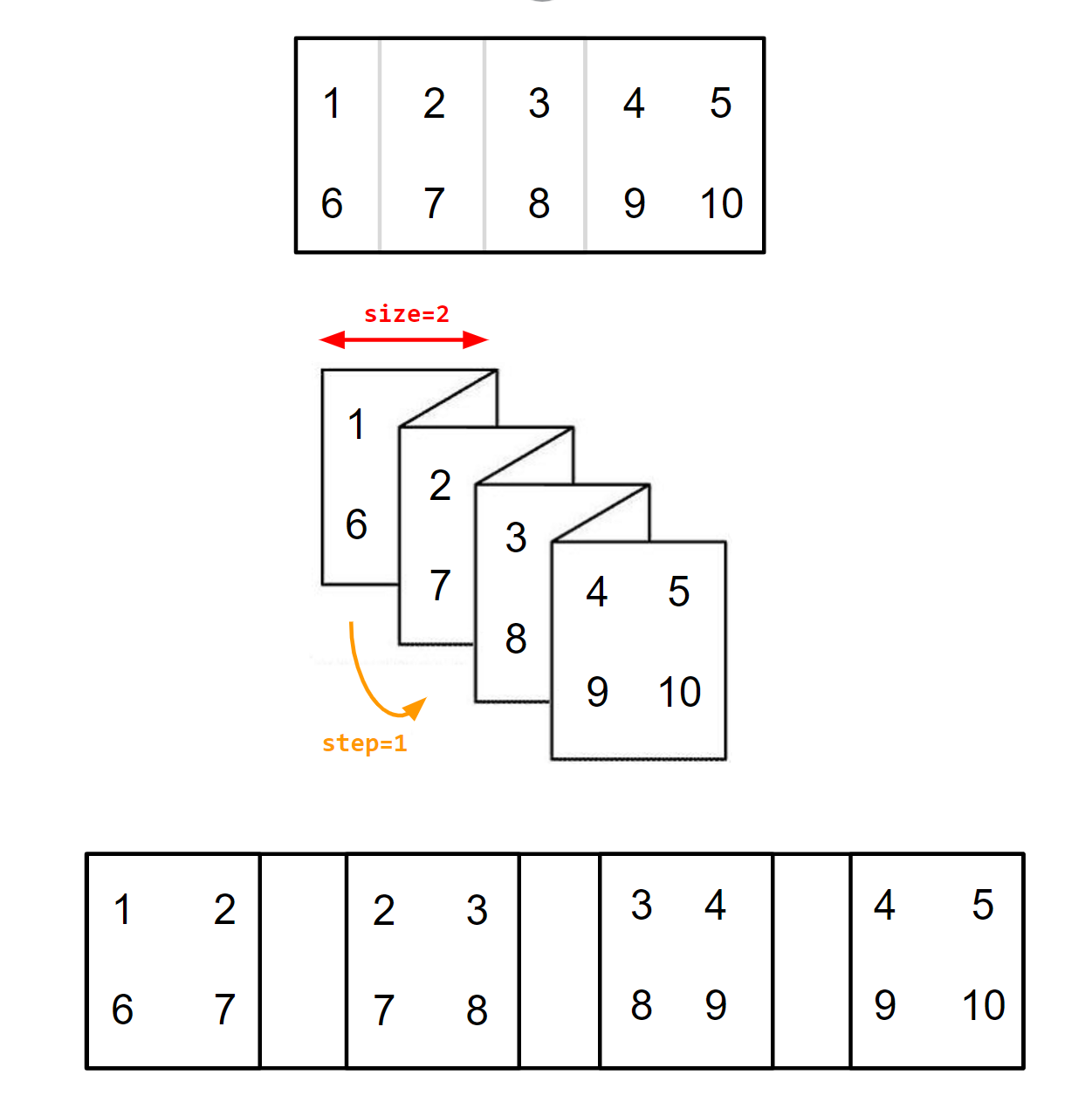
The main ingredient in CNNs are the linear operations Fold and Unfold.
Unfold takes an image, with dimensions HxW and outputs P "patches" of size K^2, where K is the kernel size. Fold is the reverse operation.
Since they are linear operations (they consists only of copying/adding) we can express them as a tensor with shape (H, W, P, K^2).
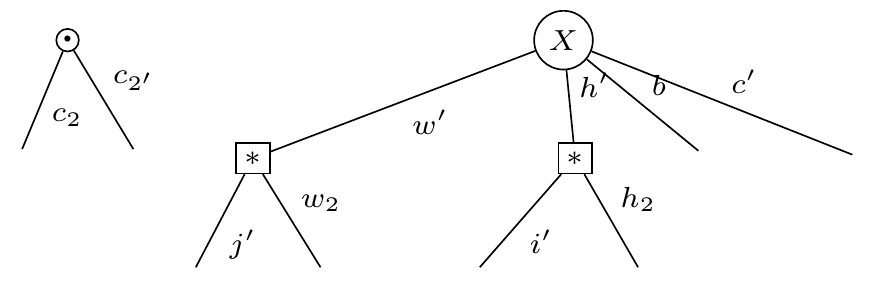
Hayashi et al. show that if you define a tensor `(∗)_{i,j,k} = [i=j+k]`, then the "Unfold" operator factors along the spacial dimensions, and you can write a bunch of different convolutional neural networks easily as tensor networks:
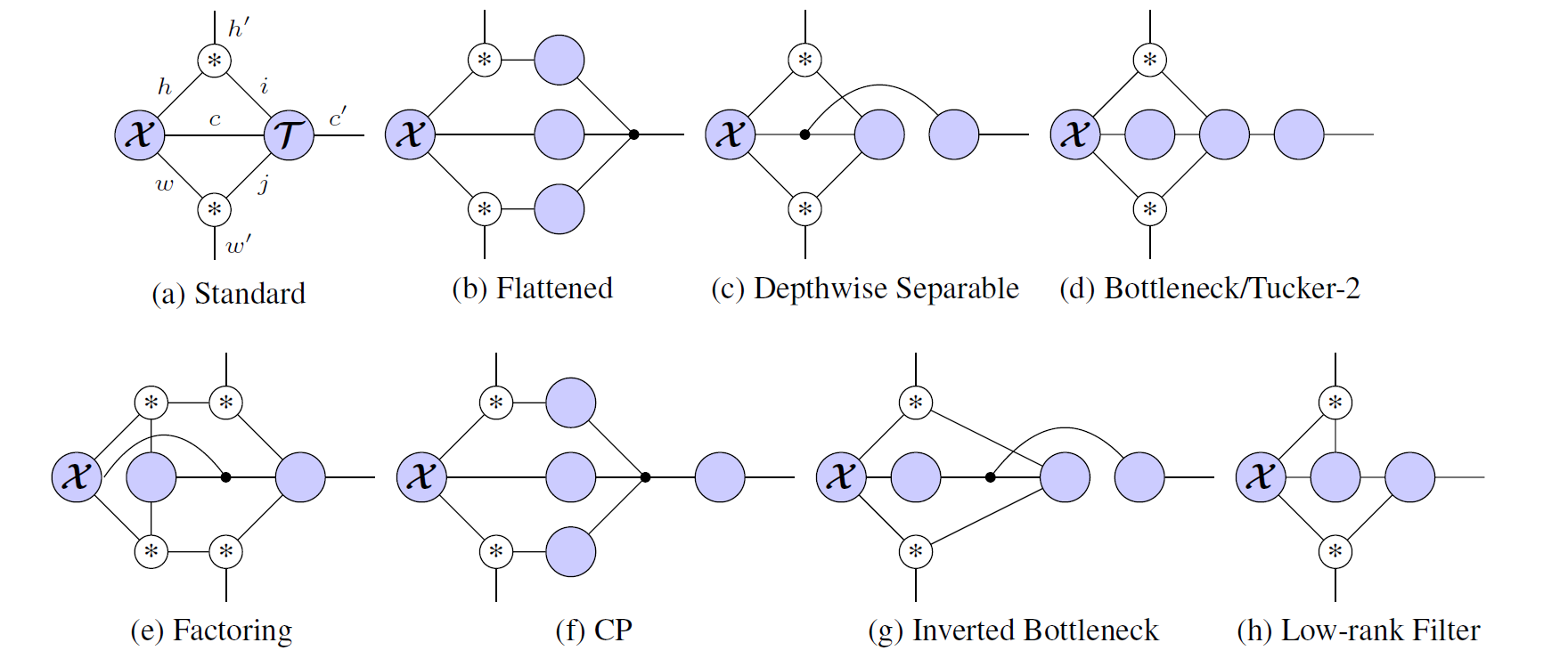
With tensorgrad you can write the "standard" convolutional neural network like this:
```python
data = Variable("data", ["b", "c", "w", "h"])
unfold = Convolution("w", "j", "w2") @ Convolution("h", "i", "h2")
kernel = Variable("kernel", ["c", "i", "j", "c2"])
expr = data @ unfold @ kernel
```
And then easily find the jacobian symbolically with `expr.grad(kernel)`:
## Tensor Sketch
Taken from [this Twitter thread](https://twitter.com/thomasahle/status/1674572437953089536):
I wish I had know about Tensor Graphs back when i worked on Tensor-sketching.
Let me correct this now and explain dimensionality reduction for tensors using Tensor Networks:
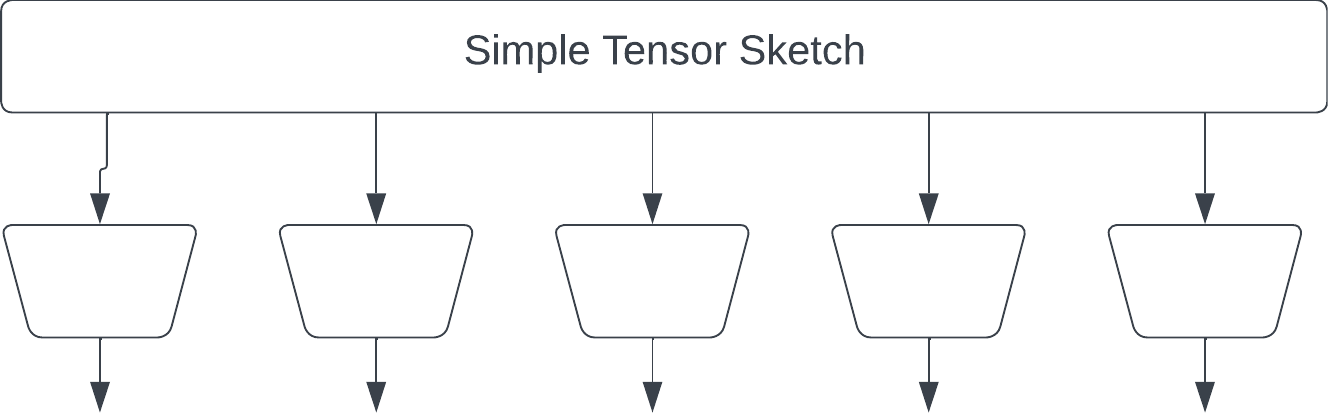
The second version is the "original" Tensor Sketch by
Rasmus Pagh and Ninh Pham. (https://rasmuspagh.net/papers/tensorsketch.pdf) Each fiber is reduced by a JL sketch, and the result is element-wise multiplied.
Note the output of each JL is larger than in the "simple" sketch to give the same output size.
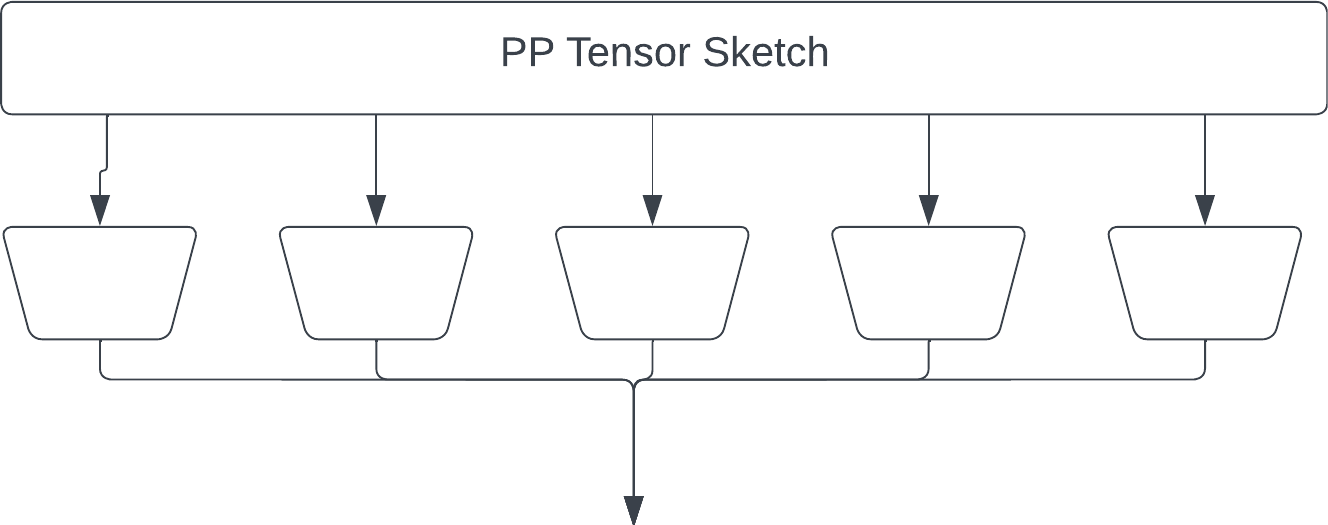
Next we have the "recursive" sketch by myself and coauthors in https://thomasahle.com/#paper-tensorsketch-joint.
In the paper we sometimes describe this as a tree, but it doesn't really matter. We just had already created the tree-graphic when we realized.
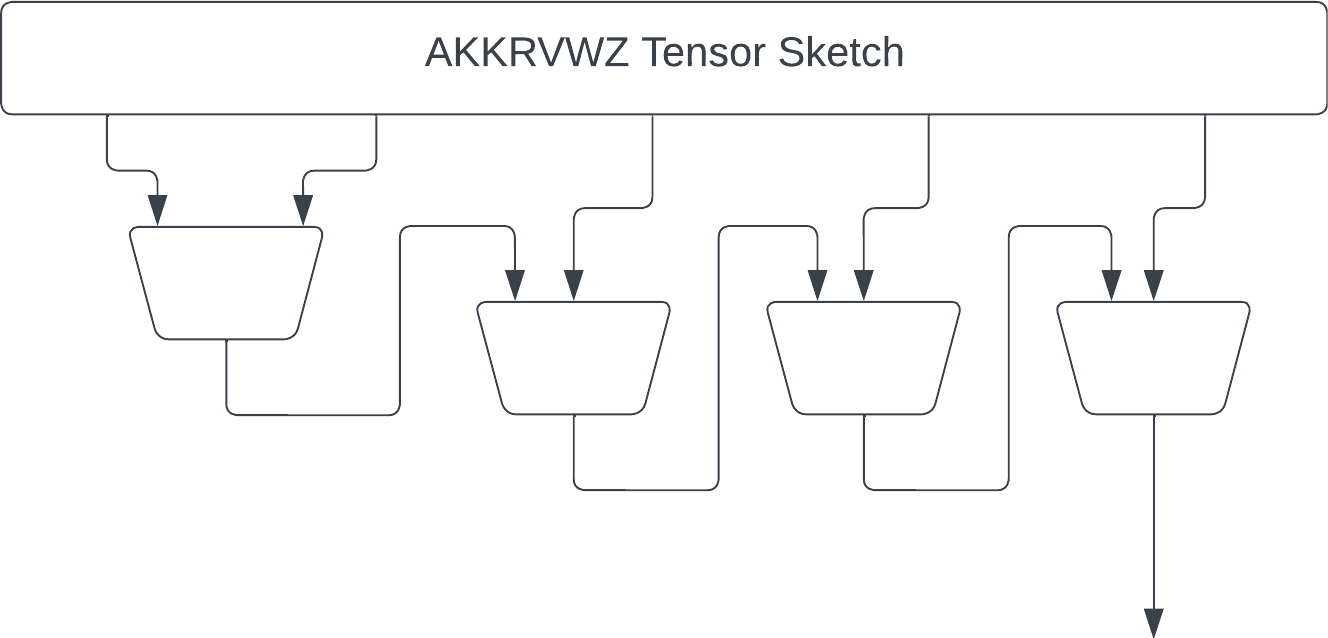
The main issue with the AKKRVWZ-sketch was that we used order-3 tensors internally, which require more space/time than simple random matrices in the PP-sketch.
We can mitigate this issue by replacing each order-3 tensor with a simple order-2 PP-sketch.
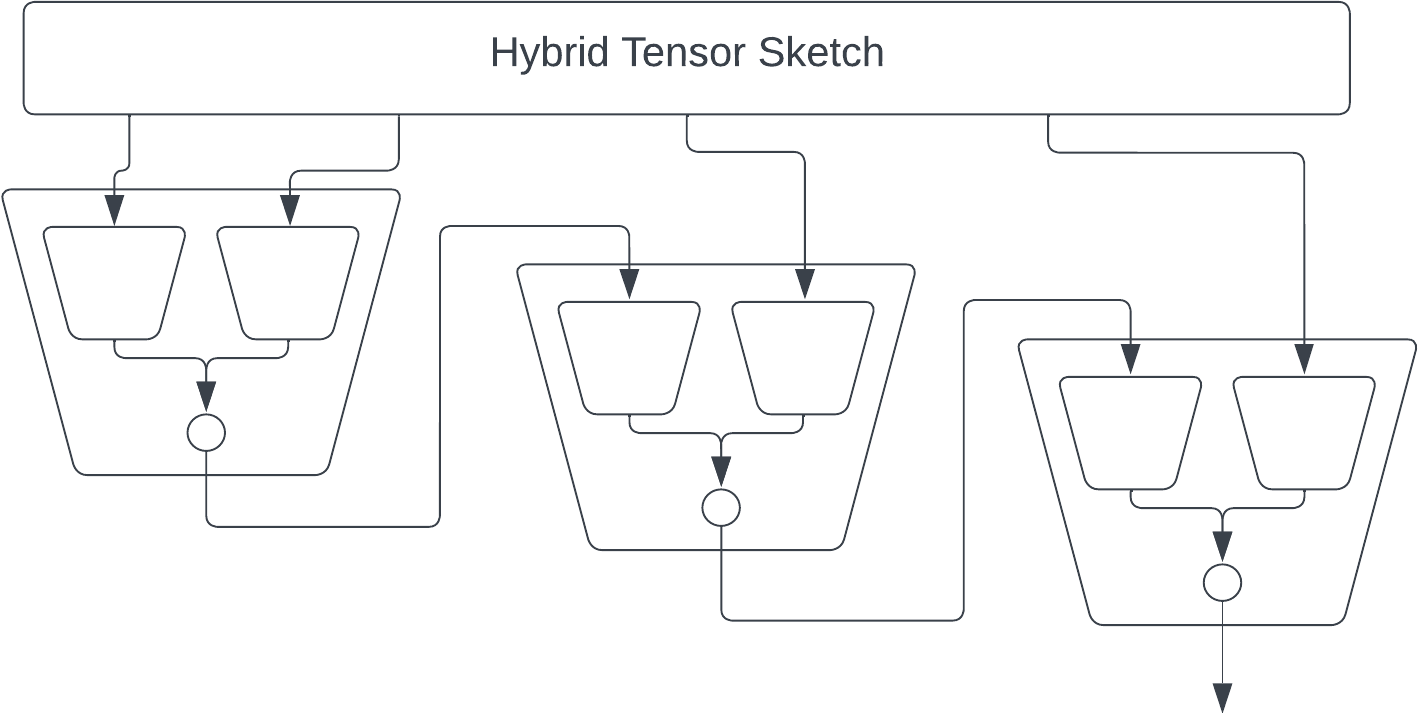
Finally we can speed up each matrix multiplication by using FastJL, which is itself basically an outer product of a bunch of tiny matrices. But at this point my picture is starting to get a bit overwhelming.
## See also
- [Tool for creating tensor diagrams from einsum](https://thomasahle.com/blog/einsum_to_dot.html?q=abc,cde,efg,ghi,ija-%3Ebdfhj&layout=circo) by Thomas Ahle
- [Ideograph: A Language for Expressing and Manipulating Structured Data](https://arxiv.org/pdf/2303.15784.pdf) by Stephen Mell, Osbert Bastani, Steve Zdancewic