https://github.com/thunder-id/thunderid
ThunderID is a high-performance, open-source identity stack designed for developers to secure and manage access for humans, AI agents, and workloads through fully composable identity flows.
https://github.com/thunder-id/thunderid
access-management ai-agents authentication authorization go golang hacktoberfest iam identity mfa oauth2 oidc
Last synced: 2 days ago
JSON representation
ThunderID is a high-performance, open-source identity stack designed for developers to secure and manage access for humans, AI agents, and workloads through fully composable identity flows.
- Host: GitHub
- URL: https://github.com/thunder-id/thunderid
- Owner: thunder-id
- License: apache-2.0
- Created: 2025-05-01T15:17:40.000Z (over 1 year ago)
- Default Branch: main
- Last Pushed: 2026-08-06T20:31:24.000Z (3 days ago)
- Last Synced: 2026-08-06T21:54:31.932Z (2 days ago)
- Topics: access-management, ai-agents, authentication, authorization, go, golang, hacktoberfest, iam, identity, mfa, oauth2, oidc
- Language: Go
- Homepage: https://thunderid.dev
- Size: 134 MB
- Stars: 386
- Watchers: 19
- Forks: 354
- Open Issues: 633
-
Metadata Files:
- Readme: README.md
- Contributing: CONTRIBUTING.md
- License: LICENSE
- Codeowners: .github/CODEOWNERS
- Security: SECURITY.md
- Maintainers: MAINTAINERS.md
- Agents: AGENTS.md
- Claude: CLAUDE.md
- Copilot: .github/copilot-instructions.md
Awesome Lists containing this project
README

###
[](https://opensource.org/licenses/Apache-2.0)
[](https://github.com/thunder-id/thunderid/commits/main)
[](https://github.com/thunder-id/thunderid/issues)
[](https://codecov.io/github/thunder-id/thunderid?branch=main)
[](https://github.com/thunder-id/thunderid/releases/latest)
ThunderID is a lightweight, open-source Identity and Access Management (IAM) engine built to secure access for humans, AI agents, and machines.
Designed for the agentic era, ThunderID provides a developer-first IAM platform and supporting tools for securing applications, APIs, services, and agent-driven workflows. It works across traditional and decentralized identity ecosystems, with post-quantum-ready security built in from the start.
Core design goals of ThunderID include:
- **Agent-native identity:** Manage AI agents as first-class identities with delegated authority, consent-aware access, traceability, and support for issuing verifiable credentials to agents. ThunderID also aims to expose IAM capabilities through interfaces that agents can use safely and programmatically.
- **Decentralized identity:** Bridge the adoption gap for relying parties by making it practical for service providers to consume, verify, and trust decentralized identity in real-world applications, including DIDs, verifiable credentials, digital wallets, trust registries, and issuer-verifier-holder interaction models.
- **Cloud-native IAM:** Provide a lightweight, containerized identity product that can run across on-premises and cloud environments, with declarative identity flows, policies, and configuration suitable for automation, versioning, and GitOps practices.
- **Post-quantum-safe security:** Build on a crypto-agile foundation where algorithms, key types, signing methods, and token protection mechanisms can evolve over time, including support for post-quantum-safe algorithms and hybrid transition approaches across key management, credential issuance, assertions, and secure service-to-service communication.
## Getting Started
Get started by exploring how ThunderID can be used to secure:
* Applications - by following [Securing B2C Application Guide](https://thunderid.dev/docs/next/use-cases/b2c/try-it-out)
* AI Agents - by following [Securing AI Agents Guide](https://thunderid.dev/docs/next/use-cases/ai-agents/try-it-out)
* MCP - by following [Securing MCP Guide](https://thunderid.dev/docs/next/use-cases/ai-agents/mcp-authorization/try-it-out)
To learn more about overall requirements, solution patterns of these scenarios, refer to the [Use Cases](https://thunderid.dev/docs/next/use-cases/overview/) section.
Visit [Get ThunderID](https://thunderid.dev/docs/next/guides/getting-started/get-thunderid/) to learn more about installation methods.
## Architecture
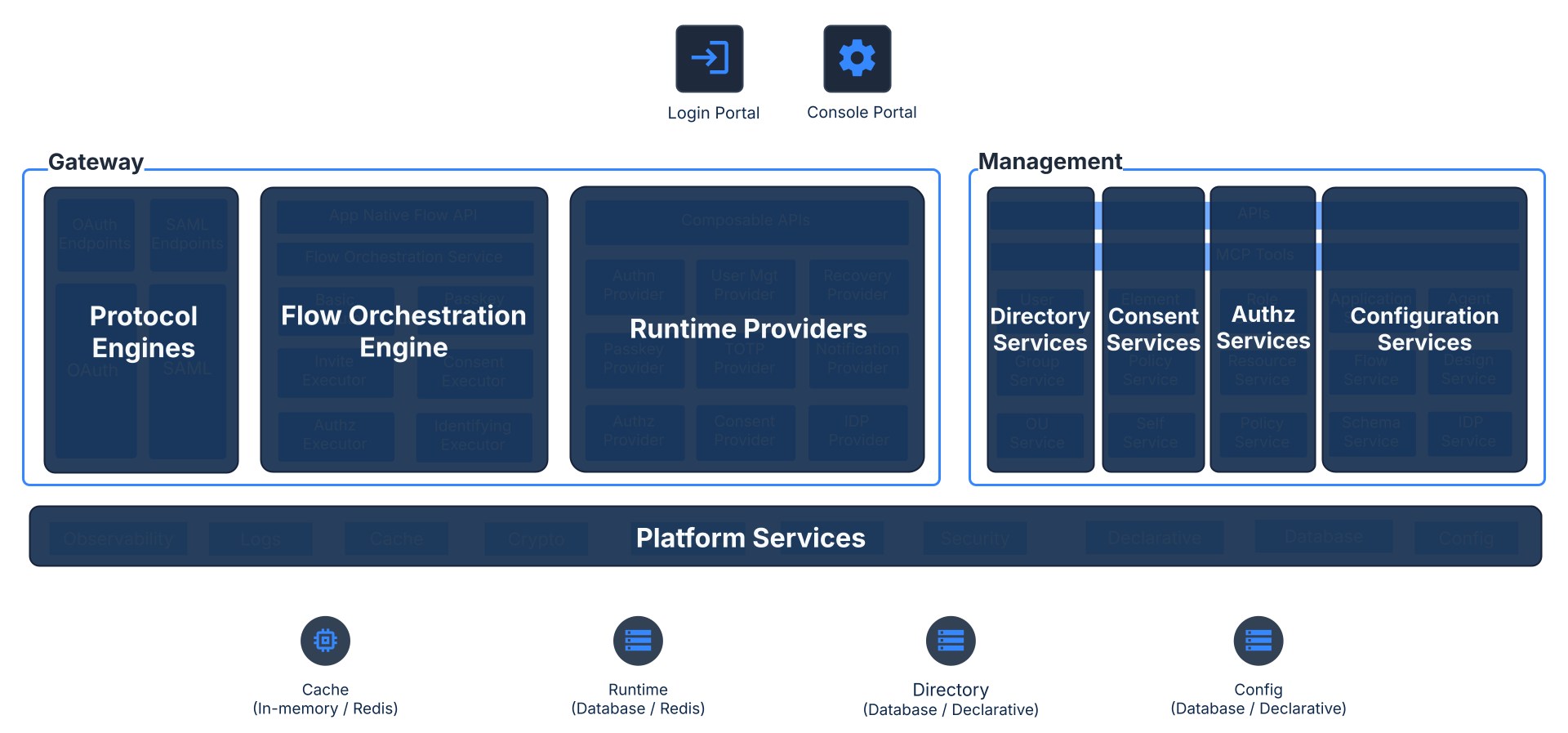
## Features
* **Identity Management**
* Humans, AI agents, and workloads as first-class identity types
* Hierarchical organizational units (OUs) and groups
* **Standards**
* OAuth 2.1 and OpenID Connect, with PAR and PKCE
* Verifiable Credentials — OpenID4VCI (issuance) and OpenID4VP (verification)
* WebAuthn / passkeys
* IdP federation — Google, Microsoft, GitHub, and any OIDC or SAML provider
* **Decentralized Identity**
* Issue Verifiable Credentials to user wallets from configurable credential templates
* Verify presented credentials against presentation definitions and trust anchors
* Use them on their own, or as part of an identity journey
* **User Journeys**
* Login, registration, and recovery defined as journeys
* 20+ built-in executors - password, passkey, OTP, social login, consent, and more
* Orchestratable in the server or the application
* Themeable end-user UI
* **Authorization**
* Hierarchical resources with derived permissions
* Role-based access control across users, agents, and applications
* Consent management with user-facing review
* **Developer Experience**
* Console UI, REST APIs, and SDKs
* MCP server for managing and querying IAM from AI agents
* **Declarative and GitOps-Ready**
* YAML resource definitions for every entity
* Immutable runtime
## Contributing
Please refer to the [Contributing Guide](https://thunderid.dev/docs/next/community/overview) for the different ways to contribute to this project and the relevant guidelines.
For code contributions, refer to the [Contributing Code](https://thunderid.dev/docs/next/community/contributing/contributing-code/prerequisites) section for details on the prerequisites and instructions for running ThunderID in development mode.
## License
Licenses this source under the Apache License, Version 2.0 ([LICENSE](LICENSE)), You may not use this file except in compliance with the License.