https://github.com/tomgrek/zincbase
A batteries-included kit for knowledge graphs
https://github.com/tomgrek/zincbase
graph-neural-networks knowledge-base knowledge-graph neural-network prolog
Last synced: 2 months ago
JSON representation
A batteries-included kit for knowledge graphs
- Host: GitHub
- URL: https://github.com/tomgrek/zincbase
- Owner: tomgrek
- License: mit
- Created: 2019-04-27T23:34:55.000Z (over 7 years ago)
- Default Branch: master
- Last Pushed: 2021-04-29T20:06:53.000Z (over 5 years ago)
- Last Synced: 2023-11-07T14:20:31.538Z (over 2 years ago)
- Topics: graph-neural-networks, knowledge-base, knowledge-graph, neural-network, prolog
- Language: Python
- Homepage:
- Size: 12 MB
- Stars: 278
- Watchers: 10
- Forks: 61
- Open Issues: 5
-
Metadata Files:
- Readme: README.md
- Contributing: CONTRIBUTING
- License: LICENSE
Awesome Lists containing this project
- awesome-github-projects - zincbase - A batteries-included kit for knowledge graphs ⭐280 `Python` (📦 Legacy & Inactive Projects)
README
[](https://circleci.com/gh/tomgrek/zincbase)
[](https://zenodo.org/badge/latestdoi/183831265)
[](https://zincbase.readthedocs.io/en/latest/?badge=latest)
# Hello!
The tech behind parts of ZincBase was acquired.
This repo is still here for reference, but it is deprecated.
Fortunately, work still goes on. Apart from a couple of fringe bits, the [active repo lives here](https://github.com/complexdb/zincbase).
The new owner of ZincBase as it is today is [ComplexDB](https://complexdb.com).
## Alright, you still want to continue

ZincBase is a state of the art knowledge base. It does the following:
* Extract facts (aka triples and rules) from unstructured data/text
* Store and retrieve those facts efficiently
* Build them into a graph
* Provide ways to query the graph, including via bleeding-edge graph neural networks.
Zincbase exists to answer questions like "what is the probability that Tom likes LARPing", or "who likes LARPing", or "classify people into LARPers vs normies":
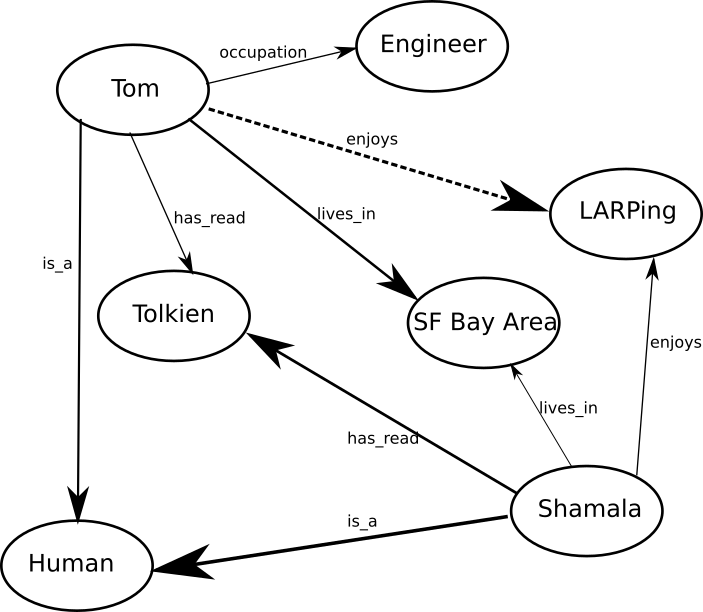
It combines the latest in neural networks with symbolic logic (think expert systems and prolog) and graph search.
View full documentation [here](https://zincbase.readthedocs.io).
## Quickstart
```
from zincbase import KB
kb = KB()
kb.store('eats(tom, rice)')
for ans in kb.query('eats(tom, Food)'):
print(ans['Food']) # prints 'rice'
...
# The included assets/countries_s1_train.csv contains triples like:
# (namibia, locatedin, africa)
# (lithuania, neighbor, poland)
kb = KB()
kb.from_csv('./assets/countries.csv')
kb.build_kg_model(cuda=False, embedding_size=40)
kb.train_kg_model(steps=2000, batch_size=1, verbose=False)
kb.estimate_triple_prob('fiji', 'locatedin', 'melanesia')
0.8467
```
# Requirements
* Python 3
* Libraries from requirements.txt
* GPU preferable for large graphs but not required
# Installation
`pip install -r requirements.txt`
_Note:_ Requirements might differ for PyTorch depending on your system.
# Testing
```
python test/test_main.py
python test/test_graph.py
python test/test_lists.py
python test/test_nn_basic.py
python test/test_nn.py
python test/test_neg_examples.py
python test/test_truthiness.py
python -m doctest zincbase/zincbase.py
```
# Validation
"Countries" and "FB15k" datasets are included in this repo.
There is a script to evaluate that ZincBase gets at least as good
performance on the Countries dataset as the original (2019) RotatE paper. From the repo's
root directory:
```
python examples/eval_countries_s3.py
```
It tests the hardest Countries task and prints out the AUC ROC, which should be
~ 0.95 to match the paper. It takes about 30 minutes to run on a modern GPU.
There is also a script to evaluate performance on FB15k: `python examples/fb15k_mrr.py`.
## Building documentation
From docs/ dir: `make html`. If something changed a lot: `sphinx-apidoc -o . ..`
# TODO
* Add documentation
* to_csv method
* utilize postgres as backend triple store
* The to_csv/from_csv methods do not yet support node attributes.
* Add relation extraction from arbitrary unstructured text
* Add context to triple - that is interpreted by BERT/ULM/GPT-2 similar and
put into an embedding that's concat'd to the KG embedding.
* Reinforcement learning for graph traversal.
# References & Acknowledgements
[Theo Trouillon. Complex-Valued Embedding Models for Knowledge Graphs. Machine Learning[cs.LG]. Université Grenoble Alpes, 2017. English. ffNNT : 2017GREAM048](https://tel.archives-ouvertes.fr/tel-01692327/file/TROUILLON_2017_archivage.pdf)
[L334: Computational Syntax and Semantics -- Introduction to Prolog, Steve Harlow](http://www-users.york.ac.uk/~sjh1/courses/L334css/complete/complete2li1.html)
[Open Book Project: Prolog in Python, Chris Meyers](http://www.openbookproject.net/py4fun/prolog/intro.html)
[Prolog Interpreter in Javascript](https://curiosity-driven.org/prolog-interpreter)
[RotatE: Knowledge Graph Embedding by Relational Rotation in Complex Space, Zhiqing Sun and Zhi-Hong Deng and Jian-Yun Nie and Jian Tang, International Conference on Learning Representations, 2019](https://openreview.net/forum?id=HkgEQnRqYQ)
# Citing
If you use this software, please consider citing:
```
@software{zincbase,
author = {{Tom Grek}},
title = {ZincBase: A state of the art knowledge base},
url = {https://github.com/tomgrek/zincbase},
version = {0.1.1},
date = {2019-05-12}
}
```
# Contributing
See CONTRIBUTING. And please do!