https://github.com/trevorsandy/ai-suite
AI-Suite - n8n, Open WebUI, OpenCode, Llama.cpp/Ollama, Flowise, Langfuse, MCP Gateway and more!
https://github.com/trevorsandy/ai-suite
ai ai-agents automation cag integrations llms low-code mcp mcp-server n8n no-code ollama open-webui openapi opencode orchestration python rag typescript workflow
Last synced: about 2 months ago
JSON representation
AI-Suite - n8n, Open WebUI, OpenCode, Llama.cpp/Ollama, Flowise, Langfuse, MCP Gateway and more!
- Host: GitHub
- URL: https://github.com/trevorsandy/ai-suite
- Owner: trevorsandy
- License: apache-2.0
- Created: 2025-12-04T16:35:49.000Z (7 months ago)
- Default Branch: main
- Last Pushed: 2026-05-03T20:26:21.000Z (2 months ago)
- Last Synced: 2026-05-03T22:23:11.972Z (2 months ago)
- Topics: ai, ai-agents, automation, cag, integrations, llms, low-code, mcp, mcp-server, n8n, no-code, ollama, open-webui, openapi, opencode, orchestration, python, rag, typescript, workflow
- Language: Python
- Homepage:
- Size: 4.29 MB
- Stars: 19
- Watchers: 0
- Forks: 5
- Open Issues: 1
-
Metadata Files:
- Readme: README.md
- License: LICENSE
Awesome Lists containing this project
README
# AI-Suite
**AI-Suite** is intended to provide an **end-to-end path from zero to working
AI workflows** for developers and those who want to enable a local, private
**AI solution**.
It provides an open, curated, pre-configured **Docker Compose** configuration
file that bootstraps fully featured Local AI Agents and a Low/No Code environment
on a self-hosted **n8n** platform, enabling users to focus on building solutions
that employ robust AI workflows.
Portions of AI-Suite extends [Cole Medin's](https://github.com/coleam00)
[Self-hosted AI Package](https://github.com/coleam00/local-ai-packaged)
which is built on the [n8n-io](https://github.com/n8n-io)
[Self-hosted AI Starter Kit](https://github.com/n8n-io/self-hosted-ai-starter-kit).
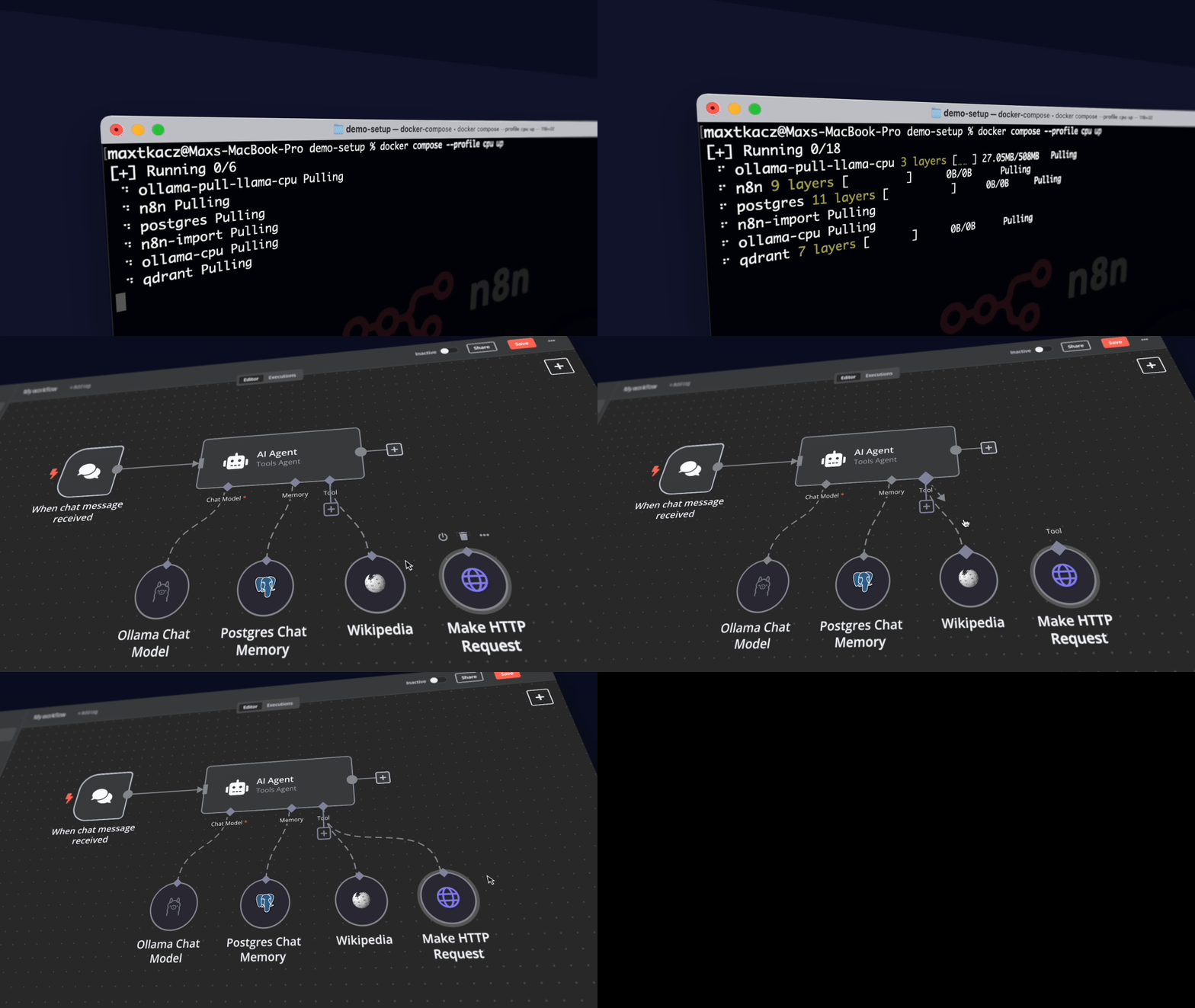
Curated by [Trevor SANDY - https://github.com/trevorsandy](https://github.com/trevorsandy).
## What’s included
✅ [**Self-hosted n8n**](https://n8n.io/) - Automation platform with over 400
integrations and advanced AI components.
✅ [**Open WebUI**](https://openwebui.com/) - ChatGPT-like interface to
privately interact with your local models and N8N agents.
✅ [**OpenCode**](https://opencode.ai/) - open source agent that helps you write
code in your terminal.
✅ [**Ollama**](https://ollama.com/) - Cross-platform LLM platform to install
and run the latest LLMs.
✅ [**LLaMA.cpp**](https://github.com/ggml-org/llama.cpp/) - Cross-platform LLaMA.cpp
HTTP Server platform to install and run the latest LLMs in gguf format.
✅ [**Supabase**](https://supabase.com/) - Open source database as a service,
most widely used database for AI agents.
✅ [**Flowise**](https://flowiseai.com/) - No/low-code AI agent builder that
pairs very well with n8n.
✅ [**Qdrant**](https://qdrant.tech/) - Open source, high performance vector
store with an comprehensive API.
✅ [**PostgreSQL**](https://www.postgresql.org/) - Workhorse of the Data
Engineering world, backend for Langfuse.
✅ [**MCP Gateway**](https://github.com/microsoft/mcp-gateway/) - Reverse proxy
and management layer for MCP servers.
✅ [**Neo4j**](https://neo4j.com/) - Knowledge graph engine that powers tools
like GraphRAG, LightRAG, and Graphiti.
✅ [**Redis (Valkey)**](https://valkey.io/) - High-performance key/value datastore,
supports caching and message queues workloads.
✅ [**SearXNG**](https://searxng.org/) - Open source internet metasearch
engine, aggregates results from up to 229 search services.
✅ [**Langfuse**](https://langfuse.com/) - Open source LLM engineering platform
for agent observability.
✅ [**MinIO**](https://www.min.io/) - High-performance, S3-compatible object
storage solution.
✅ [**ClickHouse**](https://clickhouse.com/) - Open source, database management
system that can generate analytical data reports in real-time.
✅ [**Caddy**](https://caddyserver.com/) - Managed HTTPS/TLS for custom domains.
## Prerequisites
System specifications:
- **32GB** RAM recommended (8GB minimum)
- **20GB** free disk space
Before you begin, make sure you have the following software installed:
- [Git](https://git-scm.com/install/) - For easy repository management.
- [Python 3.10+](https://www.python.org/downloads/) - To run the setup script.
Import modules
```python
import os
import sys
import argparse
import datetime
import dotenv
import logging
import pathlib
import platform
import re
import shutil
import subprocess
import textwrap
import time
```
- [Docker/Docker Desktop](https://www.docker.com/products/docker-desktop/) - Required
to setup and run all AI-Suite services.
Docker Compose commands
If you are using a machine without the `docker compose` application available
by default, run these commands to install Docker compose:
```bash
DOCKER_COMPOSE_VERSION=$(curl -s https://api.github.com/repos/docker/compose/
releases/latest | grep 'tag_name' | cut -d\\" -f4)
sudo curl -L "https://github.com/docker/compose/releases/download/${DOCKER_COMPOSE_VERSION}/docker-compose-linux-x86_64" -o /usr/local/bin docker-compose
sudo chmod +x /usr/local/bin/docker-compose
sudo mkdir -p /usr/local/lib/docker/cli-plugins
sudo ln -s /usr/local/bin/docker-compose /usr/local/lib/docker/cli-plugins/docker-compose
```
Also consider the following optional software:
- [VSCode](https://code.visualstudio.com/download) - Python development.
- [GitKraken](https://www.gitkraken.com/download-b) - Superior Git SCM platform
## Installation
### Step 1: Clone the repository and set environment variables
1. Clone the repository and navigate to the project directory:
```powershell
git clone https://github.com/trevorsandy/ai-suite.git
cd ai-suite
```
2. Make a copy of `.env.example` renamed to `.env` in the project directory.
```powershell
cp .env.example .env # update secrets and passwords inside
```
3. Set the following required `.env` environment variables:
Credential environment variables
If you will install **Supabase**, setup the Supabase environment variables
using their [self-hosting guide](https://supabase.com/docs/guides/self-hosting/docker#securing-your-services).
```ini
############
# Generating Credentials
# OpenSSL: Available by default on Linux/Mac via command 'openssl rand -hex 32'
# For Windows, use 'WSL2', 'Git Bash' terminal installed with git or from cmd
# run the command: python -c "import secrets; print(secrets.token_hex(32))"
#
# Password: Use Python command to generate 16-character strong password:
# python3 -c "import secrets;import string; alphabet = string.ascii_letters + string. digits;\
# password = ''.join(secrets.choice(alphabet) for i in range(16));\
# print(password)"
#
# JWT Tokens: Use https://jwtsecrets.com/#generator to generate keys and tokens
# ranging from 8 to 128 characters long.
############
############
# [required]
# n8n credentials - use OpenSSL for both
############
# Master key used to encrypt sensitive credentials that n8n stores
N8N_ENCRYPTION_KEY=change_me_to_a_long_super-secret-key
# Shared secret between n8n containers and runners sidecars
N8N_RUNNERS_AUTH_TOKEN=change_me_to_a_long_super-secret-key
# Specific JWT secret. By default, n8n generates one on start
N8N_USER_MANAGEMENT_JWT_SECRET=change_me_to_a_longer_even-more-secret
############
# [required]
# Supabase Secrets
############
JWT_SECRET=your-super-secret-jwt-token-at-least-40-characters-long
ANON_KEY=your-super-secret-jwt-key-see-https://supabase.com/docs/guides/self-hosting/docker#generate-api-keys
SERVICE_ROLE_KEY=your-super-secret-jwt-key-see-https://supabase.com/docs/guides/self-hosting/docker#generate-api-keys
DASHBOARD_USERNAME=supabase
DASHBOARD_PASSWORD=your-super-secret-password
POOLER_TENANT_ID=your-tenant-id
############
# [required]
# PostgreSQL database user password
############
POSTGRES_PASSWORD=your-super-secret-postgres-password
############
# [required]
# Flowise - authentication configuration
############
FLOWISE_PASSWORD=your-super-secret-flowise-password
############
# [required]
# Neo4j - username and password combination
############
NEO4J_AUTH=neo4j-user/your-super-secret-password
############
# [required]
# Langfuse credentials
############
CLICKHOUSE_PASSWORD=your-super-secret-password-1
MINIO_ROOT_PASSWORD=your-super-secret-password-2
LANGFUSE_SALT=your-super-secret-key-1 # use OpenSSL
NEXTAUTH_SECRET=your-super-secret-key-2 # use OpenSSL
ENCRYPTION_KEY=your-super-secret-key-3 # use OpenSSL
############
# [required for production]
# Caddy Config
############
# N8N_HOSTNAME=n8n.yourdomain.com
# WEBUI_HOSTNAME=openwebui.yourdomain.com
# FLOWISE_HOSTNAME=flowise.yourdomain.com
# SUPABASE_HOSTNAME=supabase.yourdomain.com
# LANGFUSE_HOSTNAME=langfuse.yourdomain.com
# OLLAMA_HOSTNAME=ollama.yourdomain.com
# LLAMACPP_HOSTNAME=llama.cpp.yourdomain.com
# SEARXNG_HOSTNAME=searxng.yourdomain.com
# NEO4J_HOSTNAME=neo4j.yourdomain.com
# LETSENCRYPT_EMAIL=internal
...
############
# Logs - Configuration for Analytics
# Please refer to https://supabase.com/docs/reference/self-hosting-analytics/introduction
############
# Change vector.toml sinks to reflect this change
# these cannot be the same value
LOGFLARE_PUBLIC_ACCESS_TOKEN=your-super-secret-and-long-logflare-key-public
LOGFLARE_PRIVATE_ACCESS_TOKEN=your-super-secret-and-long-logflare-key-private
...
```
4. Review and update the other `.env` environment variables taking into account
your installation platform specifications. Particularly pay attention to the
_Ollama_ or _LLaMA.cpp_ (depending on which LLM you are using) configuration
settings.
Ollama .env configuration
```ini
############
# Ollama - LLM
############
OLLAMA_PORT=11434
# When running Ollama in the Host:
#OLLAMA_HOST=host.docker.internal:11434
# When running Ollama in Docker:
#OLLAMA_HOST=ollama:11434
OLLAMA_HOST=host.docker.internal:11434
# Tuning
OLLAMA_CONTEXT_LENGTH=8192
OLLAMA_FLASH_ATTENTION=1
OLLAMA_KV_CACHE_TYPE=q4_0
OLLAMA_MAX_LOADED_MODELS=2
# Models
OLLAMA_DEFAULT_MODEL=llama3.2
OLLAMA_SUPPLEMENT_MODEL=qwen3:8b
OLLAMA_EMBEDDING_MODEL=nomic-embed-text
# Ollama server arguments - use ollama serve --help for available 'serve' arguments
OLLAMA_SERVER_ARGS=serve
############
# LLAMA (Ollama/LLaMA.cpp) - Shared environment variables
############
# Application Installation path
# Set for LLaMA.cpp or if using custom Ollama installation path
# e.g. LLAMA_PATH=~\Projects\ai-suite\llama.cpp\bin\llama-server.exe
# Omit '' to return 'False' when queried
LLAMA_PATH=
```
LLaMA.cpp .env configuration
```ini
############
# LLaMA.cpp - LLM
############
LLAMA_ARG_PORT=8040
# When running LLaMA.cpp in the host:
#LLAMA_ARG_HOST=host.docker.internal
# When running LLaMA.cpp in Docker:
#LLAMA_ARG_HOST=0.0.0.0
LLAMA_ARG_HOST=0.0.0.0
# Backend connect
LLAMACPP_HOST=${LLAMA_ARG_HOST}:${LLAMA_ARG_PORT}
# Model names - Dictionary keys for model download identifier values below.
# Keys, and values below include an empty slot for a user-defined model
LLAMACPP_MODEL_GEMMA=gemma-4b # Default
LLAMACPP_MODEL_DEEPSEEK=deepseek-7b
LLAMACPP_MODEL_MISTRAL=mistral-7b
LLAMACPP_MODEL_LLAMA=llama-8b
LLAMACPP_MODEL_QWEN=qwen-8b
LLAMACPP_MODEL_USER=
# Model download identifier - Dictionary values for model keys above.
# Model selected by 'best match' to LLAMACPP_MODEL_NAME
# To specify a local model, change '-hf' to '-m' in LLAMACPP_SERVER_ARGS below
# and replace the respective model id value below with 'models/'.
LLAMACPP_MODEL_GEMMA_ID=ggml-org/gemma-3-4b-it-GGUF
LLAMACPP_MODEL_DEEPSEEK_ID=mradermacher/DeepSeek-R1-Distill-Qwen-7B-Uncensored-i1-GGUF
LLAMACPP_MODEL_MISTRAL_ID=bartowski/mistralai_Ministral-3-8B-Instruct-2512-GGUF
LLAMACPP_MODEL_LLAMA_ID=bartowski/allura-forge_Llama-3.3-8B-Instruct-GGUF
LLAMACPP_MODEL_QWEN_ID=bartowski/Qwen_Qwen3-8B-GGUF
LLAMACPP_MODEL_USER_ID=
# Model and paths
LLAMACPP_PATH=llama.cpp
LLAMACPP_MODEL_NAME=${LLAMACPP_MODEL_GEMMA} # IMPORTANT: should reasonably match Dictionary model name above.
LLAMACPP_MODELS_DIR=${LLAMACPP_PATH}/models
LLAMACPP_MODEL_PATH=${LLAMACPP_MODELS_DIR}/${LLAMACPP_MODEL_NAME}
# Model management - automatically download specified model if not downloaded.
LLAMA_ARG_HF_REPO=${LLAMACPP_MODEL_GEMMA_ID}
# Tuning
LLAMA_ARG_CTX_SIZE=8192
LLAMA_ARG_FLASH_ATTN=1
LLAMA_ARG_N_GPU_LAYERS=0
LLAMA_ARG_THREADS=4
LLAMA_ARG_MODELS_MAX=4
# LLaMA.cpp server arguments - use 'llama-server --help' for available arguments
# To specify a local model, append '-m' or '––model'.
# To auto-download model (if not already downloaded) and if LLAMA_ARG_HF_REPO is
# not used (commented), append '-hf' or '--hf-file'.
LLAMACPP_SERVER_ARGS=--jinja
```
> [!IMPORTANT]
> Make sure to generate secure random values for all secrets. Never use the
> example values in production.
---
### Step 2: Run the setup script
**AI-Suite** uses the `suite_services.py` script for the _installation_ command
that handles the AI-Suite functional module selection, **LLAMA** (_Ollama_/_LLaMA.cpp_)
CPU/GPU configuration, and starting Supabase and Open WebUI Filesystem when specified.
Additionally, this script is used to perform _operational_ actions such as stopping
or pausing the running suite stack and updating its container images.
> [!NOTE]
> The following example commands will use the `n8n` and `OpenCode` functional
> modules. Simply substitute these modules for your desired options if you elect
> to use these examples in your environment.
---
#### The _profile_ command arguments
Both installation and operation commands utilize the optional `--profile`
arguments to specify which AI-Suite functional modules and which **LLAMA** CPU/GPU
configuration to use. When no functional profile argument is specified, the
default functional module `open-webui` is used, Likewise, if no CPU/GPU configuration
profile argument is specified, it is assumed LLAMA is being run from the **Host**.
**Multiple profile arguments for functional modules are supported**.
`suite_services.py` `--profile` functional module arguments
| Argument | Functional Module |
| -----------------------: | ------: |
| `n8n` | n8n - automation platform |
| `opencode` | OpenCode - low-code, no-code agent |
| `open-webui` | Open WebUI - chatbot interface |
| `open-webui-mcpo` | Open WebUI MCPO - MCP to OpenAPI translator |
| `open-webui-pipe` | Open WebUI Pipelines - agent tools and functions |
| `flowise` | Flowise - complementary agent builder |
| `supabase` | Supabase - alternative database |
| `searxng` | SearXNG - internet metasearch |
| `langfuse` | Langfuse - agent observability platform |
| `neo4j` | Neo4j - knowledge graph |
| `caddy` | Caddy - managed https/tls server |
| `n8n-all` | n8n - complete bundle |
| `open-webui-all` | Open WebUI - complete bundle |
| `ai-all` | AI-Suite full stack - all modules |
`suite_services.py` `--profile` LLAMA CPU/GPU in Docker argument:
| Argument | LLAMA CPU/GPU |
| -----------------------: | ------: |
| `cpu` | Ollama - run on CPU |
| `gpu-nvidia` | Ollama - run on Nvidia GPU |
| `gpu-amd` | Ollama - run on AMD GPU |
| `cpp-cpu` | LLaMA.cpp - run on CPU |
| `cpp-gpu-nvidia` | LLaMA.cpp - run on Nvidia GPU |
| `cpp-gpu-amd` | LLaMA.cpp - run on AMD GPU |
Example command:
```powershell
# Ollama
python suite_services.py --profile n8n opencode gpu-nvidia
# LLaMA.cpp
python suite_services.py --profile n8n opencode cpp-gpu-nvidia
```
`suite_services.py` `--profile` LLAMA running on Host argument:
| Argument | LLAMA CPU/GPU |
| -----------------------: | ------: |
| `ollama` | Ollama - run on Host (Default) |
| `llama.cpp` | LLaMA.cpp - run on Host |
Example command:
```powershell
# Ollama - As the default LLAMA option, the argument is not required
python suite_services.py --profile n8n opencode
# LLaMA.cpp
python suite_services.py --profile n8n opencode llama.cpp
```
---
If you intend to install **Supabase**, before running `suite_services.py`, setup
the Supabase environment variables using their [self-hosting guide](https://supabase.com/docs/guides/self-hosting/docker#securing-your-services).
#### For Docker LLAMA with Nvidia GPU users
```powershell
# Ollama
python suite_services.py --profile gpu-nvidia n8n opencode
# LLaMA.cpp
python suite_services.py --profile cpp-gpu-nvidia n8n opencode
```
> [!NOTE]
> If you have not used your Nvidia GPU with Docker before, please follow the
> [Ollama Docker instructions](https://github.com/ollama/ollama/blob/main/docs/docker.mdx).
> [LLaMA.cpp Docker instructions](https://github.com/ggml-org/llama.cpp/blob/master/docs/docker.md)
#### For Docker LLAMA with AMD GPU users
```powershell
# Ollama
python suite_services.py --profile gpu-amd n8n opencode
# LLaMA.cpp
python suite_services.py --profile cpp-gpu-amd n8n opencode
```
#### For LLAMA on Mac running Apple Silicon users
If you're using a Mac with an M1 or newer processor, you cannot expose your GPU
to the Docker instance, unfortunately. There are two options in this case:
1. Run ai-suite fully on CPU:
```powershell
# Ollama
python suite_services.py --profile cpu n8n opencode
# LLaMA.cpp
python suite_services.py --profile cpp-cpu n8n opencode
```
2. Run LLAMA on your Host for faster inference, and connect to that from the
n8n instance:
```powershell
# Ollama
python suite_services.py --profile n8n opencode
# LLaMA.cpp
python suite_services.py --profile n8n opencode llama.cpp
```
If you want to run LLAMA on your Mac, check the [Ollama homepage](https://ollama.com/)
or [LLaMA.cpp install](https://github.com/ggml-org/llama.cpp/blob/master/docs/install.md)
for installation instructions.
#### For LLAMA running on the Host users
If you're running LLAMA on your Host (not in Docker), the `suite_services.py`
script will automatically set your `OLLAMA_HOST`/`LLAMA_ARG_HOST` environment
variable in the `.env` file. Using interpolation, these settings will also be set
for the n8n service configuration.
To manually configure the **Ollama** settings and update the x-n8n section in
your `.env` file:
Manual Ollama .env Host configuration
```ini
OLLAMA_HOST=host.docker.internal:11434
#OLLAMA_HOST=ollama:11434
# ... other configurations ...
# When running Ollama in the Host and Open WebUI in Docker:
OLLAMA_BASE_URL=http://host.docker.internal:11434
#OLLAMA_BASE_URL=http://localhost:11434
```
... or youe Docker Compose file:
```yaml
x-n8n: &service-n8n
# ... other configurations ...
environment:
# ... other environment variables ...
- OLLAMA_HOST=host.docker.internal:11434
```
The `suite_services.py` script will similiarly set the `OPENAI_API_BASE_URL`
environment variable to use the _HOST_ and _PORT_ of the selected LLAMA LLM
(_Ollama_/_LLaMA.cpp_). This option will enable n8n backend connections to
**LLaMA.cpp**.
Manual LLaMA.cpp .env Host configuration
```ini
LLAMA_ARG_PORT=8040
# When running LLaMA.cpp in the host:
#LLAMA_ARG_HOST=host.docker.internal
# When running LLaMA.cpp in Docker:
#LLAMA_ARG_HOST=0.0.0.0
LLAMA_ARG_HOST='host.docker.internal'
# Backend connect
LLAMACPP_HOST=${LLAMA_ARG_HOST}:${LLAMA_ARG_PORT}
# ... other configurations ...
# Conecting to LLAMA using OpenAI API connection
# When running Ollama: ${OLLAMA_HOST}
# When running LLaMA.cpp: ${LLAMA_ARG_HOST}:${LLAMA_ARG_PORT}
OPENAI_API_BASE_URL='${LLAMACPP_HOST}'
```
#### For everyone else (...using CPU)
```powershell
# Ollama
python suite_services.py --profile n8n opencode cpu
# LLaMA.cpp
python suite_services.py --profile n8n opencode cpp-cpu
```
> [!NOTE]
> Script examples beyond this point will use _Ollama_ or _LLaMA.cpp_ interchangeably.
---
#### The _operation_ command argument
There are also operation commands that _start_, _stop_, _stop-llama_, _pause_,
_unpause_, _update_ and _install_ the AI-Suite services using the optional
`--operation` argument. A **LLAMA** (_Ollama_/_LLaMA.cpp_) check is performed when
it is assumed LLAMA is running from the Host. If **LLAMA** is determined to be
installed but not running, an attempt to launch the Ollama/LLaMA.cpp service
is executed on _install_, _start_ and _unpause_. The check will also attempt to
_stop_ the running LLAMA service (in addition to stopping the AI-Suite services)
when the _stop-llama_ operational command argument is specified.
`suite_services.py` ... `--operation` argument:
| Argument | Operation |
| -----------------------: | ------: |
| `start` | Start - start the previously stopped, specified profile containers |
| `stop` | Stop - shut down the specified profile containers |
| `stop-llama` | Stop - perform `stop` and shut down Ollama/LLaMA.cpp on Host |
| `pause` | Pause - pause the specified profile containers |
| `unpause` | Unpause - unpause the previously paused profile containers |
Example command:
```powershell
# Ollama
python suite_services.py --profile n8n opencode gpu-nvidia --operation stop
# LLaMA.cpp
python suite_services.py --profile n8n opencode llama.cpp --operation stop-llama
```
---
#### The _environment_ command argument
The `--environment` command allows the installation to be defined as _private_
(default) or _public_. A public install restricts the communication ports exposed
to the network.
The `suite_services.py` script supports the `private` (default) and `public`
environment argument:
- **private:** you are deploying the stack in a safe environment, all AI-Suite
ports are accessible
- **public:** the stack is deployed in a public environment, all AI-Suite ports
except _80_ and _443_ are closed
`suite_services.py` ... `--environment` argument:
| Argument | Scope |
| -----------------------: | ------: |
| `private` | Private network |
| `public` | Public network |
Example command:
The AI-Suite stack initialized with...
```powershell
python suite_services.py --profile n8n opencode cpp-cpu --environment private
```
is equal to being initialized with:
```powershell
python suite_services.py --profile gpu-nvidia
```
#### The _log_ command argument
The `suite_services.py` script enables stream (console) logging and setting the
logging level. File logging is always enabled at **DEBUG** and is not affected
by this argument. The default console logging level is **INFO**.
environment argument:
`suite_services.py` ... `--log` argument:
| Argument | Scope |
| -----------------------: | ------: |
| `OFF` | Console logging is disabled |
| `DEBUG` | Debug logging level |
| `INFO` | Standard output logging level |
| `WARNING` | Warning logging level |
| `ERROR` | Error logging level |
| `CRITICAL` | Critical logging level |
Example command:
```powershell
python suite_services.py --profile n8n opencode cpp-cpu --operation update --log DEBUG
```
---
## Deploying to the Cloud
### Prerequisite
- Linux machine (preferably Unbuntu) with Nano, Git, and Docker installed
### Extra steps
Before running the above commands to pull the repo and install everything:
> [!WARNING]
> ufw does not shield ports published by Docker, because the iptables rules
> configured by Docker are analyzed before those configured by ufw. There is a
> solution to change this behavior, but that is out of scope for this project.
> Just make sure that all traffic runs through the Caddy service via port _443_.
> Port _80_ should only be used to redirect to port _443_.
1. Run the commands as root to open up the necessary ports:
```bash
ufw enable
ufw allow 80 && ufw allow 443
ufw reload
```
2. Run the `suite_services.py` script with the environment argument **public**
to indicate you are going to run the package in a public environment. The
script will make sure that all ports, except for _80_ and _443_, are closed
down, e.g.
```bash
python3 suite_services.py --profile gpu-nvidia --environment public
```
3. Set up A records for your DNS provider to point your subdomains you'll set
up in the `.env` file for Caddy to the IP address of your cloud instance.
For example, A record to point n8n to [cloud instance IP] for n8n.yourdomain.com
> [!NOTE]
> If you are using a cloud machine without the "docker compose" command
> available by default such as a Ubuntu GPU instance on DigitalOcean, run these
> commands before running suite_services.py:
Docker Compose setup commands
```bash
DOCKER_COMPOSE_VERSION=$(curl -s https://api.github.com/repos/docker/compose/releases/latest | grep 'tag_name' | cut -d\\" -f4)
sudo curl -L "https://github.com/docker/compose/releases/download/${DOCKER_COMPOSE_VERSION}/docker-compose-linux-x86_64" -o /usr/local/bin/docker-compose
sudo chmod +x /usr/local/bin/docker-compose
sudo mkdir -p /usr/local/lib/docker/cli-plugins
sudo ln -s /usr/local/bin/docker-compose /usr/local/lib/docker/cli-plugins/docker-compose
```
## ⚡️ Quick start and usage
All components of the self-hosted **AI-Suite**, except if running LLAMA from your
host, is installed through `suite_services.py` and managed through a Docker Compose
file pre-configured with network and disk so there isn’t much else you need to
install. After completing the installation steps above, follow the steps below
to get started. First, start with **n8n**.
Use the following settings to confirm or upate **n8n Credentials**.
- Local Ollama service: base URL (n8n config),
(browser)
- Local LLaMA.cpp service: base URL (n8n config),
(browser)
- Local QdrantApi database: base URL (n8n config),
(browser)
- Postgres account: use _POSTGRES_HOST_, _POSTGRES_USER_, and _POSTGRES_PASSWORD_
from your `.env` file.
- Google Drive: This credential is optional. Follow [this guide from n8n](https://docs.n8n.io/integrations/builtin/credentials/google/).
-
Full list of AI-Suite service endpoints:
| Service | Container | Docker | Host |
| -----------------------: | ------: | ------: | ------: |
| `n8n` | | | |
| `Open WebUI` | | | |
| `Opencode` | ./opencode/run_opencode_docker.py | | |
| `Flowise` | | | |
| `Open webUI MCPO` | | | |
| `Ollama` | | | |
| `LLaMA.cpp` | | | |
| `QDrant` | | | |
| `Subabase` | | | |
| `Postgres` | | | |
| `MCP Gateway` | | | |
| `Open webUI Filesystem` | | | |
| `Redis` | | | |
| `MinIO` | | | |
| `Langfuse Web` | | | |
| `Langfuse Worker` | | | |
| `Logflare` | | | |
| `ClickHouse` | | | |
| `SearXNG` | | | |
| `Neo4j` | | | |
| `Caddy` | | | |
> [!IMPORTANT]
> For **Supabase**, _POSTGRES_HOST_ is 'db' since that is the name of the
> service running Supabase.
> [!NOTE]
> If you are running LLAMA on your Host, for the credential _Local Ollama
> service_, set the base URL to and set
> _Local QdrantApi database_ to . For a
> LLaMA.cpp service, you can create a _Local LLaMA service_ node using the
> connection credential or simply point
> the _Local Ollama service_ to this credential.
>
> Don't use _localhost_ for the redirect URI, instead, use another domain.
> It will still work!
> Alternatively, you can set up [local file triggers](https://docs.n8n.io/integrations/builtin/core-nodes/n8n-nodes-base.localfiletrigger/).
1. Open in your browser to initialize and set up n8n.
You’ll only have to set your admin login credentials once. You are NOT creating
an account with n8n in the setup here, it is only a local account for your
instance!
- Go to to configure credentials.
- Click on **Local QdrantApi database** and set the base URL as specified above.
- Click on **Local Ollama/LLaMA service** and set the base URL as specified above.
- Click on **Create credential**, enter _Postgres_ in the search field and
follow the subsequent dialogs to setup the _Postgres account_ as specified
above.
2. Open the [Demo workflow](http://localhost:5678/workflow/srOnR8PAY3u4RSwb) and
confirm the credentials for _Local Ollama/LLaMA service_ is properly configured.
3. Select **Test workflow** to confirm the workflow is properly configured.
If this is the first time you’re running the workflow, you may need to wait
until Ollama finishes downloading the specified model. You can inspect the
docker console logs to check on the progress.
4. Toggle the _Demo workflow_ as active and treat the _RAG AI Agent_ workflows.
Configure additional n8n workflows as desired:
[V1 Local RAG AI Agent]()
[V2 Qdrant RAG AI Agent]()
[V3 Local Agentic RAG AI Agent]()
[V4 Local_Get_Postgres_Tables]()
5. Next, configure **Open WebUI**. Open in your browser
to initialize and set up Open WebUI. You’ll only have to set your admin login
credentials once. You are NOT creating an account with Open WebUI in the setup
here, it is only a local account for your instance!
6. Go to **Workspace → Functions** to setup the n8n Pipes (Pipeline) function.
This function will enable integration with n8n as an entry in your model dropdown
list.
- Click on **New Function**
- Enter _n8n Pipeline_ at **Function Name** and **Function ID** will auto-populate
with _n8n_Pipeline_
- Enter _An optimized streaming-enabled pipeline for interacting with n8n workflows_
in **Description**
- Copy the _n8n_Pipeline function_ code at [n8n.py](https://github.com/owndev/Open-WebUI-Functions/blob/main/pipelines/n8n/n8n.py)
(or the downloaded instance at `./open-webui/functions/owndev/pipelines/n8n/n8n.py`)
and paste it into the edit dialog.
7. Copy the webhook URL from the _n8n_Pipeline_ function set in step 6.
8. Click on the gear icon and set the n8n_url to the webhook URL you copied
in a previous step.
9. Toggle the function on and now it will be available in your model dropdown
in the top left.
To open **n8n**, visit from your browser.
To open **Open WebUI**, visit from your browser.
To open **OpenCode** run `./opencode/run_opencode_docker.py` from a new terminal.
## Additional Configuration
With **n8n**, you have access to over **400** integrations and a suite of basic
and advanced AI nodes such as:
[AI Agent](https://docs.n8n.io/integrations/builtin/cluster-nodes/root-nodes/n8n-nodes-langchain.agent/),
[Text classifier](https://docs.n8n.io/integrations/builtin/cluster-nodes/root-nodes/n8n-nodes-langchain.text-classifier/),
and [Information Extractor](https://docs.n8n.io/integrations/builtin/cluster-nodes/root-nodes/n8n-nodes-langchain.information-extractor/)
nodes.
To keep everything local, use the **Ollama**/**LLaMA.cpp** node for your language
model and **Qdrant** as your vector store.
> [!NOTE]
> AI-Suite is designed to help you get started with self-hosted AI
> workflows. While it is not fully optimized for production environments, it
> combines robust components that work well together for personal porjects.
> Of course, you can further customize it to meet your specific needs.
### PROJECTS_PATH environment variable
You can use the `PROJECTS_PATH` environment variable to allow **n8n**,
**OpenCode**, and **Open WebUI Filesystem** access to your project files.
During the installation process, if the key is not already present (or has no
value) in your `.env` file, the key and value are written to the working
environment variables with the value set to `~/projects`. You can override this
behaviour by manually setting your desired path for this key in the .env file.
`PROJECTS_PATH` forms a volume _bind mount_ to container paths for the functional
modules described above:
| Module | Container | Bind Mount |
| ---------: | -----------: | ------: |
| n8n | n8n | `/home/node/projects` |
| OpenCode | opencode | `/root/projects` |
| Open WebUI Tool Filesystem | open-webui-filesystem | `/nonexistent/tmp` |
### n8n
- **MCP Client**
- Configure MCP Client credentials.
- In **Nodes panel**, search for `MCP`.
- Select `MCP Client`.
- Set _MCP Endpoint URL_: `http://host.docker.internal:8060`.
- **MCP Client (node)**
- Install community nodes - You may need to restart container.
- Go to **Settings → Community nodes**
- Use npm _Package Name_: _n8n-nodes-mcp_.
- Install node.
- Configure MCP Client (node) credentials.
- In **Nodes panel**, search for `MCP`.
- Select `MCP Client (node)`.
- In the node settings, select _Connection Type_: `HTTP Streamable`.
- Create new credentials of type _MCP Client (HTTP Streamable) API_.
- Set _HTTP Streamable URL_: `http://host.docker.internal:3001/stream`.
- Add any required headers for authentication.
### Open WebUI
- **MCPO**
- Your MCP tool is available at .
- Test it live at .
- Using the config file [./open-webui/mcpo/config.json](./open-webui/mcpo/config.json),
set additional configuration settings as desired.
- As we are using the config file _config.json_, each tool will be accessible
under its own unique route, e.g. .
- **Locally available functions**
Pipes:
-
n8n
```sh
./open-webui/functions/owndev/pipelines/n8n/
```
-
Anthropic
```sh
./open-webui/functions/open-webui/functions/pipes/anthropic/
```
-
Open AI
```sh
./open-webui/functions/open-webui/functions/pipes/openai/
```
Filters:
-
Various filters
```sh
./open-webui/functions/owndev/filters/
```
-
Agent hotswap
```sh
./open-webui/functions/open-webui/functions/filters/agent_hotswap/
```
-
Context clip
```sh
./open-webui/functions/open-webui/functions/filters/context_clip/
```
-
Dynamic vision router
```sh
./open-webui/functions/open-webui/functions/filters/dynamic_vision_router/
```
-
Max turns
```sh
./open-webui/functions/open-webui/functions/filters/max_turns/
```
-
Moderation
```sh
./open-webui/functions/open-webui/functions/filters/moderation/
```
-
Summarizer
```sh
./open-webui/functions/open-webui/functions/filters/summarizer/
```
- Manual Configuration.
- Navigate to the _locally available functions_ folder containing your desired
function `.py` file.
- Copy the complete code from the function file (e.g. main.py)
- Add as a new Function in **OpenWebUI → Admin Panel → Functions**
- Configure function-specific settings as needed - follow function README for
details.
- Enable the Function (also be sure to enable to Agent Swapper Icon in chat)
- **Filesystem** (Server Tool)
- Your Filesystem server is available at .
- **Pipelines**
- Connect to Open WebUI.
- Navigate to the **Settings → Connections → OpenAI API** section in Open WebUI.
- Set the _API URL_ to `http:\\host.docker.internal:9099` and the _API key_
to `0p3n-w3bu!`. Your pipelines should now be active.
- Manage Configurations.
- In the _admin panel_, go to **Admin Settings → Pipelines tab**.
- Select your desired pipeline and modify the valve values directly from WebUI.
### Open Code
- **run_opencode_docker.py**
- Copy `./opencode/run_opencode_docker.py` to or run it from your current work
project.
- **opencode.jsonc**
- Using the config file at [./opencode/opencode.jsonc](./opencode/opencode.jsonc)
- Set additional configuration settings as desired.
- **PROJECT_PATH environment variable**
- Set the `PROJECT_PATH` env variable to your working project directory before
running OpenCode if you wish to set the work path to your current project but
you will _NOT_ launch OpenCode from the root of your working project.
If the `PROJECT_PATH` var is not defined, the currend working directory from
which OpenCode was launched is assumed.
- **project_path argument**
- You can also pass a _project_path_ argument to `./opencode/run_opencode_docker.py`
with `-p`, `--project_path` so an example command would be:
```powershell
python run_opencode_docker.py --project_path 'opencode'
```
> [!NOTE]
> It is recommended that your working project directory be within and relative to
> the path set for `PROJECTS_PATH` in the AI-Suite `.env` file - see
> **PROJECTS_PATH environment variable** section described above.
>
> **Important**: The format of the `PROJECT_PATH` entry must be the portion of
> your project path that is relative to the entry specified in `PROJECTS_PATH`.
> For example, if the _full path_ to your project is `~/projects/ai-suite/opencode`
> , your `PROJECT_PATH` entry must be `ai-suite/opencode`, if your `PROJECTS_PATH`
> entry is `~/projects`.
>
> When set, `PROJECT_PATH` is appended to the OpenCode container bind mounted
> path `/root/projects` and the resulting path is set as _work_dir_ to form the
> OpenCode Docker exec command's _workdir=work_dir_ keyword argument.
### Ollama or LLaMA.cpp - running on host
- **LLAMA_PATH environment variable**
- If _Ollama_ is installed in a custom location or you are using _LLaMA.cpp_,
Add `LLAMA_PATH` with its absolute path (including the file name) to your
_.env_ file.
- **OLLAMA_SERVER_ARGS environment variable**
- Add _OLLAMA_SERVER_ARGS_ with additional Ollama server process start arguments
to your `.env` file.
- **LLAMACPP_MODELS_DIR environment variable**
- If you are using _LLaMA.cpp_ with models that were **not** downloaded with
that instance of _LLaMA.cpp_, add `LLAMACPP_MODELS_DIR` with said models path
to your `.env` file.
- **LLAMACPP_SERVER_ARGS environment variable**
- Add _LLAMACPP_SERVER_ARGS_ with additional LLaMA.cpp server process start arguments
to your `.env` file.
## Upgrading
To update **AI-Suite** images to their latest versions (n8n, Open WebUI, etc.),
run the _update_ operation command argument optionally preceded by the specified
profile arguments (functional modules).
Alternatively, you run the install_ operation argument to perform an update without
the confirmation prompt. Using _install_, AI-Suite will assume you are proceeding
as if performing a new installation - i.e. no previous installation exists.
`suite_services.py` [`--profile` arguments] `--operation` argument:
| Argument | Operation |
| -----------: | ------: |
| `update` | Update - for specified containers, stop, pull images, and restart |
| `install` | Install - proceed as if performing a new installation |
> [!CAUTION]
> Installation updates can impact the AI-Suite integrity. Consider backing
> up your volumes to enable rollback. Performing an _install_ will prune both
> named and anonymous volumes. Volumes are not disturbed when performing
> an _update_.
> [!NOTE]
> The `suite_services.py` _update_ operation argument will stop, pull the
> image and restart containers for the specified `--profile` arguments.
> However, to update the entire suite, simply omit the profile arguments.
>
> If no profile arguments are specified, container images for all functional
> modules plus Docker LLAMA (_Ollama_/_LLaMA.cpp_) will be _pulled_ but only
> functional module containers (n8n, Open WebUI, OpenCode etc.) will be
> _started_. Docker LLAMA containers will not be started unless they are
> explicitly specified as a profile argument.
Example command to full update:
```powershell
python suite_services.py --operation update
```
Example command for full (new) install with Docker Ollama running on CPU:
```powershell
python suite_services.py --profile ai-all cpu --operation install
```
### Manual steps to upgrade
-
Stop services for running containers
```powershell
# Before starting the update, stop services for running containers
docker compose -p ai-suite -f docker-compose.yml --profile down --volumes
```
-
Update images built locally (Supabase, Open WebUI Filesystem)
```powershell
# First, pull the Supabase GitHub repository
cd ai-suite/supabase
git pull
```
-
Perform the Supabase Docker Compose build
```powershell
# Next, perform the Supabase Docker Compose build
# Note: If in public environment, add '-f ../docker-compose.override.public.yml'
docker compose -p ai-suite -f docker/docker-compose.yml up -d --build --remove-orphans
```
-
Pull the Open WebUI Tools Fileserver repository
```powershell
# Next, pull the Open WebUI Tools Fileserver
cd ../open-webui/tools
git pull
```
-
Perform the, Fileserver Docker Compose build
```powershell
# Next, perform the, Fileserver Docker Compose build
# Note: If in public environment, add '-f ../../../../docker-compose.override.public.yml'
docker compose -p ai-suite -f servers/filesystem/compose.yaml up -d --build --remove-orphans
```
-
Return to AI-Suite root directory
```powershell
# Return to AI-Suite root directory
cd ../../
```
-
Pull latest versions of container images
```powershell
# Pull latest versions of container images for specified profile arguments
docker compose -p ai-suite -f docker-compose.yml --profile pull
```
-
Start services again for specified profile arguments
```powershell
# Start services again for specified profile arguments
# Note: If in public environment, replace 'docker-compose.override.private.yml' with 'docker-compose.override.public.yml'
docker compose -p ai-suite -f docker-compose.yml -f docker-compose.override.private.yml --profile up -d --build --remove-orphans
```
Replace profile `` with `ai-all` to update all container images or
with your desired functional modules, e.g. `n8n`, `opencode` etc, plus your CPU/GPU
argument [`cpu` | `gpu-nvidia` | `gpu-amd`] if you are running Ollama in Docker.
See the profile arguments table above for all arguments.
## Accessing local files
Some **AI-Suite** functional modules require access to a project workspace, a
shared data folder and/or its configuration file located on the Docker host.
These resources are mounted from the host to the module container the using a
Docker Compose _volume_ _bind mount_.
AI-Suite Docker Compose bind mounts
```yaml
:
- :[:]
```
**n8n** creates a `shared` folder located at `/data/shared` - use this path in
nodes that interact with the host filesystem. Additional folders include the
`n8n-files` folder located at `/home/node/.n8n-files`, the `projects` folder
located at `/home/node/projects` and the `data` folder located at `/data`.
The host root path is `./n8n/data`.
```yaml
n8n:
- ./n8n/local-files:/home/node/.n8n-files
- ./n8n/data:/data
- ${PROJECTS_PATH:-./n8n/local-files}:/home/node/projects
n8n-import:
- ./n8n/data:/data
```
**Open WebUI MCPO** OpenAPI configuration file.
```yaml
open-webui-mcpo:
- ./open-webui/mcpo/config.json:/app/config.json
```
**Open WebUI Filesystem** local project files access.
```yaml
open-webui-filesystem:
- ${PROJECTS_PATH:-../shared}:/nonexistent/tmp
```
**Open WebUI Pipelines** shared files access.
```yaml
open-webui-pipelines:
- ./open-webui/piplines:/root/.pipelines
```
**OpenCode** configuration file and local project files access.
```yaml
opencode:
- ./opencode/opencode.jsonc:/root/.config/opencode/opencode.jsonc
- ${PROJECTS_PATH:-./opencode}:/root/projects
```
**Flowise** shared files access.
```yaml
flowise:
- ./flowise:/root/.flowise
```
**SearXNG** shared files access.
```yaml
searxng:
- ./searxng:/etc/searxng:rw
```
**Caddy** configuration file and addond folder access.
```yaml
caddy:
- ./caddy/Caddyfile:/etc/caddy/Caddyfile:ro
- ./caddy/addons:/etc/caddy/addons:ro
```
### n8n Nodes that interact with the local filesystem
- [MCP Client](https://docs.docker.com/ai/mcp-catalog-and-toolkit/dynamic-mcp/)
- [MCP Client (node)](https://modelcontextprotocol.io/docs/getting-started/intro/)
- [Read/Write Files from Disk](https://docs.n8n.io/integrations/builtin/core-nodes/n8n-nodes-base.filesreadwrite/)
- [Local File Trigger](https://docs.n8n.io/integrations/builtin/core-nodes/n8n-nodes-base.localfiletrigger/)
- [Execute Command](https://docs.n8n.io/integrations/builtin/core-nodes/n8n-nodes-base.executecommand/)
## Troubleshooting
Here are solutions to common issues you might encounter:
### Supabase Issues
- **Supabase Pooler Restarting**: If the supabase-pooler container keeps
restarting itself, follow the instructions in [this GitHub issue](https://github.com/supabase/supabase/issues/30210#issuecomment-2456955578).
- **Supabase Analytics Startup Failure**: If the supabase-analytics container
fails to start after changing your Postgres password, delete the folder `supabase/docker/volumes/db/data`.
- **If using Docker Desktop**: Go into the Docker settings and make sure
"Expose daemon on tcp://localhost:2375 without TLS" is turned on
- **Supabase Service Unavailable** - Make sure you don't have an "@" character
in your Postgres password! If the connection to the kong container is working
(the container logs say it is receiving requests from n8n) but n8n says it
cannot connect, this is generally the problem from what the community has
shared. Other characters might not be allowed too, the @ symbol is just the
one I know for sure!
- **SearXNG Restarting**: If the SearXNG container keeps restarting, run the
command "chmod 755 searxng" within the ai-suite folder so SearXNG has the
permissions it needs to create the uwsgi.ini file.
- **Files not Found in Supabase Folder** - If you get any errors around files
missing in the supabase/ folder like `.env`, docker/docker-compose.yml, etc. This
most likely means you had a "bad" pull of the Supabase GitHub repository when
you ran the suite_services.py script. Delete the supabase/ folder within the
Local AI Package folder entirely and try again.
### GPU Support Issues
- **Windows GPU Support**: If you're having trouble running Ollama with GPU
support on Windows with Docker Desktop:
1. Open Docker Desktop settings
2. Ensure 'Enable WSL2 backend' is enabled
3. See the [Docker GPU documentation](https://docs.docker.com/desktop/features/gpu/)
for more details
- **Linux GPU Support**: If you're having trouble running Ollama with GPU
support on Linux, follow the [Ollama Docker instructions](https://github.com/ollama/ollama/blob/main/docs/docker.md).
## 🛍️ More AI templates
For more AI workflow ideas, visit the [**official n8n AI template
gallery**](https://n8n.io/workflows/?categories=AI). From each workflow,
select the **Use workflow** button to automatically import the workflow into
your local n8n instance.
## 👓 Recommended reading
Useful content for deeper understanding AI concepts.
- [AI agents for developers: from theory to practice with n8n](https://blog.n8n.io/ai-agents/)
- [Tutorial: Build an AI workflow in n8n](https://docs.n8n.io/advanced-ai/intro-tutorial/)
- [Langchain Concepts in n8n](https://docs.n8n.io/advanced-ai/langchain/langchain-n8n/)
- [Demonstration of key differences between agents and chains](https://docs.n8n.io/advanced-ai/examples/agent-chain-comparison/)
## 📜 License
This project (portions of which were adapted from content produced by the n8n
team, then Cole Medin, links at the top of the README) is licensed under the
Apache License 2.0 - see the [LICENSE](LICENSE) file for details.