https://github.com/ultrasphere-dev/ultrasphere
Vilenkin–Kuznetsov–Smorodinsky polyspherical (hyperspherical) coordinates in NumPy / PyTorch
https://github.com/ultrasphere-dev/ultrasphere
array-api hypersphere spherical-coordinates
Last synced: 2 months ago
JSON representation
Vilenkin–Kuznetsov–Smorodinsky polyspherical (hyperspherical) coordinates in NumPy / PyTorch
- Host: GitHub
- URL: https://github.com/ultrasphere-dev/ultrasphere
- Owner: ultrasphere-dev
- License: mit
- Created: 2025-06-28T04:00:21.000Z (12 months ago)
- Default Branch: main
- Last Pushed: 2026-04-07T21:23:31.000Z (2 months ago)
- Last Synced: 2026-04-07T23:20:27.888Z (2 months ago)
- Topics: array-api, hypersphere, spherical-coordinates
- Language: Python
- Homepage:
- Size: 1.17 MB
- Stars: 2
- Watchers: 0
- Forks: 0
- Open Issues: 4
-
Metadata Files:
- Readme: README.md
- Changelog: CHANGELOG.md
- Contributing: CONTRIBUTING.md
- Funding: .github/FUNDING.yml
- License: LICENSE
- Code of conduct: .github/CODE_OF_CONDUCT.md
Awesome Lists containing this project
README
# ultrasphere









---
**Documentation**: https://ultrasphere.readthedocs.io
**Source Code**: https://github.com/ultrasphere-dev/ultrasphere
---
Vilenkin–Kuznetsov–Smorodinsky (VKS) polyspherical (hyperspherical) coordinates in NumPy / PyTorch
## Installation
Install this via pip (or your favourite package manager):
```shell
pip install ultrasphere[plot]
```
## Usage
### Spherical Coordinates ↔ Cartesian Coordinates
First import the module and create a spherical coordinates object.
```python
>>> import ultrasphere as us
>>> from array_api_compat import numpy as np
>>> from array_api_compat import torch
>>> rng = np.random.default_rng(0)
>>> c = us.create_spherical()
```
Getting spherical coordinates from cartesian coordinates:
```python
>>> spherical = c.from_cartesian(torch.asarray([1.0, 2.0, 3.0]))
>>> spherical
{'r': tensor(3.7417), 'phi': tensor(1.1071), 'theta': tensor(0.6405)}
```
Getting cartesian coordinates from spherical coordinates:
```python
>>> c.to_cartesian(spherical)
{0: tensor(1.), 1: tensor(2.0000), 2: tensor(3.)}
```
### Using various VKS polyspherical coordinates
```python
>>> us.create_polar()
SphericalCoordinates(a)
>>> us.create_spherical()
SphericalCoordinates(ba)
>>> us.create_standard(3)
SphericalCoordinates(bba)
>>> us.create_standard_prime(4)
SphericalCoordinates(b'b'b'a)
>>> us.create_hopf(3)
SphericalCoordinates(ccaacaa)
>>> us.create_from_branching_types("cbab'a")
SphericalCoordinates(cbab'a)
>>> us.create_random(10, rng=rng)
SphericalCoordinates(cacccaaaba)
```
One can convert between Cartesian coordinates and VKS polyspherical coordinates in the same way as above.
The name of the spherical nodes and cartesian nodes can be obtained by:
```python
>>> c = us.create_standard(5)
>>> c.s_nodes
['theta0', 'theta1', 'theta2', 'theta3', 'theta4']
>>> c.s_ndim
5
>>> c.c_nodes
[0, 1, 2, 3, 4, 5]
>>> c.c_ndim
6
```
`"r"` is a special node which represents the radius and is not included in `s_nodes`.
The definition and notation of VKS polyspherical coordinates follows [Cohl2012, Appendix B].
Following sections would also help understand the VKS polyspherical coordinates.
- [Cohl2012] Cohl, H. (2012). Fourier, Gegenbauer and Jacobi Expansions for a Power-Law Fundamental Solution of the Polyharmonic Equation and Polyspherical Addition Theorems. Symmetry, Integrability and Geometry: Methods and Applications (SIGMA), 9. https://doi.org/10.3842/SIGMA.2013.042
### Drawing spherical coordinates using rooted trees (Vilenkin's method of trees)
#### Python
```python
>>> c = us.create_from_branching_types("ccabbab'b'ba")
>>> us.draw(c)
(6.5, 3.5)
```
#### CLI
```shell
ultrasphere "ccabbab'b'ba"
```
Output:
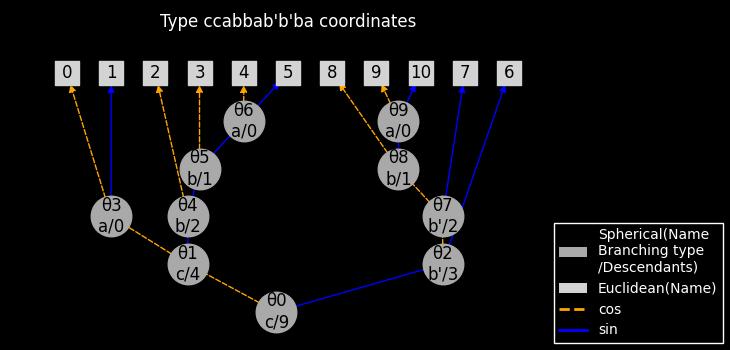
The image shows how Cartesian coordinates (leaf nodes) are calculated from spherical coordinates (internal nodes).
For example, $x_{10}$, corresponding to node `10`, is a leaf node which ancestors are `[θ0, θ2, θ7, θ8, θ9]`. The edges which connect these nodes are named `[sin, cos, cos, sin, sin]`, respectively. Thus, $x_{10}$ is calculated as:
$$
x_{10} = \sin \theta_0 \cos \theta_2 \cos \theta_7 \sin \theta_8 \sin \theta_9
$$
### Integration over sphere using spherical coordinates
```python
>>> c = us.create_spherical()
>>> f = lambda spherical: spherical["theta"] ** 2 * spherical["phi"]
>>> np.round(us.integrate(
... c,
... f,
... False, # does not support separation of variables
... 10, # number of quadrature points
... xp=np # the array namespace
... ), 5)
np.float64(110.02621)
```
### Random sampling
Sampling random points uniformly from the unit ball:
```python
>>> c = us.create_spherical()
>>> points_ball = us.random_ball(c, shape=(), xp=np, rng=rng)
>>> points_ball
array([0.12504754, 0.45095196, 0.32752147])
>>> np.linalg.vector_norm(points_ball)
np.float64(0.5711960026239531)
```
Sampling random points uniformly from the sphere (does not include interior points):
```python
>>> points_sphere = us.random_ball(c, shape=(), xp=np, surface=True, rng=rng)
>>> points_sphere
array([-0.89670228, -0.44166441, 0.02928439])
>>> np.linalg.vector_norm(points_sphere)
np.float64(1.0)
```
#### References
- Barthe, F., Guédon, O., Mendelson, S., & Naor, A. (2005). A probabilistic approach to the geometry of the ? P n -ball. The Annals of Probability, 33. https://doi.org/10.1214/009117904000000874
## Contributors ✨
Thanks goes to these wonderful people ([emoji key](https://allcontributors.org/docs/en/emoji-key)):
This project follows the [all-contributors](https://github.com/all-contributors/all-contributors) specification. Contributions of any kind welcome!
## Credits
[](https://github.com/copier-org/copier)
This package was created with
[Copier](https://copier.readthedocs.io/) and the
[browniebroke/pypackage-template](https://github.com/browniebroke/pypackage-template)
project template.
The code examples in the documentation and docstrings are
automatically tested as doctests using [Sybil](https://sybil.readthedocs.io/).