https://github.com/unpackai/dl201
Deep learning 201
https://github.com/unpackai/dl201
Last synced: 12 months ago
JSON representation
Deep learning 201
- Host: GitHub
- URL: https://github.com/unpackai/dl201
- Owner: unpackAI
- Created: 2022-01-23T08:44:35.000Z (over 4 years ago)
- Default Branch: main
- Last Pushed: 2023-01-13T05:56:57.000Z (over 3 years ago)
- Last Synced: 2025-04-12T12:44:53.661Z (about 1 year ago)
- Language: Jupyter Notebook
- Size: 96.1 MB
- Stars: 6
- Watchers: 4
- Forks: 5
- Open Issues: 11
-
Metadata Files:
- Readme: README.md
Awesome Lists containing this project
README
# DL201
# 4-Weeks Advanced Deep Learning Bootcamp from Unpack AI
### Deep dive into working with data, data processing and building predictive models.
🎉Congratulations on continuing your learning path to become a versatile AI Practitioner.
At unpackAI, we are strong believers in a top-down approach when it comes to learning technical
multi-disciplinary AI skills in order to give a completed picture of the current state-of-the-art and
how you can apply it to your personal needs or work. You might have recently completed DL101
and learned about machine learning use cases and built your first AI mini-projects. That was a
really good start to build up "I can do it" confidence and excitement about the possibilities of AI.
At the same time, you also encountered some limitations in exploring, buidling and validating
good AI projects, such as :
- data collection, data preparation and data quality issues
- scarcity of computing power to train big models on Colab or Kaggle
- and above all, your own limited coding skills and lack of strong technical foundation.
🔥🔥🔥That's why we invite you to take another BIG leap forward by joining your next
adventure in harnessing artificial intelligence: DL201 Bootcamp with deep dive into working
with data, data processing and building predictive models.
Let's learn what the course is about :👇
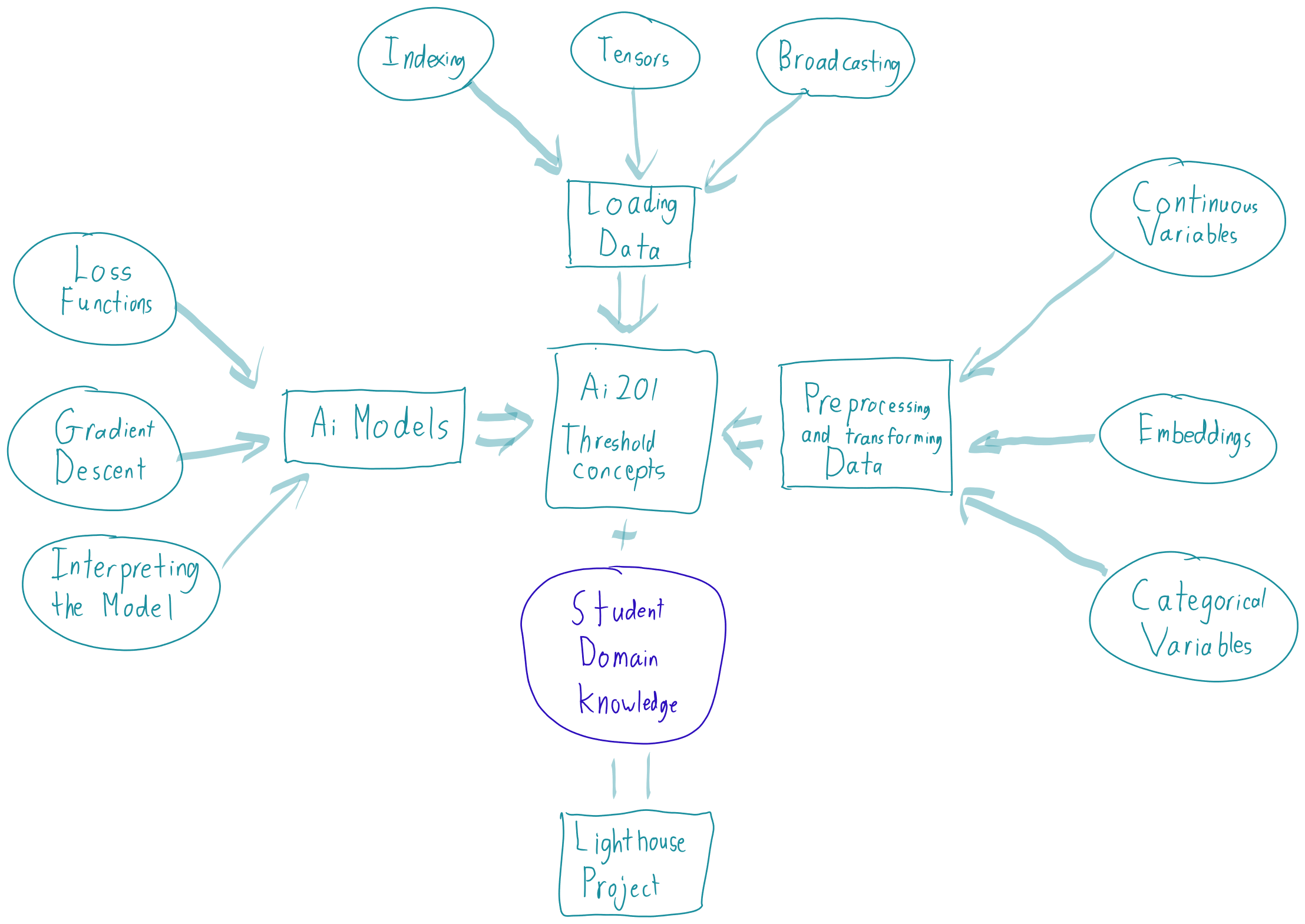
### 1. 🎳Goals
Be able to build AI proof of a concept to demonstrate to a software developer what should
be done in a production environment. You will be able to connect the dots between the
business requirements and technical feasibility of the AI project.
- Be able to work with the most common data types to load, analyze and prepare them for
building predictive models. You will be able to parse images (jpg, png etc), text (pdf, word
etc), web pages (html, json) and convert them into data frames, a required step before
starting your ML experimentation.
- Be able to experiment with the most promising neural network architectures, traditional
ML algorithms and pretrained models to find out which one fits data best. You will able to
compare the results by understanding the mechanics of the model training and
evaluation.
- Be able to work with many python packages and ML and AutoML tools, e.g pandas,
numpy, pytorch, fast.ai, tai-chi, pycaret, unpackai and many more.
- Get familiar with the everyday techniques and skills of machine learning engineers and software developers, such as
check github repos for code, read documentation, google as a pro etc
- Become a contributor to unpackai's AutoML packages: unpackai and tai-chi that simplifies
the code and accelerates the development cycles of AI models. Unlock the opportunity to
become the mentor for DL101s to enable more business professionals to learn and apply
AIML.
### 2. Schedule
Week
Skills
Learning Content
0
Course deliverables and project setup
Meet your mentors, unpackers
Understand the bootcamp objectives and logistics
Receive the framework for building your AI project in this
course. Learn and build as you go over the first three weeks, finalize
the project by the end of 4th week.
1
Data Loading and Exploratory Analysis
Understand how to load datasets and metadata in the most common
file formats
Explore the datasets and discern if it is suitable for adaptation
to our problem
Gain tools to manipulate metadata and tabular data using
Pandas
Have an appreciation for how data can be represented as tensors
Explore the data-centric approach in AI, and learn about its importance
in Machine & Deep Learning.
Utilize tools to label, improve and balance your
datasets.
2
Data Preprocessing and Transformations
Explore common data wrangling tasks
Learn how to apply feature engineering methods to spreadsheet data, such as grouping into categories, feature decomposition, tabular data transformation methods
Master computer vision preprocessing techniques like label encoding, handling unbalanced classes; image data transformation like normalizing pixel values
Dive into text preprocessing for NLP tasks like encoding and embeddings
3
Algorithms and Model Training
Discuss the most common cutting edge DL algorithms and architectures in computer vision, NLP
Explore the best performing machine learning models used in supervised machine learning for structured data
Learn how to apply pretrained models on new ML tasks with hyperparameters optimization and most common fine-tuning approaches
Train Neural Network from Scratch using only Pytorch to undersand the mechanics of building ML model.
4
Project Finalization
Fully apply newly gained machine learning skills to your ongoing
project to deliver the final results.
Get on 1:1 calls with mentors to get personalized feedback and
recommendations before presenting it as a proof-of-concept project on
Demo Day.
5
Graduation and Demo Day
Present your project in the final session, receive the final feedback from mentors in order to get yourself ready for Demo Day
Participate in Demo Day to showcase your achievement and feature your project in front of anyone. We will broadast this event on our social media to invite anyone interested in real AI use cases built by our graduates.
Receive the certificate and get endorse for your skills on LinkedIn