https://github.com/webcoyote/sandvault
Run AI agents isolated in a macOS user account and sandbox-exec. Configured to run Claude Code, OpenAI Codex, Cursor Agent, Google Gemini.
https://github.com/webcoyote/sandvault
claude-code macos openai-codex sandbox
Last synced: 3 months ago
JSON representation
Run AI agents isolated in a macOS user account and sandbox-exec. Configured to run Claude Code, OpenAI Codex, Cursor Agent, Google Gemini.
- Host: GitHub
- URL: https://github.com/webcoyote/sandvault
- Owner: webcoyote
- License: apache-2.0
- Created: 2025-09-12T07:17:45.000Z (11 months ago)
- Default Branch: main
- Last Pushed: 2026-05-01T23:40:42.000Z (3 months ago)
- Last Synced: 2026-05-04T03:13:09.904Z (3 months ago)
- Topics: claude-code, macos, openai-codex, sandbox
- Language: Shell
- Homepage:
- Size: 588 KB
- Stars: 250
- Watchers: 4
- Forks: 11
- Open Issues: 2
-
Metadata Files:
- Readme: README.md
- Changelog: CHANGELOG.md
- License: LICENSE.md
- Agents: AGENTS.md
Awesome Lists containing this project
- awesome-agent-runtime-security - sandvault - exec` profile — no access to your home, keychain, or SSH agent. Shared workspace via git remotes. Brew-installable. | (Sandboxing & Isolation)
- awesome-ai-sandbox - SandVault - Runs agents in a separate macOS user account with `sandbox-exec` hardening. (Host-level sandboxes and local workspace isolation / macOS)
README
# SandVault - Run AI agents and shell commands in a sandboxed macOS user account. Sandboxed web and app testing with Chrome and iOS Simulator.

SandVault (`sv`) manages a limited user account to sandbox shell commands and AI agents, providing a lightweight alternative to application isolation using virtual machines.
- **AI ready** - Includes Claude Code, OpenAI Codex, OpenCode, Google Gemini
- **Web and iOS automation** - sandbox access to Chrome and iOS Simulator
- **Fast context switching** - No VM overhead; instant user switching
- **Passwordless** - switch accounts without a prompt (after setup)
- **Shared workspace** - joint access to `/Users/Shared/sv-$USER`
- **Defense in depth** - limited user account + `sandbox-exec`
- **Clean uninstall** - Complete removal with `sv uninstall`
---
## Quick Links
0. Run [Browser Automation](#Browser-Automation) from within the sandbox that can be used for testing web interactions.
1. Run [iOS Simulator Automation](#iOS-Simulator-Automation) from within the sandbox that can be used for iOS app testing.
2. To run `xcodebuild` or `swift` see [Sandboxing xcodebuild and swift](#Sandboxing-xcodebuild-and-swift) for details.
3. To run other sandboxed applications inside sandvault, use the `-x` option. See [Sandboxing other apps](#Sandboxing-other-apps) for details.
4. It's not possible to run GUI applications from within the sandbox; see [Running GUI Applications](#Running-GUI-Applications) for details.
## Security Model
SandVault has limited access to your computer:
- Cannot access your home directory
- Runs with standard user privileges
- Cannot modify system files
- Has no access to mounted drives
```
- writable: /Users/Shared/sv-$USER -- only accessible by you & sandvault-$USER
- writable: /Users/sandvault-$USER -- sandvault's home directory
- readable: /usr, /bin, /etc, /opt -- system directories
- no access: /Users/* -- other user directories
- writable: /Volumes/Macintosh HD -- accessible as per file permissions
- no access: /Volumes/* -- cannot access mounted/remote/network drives
```
## Installation
Install via Homebrew:
```bash
brew install sandvault
```
Install via git:
```bash
# Clone the repository
git clone https://github.com/webcoyote/sandvault
# Option 1: add the sandvault directory to your path
export PATH="$PATH:/path/to/where/you/cloned/sandvault"
# Option 2: add to your shell configuration for easy access
echo >> ~/.zshrc 'alias sv="/path/to/where/you/cloned/sandvault/sv"'
echo >> ~/.bashrc 'alias sv="/path/to/where/you/cloned/sandvault/sv"'
```
## Quick Start
```bash
# Run Claude Code in the sandbox
# shortcut: sv cl
sv claude
# Run OpenAI Codex in the sandbox
# shortcut: sv co
sv codex
# Run OpenCode in the sandbox
# shortcut: sv o
sv opencode
# Run Google Gemini in the sandbox
# shortcut: sv g
sv gemini
# Run command shell in the sandbox
# shortcut: sv s
sv shell
```
## Connect via SSH
The default mode for sandvault runs commands as a limited user (basically `sudo -u sandbox-$USER COMMAND`). Sandvault also configures the limited sandvault account so that you can run commands via SSH (basically `ssh sandbox-$USER@$HOSTNAME`), and everything works the same. Use the `-s` or `--ssh` option to use SSH mode with `sv`, or use `tmux` or `screen` for users so inclined.
```bash
# Run using impersonation
# sv COMMAND
sv gemini
# Run using ssh
# sv -s/--ssh COMMAND
sv --ssh gemini
```
## Advanced Commands
```bash
# Run AI agent with optional arguments
# Usage:
# sv [PATH] [-- AGENT_ARGUMENTS]
# Example:
sv gemini -- --continue
# Run shell command in sandvault and exit
# Usage:
# sv shell [PATH] -- [SHELL_COMMAND]
# Example:
sv shell /Users -- pwd # output: /Users
# Send input via stdin
# Usage:
# | sv shell [PATH] [-- SHELL_COMMAND]
# Examples:
echo "pwd ; exit" | sv shell /Users # output: /Users
echo ABC | sv shell -- tr 'A-Z' 'a-z' # output: abc
cat PROMPT.md | sv gemini
# Clone local/remote Git repository into /Users/sandvault-$USER/repositories/ and open there
# Usage:
# sv --clone URL_OR_LOCAL_PATH [-- AGENT_OR_SHELL_ARGS]
# Examples:
sv codex --clone https://github.com/webcoyote/sandvault.git
sv codex -c ~/src/my-app
sv shell --clone https://github.com/webcoyote/sandvault.git
sv shell -c ../my-app
Use a full or relative path with a directory name for local clones.
For local Git repositories, sandvault also wires remotes:
- Your local Git repository gets/updates remote `sandvault` -> `/Users/sandvault-$USER/repositories/`
- This lets you run `git fetch sandvault` from the original local Git repository to pull commits made in the sandvault Git repository.
```
## Native Install
By default, SandVault installs AI tools via Homebrew on the host side. With `--native-install` (`-N`), tools are instead installed inside the sandbox using their own installers:
- **Claude Code** — installed via `curl -fsSL https://claude.ai/install.sh | bash`
- **Codex** — installed via `npm install -g @openai/codex`
- **OpenCode** — installed via `curl -fsSL https://opencode.ai/install | bash`
- **Gemini** — installed via `npm install -g @google/gemini-cli`
Tools are installed on first run and reused on subsequent runs.
```bash
# Install and run Claude Code natively
sv --native-install claude
sv -N claude
# Works with all AI agents
sv -N codex
sv -N opencode
sv -N gemini
```
To make native install the default, set `SANDVAULT_ARGS`:
```bash
# Add to your shell profile (~/.zshrc, ~/.bashrc, etc.)
export SANDVAULT_ARGS="--native-install"
# Now 'sv claude' uses native install automatically
sv claude
```
## Environment Variables
Set `SANDVAULT_ARGS` to supply default arguments that are prepended to the command line:
```bash
# Add to your shell profile (~/.zshrc, ~/.bashrc, etc.)
export SANDVAULT_ARGS="--verbose --ssh"
# Now these are equivalent:
sv claude
sv --verbose --ssh claude
```
Shell quoting is supported, so arguments with spaces work:
```bash
export SANDVAULT_ARGS='--clone "my project"'
```
Explicit command-line arguments are appended after `SANDVAULT_ARGS`, so they are processed afterwards.
## Maintenance Commands
```bash
# Build sandvault but do not run a command
sv build
sv b
# Rebuild sandvault, including updating all file permissions and ACLs in the shared volume
sv build --rebuild
sv b -r
# Fix permissions when using a restrictive umask (e.g. 077)
sv --fix-permissions
sv --fix-permissions build
# Uninstall sandvault (does not delete files in the shared volume)
sv uninstall
# Misc commands
sv --version
sv --help
```
## `agentsview` Integration
[`agentsview`](https://github.com/badlogic/agentsview) is a dashboard that aggregates session history, search, and cost tracking across AI coding agents (Claude Code, Codex, OpenCode, Gemini). If you have agentsview installed on the host, `sv-agentsview-setup` mirrors sandbox session data so it appears alongside your host-side sessions.
```bash
# Detect agentsview, prompt to opt in, and configure
sv-agentsview-setup
```
Then run `agentsview serve` and you'll see your sandvault AI sessions included in the `agentsview` dashboard.
## Nested sandboxes
In addition to running in a different macOS user account, sandvault also runs applications using macOS `sandbox-exec`, which further limits what resources are accessible.
Some applications, like `swift`, already run inside a sandbox. Because macOS does not support nested (i.e. recursive) sandboxes, these applications fail to run.
Read on for solutions.
### Sandboxing xcodebuild and swift
For `swift` (and `xcodebuild`, which runs `swift`), you can set the following variables in your build scripts to run inside sandvault:
For `swift`:
```bash
ARGS=()
# Disable sandboxing when running inside sandvault to avoid nested sandbox-exec
if [[ -n "${SV_SESSION_ID:-}" ]]; then
ARGS+=(--disable-sandbox)
fi
swift build "${ARGS[@]}" "$@"
```
For `xcodebuild`:
```bash
ARGS=()
# Disable sandboxing when running inside sandvault to avoid nested sandbox-exec
if [[ -n "${SV_SESSION_ID:-}" ]]; then
export SWIFTPM_DISABLE_SANDBOX=1
export SWIFT_BUILD_USE_SANDBOX=0
ARGS+=("-IDEPackageSupportDisableManifestSandbox=1")
ARGS+=("-IDEPackageSupportDisablePackageSandbox=1")
# shellcheck disable=SC2016 # Expressions don't expand in single quotes # that is intentional
ARGS+=('OTHER_SWIFT_FLAGS=$(inherited) -disable-sandbox')
fi
xcodebuild \
build \
"${ARGS[@]}" \
...
```
### Sandboxing other apps
If the app you intend to run does not support disabling the use of sandbox-exec like `xcodebuild` and `swift` you can run sandvault without `sandbox-exec`:
```bash
# Disable use of sandbox-exec (app still runs as sandvault user) using -x / --no-sandbox
sv -x claude
sv --no-sandbox codex
sv --no-sandbox shell $HOME/projects/my-app -- xcodebuild ...
```
Disabling `sandbox-exec` has the following security implications:
- No protection against reading/writing removable drives (`/Volumes/...`)
- No protection against writing files with `o+w` (`0002`) file permissions
```bash
# To find all files on your computer that are "world writable" (perms: `o+w` / 0002)
# run this command from your account (not in sandvault):
find / \
-path "/Users/sandvault-$USER" -prune \
-o -path "/Users/sv-$USER" -prune \
-o -perm -o=w -print 2>/dev/null
```
## Troubleshooting
If your sandbox is misbehaving you can fix it with a rebuild or uninstall/reinstall. They're both safe and will not delete files in the shared sandbox folder.
```bash
# Force rebuild
sv --rebuild build
# Uninstall then reinstall
sv uninstall
sv build
```
### Fix the security popup
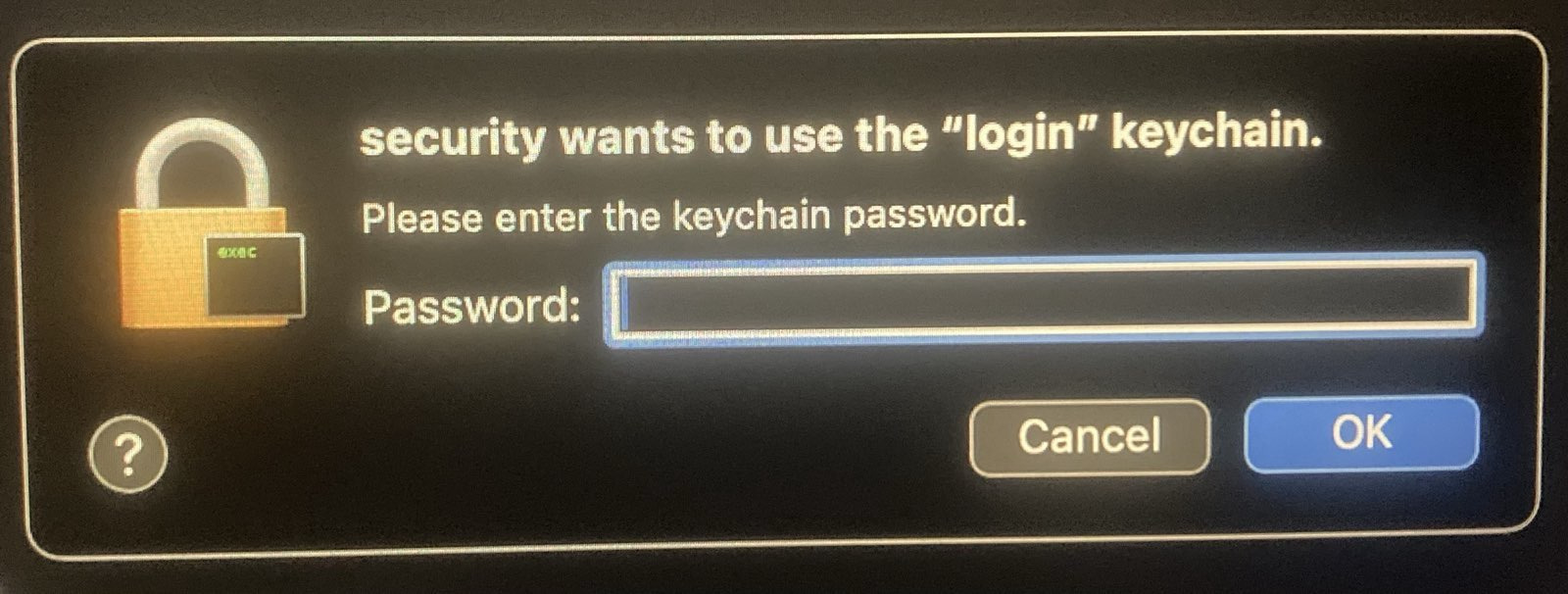
If you see a security popup above, it may be because files in the shared sandvault directory don't have the correct ACLs, which occurs when another user's files are copied into the sandvault shared directory (`/Users/Shared/sv-$USER`). This can be corrected by running the rebuild command `sv --rebuild build`, or adding the rebuild flag to any command, e.g. `sv -r shell`. This only needs to be done once.
### Fix permission errors from restrictive umask
If you see "Permission denied" errors when running `sv`, your shell may have a restrictive `umask` (e.g., `077` instead of the default `022`). Check with:
```bash
umask
```
SandVault detects this and warns you. To fix it for the current session, add `--fix-permissions`:
```bash
# Fix permissions (standalone or with build)
sv --fix-permissions
sv --fix-permissions build
```
If you previously installed Homebrew under a restrictive umask, you may also need to fix its directory permissions:
```bash
sudo chmod -R o+rX /opt/homebrew
```
## Custom Shell Configuration
If you're using `sandvault`, you're probably the type of person who also sets custom shell configuration files, and you'd be disappointed if you had to use default zsh while running `sv shell`. Here's how to configure your custom configuration for sandvault:
1. Ensure sandvault has been installed by running a command like `sandvault build`, `sandvault shell`, `sandvault claude`, etc.
2. Copy your desired configuration files (e.g. `.zshrc`, `.zprofile`, etc.) to `/Users/Shared/sv-${USER}/user/`.
Next time you run sandvault, your files will be copied to the sandvault user home directory, and your zsh configuration files will be sourced:
.zshenv → .zprofile → .zshrc
NOTE: .zlogin and .zlogout not supported
> **Note:** Earlier versions of sandvault supported configuration files in `guest/home/user/`, which didn't work for Homebrew installations. Consequently, this is no longer supported, and you'll get an error message asking you to move `guest/home/user` to `/Users/Shared/sv-${USER}/user/`.
## Browser Automation
SandVault supports headless Chrome for browser automation from within the sandbox. Chrome runs on the host side and the sandbox connects to it via the Chrome DevTools Protocol (CDP) over localhost.
### Usage
```bash
# Launch with browser support
sv --browser claude
sv --browser shell
```
Inside the sandbox, the `SV_BROWSER_ENDPOINT` environment variable contains the CDP endpoint URL (e.g. `http://127.0.0.1:52858`).
```javascript
// Playwright
const browser = await chromium.connectOverCDP(process.env.SV_BROWSER_ENDPOINT);
// Puppeteer
const browser = await puppeteer.connect({ browserURL: process.env.SV_BROWSER_ENDPOINT });
```
From the host, you can query the endpoint URL:
```bash
# Prints the CDP endpoint URL (or errors if browser is unavailable)
sv --endpoint
```
See also [`./tests/browser/*.js`](./tests/browser) for examples of using Playwright and Puppeteer. See [`guest/home/bin/prompts/browser.md`](./guest/home/bin/prompts/browser.md) for prompt.
### How it works
- Chrome is launched headless on the host side with a dynamic port (`--remote-debugging-port=0`), and sandvault connections via `localhost`
- Chrome stays running across sandbox sessions and is stopped when the last `--browser` session exits
- Chrome uses an isolated user data directory, separate from your personal Chrome profile
### Requirements
Google Chrome or Chromium must be installed in `/Applications/`.
## iOS Simulator Automation
SandVault can expose the iOS Simulator to sandboxed AI agents for iOS app testing. The simulator runs on the host (it is a GUI app and cannot run inside the sandbox), and an HTTP bridge on localhost translates sandbox-side requests into `xcrun simctl` and [`iosef`](https://github.com/riwsky/iosef) invocations.
### Usage
```bash
# Launch with iOS Simulator support
sv --ios claude
sv --ios shell
```
Add `--ios-gui` to also show the Simulator.app window — useful when debugging interactively or watching an agent's actions:
```bash
sv --ios-gui shell
```
Simulator.app is left running on session exit so that other simulators (yours or other tools') aren't disrupted.
Inside the sandbox, the `SV_IOS_SIMULATOR_ENDPOINT` environment variable points at the HTTP bridge (e.g. `http://127.0.0.1:52861`).
```bash
# Check if simulator is ready
curl $SV_IOS_SIMULATOR_ENDPOINT/ready
# Read the accessibility tree
curl $SV_IOS_SIMULATOR_ENDPOINT/describe
# Tap a button by accessibility name
curl -X POST -H 'Content-Type: application/json' \
-d '{"name":"Sign In"}' \
$SV_IOS_SIMULATOR_ENDPOINT/tap
# Launch an app by bundle id
curl -X POST -H 'Content-Type: application/json' \
-d '{"bundle_id":"com.apple.Preferences"}' \
$SV_IOS_SIMULATOR_ENDPOINT/launch
# Save a screenshot as JPG (point resolution)
curl -o low_res.jpg $SV_IOS_SIMULATOR_ENDPOINT/view
# Save a screenshot as PNG (pixel resolution)
curl -o high_res.png $SV_IOS_SIMULATOR_ENDPOINT/view_pixels
```
See [`guest/home/bin/prompts/ios-simulator.md`](./guest/home/bin/prompts/ios-simulator.md) for the full list of endpoints. This file is automatically included in your AI agent prompt when using --ios/--ios-gui. See [`tests/ios-simulator/scripts/tests`](./tests/ios-simulator/scripts/tests) for a runnable example.
### How it works
- A fresh scratch simulator (named `sandvault-`) is created and booted on the host for each `--ios` session, and deleted on exit.
- A Python HTTP bridge (`helpers/sv-ios-bridge`) listens on a dynamic localhost port and fronts a whitelisted set of `iosef` and `xcrun simctl` subcommands.
- `.app` bundles passed to `/install` must live under `/Users/Shared/` (so the sandbox user can already access them); the bridge rejects paths outside that tree.
- All subprocess calls use explicit argv lists, not shells.
### Requirements
- Xcode with at least one iOS runtime installed (Xcode → Settings → Platforms).
- Homebrew (used to install `uv`, which installs `iosef`). sandvault installs both automatically on first use.
## Running GUI Applications
TL;DR: Sorry, macOS security limitations prevent this from working.
It would be great to be able to run GUI applications (e.g. browsers, Claude Desktop) in the sandbox account to limit their access to main account resources.
The issue seems to be that an application cannot report to a WindowServer that's owned by a different user.
Internet posts suggest it's possible using `sudo su`, `sudo launchctl asuser`, and `sudo launchctl bsexec`, but those answers are from long ago and it seems likely that Apple improvements to macOS security have closed those doors.
In the event you do find a solution, send a PR please :)
## Why SandVault?
After exploring Docker containers, Podman, sandbox-exec, and virtualization, I needed something that:
- Works natively on macOS without virtualization overhead
- Provides meaningful isolation without too much complexity
- Runs Claude Code with `--dangerously-skip-permissions`
- Runs OpenAI Codex with `--dangerously-bypass-approvals-and-sandbox`
- Runs OpenCode with `OPENCODE_PERMISSION='{"*":"allow"}'`
- Runs Google Gemini with `--yolo`
- Automates Chrome for web testing (via Chrome DevTools Protocol)
- Automated iOS Simulator for app testing (via `xcrun simctl`, and `iosef`)
- Maintains a clean separation between trusted and untrusted code
SandVault uses macOS's Unix heritage and user account system to create a simple but effective sandbox.
# Alternatives
- [ClodPod](https://github.com/webcoyote/clodpod) runs Claude Code inside a macOS virtual machine.
- [Chamber](https://github.com/cirruslabs/chamber) is a proof-of-concept app for running Claude Code inside a macOS virtual machine.
- [Claude Code Sandbox](https://github.com/textcortex/claude-code-sandbox) runs Claude Code in a Docker container (Linux)
# License
Apache License, Version 2.0
SandVault Copyright © 2026 Patrick Wyatt
See [LICENSE.md](LICENSE.md) for details.
# Contributors
We welcome contributions and bug reports.
See [CONTRIBUTORS.md](CONTRIBUTORS.md) for the list of contributors to this project.
# Thanks to
This project builds on the great works of other open-source authors:
- [Claude](https://www.anthropic.com/claude) - AI coding assistant
- [Codex](https://openai.com/codex/) - AI coding assistant
- [CMux](https://github.com/manaflow-ai/cmux) - an awesome terminal
- [Ghostty](https://ghostty.org) - an awesome terminal & terminal library
- [Homebrew](https://brew.sh): 🍺 The missing package manager for macOS (or Linux)
- [Shellcheck](https://www.shellcheck.net): finds bugs in your shell scripts
- [uv](https://docs.astral.sh/uv/): An extremely fast Python package and project manager, written in Rust
- [Claude Code Hooks Mastery](https://github.com/disler/claude-code-hooks-mastery): Quickly master how to use Claude Code hooks to add deterministic (or non-deterministic) control over Claude Code's behavior
- [StatusLine](https://gist.github.com/dhkts1/55709b1925b94aec55083dd1da9d8f39): project status information for Claude Code
... as well as GNU, BSD, Linux, curl, Git, Sqlite, Node, Python, netcat, jq, and more. "We stand upon the shoulders of giants."