https://github.com/webdevcaptain/cassandra-iot-sample
IoT Data API using Cassandra 5
https://github.com/webdevcaptain/cassandra-iot-sample
cassandra
Last synced: about 1 month ago
JSON representation
IoT Data API using Cassandra 5
- Host: GitHub
- URL: https://github.com/webdevcaptain/cassandra-iot-sample
- Owner: WebDevCaptain
- Created: 2025-03-12T10:20:36.000Z (over 1 year ago)
- Default Branch: main
- Last Pushed: 2025-03-12T11:34:23.000Z (over 1 year ago)
- Last Synced: 2025-03-12T12:22:37.093Z (over 1 year ago)
- Topics: cassandra
- Language: JavaScript
- Homepage:
- Size: 14.6 KB
- Stars: 0
- Watchers: 1
- Forks: 0
- Open Issues: 0
-
Metadata Files:
- Readme: README.md
Awesome Lists containing this project
README
# IOT Data API
A Smart City IoT Data API that registers sensors and ingests time-stamped readings.
## Data Model
### Sensors Table
- Stores the core info needed for each sensor.
- **Fields:**
- `sensor_id` (PK): Unique id for each sensor
- `type`: Type of sensor (e.g. air_quality, temperature)
- `lat` and `lng`: Geographic coordinates of the sensor
- `description`: description of the sensor
- `created_at`: Timestamp when the sensor was registered. We use `toTimestamp(now())` to get the current timestamp while storing.
### Sensor Readings Table
- **Fields:**
- `sensor_id`: Id to link the reading to a sensor (kind of FK in RDBMS)
- `timestamp` (Clustering Key): When the reading was taken. Helps order the data (we use it for querying)
- `value`: The numeric reading (e.g. air quality value).
- `unit`: The unit of measurement (e.g PPM)
- `status`: The status of the reading (e.g. ok, warning).
- **Notes --**
- **Time-Series Data:** Using `sensor_id` as partition key and `timestamp` as clustering key supports efficient time-range queries.
- **High Write Throughput:** Designed to handle a large number of writes from sensors.
- **TTL Support:** Can use Cassandra’s TTL to automatically remove old data. [TODO]
---
## API Endpoints
- [Sensor Management Endpoints](./endpoints-test/sensors.http)
- [Sensor Readings Endpoints](./endpoints-test/readings.http)
---
## Tech Used
1. Apache Cassandra (v5.x)
2. Node.js & Express with DataStax Cassandra Driver
---
## Why use Cassandra for this IoT system ????
> Compared to Traditional Databases (MySQL/Postgres) and MongoDB
- **High Write Throughput:** Cassandra is designed to handle many writes per second (with very low latency), which is ideal for time-series sensor data. Can easily load balance across multiple nodes in a Cluster...
- **Scalability:** It scales horizontally very easily; new nodes can be added without downtime (Mongo can also do this)
- **Distributed Architecture:** There is no single point of failure. Data is automatically replicated across multiple nodes (No master/slave setup)
- **Tunable Consistency** You can balance between consistency and performance by choosing the right consistency level
- **Time-Series Support:** With its partition and clustering keys, Cassandra naturally supports time-series data models..
- **Built-In TTL** Easily set expiration times on data, automatically cleaning up old sensor readings (caches like Valkey(Redis), Memcached do this often)
---
## Key Cassandra internals:-
[Architecture](https://cassandra.apache.org/doc/latest/cassandra/architecture/index.html#architecture/snitch.adoc)
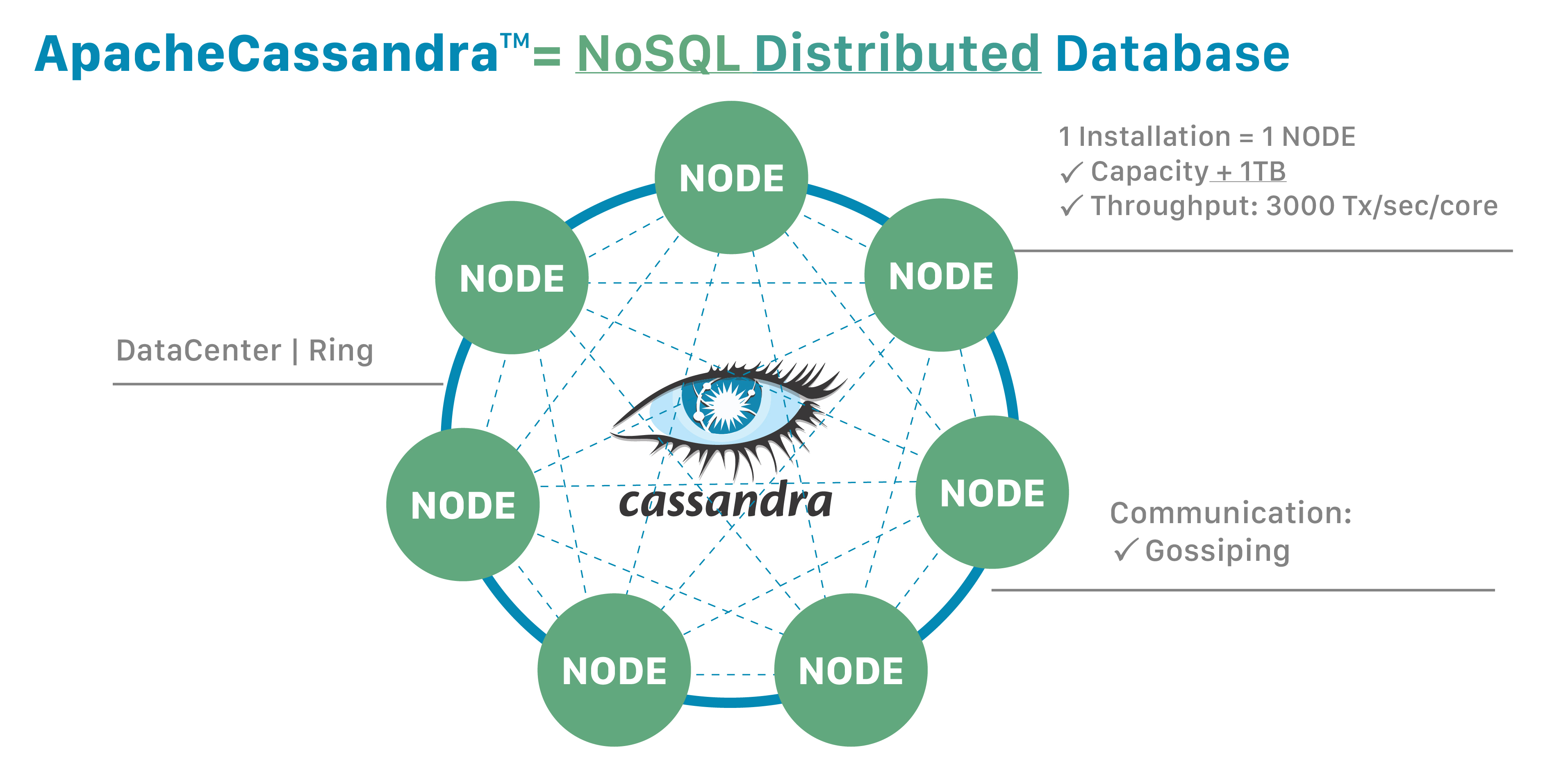
1. **P2P Architecture:**
- Every node in the Cassandra cluster is equal. There is no master node.
2. **Partitioning:**
- Data is divided across nodes using partition keys, ensuring balanced load
3. **Replication:**
- Data is replicated across multiple nodes. The replication factor is configurable
4. **Consistency Levels:**
- Cassandra lets user choose the consistency level for each operation, balancing performance and data accuracy.
5. **Write Path:**
- Writes are fast because data is first written to a commit log, and then stored in an in-memory table (SST, memtable) before being flushed to disk.
6. **Read Path:**
- Uses SSTables (Sorted String Table or SST) and bloom filters to quickly locate data on disk.
7. **Compaction:**
- Compaction is a process that merges SSTables to reduce disk usage and improve performance. It is automatically triggered when the number of SSTables exceeds a certain threshold (as a batch process)
8. **Tombstone:**
- A tombstone is a special marker in Cassandra that indicates that a row has been deleted. It is used to optimize read performance by skipping deleted rows.
---
## License
This repo is released under the [MIT License](LICENSE) and can be used for any purpose.