https://github.com/wesselb/stheno
Gaussian process modelling in Python
https://github.com/wesselb/stheno
gaussian-processes machine-learning python
Last synced: over 1 year ago
JSON representation
Gaussian process modelling in Python
- Host: GitHub
- URL: https://github.com/wesselb/stheno
- Owner: wesselb
- License: mit
- Created: 2017-06-13T11:15:22.000Z (about 9 years ago)
- Default Branch: master
- Last Pushed: 2024-01-20T14:11:37.000Z (over 2 years ago)
- Last Synced: 2024-12-06T22:36:11.572Z (over 1 year ago)
- Topics: gaussian-processes, machine-learning, python
- Language: Python
- Homepage:
- Size: 11.5 MB
- Stars: 218
- Watchers: 10
- Forks: 18
- Open Issues: 4
-
Metadata Files:
- Readme: README.md
Awesome Lists containing this project
- awesome-gaussian-processes - Stheno
README
# [Stheno](https://github.com/wesselb/stheno)
[](https://github.com/wesselb/stheno/actions?query=workflow%3ACI)
[](https://coveralls.io/github/wesselb/stheno?branch=master)
[](https://wesselb.github.io/stheno)
[](https://github.com/psf/black)
Stheno is an implementation of Gaussian process modelling in Python. See
also [Stheno.jl](https://github.com/willtebbutt/Stheno.jl).
[Check out our post about linear models with Stheno and JAX.](https://wesselb.github.io/2021/01/19/linear-models-with-stheno-and-jax.html)
Contents:
* [Nonlinear Regression in 20 Seconds](#nonlinear-regression-in-20-seconds)
* [Installation](#installation)
* [Manual](#manual)
- [AutoGrad, TensorFlow, PyTorch, or JAX? Your Choice!](#autograd-tensorflow-pytorch-or-jax-your-choice)
- [Model Design](#model-design)
- [Finite-Dimensional Distributions](#finite-dimensional-distributions)
- [Prior and Posterior Measures](#prior-and-posterior-measures)
- [Inducing Points](#inducing-points)
- [Kernels and Means](#kernels-and-means)
- [Batched Computation](#batched-computation)
- [Important Remarks](#important-remarks)
* [Examples](#examples)
- [Simple Regression](#simple-regression)
- [Hyperparameter Optimisation with Varz](#hyperparameter-optimisation-with-varz)
- [Hyperparameter Optimisation with PyTorch](#hyperparameter-optimisation-with-pytorch)
- [Decomposition of Prediction](#decomposition-of-prediction)
- [Learn a Function, Incorporating Prior Knowledge About Its Form](#learn-a-function-incorporating-prior-knowledge-about-its-form)
- [Multi-Output Regression](#multi-output-regression)
- [Approximate Integration](#approximate-integration)
- [Bayesian Linear Regression](#bayesian-linear-regression)
- [GPAR](#gpar)
- [A GP-RNN Model](#a-gp-rnn-model)
- [Approximate Multiplication Between GPs](#approximate-multiplication-between-gps)
- [Sparse Regression](#sparse-regression)
- [Smoothing with Nonparametric Basis Functions](#smoothing-with-nonparametric-basis-functions)
## Nonlinear Regression in 20 Seconds
```python
>>> import numpy as np
>>> from stheno import GP, EQ
>>> x = np.linspace(0, 2, 10) # Some points to predict at
>>> y = x ** 2 # Some observations
>>> f = GP(EQ()) # Construct Gaussian process.
>>> f_post = f | (f(x), y) # Compute the posterior.
>>> pred = f_post(np.array([1, 2, 3])) # Predict!
>>> pred.mean
>>> pred.var
```
[These custom matrix types are there to accelerate the underlying linear algebra.](#important-remarks)
To get vanilla NumPy/AutoGrad/TensorFlow/PyTorch/JAX arrays, use `B.dense`:
```python
>>> from lab import B
>>> B.dense(pred.mean)
array([[1.00000068],
[3.99999999],
[8.4825932 ]])
>>> B.dense(pred.var)
array([[ 8.03246358e-13, 7.77156117e-16, -4.57690943e-09],
[ 7.77156117e-16, 9.99866856e-13, 2.77333267e-10],
[-4.57690943e-09, 2.77333267e-10, 3.31283378e-03]])
```
Moar?! Then read on!
## Installation
```
pip install stheno
```
## Manual
Note: [here](https://wesselb.github.io/stheno) is a nicely rendered and more
readable version of the docs.
### AutoGrad, TensorFlow, PyTorch, or JAX? Your Choice!
```python
from stheno.autograd import GP, EQ
```
```python
from stheno.tensorflow import GP, EQ
```
```python
from stheno.torch import GP, EQ
```
```python
from stheno.jax import GP, EQ
```
### Model Design
The basic building block is a `f = GP(mean=0, kernel, measure=prior)`, which takes
in [a _mean_, a _kernel_](#kernels-and-means), and a _measure_.
The mean and kernel of a GP can be extracted with `f.mean` and `f.kernel`.
The measure should be thought of as a big joint distribution that assigns a mean and
a kernel to every variable `f`.
A measure can be created with `prior = Measure()`.
A GP `f` can have different means and kernels under different measures.
For example, under some _prior_ measure, `f` can have an `EQ()` kernel; but, under some
_posterior_ measure, `f` has a kernel that is determined by the posterior distribution
of a GP.
[We will see later how posterior measures can be constructed.](#prior-and-posterior-measures)
The measure with which a `f = GP(kernel, measure=prior)` is constructed can be
extracted with `f.measure == prior`.
If the keyword argument `measure` is not set, then automatically a new measure is
created, which afterwards can be extracted with `f.measure`.
Definition, where `prior = Measure()`:
```python
f = GP(kernel)
f = GP(mean, kernel)
f = GP(kernel, measure=prior)
f = GP(mean, kernel, measure=prior)
```
GPs that are associated to the same measure can be combined into new GPs, which is
the primary mechanism used to build cool models.
Here's an example model:
```python
>>> prior = Measure()
>>> f1 = GP(lambda x: x ** 2, EQ(), measure=prior)
>>> f1
GP(, EQ())
>>> f2 = GP(Linear(), measure=prior)
>>> f2
GP(0, Linear())
>>> f_sum = f1 + f2
>>> f_sum
GP(, EQ() + Linear())
>>> f_sum + GP(EQ()) # Not valid: `GP(EQ())` belongs to a new measure!
AssertionError: Processes GP(, EQ() + Linear()) and GP(0, EQ()) are associated to different measures.
```
To avoid setting the keyword `measure` for every `GP` that you create, you can enter
a measure as a context:
```python
>>> with Measure() as prior:
f1 = GP(lambda x: x ** 2, EQ())
f2 = GP(Linear())
f_sum = f1 + f2
>>> prior == f1.measure == f2.measure == f_sum.measure
True
```
#### Compositional Design
* Add and subtract GPs and other objects.
Example:
```python
>>> GP(EQ(), measure=prior) + GP(Exp(), measure=prior)
GP(0, EQ() + Exp())
>>> GP(EQ(), measure=prior) + GP(EQ(), measure=prior)
GP(0, 2 * EQ())
>>> GP(EQ()) + 1
GP(1, EQ())
>>> GP(EQ()) + 0
GP(0, EQ())
>>> GP(EQ()) + (lambda x: x ** 2)
GP(, EQ())
>>> GP(2, EQ(), measure=prior) - GP(1, EQ(), measure=prior)
GP(1, 2 * EQ())
```
* Multiply GPs and other objects.
*Warning:*
The product of two GPs it *not* a Gaussian process.
Stheno approximates the resulting process by moment matching.
Example:
```python
>>> GP(1, EQ(), measure=prior) * GP(1, Exp(), measure=prior)
GP( + + -1 * 1, * Exp() + * EQ() + EQ() * Exp())
>>> 2 * GP(EQ())
GP(2, 2 * EQ())
>>> 0 * GP(EQ())
GP(0, 0)
>>> (lambda x: x) * GP(EQ())
GP(0, * EQ())
```
* Shift GPs.
Example:
```python
>>> GP(EQ()).shift(1)
GP(0, EQ() shift 1)
```
* Stretch GPs.
Example:
```python
>>> GP(EQ()).stretch(2)
GP(0, EQ() > 2)
```
* Select particular input dimensions.
Example:
```python
>>> GP(EQ()).select(1, 3)
GP(0, EQ() : [1, 3])
```
* Transform the input.
Example:
```python
>>> GP(EQ()).transform(f)
GP(0, EQ() transform f)
```
* Numerically take the derivative of a GP.
The argument specifies which dimension to take the derivative with respect
to.
Example:
```python
>>> GP(EQ()).diff(1)
GP(0, d(1) EQ())
```
* Construct a finite difference estimate of the derivative of a GP.
See `Measure.diff_approx` for a description of the arguments.
Example:
```python
>>> GP(EQ()).diff_approx(deriv=1, order=2)
GP(50000000.0 * (0.5 * EQ() + 0.5 * ((-0.5 * (EQ() shift (0.0001414213562373095, 0))) shift (0, -0.0001414213562373095)) + 0.5 * ((-0.5 * (EQ() shift (0, 0.0001414213562373095))) shift (-0.0001414213562373095, 0))), 0)
```
* Construct the Cartesian product of a collection of GPs.
Example:
```python
>>> prior = Measure()
>>> f1, f2 = GP(EQ(), measure=prior), GP(EQ(), measure=prior)
>>> cross(f1, f2)
GP(MultiOutputMean(0, 0), MultiOutputKernel(EQ(), EQ()))
```
#### Displaying GPs
GPs have a `display` method that accepts a formatter.
Example:
```python
>>> print(GP(2.12345 * EQ()).display(lambda x: f"{x:.2f}"))
GP(2.12 * EQ(), 0)
```
#### Properties of GPs
[Properties of kernels](https://github.com/wesselb/mlkernels#properties-of-kernels-and-means)
can be queried on GPs directly.
Example:
```python
>>> GP(EQ()).stationary
True
```
#### Naming GPs
It is possible to give a name to a GP.
Names must be strings.
A measure then behaves like a two-way dictionary between GPs and their names.
Example:
```python
>>> prior = Measure()
>>> p = GP(EQ(), name="name", measure=prior)
>>> p.name
'name'
>>> p.name = "alternative_name"
>>> prior["alternative_name"]
GP(0, EQ())
>>> prior[p]
'alternative_name'
```
### Finite-Dimensional Distributions
Simply call a GP to construct a finite-dimensional distribution at some inputs.
You can give a second argument, which specifies the variance of additional additive
noise.
After constructing a finite-dimensional distribution, you can compute the mean,
the variance, sample, or compute a logpdf.
Definition, where `f` is a `GP`:
```python
f(x) # No additional noise
f(x, noise) # Additional noise with variance `noise`
```
Things you can do with a finite-dimensional distribution:
*
Use `f(x).mean` to compute the mean.
*
Use `f(x).var` to compute the variance.
*
Use `f(x).mean_var` to compute simultaneously compute the mean and variance.
This can be substantially more efficient than calling first `f(x).mean` and then
`f(x).var`.
*
Use `Normal.sample` to sample.
Definition:
```python
f(x).sample() # Produce one sample.
f(x).sample(n) # Produce `n` samples.
f(x).sample(noise=noise) # Produce one samples with additional noise variance `noise`.
f(x).sample(n, noise=noise) # Produce `n` samples with additional noise variance `noise`.
```
*
Use `f(x).logpdf(y)` to compute the logpdf of some data `y`.
*
Use `means, variances = f(x).marginals()` to efficiently compute the marginal means
and marginal variances.
Example:
```python
>>> f(x).marginals()
(array([0., 0., 0.]), np.array([1., 1., 1.]))
```
*
Use `means, lowers, uppers = f(x).marginal_credible_bounds()` to efficiently compute
the means and the marginal lower and upper 95% central credible region bounds.
Example:
```python
>>> f(x).marginal_credible_bounds()
(array([0., 0., 0.]), array([-1.96, -1.96, -1.96]), array([1.96, 1.96, 1.96]))
```
*
Use `Measure.logpdf` to compute the joint logpdf of multiple observations.
Definition, where `prior = Measure()`:
```python
prior.logpdf(f(x), y)
prior.logpdf((f1(x1), y1), (f2(x2), y2), ...)
```
*
Use `Measure.sample` to jointly sample multiple observations.
Definition, where `prior = Measure()`:
```python
sample = prior.sample(f(x))
sample1, sample2, ... = prior.sample(f1(x1), f2(x2), ...)
```
Example:
```python
>>> prior = Measure()
>>> f = GP(EQ(), measure=prior)
>>> x = np.array([0., 1., 2.])
>>> f(x) # FDD without noise.
>>> f(x, 0.1) # FDD with noise.
>
>>> f(x).mean
array([[0.],
[0.],
[0.]])
>>> f(x).var
>>> y1 = f(x).sample()
>>> y1
array([[-0.45172746],
[ 0.46581948],
[ 0.78929767]])
>>> f(x).logpdf(y1)
-2.811609567720761
>>> y2 = f(x).sample(2)
array([[-0.43771276, -2.36741858],
[ 0.86080043, -1.22503079],
[ 2.15779126, -0.75319405]]
>>> f(x).logpdf(y2)
array([-4.82949038, -5.40084225])
```
### Prior and Posterior Measures
Conditioning a _prior_ measure on observations gives a _posterior_ measure.
To condition a measure on observations, use `Measure.__or__`.
Definition, where `prior = Measure()` and `f*` are `GP`s:
```python
post = prior | (f(x, [noise]), y)
post = prior | ((f1(x1, [noise1]), y1), (f2(x2, [noise2]), y2), ...)
```
You can then obtain a posterior process with `post(f)` and a finite-dimensional
distribution under the posterior with `post(f(x))`.
Alternatively, the posterior of a process `f` can be obtained by conditioning `f`
directly.
Definition, where and `f*` are `GP`s:
```python
f_post = f | (f(x, [noise]), y)
f_post = f | ((f1(x1, [noise1]), y1), (f2(x2, [noise2]), y2), ...)
```
Let's consider an example.
First, build a model and sample some values.
```python
>>> prior = Measure()
>>> f = GP(EQ(), measure=prior)
>>> x = np.array([0., 1., 2.])
>>> y = f(x).sample()
```
Then compute the posterior measure.
```python
>>> post = prior | (f(x), y)
>>> post(f)
GP(PosteriorMean(), PosteriorKernel())
>>> post(f).mean(x)
>>> post(f).kernel(x)
>>> post(f(x))
>
>>> post(f(x)).mean
>>> post(f(x)).var
```
We can also obtain the posterior by conditioning `f` directly:
```python
>>> f_post = f | (f(x), y)
>>> f_post
GP(PosteriorMean(), PosteriorKernel())
>>> f_post.mean(x)
>>> f_post.kernel(x)
>>> f_post(x)
>
>>> f_post(x).mean
>>> f_post(x).var
```
We can further extend our model by building on the posterior.
```python
>>> g = GP(Linear(), measure=post)
>>> f_sum = post(f) + g
>>> f_sum
GP(PosteriorMean(), PosteriorKernel() + Linear())
```
However, what we cannot do is mixing the prior and posterior.
```python
>>> f + g
AssertionError: Processes GP(0, EQ()) and GP(0, Linear()) are associated to different measures.
```
### Inducing Points
Stheno supports pseudo-point approximations of posterior distributions with
various approximation methods:
1. The Variational Free Energy (VFE;
[Titsias, 2009](http://proceedings.mlr.press/v5/titsias09a/titsias09a.pdf))
approximation.
To use the VFE approximation, use `PseudoObs`.
2. The Fully Independent Training Conditional (FITC;
[Snelson & Ghahramani, 2006](http://www.gatsby.ucl.ac.uk/~snelson/SPGP_up.pdf))
approximation.
To use the FITC approximation, use `PseudoObsFITC`.
3. The Deterministic Training Conditional (DTC;
[Csato & Opper, 2002](https://direct.mit.edu/neco/article/14/3/641/6594/Sparse-On-Line-Gaussian-Processes);
[Seeger et al., 2003](http://proceedings.mlr.press/r4/seeger03a/seeger03a.pdf))
approximation.
To use the DTC approximation, use `PseudoObsDTC`.
The VFE approximation (`PseudoObs`) is the approximation recommended to use.
The following definitions and examples will use the VFE approximation with `PseudoObs`,
but every instance of `PseudoObs` can be swapped out for `PseudoObsFITC` or
`PseudoObsDTC`.
Definition:
```python
obs = PseudoObs(
u(z), # FDD of inducing points
(f(x, [noise]), y) # Observed data
)
obs = PseudoObs(u(z), f(x, [noise]), y)
obs = PseudoObs(u(z), (f1(x1, [noise1]), y1), (f2(x2, [noise2]), y2), ...)
obs = PseudoObs((u1(z1), u2(z2), ...), f(x, [noise]), y)
obs = PseudoObs((u1(z1), u2(z2), ...), (f1(x1, [noise1]), y1), (f2(x2, [noise2]), y2), ...)
```
The approximate posterior measure can be constructed with `prior | obs`
where `prior = Measure()` is the measure of your model.
To quantify the quality of the approximation, you can compute the ELBO with
`obs.elbo(prior)`.
Let's consider an example.
First, build a model and sample some noisy observations.
```python
>>> prior = Measure()
>>> f = GP(EQ(), measure=prior)
>>> x_obs = np.linspace(0, 10, 2000)
>>> y_obs = f(x_obs, 1).sample()
```
Ouch, computing the logpdf is quite slow:
```python
>>> %timeit f(x_obs, 1).logpdf(y_obs)
219 ms ± 35.7 ms per loop (mean ± std. dev. of 7 runs, 10 loops each)
```
Let's try to use inducing points to speed this up.
```python
>>> x_ind = np.linspace(0, 10, 100)
>>> u = f(x_ind) # FDD of inducing points.
>>> %timeit PseudoObs(u, f(x_obs, 1), y_obs).elbo(prior)
9.8 ms ± 181 µs per loop (mean ± std. dev. of 7 runs, 100 loops each)
```
Much better.
And the approximation is good:
```python
>>> PseudoObs(u, f(x_obs, 1), y_obs).elbo(prior) - f(x_obs, 1).logpdf(y_obs)
-3.537934389896691e-10
```
We finally construct the approximate posterior measure:
```python
>>> post_approx = prior | PseudoObs(u, f(x_obs, 1), y_obs)
>>> post_approx(f(x_obs)).mean
```
### Kernels and Means
See [MLKernels](https://github.com/wesselb/mlkernels).
### Batched Computation
Stheno supports batched computation.
See [MLKernels](https://github.com/wesselb/mlkernels/#usage) for a description of how
means and kernels work with batched computation.
Example:
```python
>>> f = GP(EQ())
>>> x = np.random.randn(16, 100, 1)
>>> y = f(x, 1).sample()
>>> logpdf = f(x, 1).logpdf(y)
>>> y.shape
(16, 100, 1)
>>> f(x, 1).logpdf(y).shape
(16,)
```
### Important Remarks
Stheno uses [LAB](https://github.com/wesselb/lab) to provide an implementation that is
backend agnostic.
Moreover, Stheno uses [an extension of LAB](https://github.com/wesselb/matrix) to
accelerate linear algebra with structured linear algebra primitives.
You will encounter these primitives:
```python
>>> k = 2 * Delta()
>>> x = np.linspace(0, 5, 10)
>>> k(x)
```
If you're using [LAB](https://github.com/wesselb/lab) to further process these matrices,
then there is absolutely no need to worry:
these structured matrix types know how to add, multiply, and do other linear algebra
operations.
```python
>>> import lab as B
>>> B.matmul(k(x), k(x))
```
If you're not using [LAB](https://github.com/wesselb/lab), you can convert these
structured primitives to regular NumPy/TensorFlow/PyTorch/JAX arrays by calling
`B.dense` (`B` is from [LAB](https://github.com/wesselb/lab)):
```python
>>> import lab as B
>>> B.dense(k(x))
array([[2., 0., 0., 0., 0., 0., 0., 0., 0., 0.],
[0., 2., 0., 0., 0., 0., 0., 0., 0., 0.],
[0., 0., 2., 0., 0., 0., 0., 0., 0., 0.],
[0., 0., 0., 2., 0., 0., 0., 0., 0., 0.],
[0., 0., 0., 0., 2., 0., 0., 0., 0., 0.],
[0., 0., 0., 0., 0., 2., 0., 0., 0., 0.],
[0., 0., 0., 0., 0., 0., 2., 0., 0., 0.],
[0., 0., 0., 0., 0., 0., 0., 2., 0., 0.],
[0., 0., 0., 0., 0., 0., 0., 0., 2., 0.],
[0., 0., 0., 0., 0., 0., 0., 0., 0., 2.]])
```
Furthermore, before computing a Cholesky decomposition, Stheno always adds a minuscule
diagonal to prevent the Cholesky decomposition from failing due to positive
indefiniteness caused by numerical noise.
You can change the magnitude of this diagonal by changing `B.epsilon`:
```python
>>> import lab as B
>>> B.epsilon = 1e-12 # Default regularisation
>>> B.epsilon = 1e-8 # Strong regularisation
```
## Examples
The examples make use of [Varz](https://github.com/wesselb/varz) and some
utility from [WBML](https://github.com/wesselb/wbml).
### Simple Regression
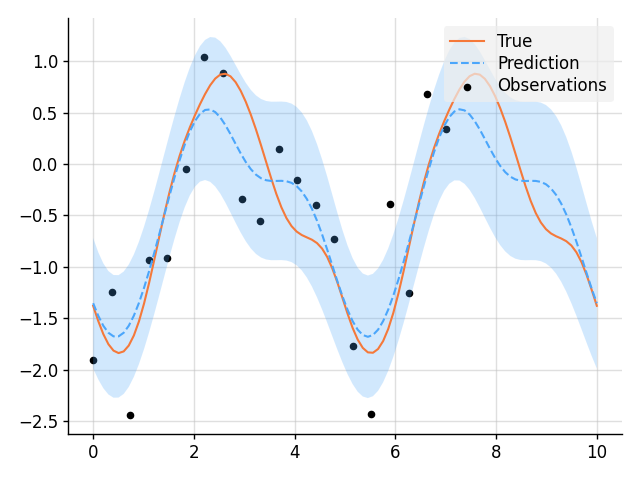
```python
import matplotlib.pyplot as plt
from wbml.plot import tweak
from stheno import B, GP, EQ
# Define points to predict at.
x = B.linspace(0, 10, 100)
x_obs = B.linspace(0, 7, 20)
# Construct a prior.
f = GP(EQ().periodic(5.0))
# Sample a true, underlying function and noisy observations.
f_true, y_obs = f.measure.sample(f(x), f(x_obs, 0.5))
# Now condition on the observations to make predictions.
f_post = f | (f(x_obs, 0.5), y_obs)
mean, lower, upper = f_post(x).marginal_credible_bounds()
# Plot result.
plt.plot(x, f_true, label="True", style="test")
plt.scatter(x_obs, y_obs, label="Observations", style="train", s=20)
plt.plot(x, mean, label="Prediction", style="pred")
plt.fill_between(x, lower, upper, style="pred")
tweak()
plt.savefig("readme_example1_simple_regression.png")
plt.show()
```
### Hyperparameter Optimisation with Varz
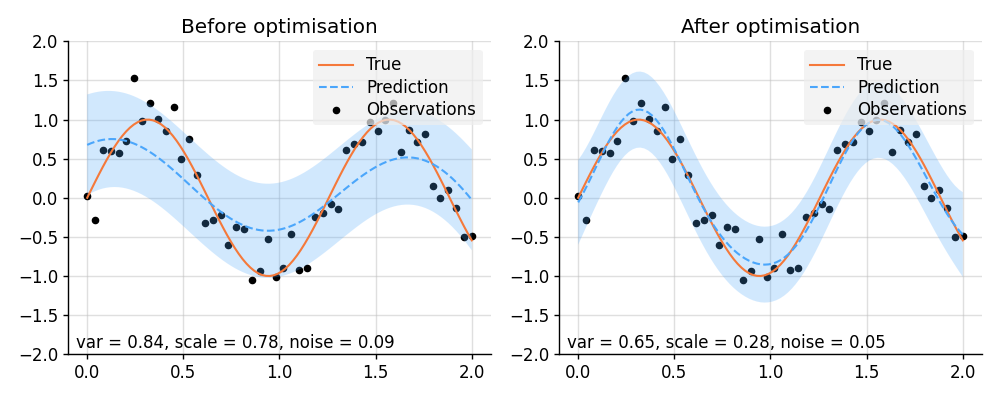
```python
import lab as B
import matplotlib.pyplot as plt
import torch
from varz import Vars, minimise_l_bfgs_b, parametrised, Positive
from wbml.plot import tweak
from stheno.torch import EQ, GP
# Increase regularisation because PyTorch defaults to 32-bit floats.
B.epsilon = 1e-6
# Define points to predict at.
x = torch.linspace(0, 2, 100)
x_obs = torch.linspace(0, 2, 50)
# Sample a true, underlying function and observations with observation noise `0.05`.
f_true = torch.sin(5 * x)
y_obs = torch.sin(5 * x_obs) + 0.05**0.5 * torch.randn(50)
def model(vs):
"""Construct a model with learnable parameters."""
p = vs.struct # Varz handles positivity (and other) constraints.
kernel = p.variance.positive() * EQ().stretch(p.scale.positive())
return GP(kernel), p.noise.positive()
@parametrised
def model_alternative(vs, scale: Positive, variance: Positive, noise: Positive):
"""Equivalent to :func:`model`, but with `@parametrised`."""
kernel = variance * EQ().stretch(scale)
return GP(kernel), noise
vs = Vars(torch.float32)
f, noise = model(vs)
# Condition on observations and make predictions before optimisation.
f_post = f | (f(x_obs, noise), y_obs)
prior_before = f, noise
pred_before = f_post(x, noise).marginal_credible_bounds()
def objective(vs):
f, noise = model(vs)
evidence = f(x_obs, noise).logpdf(y_obs)
return -evidence
# Learn hyperparameters.
minimise_l_bfgs_b(objective, vs)
f, noise = model(vs)
# Condition on observations and make predictions after optimisation.
f_post = f | (f(x_obs, noise), y_obs)
prior_after = f, noise
pred_after = f_post(x, noise).marginal_credible_bounds()
def plot_prediction(prior, pred):
f, noise = prior
mean, lower, upper = pred
plt.scatter(x_obs, y_obs, label="Observations", style="train", s=20)
plt.plot(x, f_true, label="True", style="test")
plt.plot(x, mean, label="Prediction", style="pred")
plt.fill_between(x, lower, upper, style="pred")
plt.ylim(-2, 2)
plt.text(
0.02,
0.02,
f"var = {f.kernel.factor(0):.2f}, "
f"scale = {f.kernel.factor(1).stretches[0]:.2f}, "
f"noise = {noise:.2f}",
transform=plt.gca().transAxes,
)
tweak()
# Plot result.
plt.figure(figsize=(10, 4))
plt.subplot(1, 2, 1)
plt.title("Before optimisation")
plot_prediction(prior_before, pred_before)
plt.subplot(1, 2, 2)
plt.title("After optimisation")
plot_prediction(prior_after, pred_after)
plt.savefig("readme_example12_optimisation_varz.png")
plt.show()
```
### Hyperparameter Optimisation with PyTorch
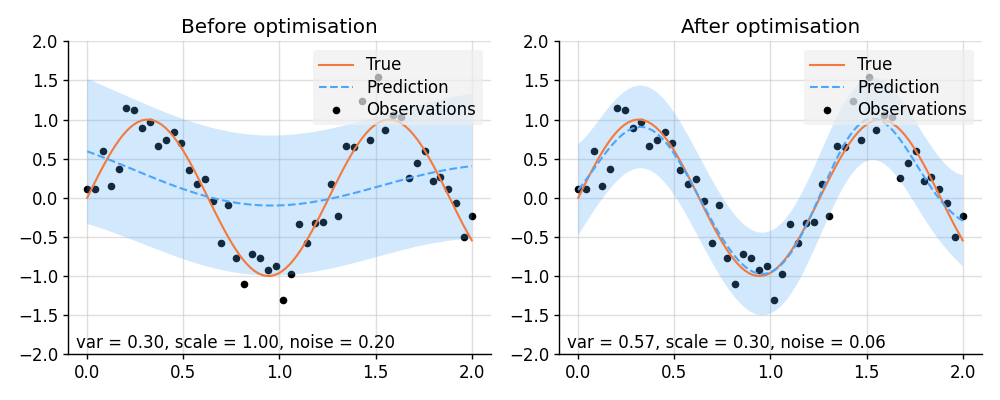
```python
import lab as B
import matplotlib.pyplot as plt
import torch
from wbml.plot import tweak
from stheno.torch import EQ, GP
# Increase regularisation because PyTorch defaults to 32-bit floats.
B.epsilon = 1e-6
# Define points to predict at.
x = torch.linspace(0, 2, 100)
x_obs = torch.linspace(0, 2, 50)
# Sample a true, underlying function and observations with observation noise `0.05`.
f_true = torch.sin(5 * x)
y_obs = torch.sin(5 * x_obs) + 0.05**0.5 * torch.randn(50)
class Model(torch.nn.Module):
"""A GP model with learnable parameters."""
def __init__(self, init_var=0.3, init_scale=1, init_noise=0.2):
super().__init__()
# Ensure that the parameters are positive and make them learnable.
self.log_var = torch.nn.Parameter(torch.log(torch.tensor(init_var)))
self.log_scale = torch.nn.Parameter(torch.log(torch.tensor(init_scale)))
self.log_noise = torch.nn.Parameter(torch.log(torch.tensor(init_noise)))
def construct(self):
self.var = torch.exp(self.log_var)
self.scale = torch.exp(self.log_scale)
self.noise = torch.exp(self.log_noise)
kernel = self.var * EQ().stretch(self.scale)
return GP(kernel), self.noise
model = Model()
f, noise = model.construct()
# Condition on observations and make predictions before optimisation.
f_post = f | (f(x_obs, noise), y_obs)
prior_before = f, noise
pred_before = f_post(x, noise).marginal_credible_bounds()
# Perform optimisation.
opt = torch.optim.Adam(model.parameters(), lr=5e-2)
for _ in range(1000):
opt.zero_grad()
f, noise = model.construct()
loss = -f(x_obs, noise).logpdf(y_obs)
loss.backward()
opt.step()
f, noise = model.construct()
# Condition on observations and make predictions after optimisation.
f_post = f | (f(x_obs, noise), y_obs)
prior_after = f, noise
pred_after = f_post(x, noise).marginal_credible_bounds()
def plot_prediction(prior, pred):
f, noise = prior
mean, lower, upper = pred
plt.scatter(x_obs, y_obs, label="Observations", style="train", s=20)
plt.plot(x, f_true, label="True", style="test")
plt.plot(x, mean, label="Prediction", style="pred")
plt.fill_between(x, lower, upper, style="pred")
plt.ylim(-2, 2)
plt.text(
0.02,
0.02,
f"var = {f.kernel.factor(0):.2f}, "
f"scale = {f.kernel.factor(1).stretches[0]:.2f}, "
f"noise = {noise:.2f}",
transform=plt.gca().transAxes,
)
tweak()
# Plot result.
plt.figure(figsize=(10, 4))
plt.subplot(1, 2, 1)
plt.title("Before optimisation")
plot_prediction(prior_before, pred_before)
plt.subplot(1, 2, 2)
plt.title("After optimisation")
plot_prediction(prior_after, pred_after)
plt.savefig("readme_example13_optimisation_torch.png")
plt.show()
```
### Decomposition of Prediction
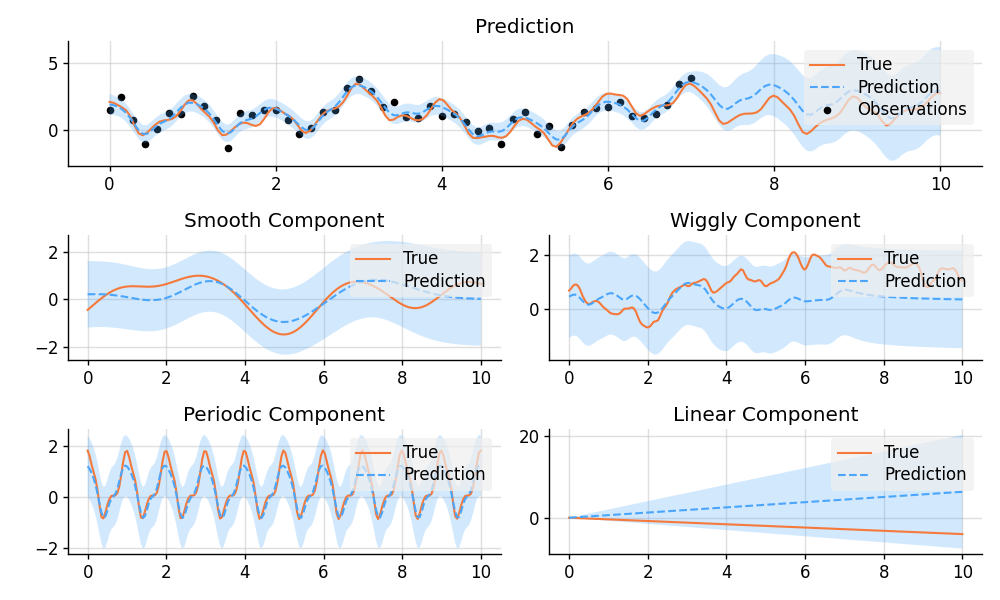
```python
import matplotlib.pyplot as plt
from wbml.plot import tweak
from stheno import Measure, GP, EQ, RQ, Linear, Delta, Exp, B
B.epsilon = 1e-10
# Define points to predict at.
x = B.linspace(0, 10, 200)
x_obs = B.linspace(0, 7, 50)
with Measure() as prior:
# Construct a latent function consisting of four different components.
f_smooth = GP(EQ())
f_wiggly = GP(RQ(1e-1).stretch(0.5))
f_periodic = GP(EQ().periodic(1.0))
f_linear = GP(Linear())
f = f_smooth + f_wiggly + f_periodic + 0.2 * f_linear
# Let the observation noise consist of a bit of exponential noise.
e_indep = GP(Delta())
e_exp = GP(Exp())
e = e_indep + 0.3 * e_exp
# Sum the latent function and observation noise to get a model for the observations.
y = f + 0.5 * e
# Sample a true, underlying function and observations.
(
f_true_smooth,
f_true_wiggly,
f_true_periodic,
f_true_linear,
f_true,
y_obs,
) = prior.sample(f_smooth(x), f_wiggly(x), f_periodic(x), f_linear(x), f(x), y(x_obs))
# Now condition on the observations and make predictions for the latent function and
# its various components.
post = prior | (y(x_obs), y_obs)
pred_smooth = post(f_smooth(x))
pred_wiggly = post(f_wiggly(x))
pred_periodic = post(f_periodic(x))
pred_linear = post(f_linear(x))
pred_f = post(f(x))
# Plot results.
def plot_prediction(x, f, pred, x_obs=None, y_obs=None):
plt.plot(x, f, label="True", style="test")
if x_obs is not None:
plt.scatter(x_obs, y_obs, label="Observations", style="train", s=20)
mean, lower, upper = pred.marginal_credible_bounds()
plt.plot(x, mean, label="Prediction", style="pred")
plt.fill_between(x, lower, upper, style="pred")
tweak()
plt.figure(figsize=(10, 6))
plt.subplot(3, 1, 1)
plt.title("Prediction")
plot_prediction(x, f_true, pred_f, x_obs, y_obs)
plt.subplot(3, 2, 3)
plt.title("Smooth Component")
plot_prediction(x, f_true_smooth, pred_smooth)
plt.subplot(3, 2, 4)
plt.title("Wiggly Component")
plot_prediction(x, f_true_wiggly, pred_wiggly)
plt.subplot(3, 2, 5)
plt.title("Periodic Component")
plot_prediction(x, f_true_periodic, pred_periodic)
plt.subplot(3, 2, 6)
plt.title("Linear Component")
plot_prediction(x, f_true_linear, pred_linear)
plt.savefig("readme_example2_decomposition.png")
plt.show()
```
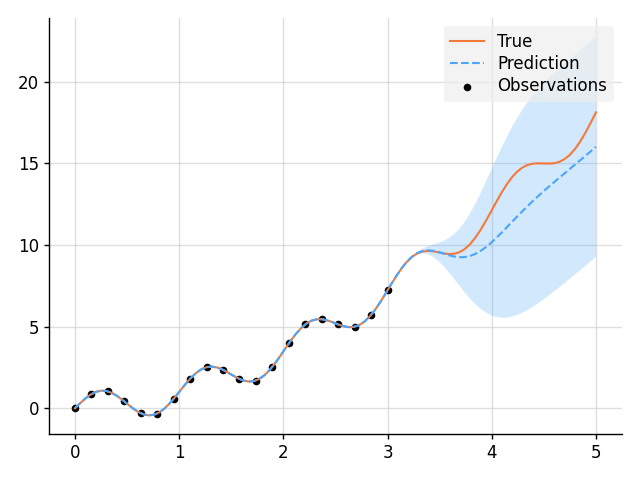
### Learn a Function, Incorporating Prior Knowledge About Its Form
```python
import matplotlib.pyplot as plt
import tensorflow as tf
import wbml.out as out
from varz.spec import parametrised, Positive
from varz.tensorflow import Vars, minimise_l_bfgs_b
from wbml.plot import tweak
from stheno.tensorflow import B, Measure, GP, EQ, Delta
# Define points to predict at.
x = B.linspace(tf.float64, 0, 5, 100)
x_obs = B.linspace(tf.float64, 0, 3, 20)
@parametrised
def model(
vs,
u_var: Positive = 0.5,
u_scale: Positive = 0.5,
noise: Positive = 0.5,
alpha: Positive = 1.2,
):
with Measure():
# Random fluctuation:
u = GP(u_var * EQ().stretch(u_scale))
# Construct model.
f = u + (lambda x: x**alpha)
return f, noise
# Sample a true, underlying function and observations.
vs = Vars(tf.float64)
f_true = x**1.8 + B.sin(2 * B.pi * x)
f, y = model(vs)
post = f.measure | (f(x), f_true)
y_obs = post(f(x_obs)).sample()
def objective(vs):
f, noise = model(vs)
evidence = f(x_obs, noise).logpdf(y_obs)
return -evidence
# Learn hyperparameters.
minimise_l_bfgs_b(objective, vs, jit=True)
f, noise = model(vs)
# Print the learned parameters.
out.kv("Prior", f.display(out.format))
vs.print()
# Condition on the observations to make predictions.
f_post = f | (f(x_obs, noise), y_obs)
mean, lower, upper = f_post(x).marginal_credible_bounds()
# Plot result.
plt.plot(x, B.squeeze(f_true), label="True", style="test")
plt.scatter(x_obs, B.squeeze(y_obs), label="Observations", style="train", s=20)
plt.plot(x, mean, label="Prediction", style="pred")
plt.fill_between(x, lower, upper, style="pred")
tweak()
plt.savefig("readme_example3_parametric.png")
plt.show()
```
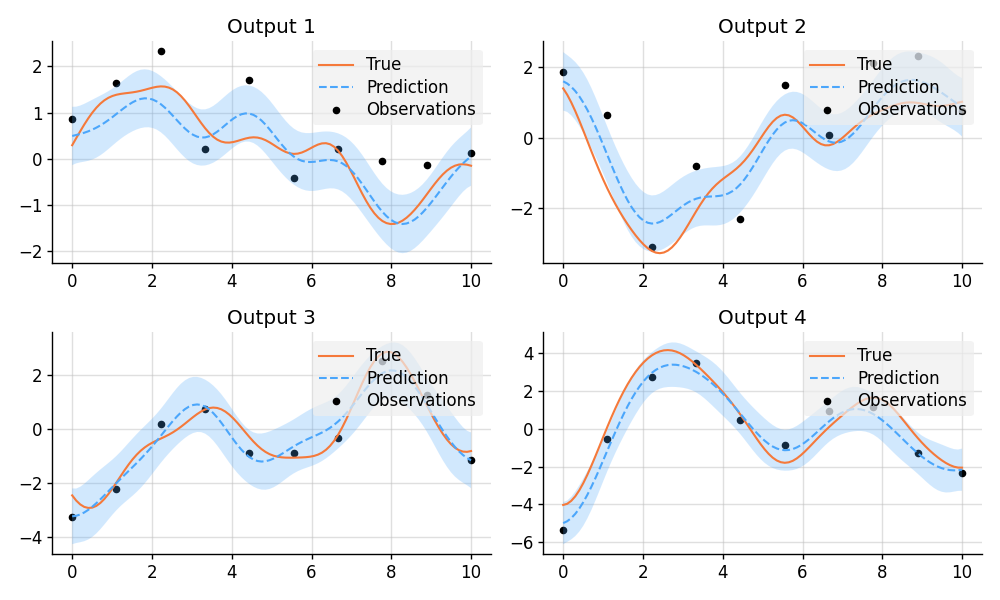
### Multi-Output Regression
```python
import matplotlib.pyplot as plt
from wbml.plot import tweak
from stheno import B, Measure, GP, EQ, Delta
class VGP:
"""A vector-valued GP."""
def __init__(self, ps):
self.ps = ps
def __add__(self, other):
return VGP([f + g for f, g in zip(self.ps, other.ps)])
def lmatmul(self, A):
m, n = A.shape
ps = [0 for _ in range(m)]
for i in range(m):
for j in range(n):
ps[i] += A[i, j] * self.ps[j]
return VGP(ps)
# Define points to predict at.
x = B.linspace(0, 10, 100)
x_obs = B.linspace(0, 10, 10)
# Model parameters:
m = 2
p = 4
H = B.randn(p, m)
with Measure() as prior:
# Construct latent functions.
us = VGP([GP(EQ()) for _ in range(m)])
# Construct multi-output prior.
fs = us.lmatmul(H)
# Construct noise.
e = VGP([GP(0.5 * Delta()) for _ in range(p)])
# Construct observation model.
ys = e + fs
# Sample a true, underlying function and observations.
samples = prior.sample(*(p(x) for p in fs.ps), *(p(x_obs) for p in ys.ps))
fs_true, ys_obs = samples[:p], samples[p:]
# Compute the posterior and make predictions.
post = prior.condition(*((p(x_obs), y_obs) for p, y_obs in zip(ys.ps, ys_obs)))
preds = [post(p(x)) for p in fs.ps]
# Plot results.
def plot_prediction(x, f, pred, x_obs=None, y_obs=None):
plt.plot(x, f, label="True", style="test")
if x_obs is not None:
plt.scatter(x_obs, y_obs, label="Observations", style="train", s=20)
mean, lower, upper = pred.marginal_credible_bounds()
plt.plot(x, mean, label="Prediction", style="pred")
plt.fill_between(x, lower, upper, style="pred")
tweak()
plt.figure(figsize=(10, 6))
for i in range(4):
plt.subplot(2, 2, i + 1)
plt.title(f"Output {i + 1}")
plot_prediction(x, fs_true[i], preds[i], x_obs, ys_obs[i])
plt.savefig("readme_example4_multi-output.png")
plt.show()
```
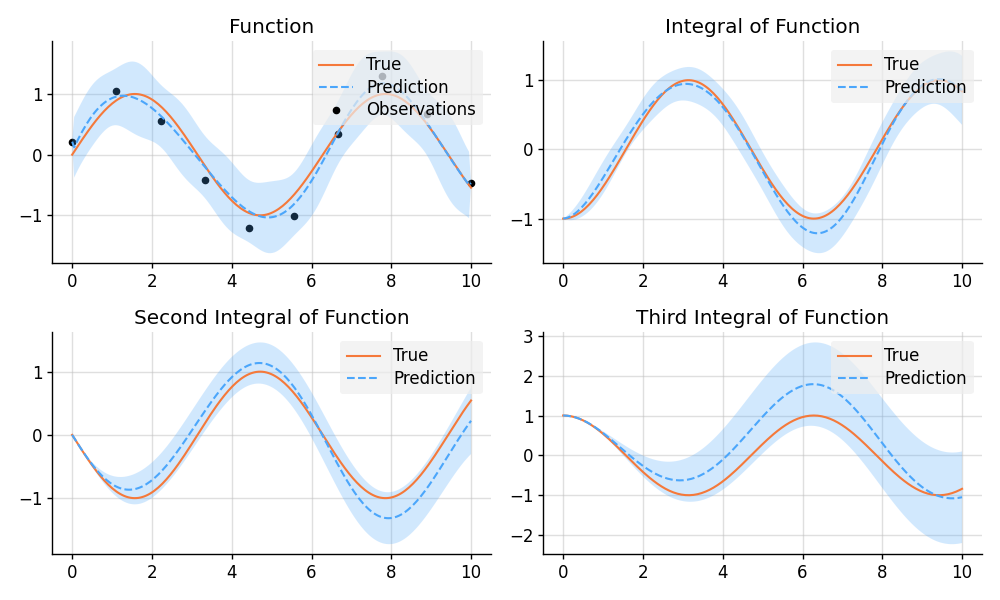
### Approximate Integration
```python
import matplotlib.pyplot as plt
import numpy as np
import tensorflow as tf
import wbml.plot
from stheno.tensorflow import B, Measure, GP, EQ, Delta
# Define points to predict at.
x = B.linspace(tf.float64, 0, 10, 200)
x_obs = B.linspace(tf.float64, 0, 10, 10)
with Measure() as prior:
# Construct a model.
f = 0.7 * GP(EQ()).stretch(1.5)
e = 0.2 * GP(Delta())
# Construct derivatives.
df = f.diff()
ddf = df.diff()
dddf = ddf.diff() + e
# Fix the integration constants.
zero = B.cast(tf.float64, 0)
one = B.cast(tf.float64, 1)
prior = prior | ((f(zero), one), (df(zero), zero), (ddf(zero), -one))
# Sample observations.
y_obs = B.sin(x_obs) + 0.2 * B.randn(*x_obs.shape)
# Condition on the observations to make predictions.
post = prior | (dddf(x_obs), y_obs)
# And make predictions.
pred_iiif = post(f)(x)
pred_iif = post(df)(x)
pred_if = post(ddf)(x)
pred_f = post(dddf)(x)
# Plot result.
def plot_prediction(x, f, pred, x_obs=None, y_obs=None):
plt.plot(x, f, label="True", style="test")
if x_obs is not None:
plt.scatter(x_obs, y_obs, label="Observations", style="train", s=20)
mean, lower, upper = pred.marginal_credible_bounds()
plt.plot(x, mean, label="Prediction", style="pred")
plt.fill_between(x, lower, upper, style="pred")
wbml.plot.tweak()
plt.figure(figsize=(10, 6))
plt.subplot(2, 2, 1)
plt.title("Function")
plot_prediction(x, np.sin(x), pred_f, x_obs=x_obs, y_obs=y_obs)
plt.subplot(2, 2, 2)
plt.title("Integral of Function")
plot_prediction(x, -np.cos(x), pred_if)
plt.subplot(2, 2, 3)
plt.title("Second Integral of Function")
plot_prediction(x, -np.sin(x), pred_iif)
plt.subplot(2, 2, 4)
plt.title("Third Integral of Function")
plot_prediction(x, np.cos(x), pred_iiif)
plt.savefig("readme_example5_integration.png")
plt.show()
```
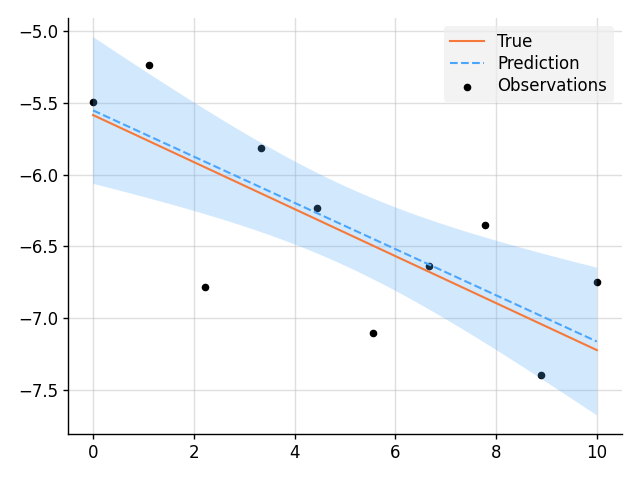
### Bayesian Linear Regression
```python
import matplotlib.pyplot as plt
import wbml.out as out
from wbml.plot import tweak
from stheno import B, Measure, GP
B.epsilon = 1e-10 # Very slightly regularise.
# Define points to predict at.
x = B.linspace(0, 10, 200)
x_obs = B.linspace(0, 10, 10)
with Measure() as prior:
# Construct a linear model.
slope = GP(1)
intercept = GP(5)
f = slope * (lambda x: x) + intercept
# Sample a slope, intercept, underlying function, and observations.
true_slope, true_intercept, f_true, y_obs = prior.sample(
slope(0), intercept(0), f(x), f(x_obs, 0.2)
)
# Condition on the observations to make predictions.
post = prior | (f(x_obs, 0.2), y_obs)
mean, lower, upper = post(f(x)).marginal_credible_bounds()
out.kv("True slope", true_slope[0, 0])
out.kv("Predicted slope", post(slope(0)).mean[0, 0])
out.kv("True intercept", true_intercept[0, 0])
out.kv("Predicted intercept", post(intercept(0)).mean[0, 0])
# Plot result.
plt.plot(x, f_true, label="True", style="test")
plt.scatter(x_obs, y_obs, label="Observations", style="train", s=20)
plt.plot(x, mean, label="Prediction", style="pred")
plt.fill_between(x, lower, upper, style="pred")
tweak()
plt.savefig("readme_example6_blr.png")
plt.show()
```
### GPAR
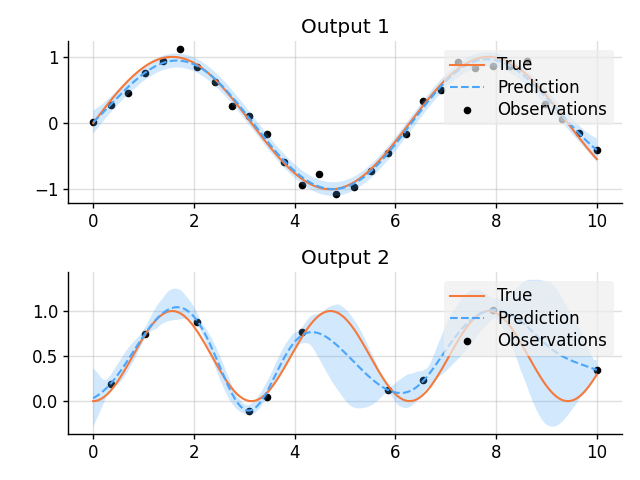
```python
import matplotlib.pyplot as plt
import numpy as np
import tensorflow as tf
from varz.spec import parametrised, Positive
from varz.tensorflow import Vars, minimise_l_bfgs_b
from wbml.plot import tweak
from stheno.tensorflow import B, GP, EQ
# Define points to predict at.
x = B.linspace(tf.float64, 0, 10, 200)
x_obs1 = B.linspace(tf.float64, 0, 10, 30)
inds2 = np.random.permutation(len(x_obs1))[:10]
x_obs2 = B.take(x_obs1, inds2)
# Construction functions to predict and observations.
f1_true = B.sin(x)
f2_true = B.sin(x) ** 2
y1_obs = B.sin(x_obs1) + 0.1 * B.randn(*x_obs1.shape)
y2_obs = B.sin(x_obs2) ** 2 + 0.1 * B.randn(*x_obs2.shape)
@parametrised
def model(
vs,
var1: Positive = 1,
scale1: Positive = 1,
noise1: Positive = 0.1,
var2: Positive = 1,
scale2: Positive = 1,
noise2: Positive = 0.1,
):
# Build layers:
f1 = GP(var1 * EQ().stretch(scale1))
f2 = GP(var2 * EQ().stretch(scale2))
return (f1, noise1), (f2, noise2)
def objective(vs):
(f1, noise1), (f2, noise2) = model(vs)
x1 = x_obs1
x2 = B.stack(x_obs2, B.take(y1_obs, inds2), axis=1)
evidence = f1(x1, noise1).logpdf(y1_obs) + f2(x2, noise2).logpdf(y2_obs)
return -evidence
# Learn hyperparameters.
vs = Vars(tf.float64)
minimise_l_bfgs_b(objective, vs)
# Compute posteriors.
(f1, noise1), (f2, noise2) = model(vs)
x1 = x_obs1
x2 = B.stack(x_obs2, B.take(y1_obs, inds2), axis=1)
f1_post = f1 | (f1(x1, noise1), y1_obs)
f2_post = f2 | (f2(x2, noise2), y2_obs)
# Predict first output.
mean1, lower1, upper1 = f1_post(x).marginal_credible_bounds()
# Predict second output with Monte Carlo.
samples = [
f2_post(B.stack(x, f1_post(x).sample()[:, 0], axis=1)).sample()[:, 0]
for _ in range(100)
]
mean2 = np.mean(samples, axis=0)
lower2 = np.percentile(samples, 2.5, axis=0)
upper2 = np.percentile(samples, 100 - 2.5, axis=0)
# Plot result.
plt.figure()
plt.subplot(2, 1, 1)
plt.title("Output 1")
plt.plot(x, f1_true, label="True", style="test")
plt.scatter(x_obs1, y1_obs, label="Observations", style="train", s=20)
plt.plot(x, mean1, label="Prediction", style="pred")
plt.fill_between(x, lower1, upper1, style="pred")
tweak()
plt.subplot(2, 1, 2)
plt.title("Output 2")
plt.plot(x, f2_true, label="True", style="test")
plt.scatter(x_obs2, y2_obs, label="Observations", style="train", s=20)
plt.plot(x, mean2, label="Prediction", style="pred")
plt.fill_between(x, lower2, upper2, style="pred")
tweak()
plt.savefig("readme_example7_gpar.png")
plt.show()
```
### A GP-RNN Model
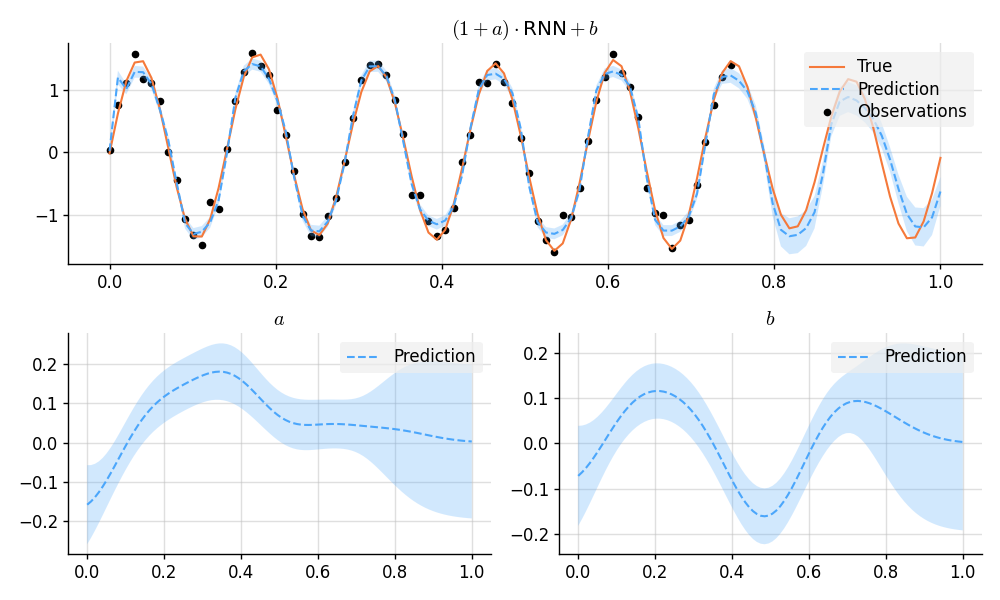
```python
import matplotlib.pyplot as plt
import numpy as np
import tensorflow as tf
from varz.spec import parametrised, Positive
from varz.tensorflow import Vars, minimise_adam
from wbml.net import rnn as rnn_constructor
from wbml.plot import tweak
from stheno.tensorflow import B, Measure, GP, EQ
# Increase regularisation because we are dealing with `tf.float32`s.
B.epsilon = 1e-6
# Construct points which to predict at.
x = B.linspace(tf.float32, 0, 1, 100)[:, None]
inds_obs = B.range(0, int(0.75 * len(x))) # Train on the first 75% only.
x_obs = B.take(x, inds_obs)
# Construct function and observations.
# Draw random modulation functions.
a_true = GP(1e-2 * EQ().stretch(0.1))(x).sample()
b_true = GP(1e-2 * EQ().stretch(0.1))(x).sample()
# Construct the true, underlying function.
f_true = (1 + a_true) * B.sin(2 * np.pi * 7 * x) + b_true
# Add noise.
y_true = f_true + 0.1 * B.randn(*f_true.shape)
# Normalise and split.
f_true = (f_true - B.mean(y_true)) / B.std(y_true)
y_true = (y_true - B.mean(y_true)) / B.std(y_true)
y_obs = B.take(y_true, inds_obs)
@parametrised
def model(vs, a_scale: Positive = 0.1, b_scale: Positive = 0.1, noise: Positive = 0.01):
# Construct an RNN.
f_rnn = rnn_constructor(
output_size=1, widths=(10,), nonlinearity=B.tanh, final_dense=True
)
# Set the weights for the RNN.
num_weights = f_rnn.num_weights(input_size=1)
weights = Vars(tf.float32, source=vs.get(shape=(num_weights,), name="rnn"))
f_rnn.initialise(input_size=1, vs=weights)
with Measure():
# Construct GPs that modulate the RNN.
a = GP(1e-2 * EQ().stretch(a_scale))
b = GP(1e-2 * EQ().stretch(b_scale))
# GP-RNN model:
f_gp_rnn = (1 + a) * (lambda x: f_rnn(x)) + b
return f_rnn, f_gp_rnn, noise, a, b
def objective_rnn(vs):
f_rnn, _, _, _, _ = model(vs)
return B.mean((f_rnn(x_obs) - y_obs) ** 2)
def objective_gp_rnn(vs):
_, f_gp_rnn, noise, _, _ = model(vs)
evidence = f_gp_rnn(x_obs, noise).logpdf(y_obs)
return -evidence
# Pretrain the RNN.
vs = Vars(tf.float32)
minimise_adam(objective_rnn, vs, rate=5e-3, iters=1000, trace=True, jit=True)
# Jointly train the RNN and GPs.
minimise_adam(objective_gp_rnn, vs, rate=1e-3, iters=1000, trace=True, jit=True)
_, f_gp_rnn, noise, a, b = model(vs)
# Condition.
post = f_gp_rnn.measure | (f_gp_rnn(x_obs, noise), y_obs)
# Predict and plot results.
plt.figure(figsize=(10, 6))
plt.subplot(2, 1, 1)
plt.title("$(1 + a)\\cdot {}$RNN${} + b$")
plt.plot(x, f_true, label="True", style="test")
plt.scatter(x_obs, y_obs, label="Observations", style="train", s=20)
mean, lower, upper = post(f_gp_rnn(x)).marginal_credible_bounds()
plt.plot(x, mean, label="Prediction", style="pred")
plt.fill_between(x, lower, upper, style="pred")
tweak()
plt.subplot(2, 2, 3)
plt.title("$a$")
mean, lower, upper = post(a(x)).marginal_credible_bounds()
plt.plot(x, mean, label="Prediction", style="pred")
plt.fill_between(x, lower, upper, style="pred")
tweak()
plt.subplot(2, 2, 4)
plt.title("$b$")
mean, lower, upper = post(b(x)).marginal_credible_bounds()
plt.plot(x, mean, label="Prediction", style="pred")
plt.fill_between(x, lower, upper, style="pred")
tweak()
plt.savefig(f"readme_example8_gp-rnn.png")
plt.show()
```
### Approximate Multiplication Between GPs
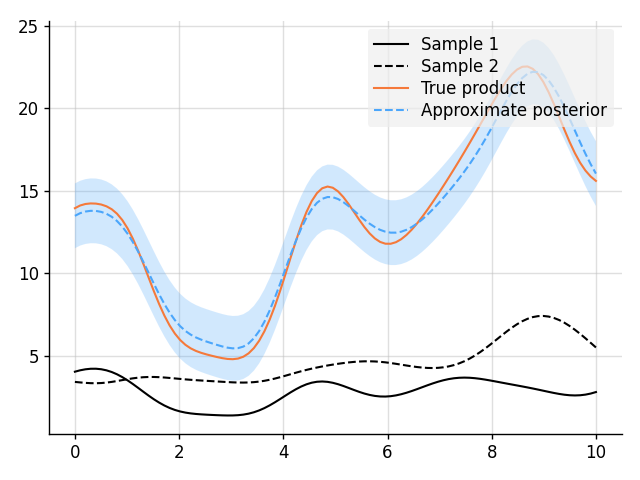
```python
import matplotlib.pyplot as plt
from wbml.plot import tweak
from stheno import B, Measure, GP, EQ
# Define points to predict at.
x = B.linspace(0, 10, 100)
with Measure() as prior:
f1 = GP(3, EQ())
f2 = GP(3, EQ())
# Compute the approximate product.
f_prod = f1 * f2
# Sample two functions.
s1, s2 = prior.sample(f1(x), f2(x))
# Predict.
f_prod_post = f_prod | ((f1(x), s1), (f2(x), s2))
mean, lower, upper = f_prod_post(x).marginal_credible_bounds()
# Plot result.
plt.plot(x, s1, label="Sample 1", style="train")
plt.plot(x, s2, label="Sample 2", style="train", ls="--")
plt.plot(x, s1 * s2, label="True product", style="test")
plt.plot(x, mean, label="Approximate posterior", style="pred")
plt.fill_between(x, lower, upper, style="pred")
tweak()
plt.savefig("readme_example9_product.png")
plt.show()
```
### Sparse Regression
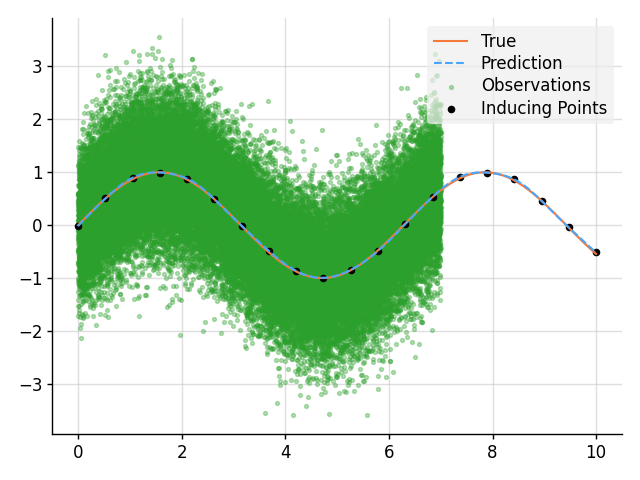
```python
import matplotlib.pyplot as plt
import wbml.out as out
from wbml.plot import tweak
from stheno import B, GP, EQ, PseudoObs
# Define points to predict at.
x = B.linspace(0, 10, 100)
x_obs = B.linspace(0, 7, 50_000)
x_ind = B.linspace(0, 10, 20)
# Construct a prior.
f = GP(EQ().periodic(2 * B.pi))
# Sample a true, underlying function and observations.
f_true = B.sin(x)
y_obs = B.sin(x_obs) + B.sqrt(0.5) * B.randn(*x_obs.shape)
# Compute a pseudo-point approximation of the posterior.
obs = PseudoObs(f(x_ind), (f(x_obs, 0.5), y_obs))
# Compute the ELBO.
out.kv("ELBO", obs.elbo(f.measure))
# Compute the approximate posterior.
f_post = f | obs
# Make predictions with the approximate posterior.
mean, lower, upper = f_post(x).marginal_credible_bounds()
# Plot result.
plt.plot(x, f_true, label="True", style="test")
plt.scatter(
x_obs,
y_obs,
label="Observations",
style="train",
c="tab:green",
alpha=0.35,
)
plt.scatter(
x_ind,
obs.mu(f.measure)[:, 0],
label="Inducing Points",
style="train",
s=20,
)
plt.plot(x, mean, label="Prediction", style="pred")
plt.fill_between(x, lower, upper, style="pred")
tweak()
plt.savefig("readme_example10_sparse.png")
plt.show()
```
### Smoothing with Nonparametric Basis Functions
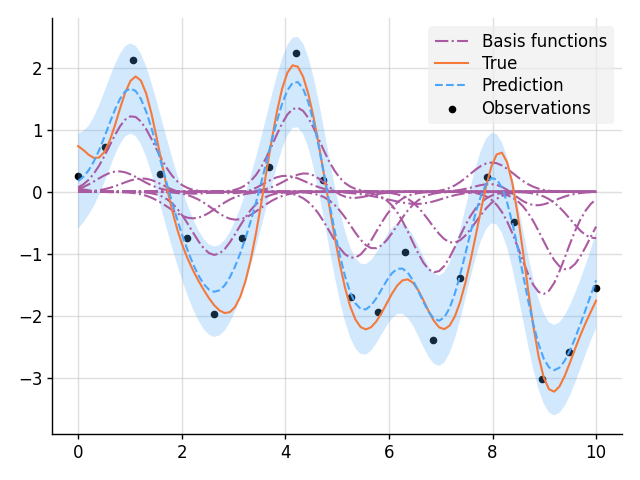
```python
import matplotlib.pyplot as plt
from wbml.plot import tweak
from stheno import B, Measure, GP, EQ
# Define points to predict at.
x = B.linspace(0, 10, 100)
x_obs = B.linspace(0, 10, 20)
with Measure() as prior:
w = lambda x: B.exp(-(x**2) / 0.5) # Basis function
b = [(w * GP(EQ())).shift(xi) for xi in x_obs] # Weighted basis functions
f = sum(b)
# Sample a true, underlying function and observations.
f_true, y_obs = prior.sample(f(x), f(x_obs, 0.2))
# Condition on the observations to make predictions.
post = prior | (f(x_obs, 0.2), y_obs)
# Plot result.
for i, bi in enumerate(b):
mean, lower, upper = post(bi(x)).marginal_credible_bounds()
kw_args = {"label": "Basis functions"} if i == 0 else {}
plt.plot(x, mean, style="pred2", **kw_args)
plt.plot(x, f_true, label="True", style="test")
plt.scatter(x_obs, y_obs, label="Observations", style="train", s=20)
mean, lower, upper = post(f(x)).marginal_credible_bounds()
plt.plot(x, mean, label="Prediction", style="pred")
plt.fill_between(x, lower, upper, style="pred")
tweak()
plt.savefig("readme_example11_nonparametric_basis.png")
plt.show()
```