https://github.com/windmill-labs/windmill
Open-source developer platform to power your entire infra and turn scripts into webhooks, workflows and UIs. Fastest workflow engine (13x vs Airflow). Open-source alternative to Retool and Temporal.
https://github.com/windmill-labs/windmill
low-code open-source platform postgresql python self-hostable typescript
Last synced: 2 months ago
JSON representation
Open-source developer platform to power your entire infra and turn scripts into webhooks, workflows and UIs. Fastest workflow engine (13x vs Airflow). Open-source alternative to Retool and Temporal.
- Host: GitHub
- URL: https://github.com/windmill-labs/windmill
- Owner: windmill-labs
- License: other
- Created: 2022-05-05T02:21:17.000Z (over 4 years ago)
- Default Branch: main
- Last Pushed: 2026-06-04T08:57:27.000Z (2 months ago)
- Last Synced: 2026-06-04T09:07:01.133Z (2 months ago)
- Topics: low-code, open-source, platform, postgresql, python, self-hostable, typescript
- Language: HTML
- Homepage: https://windmill.dev
- Size: 407 MB
- Stars: 16,647
- Watchers: 52
- Forks: 978
- Open Issues: 737
-
Metadata Files:
- Readme: README.md
- Changelog: CHANGELOG.md
- Funding: .github/FUNDING.yml
- License: LICENSE
- Codeowners: .github/CODEOWNERS
- Notice: NOTICE
- Agents: AGENTS.md
- Cla: CLA.md
Awesome Lists containing this project
- awesome-tools - windmill-labs/windmill - Open-source developer platform to turn scripts into workflows and UIs. Fastest workflow engine (5x vs Airflow). Open-source alternative to Airplane and Retool. (Workflow Automation / Packages)
- awesome-llm-services - Windmill
- awesome-soft - Windmill
- awesome_ai_agents - Windmill - Open-source developer platform to power your entire infra and turn scripts into webhooks, workflows and UIs. Fastest workflow engine (13x… (Building / Workflows)
- awesome - windmill-labs/windmill - Open-source developer platform to power your entire infra and turn scripts into webhooks, workflows and UIs. Fastest workflow engine (13x vs Airflow). Open-source alternative to Retool and Temporal. (Rust)
- awesome - windmill-labs/windmill - Open-source developer platform to power your entire infra and turn scripts into webhooks, workflows and UIs. Fastest workflow engine (13x vs Airflow). Open-source alternative to Retool and Temporal. (Rust)
- awesome-starred - windmill-labs/windmill - Open-source developer platform to turn scripts into workflows and UIs. Open-source alternative to Airplane and Retool. (open-source)
- awesome-business-intelligence - Windmill
- jimsghstars - windmill-labs/windmill - Open-source developer platform to power your entire infra and turn scripts into webhooks, workflows and UIs. Fastest workflow engine (13x vs Airflow). Open-source alternative to Retool and Temporal. (HTML)
- awesome-github-projects - windmill - Open-source developer platform to power your entire infra and turn scripts into webhooks, workflows and UIs. Fastest workflow engine (13x vs Airflow). Open-source alternative to Retool and Temporal. ⭐17,272 `Rust` 🔥 (⚙️ Backend & APIs)
- awesome-fullstack - Windmill - source developer platform to turn scripts into workflows and UIs. Open-source alternative to Airplane and Retool. (Data Science and Engineering)
- awesome-integration - Windmill (⭐17k) - Open-source developer platform that turns scripts in Python, TypeScript, Go, and more into workflows, internal UIs, and scheduled jobs. (Projects / Workflow Engine)
- awesome-ai-lead-generation - Windmill - Open-source workflow engine. Scripts in Python/TypeScript/Go with UI builder. `Rust/TypeScript` `Free` (Workflow Automation)
- awesome-open-source-alternatives - windmill-labs/windmill - labs/windmill?style=flat) | Developer platform for scripts and workflows | Retool, Airplane | (Developer Tools)
- awesome-agent-frameworks - Windmill - labs/windmill?style=social) - Open-source developer platform for turning scripts into APIs, background jobs, workflows, and internal UIs across multiple languages. (Tool / protocol / connector layer)
- my-awesome - windmill-labs/windmill - code,open-source,platform,postgresql,python,self-hostable,typescript pushed_at:2026-08 star:17.4k fork:1.1k Open-source developer platform to power your entire infra and turn scripts into webhooks, workflows and UIs. Fastest workflow engine (13x vs Airflow). Open-source alternative to Retool and Temporal. (Rust)
- awesome-github-repos - windmill-labs/windmill - Open-source developer platform to power your entire infra and turn scripts into webhooks, workflows and UIs. Fastest workflow engine (13x vs Airflow). Open-source alternative to Retool and Temporal. (Rust)
README

Open-source developer platform for internal code: APIs, background jobs, workflows and UIs. Self-hostable alternative to Retool, Pipedream, Superblocks and a simplified Temporal with autogenerated UIs and custom UIs to trigger workflows and scripts as internal apps.
Scripts are turned into sharable UIs automatically, and can be composed together into flows or used into richer apps built with low-code. Supported languages: Python, TypeScript, Go, Bash, SQL, GraphQL, PowerShell, Rust, and more.





Try it - Website - Docs - Discord - Hub - Contributor's guide
# Windmill - Developer platform for APIs, background jobs, workflows and UIs
Windmill is fully open-sourced (AGPLv3) and Windmill Labs offers dedicated instances and commercial support and licenses.

https://github.com/user-attachments/assets/d80de1d9-64de-4d89-aacd-6df23fa81fc4
- [Windmill - Developer platform for APIs, background jobs, workflows and UIs](#windmill---developer-platform-for-apis-background-jobs-workflows-and-uis)
- [Main Concepts](#main-concepts)
- [Show me some actual script code](#show-me-some-actual-script-code)
- [Local Development](#local-development)
- [Stack](#stack)
- [Fastest Self-Hostable Workflow Engine](#fastest-self-hostable-workflow-engine)
- [Security](#security)
- [Performance](#performance)
- [Architecture](#architecture)
- [How to self-host](#how-to-self-host)
- [Docker compose](#docker-compose)
- [Kubernetes (Helm charts)](#kubernetes-helm-charts)
- [Cloud providers](#cloud-providers)
- [OAuth, SSO \& SMTP](#oauth-sso--smtp)
- [License](#license)
- [Integrations](#integrations)
- [Environment Variables](#environment-variables)
- [Run a local dev setup](#run-a-local-dev-setup)
- [Frontend only](#frontend-only)
- [Backend + Frontend](#backend--frontend)
- [Contributors](#contributors)
- [Copyright](#copyright)
## Main Concepts
1. Define a minimal and generic script in Python, TypeScript, Go or Bash that solves a specific task. The code can be defined in the provided Web IDE or synchronized with your own GitHub repo (e.g. through VS Code extension): [provided Web IDE](https://www.windmill.dev/docs/code_editor) or [synchronized with your own GitHub repo](https://www.windmill.dev/docs/advanced/cli/sync) (e.g. through [VS Code](https://www.windmill.dev/docs/cli_local_dev/vscode-extension) extension):

2. Your scripts parameters are automatically parsed and [generate a frontend](https://www.windmill.dev/docs/core_concepts/auto_generated_uis).


3. Make it [flow](https://www.windmill.dev/docs/flows/flow_editor)! You can chain your scripts or scripts made by the community shared on [WindmillHub](https://hub.windmill.dev).

4. Build [complex UIs](https://www.windmill.dev/docs/apps/app_editor) on top of your scripts and flows.

Scripts and flows can be triggered by [schedules](https://www.windmill.dev/docs/core_concepts/scheduling), [webhooks](https://www.windmill.dev/docs/core_concepts/webhooks), [HTTP routes](https://www.windmill.dev/docs/core_concepts/http_routing), [Kafka](https://www.windmill.dev/docs/core_concepts/kafka_triggers), [WebSockets](https://www.windmill.dev/docs/core_concepts/websocket_triggers), [emails](https://www.windmill.dev/docs/core_concepts/email_triggers), and more.
Build your entire infra on top of Windmill!
## Show me some actual script code
```typescript
//import any dependency from npm
import * as wmill from "windmill-client";
import * as cowsay from "cowsay@1.5.0";
// fill the type, or use the +Resource type to get a type-safe reference to a resource
type Postgresql = {
host: string;
port: number;
user: string;
dbname: string;
sslmode: string;
password: string;
};
export async function main(
a: number,
b: "my" | "enum",
c: Postgresql,
d = "inferred type string from default arg",
e = { nested: "object" }
//f: wmill.Base64
) {
const email = process.env["WM_EMAIL"];
// variables are permissioned and by path
let variable = await wmill.getVariable("f/company-folder/my_secret");
const lastTimeRun = await wmill.getState();
// logs are printed and always inspectable
console.log(cowsay.say({ text: "hello " + email + " " + lastTimeRun }));
await wmill.setState(Date.now());
// return is serialized as JSON
return { foo: d, variable };
}
```
## Local Development
Windmill supports multiple ways to develop locally and sync with your instance:
| Tool | Description |
|------|-------------|
| **[CLI](https://www.windmill.dev/docs/advanced/cli)** | Sync scripts from local files or GitHub, run scripts/flows from the command line |
| **[VS Code Extension](https://www.windmill.dev/docs/cli_local_dev/vscode-extension)** | Edit and test scripts & flows directly from VS Code / Cursor with full IDE support |
| **[Git Sync](https://www.windmill.dev/docs/advanced/git_sync)** | Two-way sync between Windmill and your Git repository |
| **[Claude Code](https://www.windmill.dev/docs/core_concepts/ai_generation)** | AI-assisted development with Claude for scripts, flows, and apps |
https://github.com/user-attachments/assets/c541c326-e9ae-4602-a09a-1989aaded1e9
You can run scripts locally by passing the right environment variables for the `wmill` client library to fetch resources and variables from your instance. See [local development docs](https://www.windmill.dev/docs/advanced/local_development).
## Stack
- **Database**: Postgres (compatible with Aurora, Cloud SQL, Neon, Azure PostgreSQL)
- **Backend**: Rust - stateless API servers and workers pulling jobs from a Postgres queue
- **Frontend**: Svelte 5
- **Sandboxing**: [nsjail](https://github.com/google/nsjail) and PID namespace isolation
- **Runtimes**:
- TypeScript/JavaScript: Bun (default) and Deno
- Python: python3 with uv for dependency management
- Go, Bash, PowerShell, PHP, Rust, C#, Java, Ansible
## Fastest Self-Hostable Workflow Engine
We have compared Windmill to other self-hostable workflow engines (Airflow,
Prefect & Temporal) and Windmill is the most performant solution for both
benchmarks: one flow composed of 40 lightweight tasks & one flow composed of 10
long-running tasks.
All methodology & results on our
[Benchmarks](https://www.windmill.dev/docs/misc/benchmarks/competitors#airflow-setup)
page.

## Security
- **Sandboxing**: [nsjail](https://github.com/google/nsjail) for filesystem/resource isolation, and PID namespace isolation (enabled by default) to prevent jobs from accessing worker process memory
- **Secrets**: One encryption key per workspace for credentials stored in Windmill's K/V store. We recommend encrypting the Postgres database as well.
See [Security documentation](https://www.windmill.dev/docs/advanced/security_isolation) for details.
## Performance
Once a job started, there is no overhead compared to running the same script on
the node with its corresponding runner (Deno/Go/Python/Bash). The added latency
from a job being pulled from the queue, started, and then having its result sent
back to the database is ~50ms. A typical lightweight deno job will take around
100ms total.
## Architecture

## How to self-host
For detailed setup options, see [Self-Host documentation](https://www.windmill.dev/docs/advanced/self_host).
### Docker compose
Deploy Windmill with 3 files ([docker-compose.yml](./docker-compose.yml), [Caddyfile](./Caddyfile), [.env](./.env)):
```bash
curl https://raw.githubusercontent.com/windmill-labs/windmill/main/docker-compose.yml -o docker-compose.yml
curl https://raw.githubusercontent.com/windmill-labs/windmill/main/Caddyfile -o Caddyfile
curl https://raw.githubusercontent.com/windmill-labs/windmill/main/.env -o .env
docker compose up -d
```
Go to http://localhost - default credentials: `admin@windmill.dev` / `changeme`
**Using an external database**: Set `DATABASE_URL` in `.env` to point to your managed Postgres (AWS RDS, GCP Cloud SQL, Azure, Neon, etc.) and set db replicas to 0.
### Kubernetes (Helm charts)
```bash
helm repo add windmill https://windmill-labs.github.io/windmill-helm-charts/
helm install windmill-chart windmill/windmill --namespace=windmill --create-namespace
```
See [windmill-helm-charts](https://github.com/windmill-labs/windmill-helm-charts) for configuration options.
### Cloud providers
Windmill works on AWS (EKS/ECS), GCP, Azure, Ubicloud, Fly.io, Render.com, Hetzner, Digital Ocean, and others. Rule of thumb: 1 worker per 1vCPU and 1-2 GB RAM.
### OAuth, SSO & SMTP
Configure OAuth and SSO (Google Workspace, Microsoft/Azure, Okta) directly from the superadmin UI. [See documentation](https://www.windmill.dev/docs/misc/setup_oauth).
### License
The Community Edition is free to use internally. For commercial redistribution or managed services, contact . See [LICENSE](./LICENSE) and [Pricing](https://www.windmill.dev/pricing) for details.
The "Community Edition" of Windmill available in the docker images hosted under ghcr.io/windmill-labs/windmill and the github binary releases contains the files under the AGPLv3 and Apache 2 sources but also includes proprietary and non-public code and features which are not open source and under the following terms: Windmill Labs, Inc. grants a right to use all the features of the "Community Edition" for free without restrictions other than the limits and quotas set in the software and a right to distribute the community edition as is but not to sell, resell, serve Windmill as a managed service, modify or wrap under any form without an explicit agreement.
The binary compilable from source code in this repository without the "enterprise" feature flag is open-source under the [LICENSE-AGPLv3](https://github.com/windmill-labs/windmill/blob/main/LICENSE-AGPL) License terms and conditions.
To [re-expose directly any Windmill parts to your users](https://www.windmill.dev/docs/misc/white_labelling) as a feature of your product, with the exception of iframed public Windmill "apps", or to build a feature on top of "Windmill Community Edition" that you sell commercially or embed in a distributable product or binary, you must get a commercial license. Contact us at if you have any questions. To do the same from the binary compiled from the source code in this repository without the "enterprise" feature flag, you must comply with the AGPLv3 license terms and conditions or get a commercial license from Windmill Labs, Inc.
To use Windmill "Community Edition" as is internally in your organization, or to use its APIs as is, you do NOT need a commercial license.
### Integrations
In Windmill, integrations are referred to as [resources and resource types](https://www.windmill.dev/docs/core_concepts/resources_and_types). Each Resource has a Resource Type that defines the schema that the resource
needs to implement.
On self-hosted instances, you might want to import all the approved resource types from [WindmillHub](https://hub.windmill.dev). A setup script will prompt you to have it being synced automatically everyday.
## Environment Variables
| Environment Variable name | Default | Description | Api Server/Worker/All |
| ----------------------------------- | -------------------------------- | -------------------------------------------------------------------------------------------------------------------------------------------------------------------------------------------------- | --------------------- |
| DATABASE_URL | | The Postgres database url. | All |
| WORKER_GROUP | default | The worker group the worker belongs to and get its configuration pulled from | Worker |
| MODE | standalone | The mode if the binary. Possible values: standalone, worker, server, agent | All |
| METRICS_ADDR | None | (ee only) The socket addr at which to expose Prometheus metrics at the /metrics path. Set to "true" to expose it on port 8001 | All |
| JSON_FMT | false | Output the logs in json format instead of logfmt | All |
| BASE_URL | http://localhost:8000 | The base url that is exposed publicly to access your instance. Is overriden by the instance settings if any. | Server |
| ZOMBIE_JOB_TIMEOUT | 30 | The timeout after which a job is considered to be zombie if the worker did not send pings about processing the job (every server check for zombie jobs every 30s) | Server |
| RESTART_ZOMBIE_JOBS | true | If true then a zombie job is restarted (in-place with the same uuid and some logs), if false the zombie job is failed | Server |
| NATIVE_MODE | false | Enable native mode: sets NUM_WORKERS=8, rejects non-native jobs (nativets, postgresql, mysql, etc.) | Worker |
| SLEEP_QUEUE | 50 | The number of ms to sleep in between the last check for new jobs in the DB. It is multiplied by NUM_WORKERS such that in average, for one worker instance, there is one pull every SLEEP_QUEUE ms. | Worker |
| KEEP_JOB_DIR | false | Keep the job directory after the job is done. Useful for debugging. | Worker |
| LICENSE_KEY (EE only) | None | License key checked at startup for the Enterprise Edition of Windmill | Worker |
| SLACK_SIGNING_SECRET | None | The signing secret of your Slack app. See [Slack documentation](https://api.slack.com/authentication/verifying-requests-from-slack) | Server |
| COOKIE_DOMAIN | None | The domain of the cookie. If not set, the cookie will be set by the browser based on the full origin | Server |
| DENO_PATH | /usr/bin/deno | The path to the deno binary. | Worker |
| PYTHON_PATH | | The path to the python binary if wanting to not have it managed by uv. | Worker |
| GO_PATH | /usr/bin/go | The path to the go binary. | Worker |
| GOPRIVATE | | The GOPRIVATE env variable to use private go modules | Worker |
| GOPROXY | | The GOPROXY env variable to use | Worker |
| NETRC | | The netrc content to use a private go registry | Worker |
| PY_CONCURRENT_DOWNLOADS | 20 | Sets the maximum number of in-flight concurrent python downloads that windmill will perform at any given time. | Worker |
| PATH | None | The path environment variable, usually inherited | Worker |
| HOME | None | The home directory to use for Go and Bash , usually inherited | Worker |
| DATABASE_CONNECTIONS | 50 (Server)/3 (Worker) | The max number of connections in the database connection pool | All |
| SUPERADMIN_SECRET | None | A token that would let the caller act as a virtual superadmin superadmin@windmill.dev | Server |
| TIMEOUT_WAIT_RESULT | 20 | The number of seconds to wait before timeout on the 'run_wait_result' endpoint | Worker |
| QUEUE_LIMIT_WAIT_RESULT | None | The number of max jobs in the queue before rejecting immediately the request in 'run_wait_result' endpoint. Takes precedence on the query arg. If none is specified, there are no limit. | Worker |
| DENO_AUTH_TOKENS | None | Custom DENO_AUTH_TOKENS to pass to worker to allow the use of private modules | Worker |
| DISABLE_RESPONSE_LOGS | false | Disable response logs | Server |
| CREATE_WORKSPACE_REQUIRE_SUPERADMIN | true | If true, only superadmins can create new workspaces | Server |
| MIN_FREE_DISK_SPACE_MB | 15000 | Minimum amount of free space on worker. Sends critical alert if worker has less free space. | Worker |
| RUN_UPDATE_CA_CERTIFICATE_AT_START | false | If true, runs CA certificate update command at startup before other initialization | All |
| RUN_UPDATE_CA_CERTIFICATE_PATH | /usr/sbin/update-ca-certificates | Path to the CA certificate update command/script to run when RUN_UPDATE_CA_CERTIFICATE_AT_START is true | All |
## Run a local dev setup
We recommend using [Nix](./frontend/README_DEV.md#nix). See [./frontend/README_DEV.md](./frontend/README_DEV.md) for all options.
### Frontend only
Uses the backend of with local frontend (hot-reload):
```bash
cd frontend
npm install
npm run generate-backend-client # or generate-backend-client-mac on Mac
npm run dev
```
Windmill available at `http://localhost/`
### Backend + Frontend
See the [./frontend/README_DEV.md](./frontend/README_DEV.md) file for all
running options.
1. Start a local Postgres database using for instance the `start-dev-db.sh` script which will make a database available at `postgres://postgres:changeme@localhost:5432/windmill`
Then run the migrations using the following command:
```
cargo install sqlx-cli
env DATABASE_URL= sqlx migrate run
```
This will also avoid compile time issue with sqlx's `query!` macro.
2. (optional, linux only) Install [nsjail](https://github.com/google/nsjail) and have it accessible in
your PATH
3. Install bun, deno and python3 (+ any languages you want to use), have the bins at `/usr/bin/bun`,`/usr/bin/deno`, and
`/usr/local/bin/python3` or set the corresponding environment variables.
4. (optional) Install the [lld linker](https://lld.llvm.org/)
5. Go to `frontend/`:
1. `npm install`, `npm run generate-backend-client` then `REMOTE=http://localhost:8000 npm run dev`
2. You might need to set some extra heap space for the node runtime
`export NODE_OPTIONS="--max-old-space-size=4096"`
3. Create an empty `frontend/build` folder using `mkdir frontend/build`
6. Go to `backend/`:
1. `env DATABASE_URL= RUST_LOG=info cargo run`
2. You can specify any feature flag you want to enable, for example `cargo run --features python` to enable the python executor.
7. Windmill should be available at `http://localhost:3000`
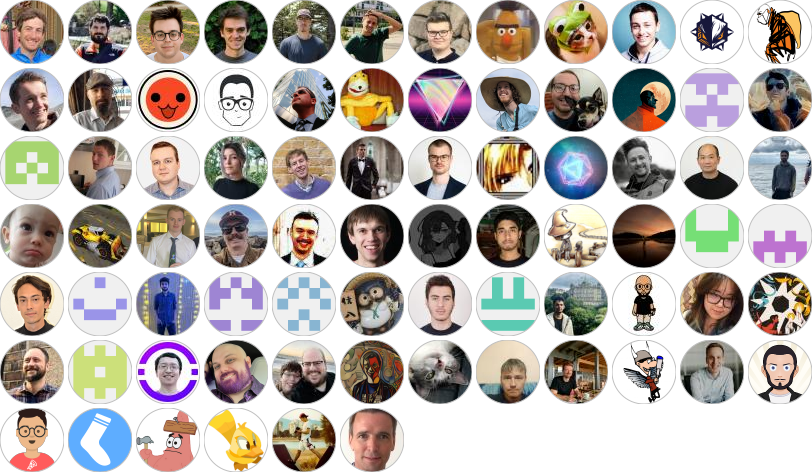
## Contributors
## Copyright
© 2023-2026 Windmill Labs, Inc.