https://github.com/youdie006/swapdex
Switch between multiple Claude Code and Codex login accounts, locally and safely. A switcher, not a rotator.
https://github.com/youdie006/swapdex
account-manager account-switcher claude claude-code cli codex credentials developer-tools openai rust
Last synced: 2 days ago
JSON representation
Switch between multiple Claude Code and Codex login accounts, locally and safely. A switcher, not a rotator.
- Host: GitHub
- URL: https://github.com/youdie006/swapdex
- Owner: youdie006
- License: mit
- Created: 2026-07-03T07:01:27.000Z (13 days ago)
- Default Branch: main
- Last Pushed: 2026-07-13T07:29:52.000Z (3 days ago)
- Last Synced: 2026-07-13T09:14:12.184Z (3 days ago)
- Topics: account-manager, account-switcher, claude, claude-code, cli, codex, credentials, developer-tools, openai, rust
- Language: Rust
- Size: 6.38 MB
- Stars: 2
- Watchers: 0
- Forks: 0
- Open Issues: 3
-
Metadata Files:
- Readme: README.md
- Contributing: CONTRIBUTING.md
- License: LICENSE
- Code of conduct: CODE_OF_CONDUCT.md
- Security: SECURITY.md
Awesome Lists containing this project
README
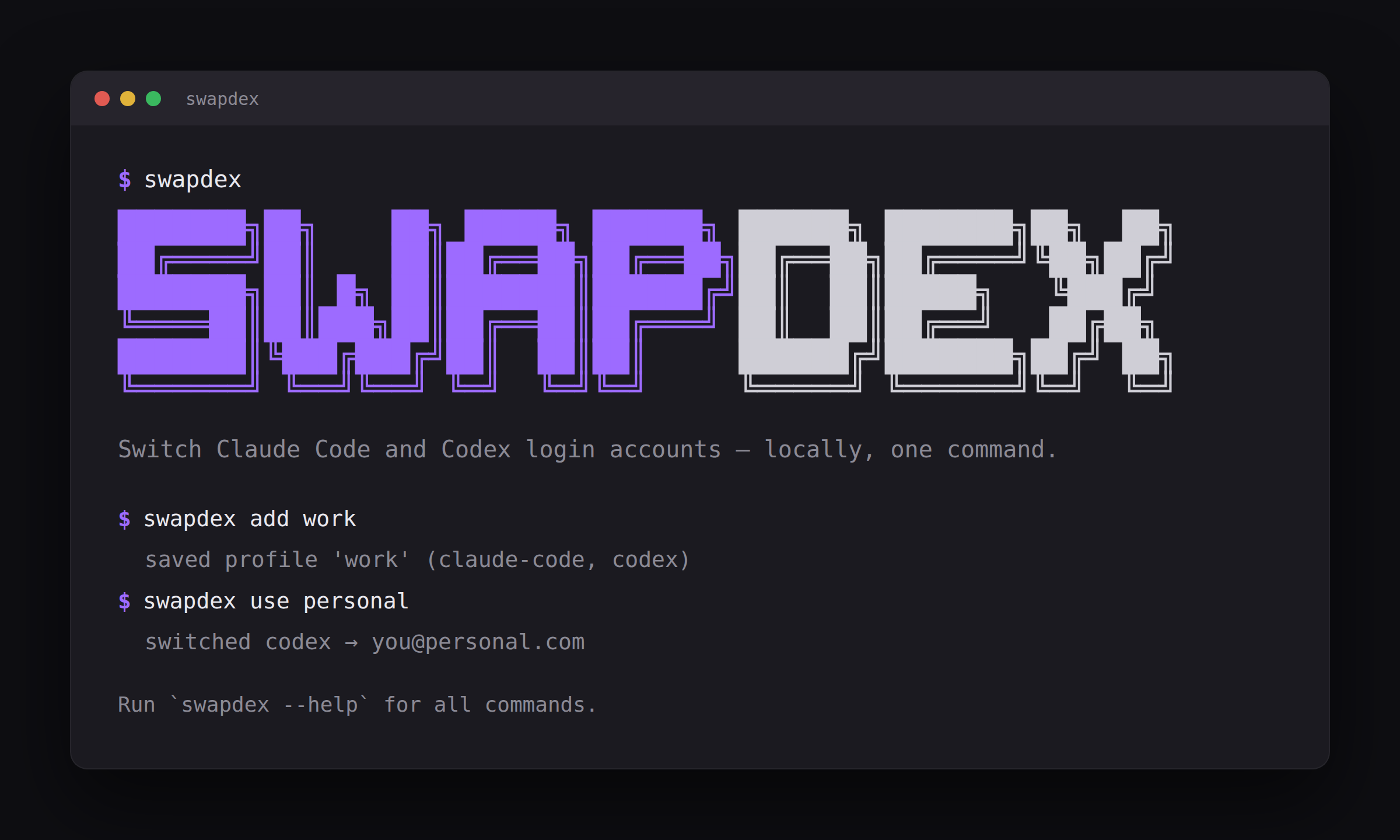
[](https://github.com/youdie006/swapdex/actions/workflows/ci.yml)
[](LICENSE)
[](#what-it-will-not-do)
One command to flip your Claude Code, Codex, Gemini CLI, or Antigravity from
your work account to your personal one, and back. No re-login, no browser, no copying
tokens around -- and the switch itself never touches the network. (One opt-in
command, `swapdex quota`, reads your remaining balance from Anthropic; nothing
else does.)

---
## Why
If you run Claude Code, Codex, Gemini CLI, or Antigravity under more than one
account -- a work seat and a
personal subscription, a client's org and your own -- switching means logging
out and back in every time. swapdex snapshots each logged-in account once, then
swaps between them in place: the running CLI picks up the new account on your
next message.
It is a **switcher, not a rotator.** It manages accounts you already own for
distinct purposes. It has no feature for cycling accounts to get around a rate
limit -- see [What it will not do](#what-it-will-not-do).
Safety is the design center: swapdex captures the *live* login before it swaps,
so a switch can never lose or clobber an account, and it only ever hands the
official CLI its own credentials -- no wrapper, no proxy, no client spoofing.
## Concepts
- **Profile** -- a named, point-in-time snapshot of a live login (the credential
files, captured with `add`). It is a copy, not a live link.
- **Account** -- the redacted identity a profile resolves to (email, tier,
expiry). Shown by `ls` and `status`; never a token.
- **Switch** -- `use` writes a profile's snapshot back into place atomically,
backing up the current login first. One account is active per tool at a time.
## Install
```sh
# crates.io (Rust)
cargo install swapdex
# Homebrew (macOS / Linux)
brew install youdie006/tap/swapdex
# npm (downloads the prebuilt binary)
npm install -g @youdie006/swapdex
# or the one-liner (prebuilt binary -> ~/.local/bin)
curl -fsSL https://raw.githubusercontent.com/youdie006/swapdex/main/install.sh | sh
```
Linux, WSL, and macOS (Claude's macOS login lives in the Keychain; swapdex
swaps it there, via `/usr/bin/security`). Requires at least one supported CLI
(Claude Code, Codex, Gemini, Antigravity) already installed and logged in. Full command, exit-code, and environment
reference: [docs/COMMANDS.md](docs/COMMANDS.md).
## Use
```sh
# Save the account you're currently logged in as
swapdex add work # snapshots Claude + Codex, whichever is logged in
swapdex add personal --tool claude
# See what you have and who's active
swapdex ls
swapdex status
# Switch (takes effect on your next message -- no restart)
swapdex ui # full-screen picker: switch, then open a
# conversation right there (resume or new)
swapdex use work --tool claude --open --dir ~/proj # switch + launch in one
swapdex login personal --tool claude # sign in to a NEW account and save it
swapdex use personal
swapdex use - # toggle back to the previous profile
swapdex use w # a unique prefix is enough
swapdex use work --tool codex
swapdex use work --dry-run # show what would change, write nothing
# Sessions grouped by the account active when they ran (needs sessionwiki)
swapdex sessions
# Recent local token usage per tool (5h/7d) -- tells you when to switch
swapdex usage
# Remaining quota per Claude account -- the one opt-in network read
swapdex quota
# Made a bad switch? Put back the login that was live before it
swapdex restore
# Anything off? Every finding comes with its fix
swapdex doctor
```
`status` shows the live account per tool, matched back to a saved profile:
```
claude-code: you@work.com [max] (profile 'work')
codex: you@personal.com [chatgpt] (profile 'personal')
```
The active account is always read from the **live** login, so if you `/login`
directly in the CLI, swapdex reports the truth rather than a stale guess.
For your shell prompt or statusline, `status --short` prints one compact line:
```sh
$ swapdex status --short
claude:work codex:personal
```
e.g. in a starship prompt: `command = "swapdex status --short"` in a
[custom module](https://starship.rs/config/#custom-commands), or in `PS1`
via `$(swapdex status --short)`.
It also drops straight into **Claude Code's own status line**, so the active
account is always visible inside the tool you are switching
(`~/.claude/settings.json`):
```json
{
"statusLine": { "type": "command", "command": "swapdex status --short" }
}
```
`usage` reads your local session logs (no network) to gauge how heavily you've
been using each tool lately, so you know when to switch to a fresher account:
```
Local usage - this machine, approximate (not the billed quota):
claude-code 5h: 8.2M tok / 12 sess 7d: 61.4M tok / 88 sess
@work 5h: 6.0M tok 7d: 40.1M tok
@personal 5h: 2.2M tok 7d: 19.3M tok
```
Once a switch history exists, tokens are attributed to the profile active at
each event's timestamp (the same honest join `sessions` uses); anything before
your first switch stays untagged. Still deliberately a hint, not a
quota-dodging auto-rotator.
Where `usage` is your local activity, `quota` is the vendor's actual remaining
balance -- the one command that reaches the network, and only when you run it:
```
$ swapdex quota
quota - remaining on your Claude accounts
live from Anthropic's usage endpoint; opt-in network, spends 0 message quota.
work (active) you@work.com
5h ▓▓▓▓▓▓▓░░░ 68% left resets in 2h 14m
7d ▓▓▓▓▓▓░░░░ 57% left resets in 3d 4h
personal you@personal.com
snapshot token expired - `swapdex use personal` to refresh, then `swapdex quota`
```
It reads each account's remaining quota from Anthropic's official OAuth usage
endpoint using that account's **own** token -- read-only, and it spends zero
message quota. The active account is always live; a saved account whose token
has expired reports so rather than showing a stale number (swapdex never
refreshes tokens -- that is the line between a switcher and a rotator). It is
also in `swapdex ui` under the `%` key.
## How it works
Each CLI keeps its login in a small on-disk file:
- Claude Code: `~/.claude/.credentials.json` plus the `oauthAccount` block inside
`~/.claude.json`
- Codex: `~/.codex/auth.json`
- Gemini CLI: `~/.gemini/oauth_creds.json` plus `~/.gemini/google_accounts.json`
- Antigravity: `~/.gemini/antigravity-cli/antigravity-oauth-token`
`add` copies the current login into a private store at
`~/.local/share/swapdex`. `use` writes a saved snapshot back into place
atomically, backing up the current login first. For Claude, only the
`oauthAccount` block of `~/.claude.json` is swapped -- your projects, MCP
servers, and settings in that file are never touched.
On macOS the Claude token lives in the login Keychain, one item per
`CLAUDE_CONFIG_DIR` profile. swapdex manages **the profile of the environment
it runs in**, exactly like `claude` itself resolves it: plain `swapdex`
manages the default profile; profiles you run side by side via
`CLAUDE_CONFIG_DIR` aliases are never touched.
## Safety
- Every credential file swapdex writes is `0600`; the store directory is `0700`.
- Writes are atomic (temp file created `0600`, then renamed) so an interrupted
switch can never leave a half-written credential that bricks the CLI.
- Symlinked credential paths and running as root are refused.
- `use` writes a backup of the current login (fsynced, or the switch aborts;
exception: an unreadable/corrupt live file is skipped with a warning - `use`
is exactly the command that can replace a corrupt login)
before overwriting anything, and `swapdex restore` brings it back in one
command if the switch was a mistake. The store keeps the last 2 backups per
tool, and `use` warns when the outgoing login is not saved as a profile --
so save accounts you care about with `add`.
- No token, refresh token, or home path is ever printed.
**The store holds plaintext refresh tokens.** Protect `~/.local/share/swapdex`
like `~/.ssh`, and do not sync it across machines (it is single-machine,
single-user by design).
### What it will not do
These are structural properties, not promises -- the code is built so they
cannot happen:
- **No HTTP client, no background network.** The binary has no HTTP client in
its dependency graph (CI asserts this on every commit), so it cannot phone
home or exfiltrate a token. Switching, `ls`, `status`, `usage` -- all 100%
local. The one exception is the opt-in `swapdex quota` command, which shells
out to `curl` to read your *own* remaining balance from Anthropic's official
usage endpoint (that account's own token, read-only, spends zero message
quota). It runs only when you type it, sends no data anywhere, and touches no
other endpoint.
- **No auto-rotation.** There is no `--auto`, `--next`, or
`--when-rate-limited` flag. `use` only ever switches to a name you type.
- **No token export.** There is no command that prints a saved credential.
- **No wrapper, no client spoofing.** swapdex swaps the credential file that the
official `claude` / `codex` binary already reads, then gets out of the way. It
never sits between the CLI and the API, never proxies requests, and never
presents itself as the official client. Your traffic is the real CLI's traffic.
(Launching the official tool once, on your explicit pick - `login`'s sign-in
flow, `ui`'s session resume - is a hand-off, not a wrapper: swapdex `exec`s
and is gone.)
Anthropic and OpenAI both permit multiple accounts for genuinely different
purposes but forbid using multiple accounts to get around a single workload's
rate limit, and forbid routing subscription OAuth tokens through third-party
tools or spoofing the official client. swapdex is built for the former and
structurally cannot do the latter -- it only ever hands the real CLI its own
credentials. See
[Anthropic Usage Policy](https://www.anthropic.com/legal/usage-policy) and
[OpenAI Usage Policies](https://openai.com/policies/usage-policies/).
## MCP (read-only)
`swapdex mcp` runs a read-only MCP server exposing `whoami` and `list_accounts`
so an agent can see which account is active. There is deliberately **no** switch
tool -- an agent can never change your account.
```sh
claude mcp add swapdex -s user -- swapdex mcp
```
## Works with
swapdex is the accounts layer of a small local AI-CLI stack:
- [sessionwiki](https://github.com/youdie006/sessionwiki) -- index, search, and
resume your AI coding sessions. `swapdex sessions` groups them by account,
and after a switch in `swapdex ui` you get that account's recent sessions
with a `sessionwiki resume ` hint -- switch, land back in your work.
- [prodex](https://github.com/youdie006/prodex) -- share one logged-in ChatGPT
Pro session across agents. swapdex coexists with it without touching its auth.
## Alternatives
Good tools exist in this space; they make different trade-offs (each line from
that project's README, July 2026):
- [claude-swap](https://github.com/realiti4/claude-swap) -- Claude Code only,
a TUI with live usage bars, and *optional auto-switching* near your limit.
If you want auto-rotation, use it -- swapdex deliberately refuses to have
that feature.
- [aisw](https://github.com/burakdede/aisw) -- cross-tool including Gemini,
OS-keyring storage, Windows support. More features, bigger surface.
- [caam](https://github.com/Dicklesworthstone/coding_agent_account_manager) --
cross-tool with a shell wrapper and automatic rotation on rate limits; the
philosophical opposite of swapdex.
Pick swapdex if you want the smallest thing that switches your AI CLIs
together, can always undo (`restore`), diagnoses itself (`doctor`), shows
your remaining balance (`quota`), and structurally cannot rotate, proxy, or
spoof the official client.
## Roadmap
- ~~Claude Code on macOS (Keychain).~~ **Shipped** (0.17-0.24): swapdex swaps
Claude's login inside the macOS Keychain via `/usr/bin/security`, resolves
the item exactly the way `claude` itself does (one item per
`CLAUDE_CONFIG_DIR` profile), and `doctor` diagnoses any mismatch.
Being considered, explicitly opt-in and advisory-only:
- **Per-directory hints (cross-tool).** Bind a directory to a profile and have
`swapdex resolve ` *suggest* the right account ("this directory is bound
to `work` -- run `swapdex use work`"). It would cover both Claude
(`CLAUDE_CONFIG_DIR`) and Codex (`CODEX_HOME`) in one binding. It will never be
a shell wrapper, never auto-switch, and never let anything but an explicit
`swapdex use` change the active account -- that bright line is what keeps
swapdex a switcher, not a rotator.
## License
MIT