https://github.com/yusukehosonuma/swiftparamtest
Parameterized test for Swift
https://github.com/yusukehosonuma/swiftparamtest
parameterized-tests swift test
Last synced: about 1 year ago
JSON representation
Parameterized test for Swift
- Host: GitHub
- URL: https://github.com/yusukehosonuma/swiftparamtest
- Owner: YusukeHosonuma
- License: mit
- Created: 2019-04-13T00:51:14.000Z (over 7 years ago)
- Default Branch: master
- Last Pushed: 2024-09-03T21:00:01.000Z (almost 2 years ago)
- Last Synced: 2025-06-03T16:27:45.702Z (about 1 year ago)
- Topics: parameterized-tests, swift, test
- Language: Swift
- Homepage: https://qiita.com/YusukeHosonuma/items/f3a8d6d38523813f6c68
- Size: 2.87 MB
- Stars: 58
- Watchers: 4
- Forks: 6
- Open Issues: 8
-
Metadata Files:
- Readme: README.md
- License: LICENSE
Awesome Lists containing this project
README
# SwiftParamTest

[](https://cocoapods.org/pods/SwiftParamTest)
[](https://github.com/Carthage/Carthage)

[](https://github.com/YusukeHosonuma/SwiftPrettyPrint/blob/master/LICENSE)
[](https://twitter.com/tobi462)
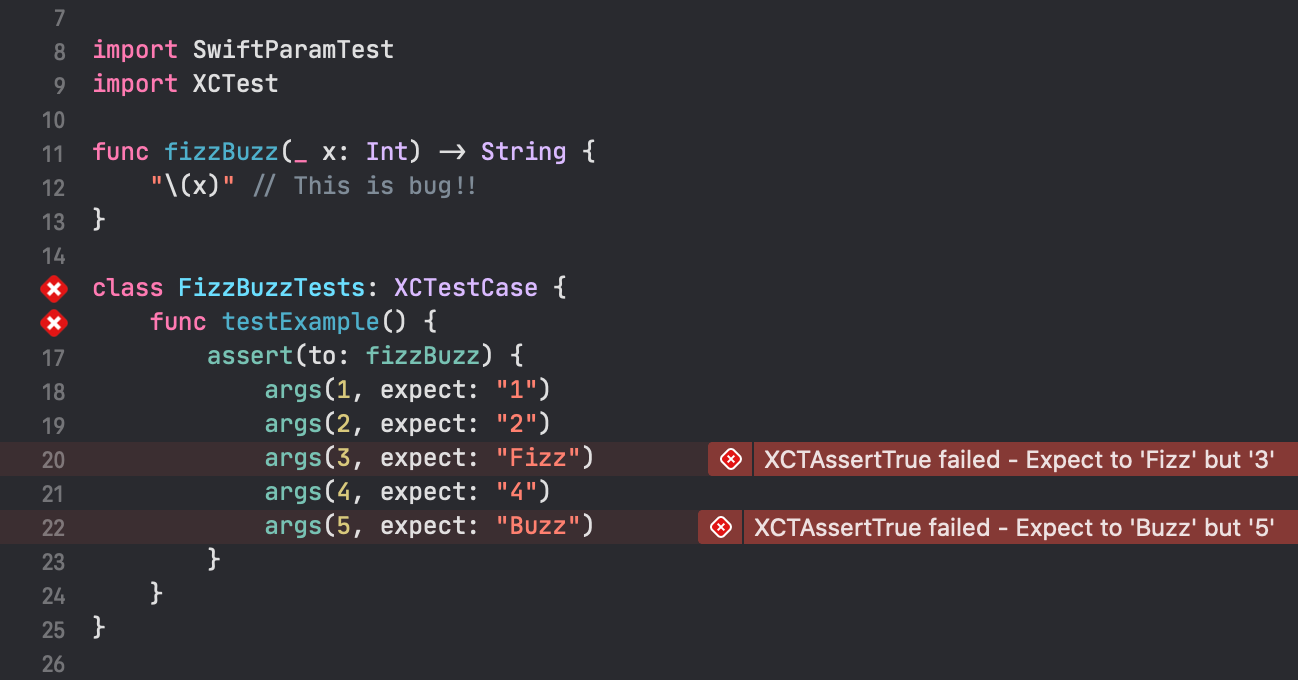
Parameterized-test for Swift. (with XCTest)
## Code Style
SwiftParamTest supports two way of code-style dependent on Swift version.
### Result builders API (recommended)
I recommend this API when you use Swift 5.1 or later.
```swift
assert(to: max) {
args(1, 2, expect: 2)
args(2, 1, expect: 2)
args(4, 4, expect: 4)
}
// You can also use tuple (with label).
assert(to: max) {
args((x: 1, y: 2), expect: 2)
args((x: 2, y: 1), expect: 2)
args((x: 4, y: 4), expect: 4)
}
```
### Legacy API
You can use array literal based API that like follwing when you use under Swift 5.1.
```swift
assert(to: max, expect: [
args(1, 2, expect: 2),
args(2, 1, expect: 2),
args(4, 4, expect: 4),
])
// You can also use tuple (with label).
assert(to: max, expect: [
args((x: 1, y: 2), expect: 2),
args((x: 2, y: 1), expect: 2),
args((x: 4, y: 4), expect: 4),
])
```
## Operator based API
You can specify row by use the operator `==>` that like following:
```swift
// Function Builder API
assert(to: max) {
expect((1, 2) ==> 2)
expect((2, 1) ==> 2)
expect((4, 4) ==> 4)
}
// Legacy API
assert(to: max, expect: [
expect((1, 2) ==> 2),
expect((2, 1) ==> 2),
expect((4, 4) ==> 4),
])
```
## Save or Output Markdown Table
Save or output markdown table when enabled by option (default is all disable).
```swift
override func setUp() {
ParameterizedTest.option = ParameterizedTest.Option(
traceTable: .markdown, // output console is enabled
saveTableToAttachement: .markdown // save to attachement is enabled
)
}
override func tearDown() {
ParameterizedTest.option = ParameterizedTest.defaultOption // restore to default
}
func testExample() {
assert(to: max) {
args(1, 2, expect: 2)
args(2, 1, expect: 2)
args(4, 4, expect: 4)
}
// =>
// | Args 0 | Args 1 | Expected |
// |--------|--------|----------|
// | 1 | 2 | 2 |
// | 2 | 1 | 2 |
// | 4 | 4 | 4 |
}
```
You can also specify column header name too.
```swift
func testMarkdownTable() {
assert(to: max, header: ["x", "y"]) { // specify `header`
args(1, 2, expect: 2)
args(2, 1, expect: 2)
args(4, 4, expect: 4)
}
// =>
// | x | y | Expected |
// |---|---|----------|
// | 1 | 2 | 2 |
// | 2 | 1 | 2 |
// | 4 | 4 | 4 |
}
```
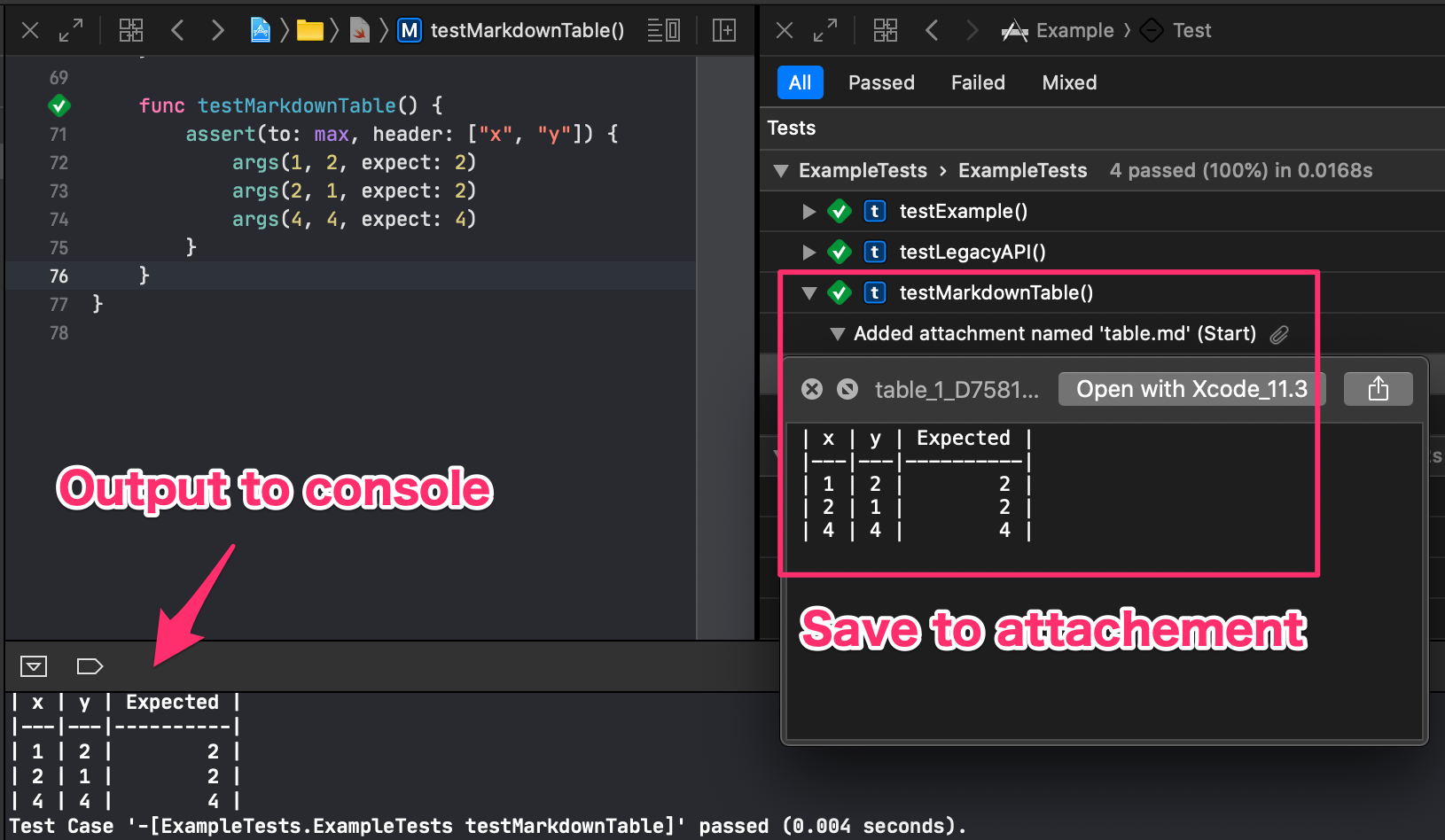
You can also retrive markdown table from result too.
```swift
let tableString = assert(to: max, header: ["x", "y"]) {
args(1, 2, expect: 2)
args(2, 1, expect: 2)
args(4, 4, expect: 4)
}.table
print(tableString)
// =>
// | x | y | Expected |
// |---|---|----------|
// | 1 | 2 | 2 |
// | 2 | 1 | 2 |
// | 4 | 4 | 4 |
```
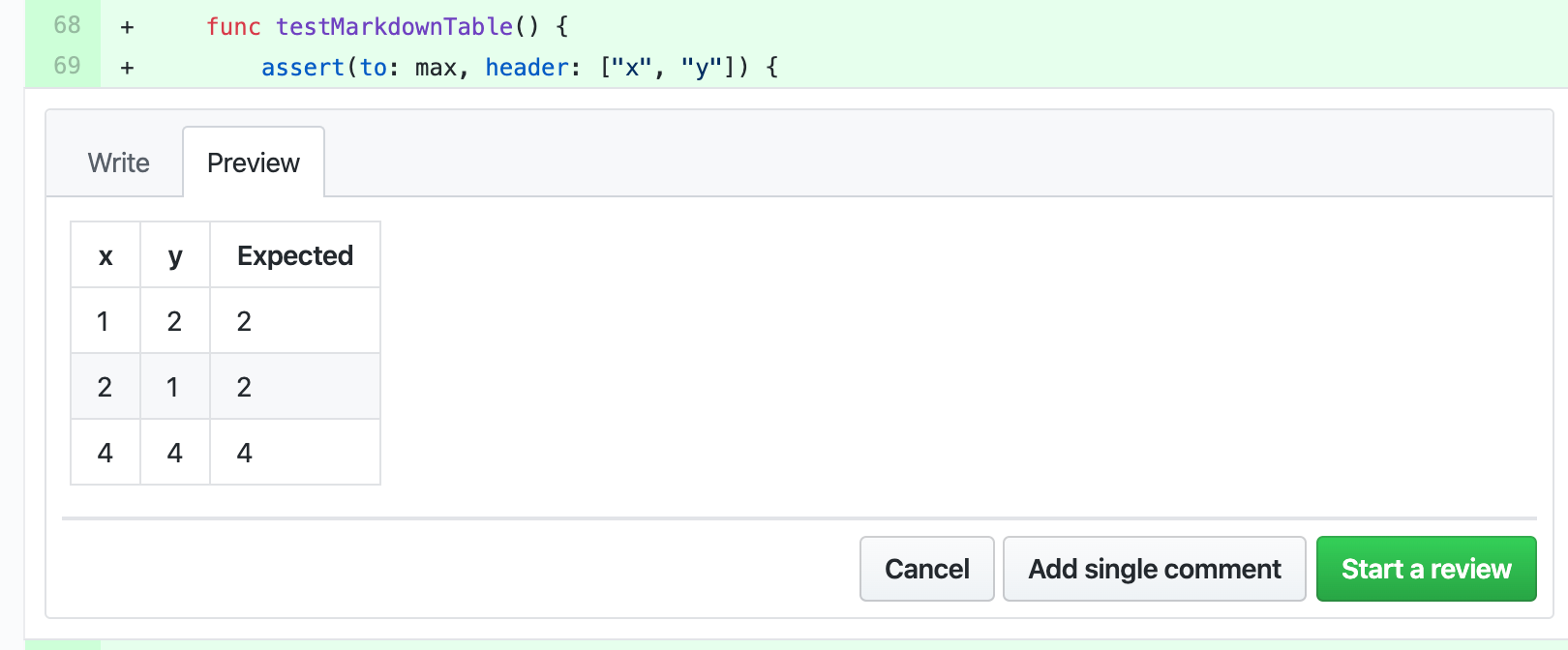
This is useful for copy and paste the test specification table to PR or others.
## Xcode Code Snippets

Copy `.codesnippet` files to the following directory from [.xcode](.xcode) directory:
```text
~/Library/Developer/Xcode/UserData/CodeSnippets/
```
and restart Xcode.
Or run the following command from the root of the repository:
```text
$ make snippets
```
## Example
```swift
import SwiftParamTest
import XCTest
class ExampleTests: XCTestCase {
override func setUp() {
ParameterizedTest.option = ParameterizedTest.Option(traceTable: .markdown,
saveTableToAttachement: .markdown)
}
override func tearDown() {
ParameterizedTest.option = ParameterizedTest.defaultOption
}
func testExample() {
// for `function`
assert(to: abs) {
args( 0, expect: 0)
args( 2, expect: 2)
args(-2, expect: 2)
}
// for `operator`
assert(to: +) {
args(1, 1, expect: 2)
args(1, 2, expect: 3)
args(2, 2, expect: 4)
}
// for `instance method` (when receiver is not fixed)
assert(to: String.hasPrefix) {
args("hello", "he", expect: true)
args("hello", "HE", expect: false)
}
// for `instance method` (when receiver is fixed)
assert(to: "hello".hasPrefix) {
args("he", expect: true)
args("HE", expect: false)
}
}
}
```
## Custom Assertion
SwiftParamTest uses `XCTAssertEqual()` and owns error messages by default.
But you can use custom assertion like follows.
```swift
// custom assertion
func customAssert(_ actual: T, _ expected: T, file: StaticString, line: UInt) {
let message = """
----
Expected: \(expected)
Actual: \(actual)
----
"""
XCTAssert(expected == actual, message, file: file, line: line)
}
// passed by `with` arguments
assert(to: fizzBuzz, with: customAssertion) {
args(1, expect: "Fizz")
// =>
//
// XCTAssertTrue failed -
// ----
// Expected: 1
// Actual: Fizz
// ----
//
}
```
## Limitation
- Only up to **four** arguments are supported.
## FAQ
### Can't compile or compiler is clashed
This library use many type inference, therefore type inference are failed in sometime.
This may be resolved by explicitly specifying the type information.
for example:
```swift
// Legacy API
assert(to: max, expect: [
args(1, 2, expect: 2),
args(2, 1, expect: 2),
args(4, 4, expect: 4),
] as [Row2]) // `N` in `RowN` is arguments count
// Function Builder API
typealias T = Int
assert(to: max) {
args(1 as T, 2 as T, expect: 2)
args(2 as T, 1 as T, expect: 2)
args(4 as T, 4 as T, expect: 4)
}
```
## Installation
### CocoaPods
```ruby
pod 'SwiftParamTest'
```
### Swift Package Manager
```swift
dependencies: [
.package(url: "https://github.com/YusukeHosonuma/SwiftParamTest.git", .upToNextMajor(from: "2.2.0")),
],
targets: [
.testTarget(
name: "YOUR_TEST_MODULE",
dependencies: [
"SwiftParamTest",
]),
],
```
### Carthage
Write following to `Cartfile.private`.
```text
github "YusukeHosonuma/SwiftParamTest"
```
## Author
Yusuke Hosonuma / tobi462@gmail.com
## License
SwiftParamTest is available under the MIT license. See the LICENSE file for more info.