https://github.com/zerdicorp/soft_body_simulation
In my opinion - one of the coolest simulations!
https://github.com/zerdicorp/soft_body_simulation
2d physics physics-simulation simulation soft-body soft-body-simulation
Last synced: 10 months ago
JSON representation
In my opinion - one of the coolest simulations!
- Host: GitHub
- URL: https://github.com/zerdicorp/soft_body_simulation
- Owner: ZERDICORP
- Created: 2022-06-14T14:42:33.000Z (about 4 years ago)
- Default Branch: master
- Last Pushed: 2022-06-24T03:58:18.000Z (almost 4 years ago)
- Last Synced: 2025-04-02T20:48:40.382Z (about 1 year ago)
- Topics: 2d, physics, physics-simulation, simulation, soft-body, soft-body-simulation
- Language: Java
- Homepage:
- Size: 39.1 KB
- Stars: 1
- Watchers: 1
- Forks: 1
- Open Issues: 0
-
Metadata Files:
- Readme: README.md
Awesome Lists containing this project
README
# soft_body_simulation :panda_face: :soccer:
#### In my opinion - one of the coolest simulations!
## What can you say about it? :raising_hand:
_**I have only two words for you: INCREDIBLY COOL!**_
I've always wanted to create some kind of simulation related to physics.
And finally, **I did it**!
_P.S. The work I have done is not perfect.
I didn't go deep into formulas.
I didn't try to create a comprehensive universal soft body engine.
Not at all.
I am driven only by wild curiosity, what are you talking about? :D_
## How it works? :hatching_chick:
> Everything written below is just a **crooked interpretation** of the coolest articles on **soft body physics**.
> Want two-page formulas and buzzwords? Google it! :3
>
> _Who seeks will find._
> _Whoever goes will come._
> _Those who google will not notice the answer in the first link._
### #1 ~ «Introduction»
Well, let's understand how **soft body simulation** works.
First, we need to understand **what the body itself** is. And by the way, it won't take long to find the answer (that's why I'm here lol):
- Particles
Yes, **particles** are everywhere.
It is from these little freaks that everything around us consists: the phone that you hold in your hands, and the hands themselves.
And, you know, if you want to create a **soft body**, you don't have to **beat around the bush** - **steal the idea from nature**!
### #2 ~ «Particles»
_So, okay, we have particles. But what exactly are they?_
Here is the basic set of properties for each **particle**:
- **location**
- **velocity**
I mean, it's pretty primitive.
We have a particle location **(x, y)** and a **velocity vector**.
It remains for each frame to update the location, adding velocity to it.
_It's all? Do we have a soft body?_
**Lol, no.. :D**
### #3 ~ «Springs»
Having only **particles**, you can get, for example, a **gas**, but obviously not a **soft body**, because, as you know, a body is a body, because it is an **ordered set of interconnected particles** (_crystal lattice_).
And, if we were making a regular **rigid body**, we wouldn't even have to tie anything.
But here's a **soft body**..
It should behave like **jelly**, or any other **soft** object, that is, **deform, and then recover**.
And the **«Spring Mass System»** will help us to achieve this effect.
I will not retell [smart definitions from Wikipedia](https://en.wikipedia.org/wiki/Soft-body_dynamics), but I will explain in simple words:
Our task is to **split the particles into pairs**. Each pair forms a **spring**.
Next, we need to go through all the **springs** (_pairs of two particles_) and, based on some data, calculate the **next position of the particles** in space.
Thus, the **particles become bound to each other**.
And the **system of spring masses** allows you to achieve the effect of **jelly**, since when the particles move away from each other, they are forced to move towards each other (**spring compression**), otherwise, if the particles are too close to each other (closer than a certain distance / **state of rest**), they forced to move in opposite directions (**stretching the spring**).
Summarizing the above, we have:
- **Particles**
- **Springs (a pair of two particles)**
This is actually enough to create a **soft body**.
### #4 ~ «Soft body»
Well, let's briefly go through the main steps:
1. Create **particles**.
2. Connect them with **springs**.
3. Iterate through the springs every frame and apply all **sorts of tricky formulas** to achieve the spring effect (move away the particles - they return to each other; bring the particles closer - they push each other with all their might; stretch the spring and release it - it will contract and stretch, making **harmonic oscillations**, until it reaches a **state of rest**).
Apart from the **spring mass system**, you will probably need a **gravity simulation** (just add a constant to the y-axis of the velocity vector every frame), a **collision resolution algorithm** (because you don't want your soft body to fall forever) and **a lot of curiosity** (no way without it)!
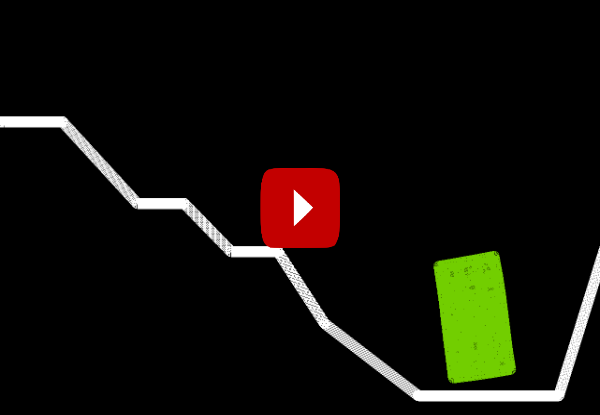
## Demo 🔥
## Thanks! Gonkee :sparkling_heart: (u r cutie btw)
* #### [But How DO Soft Body Simulations Work?](https://www.youtube.com/watch?v=kyQP4t_wOGI&t=527s&ab_channel=Gonkee) by Gonkee