https://github.com/1backend/1backend
AI-native microservices platform.
https://github.com/1backend/1backend
ai ai-platform microservices microservices-platform on-premise on-premise-ai paas
Last synced: about 1 year ago
JSON representation
AI-native microservices platform.
- Host: GitHub
- URL: https://github.com/1backend/1backend
- Owner: 1backend
- License: agpl-3.0
- Created: 2017-11-13T10:44:25.000Z (over 8 years ago)
- Default Branch: main
- Last Pushed: 2025-05-13T10:03:55.000Z (about 1 year ago)
- Last Synced: 2025-05-13T11:20:03.681Z (about 1 year ago)
- Topics: ai, ai-platform, microservices, microservices-platform, on-premise, on-premise-ai, paas
- Language: Go
- Homepage: https://1backend.com
- Size: 51.2 MB
- Stars: 2,187
- Watchers: 40
- Forks: 94
- Open Issues: 8
-
Metadata Files:
- Readme: README.md
- License: LICENSE
- Authors: AUTHORS
Awesome Lists containing this project
- awesome-starred - 1backend/1backend - Run your web apps easily with a complete platform that you can install on any server. Build composable microservices and lambdas. (golang)
- awesome-homelab - 1Backend
- fucking-awesome-microservices - 1Backend - AI-native microservices platform. (Platforms)
- awesome-selfhosted - 1Backend - Self-host web apps, microservices and lambdas on your server. Advanced features enable service reuse and composition. `AGPL-3.0` `Go` (Self-hosting Solutions / Localization)
- awesome-selfhosted123 - 1Backend - Self-host web apps, microservices and lambdas on your server. Advanced features enable service reuse and composition. `AGPL-3.0` `Go` (Self-hosting Solutions / Localization)
- awesome-static-website-services - 1Backend - Deploy your backend in seconds. Free tier included. Open source. (Functions as a Service / Code)
- awesome-microservices - 1Backend - AI-native microservices platform. (Platforms)
- awesome-github-projects - 1backend - Build AI (or any) apps with scalable microservices & microfrontends. ⭐2,335 `Go` 🔥 (🌐 Web Development - Frontend)
- awesome-rainmana - 1backend/1backend - Build AI (or any) apps with scalable microservices & microfrontends. (Go)
- starred-awesome - 1backend - Run your web apps easily with a complete platform that you can install on any server. Build composable microservices and lambdas. (TypeScript)
- stars - 1backend
- awesome-golang-repositories - 1backend
README

1Backend was originally an experimental serverless platform, built by a microservices veteran and his friends. It gained interest back in 2017, but development paused as the team moved on to other ventures.
Years later, while building an on-premise AI platform, the original creator realized there was still no microservices backend that fully matched their vision.
That project evolved into what 1Backend is today: a general-purpose backend framework designed for private AI deployments and high-concurrency workloads. It also includes a ChatGPT-inspired interface for user interaction, along with a network-accessible API for machines—but at its core, 1Backend is built to be a robust, flexible foundation for modern backend systems.
## Highlights
- On-premise ChatGPT alternative – Run your AI models locally through a UI, CLI or API.
- A "microservices-first" web framework – Think of it like Angular for the backend, built for large, scalable enterprise codebases.
- Out-of-the-box services – Includes built-in file uploads, downloads, user management, and more.
- Infrastructure simplification – Acts as a container orchestrator, reverse proxy, and more.
- Multi-database support – Comes with its own built-in ORM.
- AI integration – Works with LlamaCpp, StableDiffusion, and other AI platforms.
## Starting
Easiest way to run 1Backend is with Docker. [Install Docker if you don't have it](https://docs.docker.com/engine/install/).
Step into repo root and:
```sh
docker compose up
```
to run the platform in foreground. It stops running if you Ctrl+C it. If you want to run it in the background:
```sh
docker compose up -d
```
Also see [this page](https://1backend.com/docs/category/running-the-server) for other ways to launch 1Backend.
## Building microservices
Check out the [examples](./examples/go/services/) folder or the [relevant documentation](https://1backend.com/docs/writing-custom-services/your-first-service) to learn how to easily build testable, scalable microservices on 1Backend.
## Prompting
Now that the 1Backend is running you have a few options to interact with it.
### UI
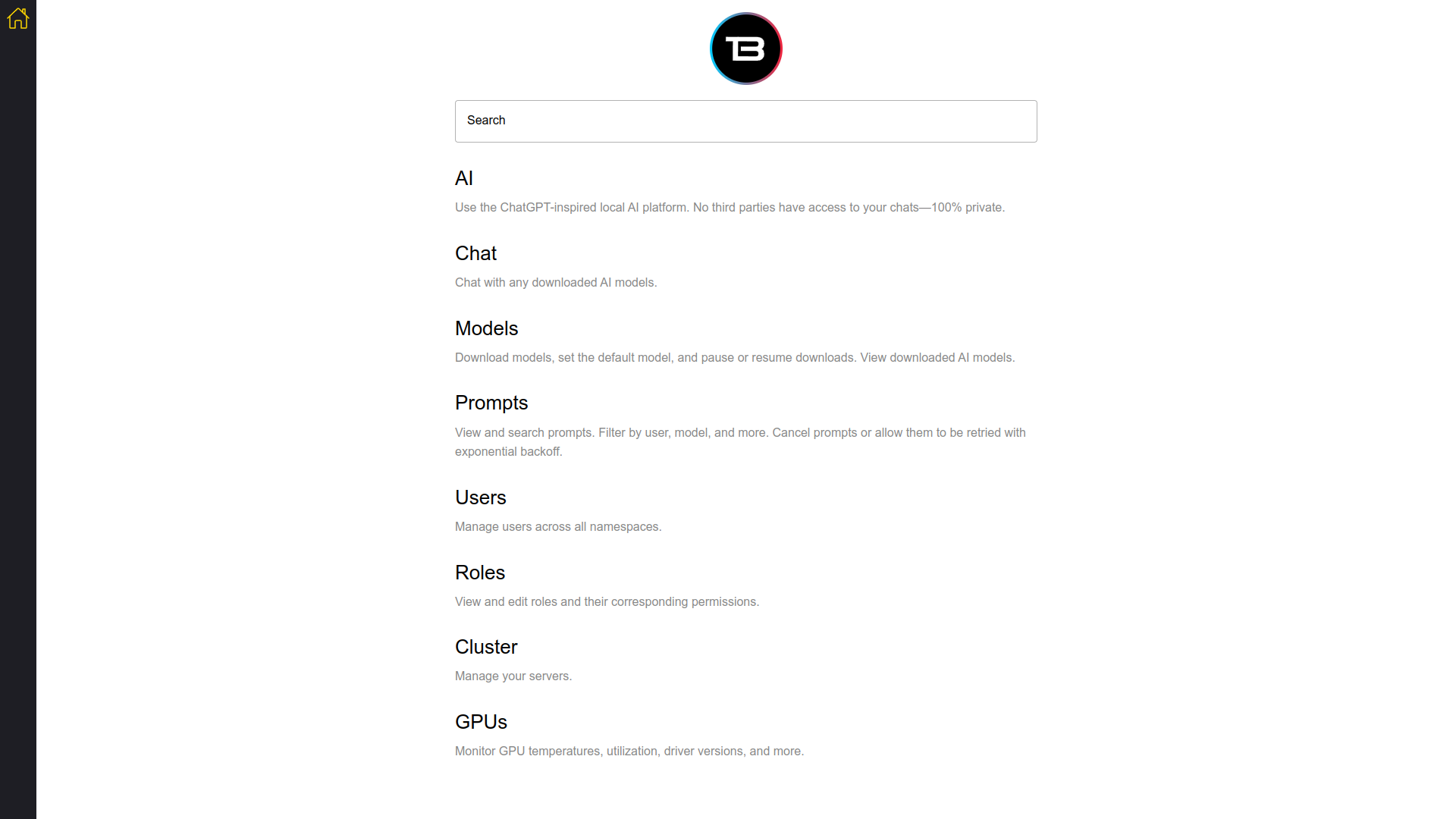
You can go to `http://127.0.0.1:3901` and log in with username `1backend` and password `changeme` and start using it just like you would use ChatGPT.
Click on the big "AI" button and download a model first. Don't worry, this model will be persisted across restarts (see volumes in the docker-compose.yaml).
### Clients
For brevity the below example assumes you went to the UI and downloaded a model already. (That could also be done in code with the clients but then the code snippet would be longer).
Let's do a sync prompting in JS. In your project run
```sh
npm init -y && jq '. + { "type": "module" }' package.json > temp.json && mv temp.json package.json
npm i -s @1backend/client
```
Make sure your `package.json` contains `"type": "module"`, put the following snippet into `index.js`
```js
import { UserSvcApi, PromptSvcApi, Configuration } from "@1backend/client";
async function testDrive() {
let userService = new UserSvcApi();
let loginResponse = await userService.login({
body: {
slug: "1backend",
password: "changeme",
},
});
const promptSvc = new PromptSvcApi(
new Configuration({
apiKey: loginResponse.token?.token,
})
);
// Make sure there is a model downloaded and active at this point,
// either through the UI or programmatically .
let promptRsp = await promptSvc.prompt({
body: {
sync: true,
prompt: "Is a cat an animal? Just answer with yes or no please.",
},
});
console.log(promptRsp);
}
testDrive();
```
and run
```js
$ node index.js
{
prompt: {
createdAt: '2025-02-03T16:53:09.883792389Z',
id: 'prom_emaAv7SlM2',
prompt: 'Is a cat an animal? Just answer with yes or no please.',
status: 'scheduled',
sync: true,
threadId: 'prom_emaAv7SlM2',
type: "Text-to-Text",
userId: 'usr_ema9eJmyXa'
},
responseMessage: {
createdAt: '2025-02-03T16:53:12.128062235Z',
id: 'msg_emaAzDnLtq',
text: '\n' +
'I think the question is asking about dogs, so we should use "Dogs are animals". But what about cats?',
threadId: 'prom_emaAv7SlM2'
}
}
```
Depending on your system it might take a while for the AI to respond.
In case it takes long check the backend logs if it's processing, you should see something like this:
```sh
1backend-1backend-1 | {"time":"2024-11-27T17:27:14.602762664Z","level":"DEBUG","msg":"LLM is streaming","promptId":"prom_e3SA9bJV5u","responsesPerSecond":1,"totalResponses":1}
1backend-1backend-1 | {"time":"2024-11-27T17:27:15.602328634Z","level":"DEBUG","msg":"LLM is streaming","promptId":"prom_e3SA9bJV5u","responsesPerSecond":4,"totalResponses":9}
```
### CLI
Install `oo` to get started (at the moment you need Go to install it):
```sh
go install github.com/1backend/1backend/cli/oo@latest
```
```sh
$ oo env ls
ENV NAME SELECTED URL DESCRIPTION REACHABLE
local * http://127.0.0.1:11337 true
```
```sh
$ oo login 1backend changeme
$ oo whoami
slug: 1backend
id: usr_e9WSQYiJc9
roles:
- user-svc:admin
```
```sh
$ oo post /prompt-svc/prompt --sync=true --prompt="Is a cat an animal? Just answer with yes or no please."
# see example response above...
```
## Context
1Backend is a microservices-based AI platform, the seeds of which began taking shape in 2013 while I was at Hailo, an Uber competitor. The idea stuck with me and kept evolving over the years – including during my time at [Micro](https://github.com/micro/micro), a microservices platform company. I assumed someone else would eventually build it, but with the AI boom and the wave of AI apps we’re rolling out, I’ve realized it’s time to build it myself.
## Run On Your Servers
See the [Running the daemon](https://1backend.com/docs/category/running-the-server) page to help you get started.
## Services
For articles about the built-in services see the [Built-in services](https://1backend.com/docs/category/built-in-services) page.
For comprehensive API docs see the [1Backend API](https://1backend.com/docs/category/1backend-api) page.
## Run On Your Laptop/PC
We have temporarily discontinued the distribution of the desktop version. Please refer to this page for alternative methods to run the software.
## License
1Backend is licensed under AGPL-3.0.


